
Type & Discipline
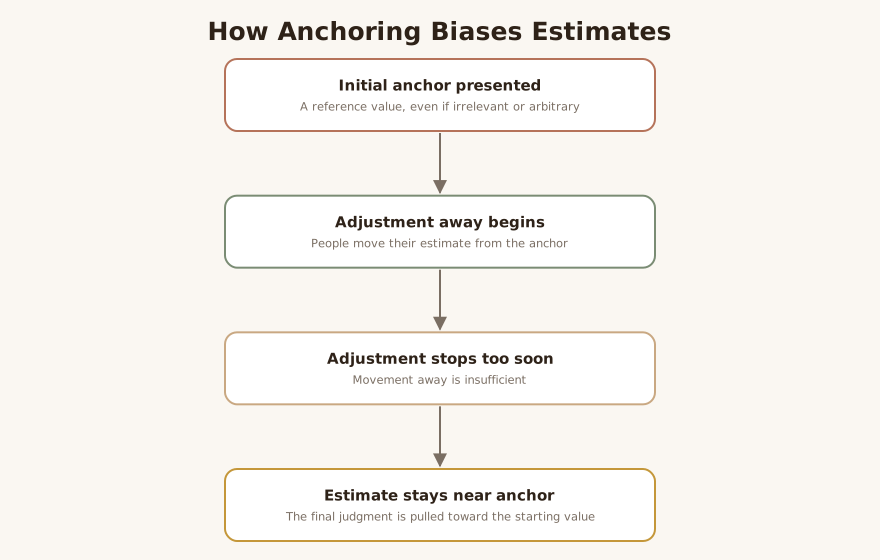
Anchoring and adjustment is a construct from cognitive psychology and behavioral economics rather than a therapy modality 1. It names a judgment heuristic: when people estimate an uncertain quantity, they begin from an initial reference value (the “anchor”) and adjust away from it, but the adjustment is typically insufficient, leaving the final judgment biased toward the starting point 2. It belongs to the broader heuristics and biases family of mental shortcuts that economize on cognitive effort but introduce systematic error 1. For clinicians, the construct matters in two directions at once: it describes a documented hazard in our own diagnostic reasoning, and it offers a mechanistic vocabulary for distortions our clients enact—first impressions that stick, self-evaluations that will not budge, and worries calibrated to a frightening initial frame LLM.
Because it is a construct and not a treatment, anchoring and adjustment is not something a therapist “delivers.” It is a lens that sharpens case formulation and informs which established techniques—largely from cognitive therapy—are likely to help a client revise an over-weighted reference point LLM.
Creators & Lineage
The heuristic was introduced by Amos Tversky and Daniel Kahneman in their 1974 paper Judgment under Uncertainty: Heuristics and Biases, which formalized anchoring alongside representativeness and availability as core shortcuts people use under uncertainty 1. Their classic demonstration used a rigged wheel of fortune predetermined to stop at 10 or 65; participants who saw 10 then guessed lower percentages of African nations in the UN (around 25%) than those who saw 65 (around 45%), even though the wheel was transparently irrelevant to the question 1. A second demonstration asked participants to estimate, in five seconds, the product of a digit sequence: those shown the ascending order produced a median estimate near 512 while those shown the descending order produced a median near 2,250, far below the true product of 40,320 1.
This work seeded the larger heuristics and biases program and fed directly into Kahneman and Tversky’s prospect theory and the field of behavioral economics 1. Later, Nicholas Epley and Thomas Gilovich refined the account, distinguishing self-generated anchors (where a person knows the true answer lies beyond a salient starting value and effortfully adjusts) from externally provided anchors, and arguing that adjustment is insufficient because the effortful, deliberate search terminates prematurely once a “plausible enough” value is reached 2. Within clinical traditions, the construct connects naturally to cognitive therapy, where anchoring helps explain why certain cognitive distortions—sticky first impressions, fixed negative self-appraisals—resist ordinary disconfirming evidence LLM.
Core Principles
The heuristic rests on a small set of robust observations LLM. First, anchors bias judgment even when irrelevant or arbitrary: a number generated by a wheel of fortune, or an implausibly extreme value, still pulls estimates toward it 1. Second, adjustment is insufficient: people move away from the anchor but stop too soon, so the final estimate remains disproportionately close to where they started 2. Third, the effect is strikingly robust—it persists when people are explicitly warned about it, when anchors are obviously random, when accuracy is financially incentivized, and even among domain experts 1.
Mechanistically, two complementary accounts coexist 5. The anchoring-and-adjustment account emphasizes a serial, effortful process that ends prematurely; this is most apparent with self-generated anchors, where adjustment is a deliberate, resource-dependent operation 2. The selective accessibility account emphasizes that the anchor makes anchor-consistent information cognitively more available, biasing what comes to mind during judgment; this is often invoked for externally provided anchors 5. Individual-differences research supports a dual-process picture: anchoring involves both automatic activation and deliberate correction, and only when people engage effortful, reflective processing does cognitive capacity meaningfully protect against the bias 3.
Interventions & Techniques
Anchoring and adjustment does not supply its own intervention protocol; it indicates what to target and lends weight to specific cognitive techniques LLM. The best-supported debiasing strategy is “consider the opposite”—deliberately generating reasons the initial value or impression might be wrong, which counters the selective availability of anchor-consistent information 1. The Decision Lab describes a cluster of related tactics that translate readily into therapy: actively generating counterarguments, “red teaming” or devil’s-advocate questioning, delaying judgment to allow more adjustment, and cultivating simple awareness of one’s susceptibility 5.
In a cognitive-therapy frame, these map onto familiar tools LLM. Socratic questioning operationalizes “consider the opposite” by inviting the client to argue against a first impression or a fixed self-label LLM. Evidence-for-and-against worksheets force a search that the premature adjustment process would otherwise skip LLM. Behavioral experiments supply new reference points by generating fresh data, which is often more powerful than verbal argument because anchoring resists mere warning 1. Because expertise and incentives alone do not reliably defeat the bias, interventions that structure the reasoning process—externalized pro/con searches, explicit second hypotheses—tend to outperform exhortations to “be more objective” 1.
LLM-generated illustrative example (not a guideline): A client states flatly, “I bombed that interview.” The clinician treats the verdict as an anchor and asks the client to list, in detail, three moments the interviewer responded positively—forcing the adjustment the client’s mind stopped short of. LLM
Evidence Base
The evidence base for anchoring and adjustment as a phenomenon is established and mature 6. It is one of the most replicated findings in judgment-and-decision-making research, documented across numerical estimation, pricing, negotiation, legal sentencing, and probability judgment 6. The 1974 demonstrations have been reproduced and extended across decades, and the effect’s resistance to debiasing—surviving warnings, transparent randomness, incentives, and expertise—is itself a well-replicated result 1. A literature review synthesizes this breadth and consistency, treating anchoring as a stable, generalizable feature of human judgment rather than a fragile laboratory curiosity 6.
Honesty requires three caveats for clinicians LLM. First, the mechanism is less settled than the effect: anchoring-and-adjustment and selective-accessibility accounts each explain different subsets of findings, and the field generally treats them as complementary rather than rivals 5. Second, moderators are real but modest: cognitive ability shows only a weak, conditional relationship with susceptibility, emerging mainly among reflective individuals, and personality findings (beyond a link to openness) are mixed 3. Third—and most important—the strong evidence concerns judgment under uncertainty in decision tasks; the clinical translation to treating client distortions is a reasonable extension of cognitive theory, not a directly trialed therapy, and should be presented to clients as a useful model, not a proven cure LLM.
Populations & Indications
The construct is indicated wherever an early reference point appears to be distorting present judgment LLM. Among people with cognitive distortions, anchoring offers a mechanism for why labels like “I’m a failure” persist: an early self-verdict functions as an anchor from which subsequent self-appraisals adjust too little LLM. In people with depression, negative self-evaluation can be reframed as an anchoring problem in which disconfirming evidence is under-weighted relative to a fixed negative starting point 4. For patients facing medical decisions, an initial figure—a survival statistic, a first quoted risk, an early prognosis—can anchor expectations and willingness to consider alternatives 4.
Negotiators and decision-makers are a classic indication: opening offers disproportionately shape final agreements, so naming the anchor can restore agency 5. Finally, clinicians themselves are a target population: initial diagnostic impressions can unduly bias subsequent reasoning, with documented risk of misdiagnosis when early symptoms anchor the work-up 4. Recognizing this is part of competent supervision, not a peripheral curiosity LLM.
Problems-for-Work
The construct maps onto several discrete problems-for-work LLM. Cognitive distortions and biased judgment: a client treats a single early data point as a settled conclusion; the work is to make the premature adjustment explicit and resume it 2. First-impression bias: in relationships, early impressions disproportionately shape later perceptions, sometimes keeping a person in a harmful situation because an initial positive frame persists 4.
LLM-generated illustrative example (not a guideline): A client describes a new colleague as “cold” after one terse email and now reads every later interaction through that anchor. Therapy surfaces the anchor and tests it against accumulated behavior. LLM
Negative self-evaluation: a fixed self-label resists updating; behavioral experiments introduce new reference points the client cannot easily dismiss LLM. Decision-making difficulties: an early option or quoted figure anchors deliberation; “consider the opposite” and delayed judgment widen the field 5. Worry and rumination: a frightening initial estimate of likelihood or severity anchors repetitive thought, and adjustment toward more calibrated probabilities stalls LLM.
LLM-generated illustrative example (not a guideline): A client anchored on “there’s a 90% chance I’ll be fired” ruminates for hours. The clinician walks through base rates and contrary evidence, treating the 90% as an unadjusted anchor rather than a fact. LLM
Contraindications, Cautions & Cultural Humility
There are no contraindications to using anchoring as a formulation lens, but several cautions apply to how it is deployed LLM. First, anchoring is robust and resistant: simply telling a client (or oneself) about the bias rarely dissolves it, so interventions should structure the reasoning process rather than rely on insight alone 1. Second, not every fixed belief is an anchoring artifact—some early appraisals are accurate, and reflexively “adjusting” a well-founded judgment can invalidate a client’s legitimate read of a situation LLM.
Susceptibility also varies across people and contexts in ways that demand humility LLM. Individual-differences work shows the protective role of cognitive reflection is conditional and the moderators modest, so clinicians should not assume a client “should” be able to reason past an anchor 3. Cross-cultural data indicate that vulnerability differs across cultural groups, with one comparison finding lower susceptibility among students from one national group than another, tracking differences in uncertainty avoidance 1. This counsels against treating any single reasoning norm as universal and against pathologizing culturally shaped reference points LLM. Finally, clinicians must hold their own anchoring as a live risk in formulation, applying the construct reflexively rather than only to clients 4.
Treatment-Plan Suggestions & SMART Objectives
| Goal | SMART objective (example) | Mechanism |
|---|---|---|
| Reduce first-impression bias in relationships | Within 6 weeks, client will identify and re-test 3 sticky first impressions, logging at least 2 disconfirming observations each | Externalizing the anchor; resuming insufficient adjustment 2 |
| Loosen fixed negative self-evaluation | Over 8 sessions, client will complete weekly evidence-for-and-against records for one negative self-label, rating belief pre/post | Forcing a search the premature process skips; selective-accessibility counter 5 |
| Recalibrate catastrophic probability estimates | Within 4 weeks, client will generate base-rate and contrary evidence for 3 worries, revising likelihood estimates each time | “Consider the opposite” against an over-weighted anchor 1 |
| Interrupt rumination tied to a frightening frame | Daily for 2 weeks, client will name the initial estimate fueling a rumination episode before disputing it | Making the anchor explicit; delayed judgment 5 |
| Improve a stalled personal decision | By session 6, client will list the opposite case for the leading option and one alternative not yet considered | Counter-argument generation; widening the choice set 5 |
| Build metacognitive awareness of anchoring | Within 3 weeks, client will correctly label 5 in-session instances of starting from a reference point and under-adjusting | Reflective engagement that conditionally reduces bias 3 |
| Support better medical decision-making | Before the next appointment, client will write 2 questions that test, rather than confirm, an initial prognosis figure | Counteracting anchor-consistent information search 4 |
Common Misconceptions
A first misconception is that awareness inoculates against anchoring; in fact the effect persists even when people are explicitly warned, when the anchor is transparently random, and when accuracy is incentivized 1. A second is that smart or expert reasoners are immune; expertise and high cognitive ability provide only weak and conditional protection, mainly among people already inclined to reflective thought 3.
A third misconception is that anchoring is just stubbornness or laziness—a character flaw LLM. It is better understood as a normal byproduct of an effortful adjustment process that terminates once a “good enough” value is reached, not a motivational failing 2. A fourth, common in clinical settings, is that anchoring only describes clients; the same mechanism distorts diagnostic reasoning, making clinician self-application essential 4. Finally, some assume the two mechanisms (insufficient adjustment versus selective accessibility) are competing theories one must choose between; the field treats them as complementary, each accounting for different anchor types 5.
Training & Certification
There is no certification in “anchoring and adjustment”; it is a research construct, not a credentialed modality LLM. Clinicians typically encounter it within graduate coursework in cognitive psychology and judgment-and-decision-making, and within cognitive therapy training where it informs work on distortions LLM. The practical clinical skills it implies—Socratic questioning, evidence examination, behavioral experiments, “consider the opposite”—are taught and supervised within Cognitive Behavioral Therapy training pathways rather than as a standalone competency LLM. For diagnostic-reasoning applications, clinical-reasoning and patient-safety curricula increasingly address anchoring as a named cognitive error to recognize and counter 4. Self-directed grounding in the primary literature—Tversky and Kahneman’s original work and Epley and Gilovich’s refinement—is the most direct route to fluency 2.
Key Terms
Anchor — the initial reference value, relevant or arbitrary, from which a judgment departs 1. Adjustment — the movement away from the anchor toward a final estimate, typically insufficient in magnitude 2. Insufficient adjustment — the core failure: the serial, effortful adjustment process ends prematurely, leaving the estimate biased toward the anchor 2. Selective accessibility — the alternative mechanism whereby an anchor makes anchor-consistent information more cognitively available 5. Self-generated vs. externally provided anchor — Epley and Gilovich’s distinction; the former relies on deliberate, resource-dependent adjustment, the latter more on accessibility 2. Consider the opposite — the best-supported debiasing strategy, deliberately generating contrary evidence 1. Heuristic — a mental shortcut that reduces effort but can introduce systematic bias 1. Dual-process — the framework in which automatic activation and deliberate correction jointly produce anchoring outcomes 3.
Resources & Further Reading
▶ Watch — a video introduction to this concept:
- Judgment under Uncertainty: Heuristics and Biases (Tversky & Kahneman, 1974) — overview
- The Anchoring-and-Adjustment Heuristic: Why the Adjustments Are Insufficient (Epley & Gilovich)
- Individual Differences in Anchoring Effect: Evidence for the Role of Insufficient Adjustment (PMC)
- Anchoring Bias and Adjustment Heuristic in Psychology — Simply Psychology
- Anchoring Bias — The Decision Lab
- A Literature Review of the Anchoring Effect (ScienceDirect, 2011)
Reflective / Supervision Questions
- Where in my recent caseload did an early impression—diagnostic or interpersonal—shape my later reasoning more than the accumulated evidence warranted? 4
- When a client presents a fixed self-verdict, can I distinguish an anchoring artifact from an accurate, well-founded appraisal before I move to “restructure” it? LLM
- Which structured tools (evidence records, behavioral experiments) do I rely on, versus simply telling clients their judgment is biased—knowing that warning alone rarely works? 1
- How do I hold cultural humility about a client’s reference points, given that susceptibility to anchoring varies across cultural and individual contexts? 1
- What would “consider the opposite” look like applied to my own current formulation of this case? 5
- Am I treating insufficient adjustment as a moral failing in the client, or as a normal feature of effortful judgment that calls for scaffolding? 2