
Type & Discipline
Dialectical Behavior Therapy (DBT) is a comprehensive, principle-driven cognitive-behavioral treatment within clinical psychology, usually grouped with the “third wave” of behavior therapies for its integration of acceptance and mindfulness alongside change-oriented technique.56 Unlike a single technique, standard DBT is a treatment package: it specifies not only what the therapist does in session but how the whole delivery system is organized.4 Its defining clinical signature is the deliberate, moment-to-moment synthesis of acceptance and change — accepting the client and their suffering as they are, while relentlessly working toward behavioral change.45 That synthesis is what the word “dialectical” names, and it is the through-line of every component of the model. LLM
DBT was originally built for chronically suicidal and self-harming clients and for people meeting criteria for borderline personality disorder (BPD), a population for whom standard cognitive-behavioral protocols often failed because the press for change felt invalidating.56 The model’s answer was to embed change techniques inside a thoroughgoing stance of validation and acceptance. LLM
Creators & Lineage
DBT was developed by Marsha M. Linehan at the University of Washington, emerging in the late 1980s and codified in her 1993 treatment manuals.26 Linehan set out to apply standard behavior therapy to severely suicidal women and found that an unrelenting focus on change was experienced as invalidating and frequently drove clients out of treatment; the corrective was to weave in acceptance drawn from her own contemplative practice.6 LLM The resulting model fuses four lineages: behaviorism and cognitive behavioral therapy (the change technology — chain analysis, contingency management, skills training, exposure), mindfulness adapted from Zen/Buddhist practice (the acceptance technology — nonjudgmental observation, “wise mind,” radical acceptance), and dialectical philosophy (the meta-stance that opposites can both be true and must be synthesized).45
The dialectical frame is not decoration. It supplies the worldview — reality as interrelated, in constant change, and composed of opposing forces whose tension drives synthesis — that lets the therapist hold “you are doing the best you can” and “you need to do better” simultaneously rather than as a contradiction.4 LLM Empirically, the synthesis matters: a process study cited in Linehan’s foundational work found that dialectical techniques balancing acceptance and change were more effective in reducing suicidal behavior than pure-change or pure-acceptance techniques alone.2
Core Principles
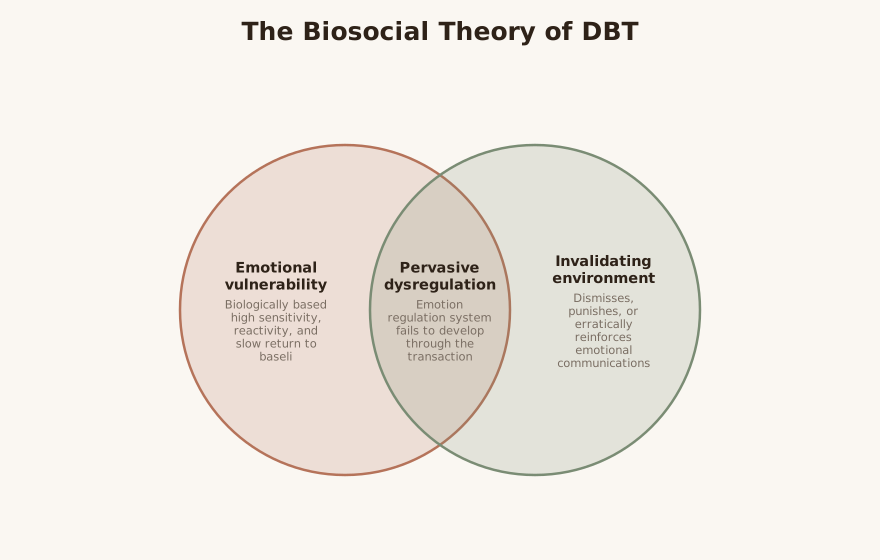
At the theoretical center sits the biosocial theory of emotion dysregulation.24 It proposes that pervasive dysregulation arises from a transaction between a biologically based emotional vulnerability — high sensitivity, high reactivity, and slow return to baseline — and a chronically invalidating environment that dismisses, punishes, or erratically reinforces the child’s emotional communications.4 Over time this transaction prevents the person from learning to label, modulate, and trust their emotions; BPD is reframed not as a disorder of character but as a dysfunction of the emotion regulation system.2 This is a profoundly de-shaming formulation, and it directly shapes treatment: if the problem is skills deficits born of invalidation, the solution is validation plus active skills teaching. LLM
Several principles follow:
- Dialectics. Acceptance and change are held in dynamic balance throughout; the therapist continually validates while pushing for change.4
- Functional, behavioral analysis. Problem behaviors are understood as solutions — usually to unbearable affect — and analyzed in fine-grained chains rather than judged.4 LLM
- Skills as the missing capability. Dysregulation is treated as a learning problem, remediated by explicit instruction in four skill domains.45
- A hierarchy of targets. Therapist attention is rationed by priority: life-threatening behaviors first, then therapy-interfering behaviors, then quality-of-life-interfering behaviors, then skills acquisition.7 LLM
Interventions & Techniques
Standard outpatient DBT is delivered through four modes, each serving a distinct function.4 (1) Weekly individual therapy (about one hour) organizes treatment around the target hierarchy and the client’s diary card. (2) Weekly group skills training (about 1.5 to 2.5 hours) teaches the four modules didactically, like a class. (3) Between-session phone (or in-the-moment) coaching generalizes skills to real life. (4) The therapist consultation team (about one to two hours) treats the therapists — supporting motivation, adherence, and burnout in clinicians doing very demanding work.4 Chapman frames these modes as serving five functions: enhancing capabilities, generalizing them, improving motivation while reducing dysfunctional behavior, enhancing therapist capability and motivation, and structuring the environment.4
The four skills modules map onto the acceptance/change dialectic.5
- Mindfulness (acceptance) — paying nonjudgmental attention to the present moment and regulating attention; the “wise mind” synthesis of emotion mind and reasonable mind.45
- Distress tolerance (acceptance) — surviving crises without making things worse, plus reality acceptance and radical acceptance.45
- Emotion regulation (change) — recognizing, naming, and changing emotional responses and reducing vulnerability to emotion mind.45
- Interpersonal effectiveness (change) — asking, refusing, and navigating conflict while maintaining relationships and self-respect.45
Core individual-therapy techniques include behavioral chain analysis (reconstructing the links from prompting event to problem behavior to consequences), validation, problem-solving, contingency management, cognitive restructuring, and the strategic use of metaphor and paradox.5 The diary card, a daily self-monitoring form, tracks treatment targets such as self-harm, suicide urges, and emotional misery, and sets the agenda for each individual session.4
Evidence Base
DBT’s evidence maturity is best described as established for its original indication and emerging elsewhere.13 The APA Society of Clinical Psychology (Division 12) lists DBT for borderline personality disorder among treatments with strong research support.1 The original RCT program, summarized in Linehan’s foundational work, showed DBT superior to treatment-as-usual in reducing parasuicide and the medical risk of parasuicidal acts, lowering treatment dropout, and reducing hospital days, with improvements in anger and social adjustment and most gains maintained at one-year follow-up.2
A 2024 systematic review of 18 RCTs (1,755 participants, mostly women) found that both short-term and standard DBT improved suicidality in BPD with small to moderate effect sizes lasting up to 24 months, and that DBT significantly improved general psychopathology and depressive symptoms while reducing impulsivity, mood instability, and hospitalization rates.3 Notably, six months of treatment produced significant gains in suicidality, general psychopathology, and BPD symptoms, suggesting briefer protocols can be effective.3
Honest read: The same 2024 review cautions that methodological heterogeneity across trials prevented meta-analysis, that samples are predominantly adult women, and that follow-up is often short.3 LLM DBT is genuinely well-supported for BPD and chronic self-harm, but evidence for its many newer applications is thinner, and the field still needs trials built on a homogeneous framework.3 LLM
Populations & Indications
The strongest and most consistent empirical support is for parasuicidal women with BPD.4 Beyond that core, controlled evidence supports use with women with BPD and co-occurring substance use disorders, people meeting criteria for binge-eating disorder, and depressed older adults with personality disorders.4 In practice DBT and its skills-only adaptations are also applied to adolescents, self-harming and suicidal individuals without a full BPD diagnosis, people with eating disorders, and clients with complex trauma whose presentation is dominated by emotion dysregulation.56 LLM The unifying indication is pervasive emotion dysregulation with associated impulsive, self-damaging, or relationship-destabilizing behavior, rather than any single diagnosis.2 LLM
Chapman’s caution is worth keeping in front of mind: clinicians should be careful when applying DBT beyond the populations in which it has actually been evaluated.4
Problems-for-Work
DBT is organized around classes of behavior rather than diagnoses, which makes it a natural fit for the following problems.7
- Chronic suicidality and self-harm — the top of the target hierarchy; reduced through chain analysis, crisis-survival distress tolerance, and phone coaching.27
- Emotional dysregulation — the central mechanism; emotion regulation and mindfulness skills directly remediate it.24
- Impulsivity and anger dysregulation — addressed via distress tolerance and “opposite action,” with documented reductions in anger.24
- Borderline personality disorder — the flagship indication, with strong support.13
- Substance use disorder — supported in clients with co-occurring BPD; dialectical abstinence and urge-surfing via distress tolerance.4 LLM
- Eating disorders — binge-eating disorder has controlled support; skills target the affect that precedes binge or purge behavior.4 LLM
- Interpersonal conflict — the interpersonal effectiveness module targets asking, refusing, and maintaining self-respect.5
- Major depressive disorder and PTSD — co-occurring depression improves with DBT in BPD samples; trauma work is typically sequenced after behavioral stability is achieved.37 LLM
LLM-generated illustrative example (not a guideline): A client who cuts after conflict completes a chain analysis tracing the prompting argument, the spike of unbearable shame, and the urge that the cut relieved. The therapist validates that the behavior “worked” to end the affect, then rehearses a distress-tolerance plan (paced breathing, cold water, calling for skills coaching) to ride out the next surge without self-harm. LLM
Contraindications, Cautions & Cultural Humility
DBT is demanding of both client and clinician, and several cautions apply. LLM Fidelity matters: stripping DBT down to a skills group without individual therapy, coaching, and a consultation team is a common, evidence-diluting adaptation, and clinicians should be honest about what they are actually delivering.4 LLM Applying DBT to populations far outside the research base risks overreach; Chapman explicitly warns against this.4 Trauma processing is sequenced, not skipped — formal exposure for PTSD generally waits until life-threatening and therapy-interfering behaviors are under control, to avoid destabilizing a client before they have the skills to tolerate it.7 LLM
On cultural humility: the biosocial model’s “invalidating environment” must be understood in context. LLM Invalidation is not always familial dysfunction; for many clients it reflects experiences of marginalization, racism, or being a poor fit for a normative environment, and the formulation should name systemic invalidation rather than implicitly blaming caregivers.4 LLM Skills such as interpersonal effectiveness encode assumptions about assertiveness and directness that vary across cultures; clinicians should adapt examples and “GIVE/DEAR MAN”-style scripts to the client’s relational world rather than impose a single template. LLM
Treatment-Plan Suggestions & SMART Objectives
Objectives follow the DBT target hierarchy: stabilize life-threatening behavior first, then build the skills that make a life worth living. LLM
| Goal | SMART objective (example) | Mechanism |
|---|---|---|
| Reduce self-harm / suicidal behavior | Over 12 weeks, reduce self-harm episodes from baseline to zero, with daily diary-card monitoring of urges (0–5) | Chain analysis, distress tolerance, crisis coaching27 |
| Strengthen distress tolerance | Within 4 weeks, client uses a crisis-survival skill (e.g., TIP, self-soothe) at the first urge spike ≥4×/week, logged | Distress tolerance module45 |
| Improve emotion regulation | Over 8 weeks, client identifies and labels the emotion preceding a target behavior in ≥80% of diary-card entries | Emotion regulation, mindfulness4 |
| Build mindfulness capacity | Within 3 weeks, client completes one daily 5-minute “observe/describe” practice logged ≥5 days/week | Mindfulness module5 |
| Increase interpersonal effectiveness | Over 6 weeks, client makes one assertive request or refusal per week using a DEAR-MAN script, debriefed in session | Interpersonal effectiveness module5 |
| Improve treatment engagement | Client attends ≥90% of scheduled individual and skills sessions over 8 weeks; lateness/absence treated as therapy-interfering behavior | Target hierarchy, contingency management7 |
| Reduce hospitalization / crisis service use | Over 6 months, reduce ED visits and inpatient days versus prior 6 months, tracked monthly | Skills generalization, phone coaching23 |
These are illustrative; tailor to the client and measure with validated instruments and the diary card. LLM
Common Misconceptions
- “DBT is just a skills group.” Standard DBT is four coordinated modes; the group teaches skills, but individual therapy, coaching, and the consultation team are integral.4 LLM
- “DBT is only for BPD.” BPD is the flagship indication, but the model targets emotion dysregulation across substance use, eating, mood, and trauma-related problems.34 LLM
- “Acceptance means approving of the behavior.” Radical acceptance is accepting reality as it is to reduce suffering and enable change — not endorsing self-harm or giving up on change.45 LLM
- “DBT is a softer, less behavioral therapy.” DBT is firmly behavioral, built on chain analysis, contingency management, exposure, and skills training; acceptance is added to that change technology, not in place of it.45 LLM
- “DBT and CBT are unrelated.” DBT grew directly out of cognitive behavioral therapy and retains its core change methods.56 LLM
Training & Certification
There is no single mandatory license to practice DBT, but the model is fidelity-sensitive, and intensive training plus ongoing consultation is the norm.4 LLM Clinicians typically complete foundational and intensive trainings, practice the skills themselves, and — critically — participate in a consultation team, which the model treats as a structural requirement rather than optional supervision.4 Formal clinician certification in standard DBT is offered through the DBT-Linehan Board of Certification; because that body’s page is not among the sources provided here, verify current requirements directly with the certifying organization. LLM
Key Terms
- Dialectics — the synthesis of opposites; in DBT, the continual balance of acceptance and change.4
- Biosocial theory — emotion dysregulation as a transaction between biological emotional vulnerability and an invalidating environment.24
- Validation — communicating that a client’s responses make sense in their context; the acceptance counterweight to change.5
- Radical acceptance — fully accepting reality as it is, a distress-tolerance skill that reduces suffering layered on top of pain.45
- Wise mind — the synthesis of emotion mind and reasonable mind in the mindfulness module.4
- Behavioral chain analysis — fine-grained reconstruction of the links leading to a problem behavior.4 LLM
- Diary card — daily self-monitoring of treatment targets that sets the individual-session agenda.4
- Target hierarchy — the priority order for therapist attention: life-threatening, then therapy-interfering, then quality-of-life-interfering behaviors.7 LLM
Resources & Further Reading
▶ Watch — a video introduction to this concept:
Clinical organizations & research-supported-treatment listings - APA Division 12 — DBT for Borderline Personality Disorder
Research & reviews - Linehan et al. — Theoretical and empirical foundations of DBT for BPD (PubMed) - Efficacy of DBT for BPD: A Systematic Review of RCTs (PMC, 2024) - DBT: Current Indications and Unique Elements (PMC) - The Course and Evolution of Dialectical Behavior Therapy (American Journal of Psychotherapy)
Clinician explainers - Psychology Tools — Dialectical Behavior Therapy (DBT) - Psychology Today — Dialectical Behavior Therapy
Related concepts: Cognitive Behavioral Therapy · Acceptance & Commitment Therapy · Mindfulness (Zen/Buddhist practice) · Dialectical philosophy · Behaviorism.
Reflective / Supervision Questions
- Am I delivering comprehensive DBT, or DBT-informed skills work — and is my documentation honest about which?
- When I push a client toward change, where is my matching validation, and does the client experience the balance as dialectical or as pressure?
- How do I formulate “invalidating environment” without implicitly blaming families or ignoring systemic and cultural sources of invalidation?
- When a client’s behavior frustrates me, do I reframe it on the team as a problem to solve, or do I quietly judge it — and what does the consultation team exist to catch in me?
- Am I respecting the target hierarchy, or letting a compelling but lower-priority issue pull the session away from a life-threatening one?