
Type & Discipline
Stage models of religious conversion are not a therapy or a technique but a family of descriptive frameworks drawn from the psychology and sociology of religion that map how a person comes to adopt, switch, or intensify a religious commitment over time 14. Their disciplinary home sits at the intersection of the psychology of religion, sociology of religious movements, and pastoral psychology, and their outputs are process models and typologies rather than manualized interventions 4LLM. For the practicing clinician, they matter because conversion is one of the more dramatic forms of identity reorganization a client can undergo, and a shared vocabulary for its phases helps the therapist formulate what is happening without pathologizing it LLM.
It is worth fixing the type distinction early, because conversion is easily medicalized. Contemporary scholarship treats conversion as a normal-range process of change in meaning, identity, and belonging rather than as a discrete pathological event or a single instantaneous flash 41. A stage model is therefore best read as a descriptive scaffold — a way of seeing the parts of a transition whole — not as a developmental ladder every convert must climb in fixed order 3LLM.
Creators & Lineage
The framework has deep roots in the founding generation of the psychology of religion. Edwin Starbuck conducted the first systematic empirical study of conversion in the 1890s, and William James drew heavily on conversion experience in The Varieties of Religious Experience, where he framed the classic distinction between the sudden convert and the more gradual, “once-born” or volitional type 56. James and Starbuck also linked sudden adolescent conversion to the developmental upheavals of that life stage, an emphasis later researchers both extended and qualified 6.
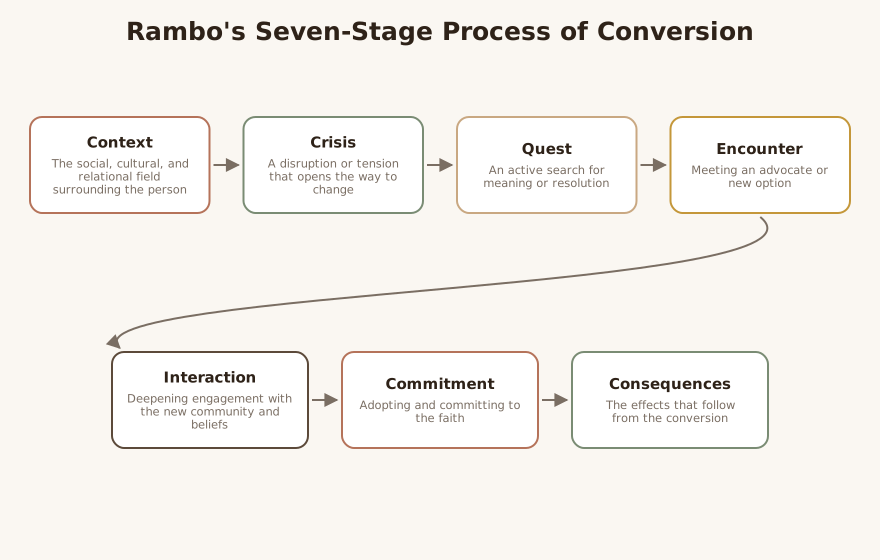
The modern sociological lineage runs through John Lofland and Rodney Stark, whose 1965 study of a millenarian group produced the influential Lofland-Stark process model — a “value-added” sequence of conditions through which a person becomes a convert 5. The most comprehensive contemporary synthesis is Lewis Rambo’s Understanding Religious Conversion (1993), which proposes a seven-stage holistic model integrating psychological, social, cultural, and religious dimensions and treating conversion as a process unfolding over time within a field of relationships 12. Rambo’s model has since been subjected to empirical testing and partial reformulation in the pastoral-psychology literature 3. Raymond Paloutzian’s later work reframes conversion within the broader construct of spiritual transformation and the meaning-systems on which it operates 4.
Core Principles
The first organizing principle of these models is that conversion is a process, not a punctual event: even experiences that feel sudden typically rest on a longer history of context, tension, and search 14. Rambo’s framework makes this explicit by insisting that conversion be seen as sequential and cumulative, with each phase shaping the next, while allowing that the stages are interactive and recursive rather than strictly linear 13. The empirical test of his model found that conversion narratives do tend to fall into recognizable temporal stages, supporting the staged structure while questioning the rigidity of any fixed order 3.
A second principle is that conversion is multidimensional and contextual. Rambo organizes the process around context, crisis, quest, encounter, interaction, commitment, and consequences — a sequence that deliberately situates the individual’s inner change within social, cultural, and relational fields rather than treating it as a purely private event 12. The Lofland-Stark model similarly emphasizes social conditions: enduring tensions, a religious problem-solving perspective, a sense of seekership, an encounter at a turning point, the formation of affective bonds, the weakening of competing attachments, and intensive interaction with the group 5. A third principle, foregrounded in the meaning-systems literature, is that what converts changes is the person’s superordinate framework of meaning, goals, and identity — which is why conversion can reorganize behavior and relationships so broadly 4. Finally, the models are descriptive rather than evaluative: they aim to explain how conversion happens, not to judge whether a given conversion is true, healthy, or good 4LLM.
Interventions & Techniques
A descriptive framework has no proprietary techniques; its clinical value lies in how it informs formulation and stance LLM. The most direct translation is to use the stages as an assessment map — locating where a client sits in a conversion (or de-conversion) trajectory, and what the salient tasks and risks are at that point 1LLM. A clinician can listen for Rambo’s elements in a client’s account: the prior context and crisis that destabilized the old framework, the quest that organized the search, the encounter and interaction with a community, the commitment moment, and the consequences now unfolding in the client’s life and relationships 12.
A second translation is narrative and exploratory rather than directive. Because conversion narratives are themselves a stage of the process — the convert learns to retell their life in the new framework — eliciting and honoring that narrative is clinically useful, and noticing how it is constructed can reveal what the change is doing for the person 4LLM. A third is to attend to the social mechanics the sociological models highlight: the affective bonds, the intensive interaction, and the weakening of prior attachments that the Lofland-Stark sequence describes are exactly the relational shifts that drive family conflict, so naming them helps the clinician and client work with the relational fallout deliberately 5LLM.
LLM-generated illustrative example (not a guideline): A clinician seeing a young adult who recently joined an intense religious community might, without endorsing or opposing the choice, map the client’s account onto the process — noting the crisis (a parent’s death) and quest that preceded it, the encounter and new affective bonds, and the strained ties to old friends. Naming these as predictable features of a conversion process, rather than as symptoms, can reduce shame and open space to work on the relational losses 15LLM.
Evidence Base
The maturity of these models is best described as established as description and limited as prediction. The frameworks are well-developed, widely cited, and embedded in the scholarly literature of the psychology and sociology of religion, and Rambo’s stage model in particular has functioned as the field’s organizing synthesis for three decades 14. The empirical record, however, is more about whether the structure fits observed conversions than about whether the models can predict who will convert or causally explain why 3LLM.
The most direct test is Kahn and Greene’s “Seeing Conversion Whole,” which examined whether converts’ accounts conform to Rambo’s holistic, stage-based structure 3. Their findings broadly supported a staged, sequential view of conversion while also prompting reformulation of how the stages relate, indicating that the descriptive architecture holds up but is not a rigid invariant sequence 3. The Lofland-Stark model, for its part, has been enormously generative as a heuristic, but later research questioned the predictive force and necessity of some of its proposed conditions, so it is best treated as an influential ideal-type rather than a validated causal pathway 5LLM.
The honest clinical summary is that these models are mature, useful organizing tools with real empirical grounding for their descriptive claims, but they were not built — and should not be used — as instruments to forecast, induce, or reverse conversion 34LLM. Their value to a therapist is in understanding a transition that is already underway, not in steering belief LLM.
Populations & Indications
The frameworks are most directly relevant to converts and new adherents, for whom the models supply a normalizing map of an intense identity change 1. They are equally useful, in mirror image, for people who have left a faith of origin, since de-conversion and switching can be read through the same staged, relational lens of crisis, quest, and consequence 4LLM. Members of high-demand or new religious movements are the population from which the Lofland-Stark model was originally derived, and its emphasis on affective bonds and intensive interaction speaks directly to their experience 5.
The models also speak to groups in transition more broadly. Families divided by a member’s conversion are a frequent clinical presentation, and the sociological account of weakened prior attachments helps explain the rupture 5LLM. Adolescents and emerging adults are classically over-represented among converts, a pattern noted since Starbuck and James, making the framework apt for identity work in that developmental window 6. Immigrants and clients in cultural transition may experience religious change as part of a larger acculturative reorganization of meaning and belonging, which the meaning-systems framing accommodates 4LLM.
Problems-for-Work
- Identity disruption and reconstruction. Conversion reorganizes a person’s superordinate meaning system and sense of self, so the stage model gives the clinician a structure for tracking and supporting that reconstruction 41.
- Family and relational conflict over belief. The weakening of prior attachments and intensified in-group bonding described by the sociological models make conflict predictable; naming the mechanism helps de-escalate it 5LLM.
- Post-conversion adjustment and disillusionment. Rambo’s consequences stage directs attention to what unfolds after commitment, including the gap between expectation and lived experience that can produce later distress 1LLM.
- Religious and spiritual struggle. Crisis and quest are built into the models, so a framework that treats struggle as a phase rather than a failure can reduce shame around doubt or upheaval 14.
- Crisis and demoralization preceding change. The crisis and context stages locate the destabilization that often precedes conversion, which is frequently the state in which a client first presents 1LLM.
- Acculturative stress and grief over a lost prior self. Where conversion accompanies cultural transition or marks a break with an earlier identity and community, the model helps frame the accompanying loss as part of the process 4LLM.
LLM-generated illustrative example (not a guideline): For a client two years into a conversion who now feels quiet disillusionment, a clinician might use the consequences stage to normalize the post-commitment “letdown,” distinguishing it from a verdict on the faith itself and opening work on realistic expectations and sustaining what the conversion was meant to provide 1LLM.
Contraindications, Cautions & Cultural Humility
The foremost caution is that these are descriptive, not directive models, and must not be used to push a client toward or away from belief 4LLM. Because some lineage in this literature historically framed conversion in relation to crisis, adolescence, or social marginality, a clinician must resist the slide from “conversion often follows crisis” to “this conversion is a symptom of pathology” — the contemporary consensus treats conversion as a normal-range transformation of meaning, not as illness 46. Reading a healthy religious change as a disorder is both a clinical error and a rupture of the therapeutic alliance LLM.
A second caution is the gap between description and prediction restated at the bedside: the stage models tell the clinician what the parts of a transition tend to look like, not which clients will convert, how a given conversion will end, or whether it can be reversed 35. Using them as a forecasting or persuasion tool overreaches their evidence LLM. Cultural and worldview humility is therefore essential — much of the foundational work derives from particular Western and Christian contexts, and the meaning and value of conversion differ sharply across traditions, so the clinician should follow the client’s own framing of what the change means rather than importing assumptions 4LLM. The clinician’s task is to understand and support the client’s process, holding their own beliefs about the faith in question out of the room LLM.
Treatment-Plan Suggestions & SMART Objectives
| Goal | SMART objective (example) | Mechanism |
|---|---|---|
| Locate the client’s position in the conversion process | Clinician and client map the client’s account onto the context-crisis-quest-encounter-interaction-commitment-consequences sequence within two sessions | Stage model used as an assessment map of an identity transition 1 |
| Normalize crisis and doubt as part of the process | Client reframes at least one episode of doubt as an expected phase rather than a failure, by week 4 | Crisis and quest are built into the conversion sequence 14 |
| Support identity reconstruction | Client articulates how core values and roles have shifted and which they wish to retain, over 6 weeks | Conversion reorganizes the superordinate meaning system 4LLM |
| Address family/relational conflict | Client identifies one weakened prior relationship to repair or grieve and takes one concrete step within 4 weeks | Sociological account of weakened attachments and intensified bonding 5LLM |
| Work with post-commitment disillusionment | Client distinguishes disappointment in expectations from a verdict on the faith and sets realistic expectations within 3 sessions | Rambo’s consequences stage; expectation-experience gap 1LLM |
| Process grief over a lost prior self or community | Client names what was lost in the transition and engages one bereavement-style coping step over 4 weeks | Conversion as transformation entailing loss 4LLM |
| Hold a non-directive, exploratory stance | Clinician elicits and honors the client’s conversion narrative without endorsing or contesting the belief, each session | Conversion narrative as a meaningful, constructed account 4LLM |
Common Misconceptions
The largest misconception is that conversion is a single, sudden, all-or-nothing event. Even the classic literature distinguished sudden from gradual types, and the modern models treat conversion as a process unfolding over time, so that experiences that feel instantaneous usually rest on a longer history of context and crisis 154. A second misconception is that the stages are a rigid, universal ladder — empirical testing supports a staged structure but argues against treating the order as invariant or every stage as obligatory 3.
A third misconception is that conversion is inherently pathological or a sign of psychological disturbance; contemporary scholarship frames it as a normal-range transformation of meaning and identity rather than as illness 46. A fourth is that the models can predict or engineer conversion — they are descriptive heuristics, and even the influential Lofland-Stark conditions have been questioned as necessary or sufficient causes 5LLM. Finally, conversion is often equated with adopting a new faith, when the same frameworks apply to switching traditions, intensifying within one, or leaving — all are forms of religious change the models help describe 4LLM.
Training & Certification
There is no certification in “religious conversion stage models,” because they constitute a scholarly literature rather than a credentialed treatment LLM. Competence comes from reading the primary sources and the broader psychology-of-religion literature in which they sit, then integrating that understanding into whatever evidence-based modality the clinician already practices 14LLM. Rambo’s Understanding Religious Conversion is the field’s reference synthesis and the natural starting point for a clinician who wants a grounding in the staged, holistic view 12.
For applied development, the realistic goal is the capacity to take a careful spiritual and conversion history, to recognize the phases of a transition in a client’s narrative, and to work with the relational and identity consequences without steering belief 14LLM. Therapists pursuing this area typically build it on top of broader training in spiritually integrated or culturally responsive care, where the conversion frameworks function as one lens among several 4LLM.
Key Terms
- Conversion as process — the view that religious change unfolds over time through identifiable phases rather than as a single punctual event 14.
- Rambo’s seven-stage model — context, crisis, quest, encounter, interaction, commitment, and consequences; a holistic, sequential framework integrating psychological, social, cultural, and religious dimensions 12.
- Lofland-Stark process model — a value-added sequence of social and psychological conditions (tension, a religious problem-solving perspective, seekership, a turning point, affective bonds, weakened prior attachments, intensive interaction) through which a person becomes a convert 5.
- Sudden vs. gradual conversion — the classic Jamesian distinction between abrupt, dramatic conversion and slow, volitional change 56.
- Quest — the active search for meaning or resolution that organizes the period before commitment in stage accounts 1.
- Consequences — Rambo’s final stage, covering what follows commitment, including post-conversion adjustment and possible disillusionment 1LLM.
- Spiritual transformation / meaning system — the reframing of conversion as a change in the person’s superordinate framework of meaning, goals, and identity 4.
Resources & Further Reading
▶ Watch — a video introduction to this concept:
- Understanding Religious Conversion (Lewis R. Rambo, 1993, Yale University Press)
- Understanding Religious Conversion (Rambo, 1993) — full text, Internet Archive
- “Seeing Conversion Whole”: Testing a Model of Religious Conversion (Pastoral Psychology)
- Psychology of Conversion and Spiritual Transformation (Pastoral Psychology)
- Psychology of religious conversion — Wikipedia
- Conversion, III (Psychology of) — Encyclopedia.com
Reflective / Supervision Questions
- When a client describes a “sudden” conversion, do I listen for the longer context, crisis, and quest that usually precede it, rather than taking the suddenness at face value 15?
- Am I using the stages as a flexible map of an identity transition, or am I imposing them as a rigid ladder the client must have climbed in order 3LLM?
- Have I checked my own reflex to read a client’s conversion as a symptom, given that the contemporary view treats it as a normal-range transformation of meaning 46?
- When conversion has fractured a client’s relationships, am I naming the relational mechanics (weakened prior bonds, intensified in-group ties) so we can work with them deliberately 5LLM?
- With a client in the post-commitment phase, am I attending to disillusionment and the consequences stage rather than assuming the change is settled 1LLM?
- Am I holding my own beliefs about the client’s faith out of the room and following their framing of what the conversion means 4LLM?