
Type & Discipline
Anicca (Pali; Sanskrit anitya) is a philosophical and contemplative doctrine drawn from Buddhist philosophy, not a standalone treatment protocol. 4 It is the teaching that all conditioned phenomena - the body across childhood, youth, maturity, and old age, as well as every mental event - are subject to constant change. 1 In the canonical framing, anicca is the first of the ti-lakkhana, the three “marks” or basic characteristics of all phenomenal existence, sitting alongside dukkha (unsatisfactoriness) and anatta (non-self). 1 For clinicians, the practical relevance is that anicca functions as the conceptual engine underneath several established, empirically studied therapies - it is the reason “this too shall pass” is treated as an observable fact rather than a platitude. LLM
This article treats anicca as a transtheoretical principle a therapist can recruit, rather than as a billable modality in itself. LLM Its therapeutic value lies in how it reframes the relationship between a client and their internal experience: if sensations, thoughts, and emotions are inherently transient, then they can be observed and tolerated rather than fixed, escaped, or fused with. LLM
Creators & Lineage
The doctrine originates with the Buddha and is woven extensively through the Pali Canon as a foundational teaching. 4 In the traditional contemplative lineages, perceiving anicca is described as “one of the first steps in the Buddhist’s spiritual progress toward enlightenment.” 1 The teaching is not meant to remain intellectual: canonical and commentarial sources stress that impermanence must be seen directly in lived experience - in decaying forests, changing clouds, the aging body - rather than merely understood as an idea. 2
A major modern transmission of anicca into psychological practice runs through vipassana (“insight”) meditation, popularized in the twentieth century by teachers such as S.N. Goenka and the Vipassana Research Institute. 3 In this lineage, impermanence is observed most concretely through bodily sensation: as sensations arise and pass moment by moment, the meditator witnesses anicca within their own body, which is said to cultivate equanimity and reduce reactive craving and aversion. 3 This somatic, sensation-anchored approach is a direct ancestor of the present-moment, body-scan-style attention used in secular mindfulness programs. LLM
From these contemplative roots, anicca entered Western clinical practice through the mindfulness-based and acceptance-based therapies that form its modern lineage: Mindfulness-Based Stress Reduction (MBSR), Mindfulness-Based Cognitive Therapy (MBCT), and Acceptance and Commitment Therapy (ACT). LLM In ACT in particular, the cultivation of acceptance of impermanence - learning to stop resisting the transient nature of experience rather than relying on avoidance - is framed as central to psychological flexibility. 6
Core Principles
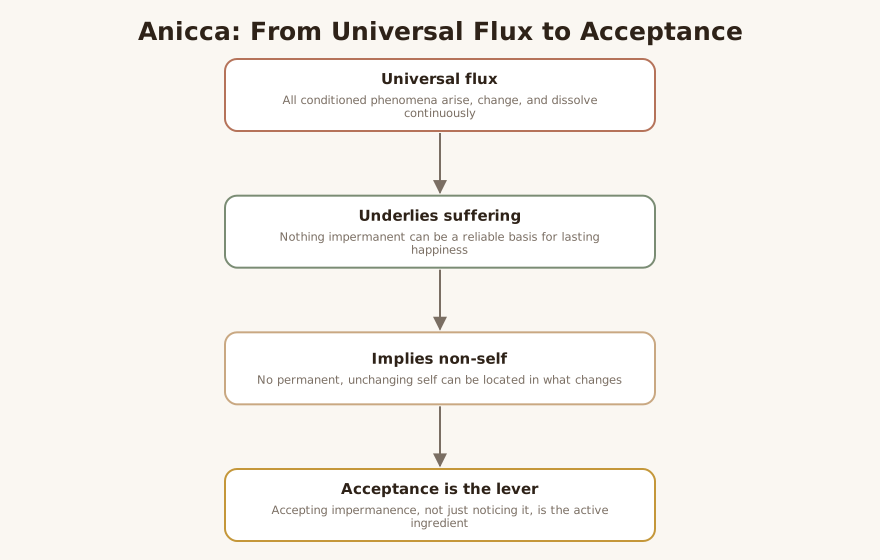
1. Universal flux. All conditioned existence, without exception, is transient and inconstant; phenomena arise, change, and dissolve in rapid succession. 4 Component things are “a process and not a group of abiding entities.” 2
2. Impermanence underlies suffering. Because everything changes, nothing impermanent can serve as a reliable basis for lasting happiness - “whatever is transient is by that very fact unsatisfactory.” 2 Clinically, much distress comes from the attempt to hold static what is by nature in motion: a mood, a relationship, a level of comfort, a sense of certainty. LLM
3. Impermanence implies non-self. Since phenomena are impermanent and unsatisfactory, no permanent, unchanging self can be located within them. 2 This links anicca to anatta: sustained contemplation of impermanence is said to loosen “all conceit of ‘I am.’” 2 Therapeutically, this maps onto decentering and defusion - the experience of being the observer of thoughts rather than their content. LLM
4. Acceptance, not just awareness, is the active ingredient. A key clinical refinement is that awareness of impermanence and acceptance of impermanence are distinct. 5 In one study, only the affective acceptance of transience - not mere intellectual awareness of it - mediated reductions in death-related distress, which has direct implications for how we deliver the concept in session. 5
Interventions & Techniques
Anicca is most often delivered as an attentional stance layered onto existing mindfulness and acceptance practices, rather than as a discrete technique. LLM
Sensation-anchored observation. Following the vipassana model, the client observes bodily sensations and watches them arise and pass, directly experiencing that “everything that has the nature of arising also has the nature of ceasing.” 3 The clinical aim is equanimity: noticing a sensation without reflexively reacting with craving or aversion. 3
Mindful breathing as a micro-demonstration of impermanence. A concrete starter practice is to attend to the in-breath, then shift attention to the sensation of the breath leaving the body - the breath itself embodies continuous arising and passing. 6 This is a low-risk, portable way to make impermanence experiential rather than abstract. 6
Urge surfing / “watching it pass.” For craving, worry, or emotional surges, the client is coached to treat the urge as a wave that crests and subsides on its own if not acted upon - an applied corollary of anicca. LLM
Mindfulness-of-death contemplation. More advanced practices deliberately contemplate mortality; these can paradoxically enhance gratitude and “zest for living,” but the source explicitly cautions that they should be approached carefully if the person is grieving a recent loss. 6
LLM-generated illustrative example (not a guideline): A client mid-panic says, “This feeling is never going to stop.” The clinician guides a 90-second observation of the bodily sensations of anxiety - heart rate, chest tightness - tracking how the intensity peaks and then shifts, even slightly. The lived data (“it changed”) becomes evidence for anicca, and the reframe becomes experiential rather than reassurance. LLM
Evidence Base
The evidence base should be characterized honestly. As a philosophical and contemplative doctrine, anicca is established and ancient, with deep textual grounding across the Buddhist tradition. 4 As a clinical mechanism with its own dedicated outcome trials, the direct empirical literature is far thinner and still emerging. LLM
The strongest emerging signal treats impermanence acceptance as a mediating mechanism. A cross-sectional study comparing 54 long-term ayahuasca users with 53 matched non-users found that the users showed lower death anxiety (d = -0.54), lower fear of death (d = -1.20), and greater death acceptance (d = 0.81). 5 Critically, impermanence acceptance - measured with the 13-item Impermanence Acceptance Scale (IMAAS) - emerged as the sole significant mediator of these death-processing differences, while impermanence awareness, personality traits, mindfulness, and afterlife beliefs did not mediate. 5 The indirect effect on death anxiety was 0.34 (SE = 0.08, 99% CI [0.14, 0.58]). 5
The honest caveats are substantial: the design is cross-sectional, so causation cannot be inferred; the sample is small and risks Type II error; there is self-selection bias; and the ayahuasca context cannot be cleanly isolated from other psychedelic use. 5 In short, anicca is best described to colleagues and clients as a well-established contemplative principle that is embedded within evidence-based therapies (MBSR, MBCT, ACT), with promising but immature direct evidence that the acceptance component specifically carries mechanistic weight. LLM
Populations & Indications
Anicca-informed work is most natural for clients already engaged in, or suited to, mindfulness and acceptance approaches. LLM Indicated populations include mindfulness practitioners, people with anxiety disorders, people with depression, grieving clients, people with chronic pain, and clients with emotion dysregulation. LLM
The concept maps onto recognizable mechanisms for each group: for anxiety and worry, recognizing the transience of feared states reduces anticipatory dread about uncertainty; 6 for depression, contact with change can interrupt the felt permanence of a low mood; LLM for chronic pain, sensation-by-sensation observation reframes pain as a fluctuating process rather than a fixed monolith; 3 and for grief, the framework offers a way to hold loss within the recognition that all states - including acute pain - are themselves impermanent. 6
Problems-for-Work
- Rumination and worry. Anicca supports decentering from repetitive thought: thoughts are observed as transient mental events that arise and pass, rather than as durable facts requiring resolution. 4
- Craving / urge surfing. Direct observation of sensations arising and ceasing trains the client to let an urge crest and subside without acting on it. 3
- Emotion dysregulation. Tracking the rise and fall of affect builds the experiential conviction that even intense emotion is time-limited, supporting distress tolerance. LLM
- Grief. Framing loss within universal impermanence can reduce the sense that the pain is fixed and total - used cautiously, and not via death-contemplation practices in acute grief. 6
- Chronic pain and distress intolerance. Observing pain as a changing process rather than a static state reduces the secondary suffering of resistance to it. 3
LLM-generated illustrative example (not a guideline): A client with chronic low-back pain is taught a brief body scan in which they rate the pain’s intensity, quality, and edges every few breaths. Over a week of logging, they observe the pain is not “an 8 all day” but oscillates between 4 and 8 and changes character. This concrete contact with change loosens the catastrophic appraisal that the pain is constant and immovable. LLM
Contraindications, Cautions & Cultural Humility
Anicca is a stance, not a sedative, and it can be misapplied. The clearest documented caution is around mortality-focused practice: mindfulness-of-death contemplation should be approached with care, and not used, with someone grieving a recent loss. 6
Clinically reasoned cautions include the risk that “everything is impermanent” becomes a vehicle for bypassing - using the doctrine to dismiss or suppress legitimate emotion rather than to relate to it differently. LLM For clients with trauma histories or dissociation, intensive interoceptive or sensation-watching practices may intensify distress and should be titrated, grounded, and not assumed safe simply because they are “mindful.” LLM The doctrine of non-self that accompanies anicca can also feel destabilizing for clients with fragile identity or active psychosis and warrants careful framing. LLM
On cultural humility: anicca is a sacred doctrine within living Buddhist traditions, and the contemplative lineages that carry it - including the vipassana tradition - hold it as a path to liberation, not merely a coping tool. 3 Clinicians should name the source tradition, avoid presenting a decontextualized “technique” as their own invention, and remain attentive to clients for whom the religious framing is either resonant or, conversely, in tension with their own faith. LLM
Treatment-Plan Suggestions & SMART Objectives
| Goal | SMART objective (example) | Mechanism |
|---|---|---|
| Reduce reactivity to distressing emotions | Within 6 weeks, client will complete a 5-minute “rise and fall” affect-tracking practice 4x/week and report it in session | Experiential contact with impermanence builds distress tolerance 3 |
| Decrease rumination | Within 4 weeks, client will use a decentering script (“this is a passing thought”) during 3 noted rumination episodes/week, logged in a journal | Decentering from transient mental events 4 |
| Improve urge management | Over 8 weeks, client will apply an urge-surfing practice to >=70% of logged cravings and rate post-urge intensity | Observing urges arise and cease without acting 3 |
| Lower anticipatory anxiety about uncertainty | Within 6 weeks, client will practice 5 minutes of mindful breathing daily and rate uncertainty-related distress weekly on a 0-10 scale | Acceptance of transience reduces dread of change 6 |
| Reduce secondary suffering from chronic pain | Over 8 weeks, client will complete a brief body scan 5x/week and track pain as a fluctuating (not fixed) rating | Reframing pain as a changing process, not a monolith 3 |
| Increase acceptance vs. avoidance | Within 6 weeks, client will identify and reduce 2 avoidance behaviors, replacing them with an acceptance-of-impermanence practice | Psychological flexibility via acceptance, not avoidance 6 |
| Support adaptive grief processing | Over 10 weeks, client will engage in 1 guided impermanence reflection/week, screening out death-contemplation practices during acute grief | Holding loss within universal transience, cautiously 6 |
Common Misconceptions
“Impermanence means nothing matters / detachment means not caring.” The contemplative aim is equanimity and reduced reactive craving and aversion, not numbness or indifference; the same practices are said to generate compassion. 3 LLM
“Just knowing things are impermanent is enough.” The empirical finding is the opposite: intellectual awareness of impermanence did not mediate reduced distress - only affective acceptance did. 5 Insight has to become felt and lived, not merely understood. 2
“Anicca is a comforting reassurance (‘this too shall pass’).” It is a structural fact about conditioned existence, and the same impermanence that ends suffering also ends pleasant states; the doctrine explicitly links transience to dukkha. 2 Using it only as reassurance flattens it. LLM
“It’s a quick technique.” In its source tradition it is a path requiring sustained, direct observation - “seeing things as they really are” through personal experience over time. 2
Training & Certification
There is no certification in “anicca” as such. LLM Clinically, the relevant credentials are in the modern therapies that carry the concept: structured MBSR/MBCT teacher training, and ACT competency through workshops, supervision, and consultation. LLM On the contemplative side, the vipassana tradition transmits direct experience of impermanence through residential courses and the teaching infrastructure of organizations such as the Vipassana Research Institute. 3 Clinicians who wish to use sensation-based impermanence practices responsibly are well advised to have a personal practice and to train in the secular therapeutic container (MBSR/MBCT/ACT) in which they will actually deliver and document the work. LLM
Key Terms
- Anicca - impermanence; the doctrine that all conditioned phenomena are in constant flux. 1
- Ti-lakkhana (three marks of existence) - the three universal characteristics: anicca (impermanence), dukkha (unsatisfactoriness), and anatta (non-self). 1
- Dukkha - unsatisfactoriness/suffering; because all is transient, nothing impermanent offers a stable basis for lasting happiness. 2
- Anatta - non-self; since phenomena are impermanent and unsatisfactory, no permanent self can be found within them. 2
- Impermanence acceptance - the affective acceptance (not mere awareness) of transience; the component shown to mediate reduced death-related distress, operationalized by the Impermanence Acceptance Scale (IMAAS). 5
- Vipassana - “insight” meditation in which impermanence is observed directly through bodily sensation. 3
- Equanimity - the non-reactive, balanced stance toward arising and passing experience cultivated by observing impermanence. 3
Resources & Further Reading
▶ Watch — a video introduction to this concept:
- Anicca | Impermanence, Suffering, Transience (Britannica) 1
- The Three Basic Facts of Existence: I. Impermanence (Anicca) - Access to Insight 2
- Anicca | Vipassana Research Institute 3
- Impermanence (Buddhism) - Wikipedia 4
- Embracing change: impermanence acceptance mediates differences in death processing (PMC) 5
- How to Accept the Impermanence of Life: A Buddhist Take (PositivePsychology.com) 6
Reflective / Supervision Questions
- When I introduce impermanence to a client, am I cultivating felt acceptance or settling for intellectual awareness - and how would I know the difference in this client? 5
- Could this client be using “everything passes” to bypass or suppress a feeling that actually needs to be approached and validated? LLM
- For trauma, dissociation, or fragile identity, have I titrated and grounded sensation-based practices rather than assuming “mindful” equals “safe”? LLM
- Am I naming the Buddhist origins of this work, and am I attentive to how the religious framing lands for a client of a different faith or worldview? 3 LLM
- For a grieving client, have I screened out mortality-contemplation practices that are contraindicated in acute grief? 6
- Which billable, evidence-based modality (MBCT, ACT, mindfulness-informed CBT) am I actually delivering this within, and does my documentation reflect that mechanism rather than the philosophical label? LLM