
Type & Discipline
Psychedelic integration therapy is a technique within clinical psychology, situated in the broader family of psychedelic-assisted therapy LLM. It is best understood not as a single branded protocol but as a stage of work — the structured therapeutic processing that follows a non-ordinary-state experience, whether that experience occurred in a clinical trial, in legal ceremony, or in unsupervised recreational use 1. Crucially, integration work does not involve administering any substance; it is talk- and practice-based therapy delivered before and, more centrally, after the drug experience itself 2.
A widely cited concept analysis defines integration as “a process in which a person revisits and actively engages in making sense of, working through, translating, and processing the content of their psychedelic experience” 1. A second practical definition frames it as “any conscious and informed attempt to facilitate processing the psychedelic experience content or resulting consequences, in order to implement its relevant outcomes into everyday life” 6. Both definitions share a load-bearing assumption: the acute experience generates raw material, but durable change depends on the deliberate, often effortful work that comes afterward 1.
Creators & Lineage
Integration has no single founder; it emerged as a distinct, named process only recently, with the great majority of formal models appearing from 2017 onward 1. Its conceptual roots are plural. Modern clinical research protocols from organizations such as the Multidisciplinary Association for Psychedelic Studies, the Beckley Foundation, and the Heffter Research Institute all build in structured preparation, support, and integration phases, normalizing integration as a standard component of psychedelic-assisted therapy 1.
The technique draws on several established lineages LLM. From transpersonal and Jungian psychology it inherits shadow work, dream work, and a vocabulary for spiritual and existential material 1. From mindfulness-based interventions it inherits a stance of non-judgmental, open curiosity toward whatever arises 2. The psychedelic harm reduction and integration model explicitly synthesizes integrative harm reduction psychotherapy, psychedelic-assisted therapy principles, mindfulness-based interventions, and relational-psychodynamic theory into one transtheoretical framework 2. Among contemporary clinicians, Ido Cohen has described integration as “a way of being and an active reflective process” of reconnecting with the feelings, sensations, thoughts, images, and spiritual experiences a person has had 5.
Core Principles
Several principles recur across integration models LLM. The first is active effort: insights are perishable, and “without such effort, valuable lessons tend to fade,” so the work is described as time-intensive and potentially lifelong 1. The second is the inner-directed stance — the assumption of an “inner healing intelligence” in which patients generate their own insights while the therapist follows and supports where they are going, rather than steering toward a predetermined outcome 2.
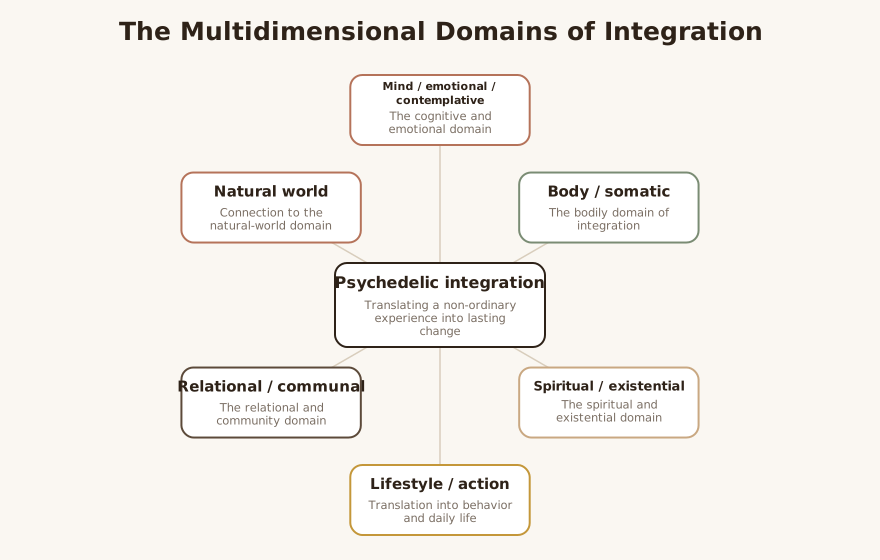
The third principle is a harm-reduction posture: a compassionate, destigmatizing acceptance of patients’ choices that values autonomy rather than demanding abstinence 2. The fourth is multidimensionality. Integration is not purely cognitive; one concept analysis organizes it into a hexagonal framework spanning mind/emotional/contemplative, bodily/somatic, spiritual/existential, lifestyle/action, relational/communal, and natural-world domains, while MAPS frames the same breadth as mind, body, spirit, nature, community, and lifestyle 14. Finally, the therapeutic alliance itself is treated as a primary mechanism, built on safety, rapport, and authentic presence within a non-hierarchical relationship 2.
Interventions & Techniques
Integration unfolds across three broad temporal phases: a capture phase that creates a narrative of the experience, an understanding phase that identifies themes and decodes content, and an implementation phase that translates insights into behavioral change 1. A complementary two-stage clinical model proposes an early stage of roughly five one-hour sessions to establish relationship and safety, screen for conditions needing medical management, provide psychoeducation, and stabilize any adverse symptoms — followed by a later stage of deeper exploration and incorporation of insights into daily functioning 6.
Concrete early-stage interventions include grounding techniques — attention to the feet, body scans, mindful walking, nature contact, and creative expression — and organizing techniques such as timeline mapping, emotion-intensity graphs, and body-sensation mapping 6. Clinicians also analyze the experience through open-ended questions that help the client reconnect with what occurred 6. Longer-term, more specific interventions named in the literature include Acceptance and Commitment Therapy practices, mindfulness-based interventions, Internal Family Systems therapy dialogue with “parts,” process-oriented amplification, Jungian or depth-psychological dream interpretation, and group sharing circles 6. MAPS specifically highlights Internal Family Systems therapy and Jungian shadow work as approaches that align closely with integration aims 4.
LLM-generated illustrative example (not a guideline): A client returns from a high-dose experience convinced she “met” a critical inner voice as a distinct character. Rather than interpreting it for her, the clinician uses Internal Family Systems therapy language to help her get to know that part — its age, its fear, what it is trying to protect — then maps how the part shows up in her current relationships, turning a vivid but disorienting image into workable relational material LLM.
For difficult or trauma-like content, integration borrows directly from established trauma treatment: clinicians may draw on cognitive processing therapy, narrative and prolonged exposure approaches, and Eye Movement Desensitization and Reprocessing, treating the symptoms much as they would other trauma presentations 6.
Evidence Base
The honest summary is that the evidence base is emerging and thin LLM. A 2024 systematised review of therapeutic frameworks used in integration sessions screened 75 sources — clinical trials, treatment manuals, protocols, qualitative studies, and reviews — and concluded that “there is currently an insufficient evidence base to suggest that any type of therapy is effective for guiding integration sessions” 3. The same review found that most retrieved evidence “was not supported by empirical data,” limiting any conclusive statement about which therapeutic framework is most appropriate, and that the field’s approaches draw predominantly from the humanistic-experiential tradition 3.
This matters for how clinicians should talk about integration with clients LLM. There is strong professional consensus that integration is important — it is built into every major research protocol — yet the specific claim that one modality outperforms another for integration has not been tested by rigorous research 13. The review explicitly calls for systematic investigation of different therapeutic frameworks and therapy-related factors 3. Practitioners should therefore present integration as clinically sensible and consensus-supported, not as an empirically validated treatment with established efficacy data LLM. Even practitioners trained in psychedelic-assisted therapy report wanting a clearer understanding of what integration actually is, which signals how unsettled the operational definition remains 1.
Populations & Indications
Integration work is relevant to anyone carrying unprocessed material from a non-ordinary-state experience LLM. This includes participants in clinical psychedelic trials, for whom integration is a protocolized phase, as well as recreational psychedelic users and other people who have used psychedelics outside a clinical setting who arrive seeking help making sense of what happened 15. The work suits people who want to apply insights to daily life, those struggling with a confusing or disturbing aftermath, and trauma survivors for whom a psychedelic experience activated stored material 5.
It also serves adults in personal growth and spiritual seekers who frame the experience in existential or spiritual terms and want help metabolizing it rather than treating a disorder 1. Because psychedelics are described as connecting people to the unconscious and the body — where traumatic events and trauma-induced patterns are stored — the population most likely to need skilled integration is precisely those for whom that material surfaces faster than they can process it alone 5.
Problems-for-Work
Integration addresses a wide span of problems-for-work LLM. Difficult psychedelic experiences are a core indication: research cited in the harm-reduction literature notes that over one-third of people rate a challenging experience among the most difficult events of their lifetime, even as a majority later report positive long-term outcomes — a tension that is itself the work of integration 2. For example, a client haunted by a frightening “ego-dissolution” passage can be helped to reframe the loss of a fixed self-sense not as damage but as workable developmental material 2.
Trauma-like symptoms — acute stress, dissociative experiences such as derealization and depersonalization, flashbacks, and nightmares — are explicitly named adverse consequences that integration must triage and, where persistent, refer or treat 6. Existential and spiritual distress, including “ontological shock” or profound worldview questioning, is another common presentation 6. Meaning-making difficulties and disappointment — particularly when a hoped-for mystical experience did not materialize — are addressed by helping the client find meaning in the experience they actually had 2. Where hallucinogen persisting perception disorder is present, involving prolonged or recurrent sensory disturbances, the guidance is to obtain psychiatric consultation while still providing supportive integration 6. Anxiety, depression, identity confusion, adjustment difficulties, and emotional dysregulation surfaced or amplified by the experience are all within scope of the surrounding therapeutic work 6LLM.
Contraindications, Cautions & Cultural Humility
Integration itself is low-risk, but the populations and the material are not, and several cautions apply LLM. The literature flags an “afterglow” window of roughly six to eight weeks after the experience marked by increased suggestibility, during which clinicians should avoid dogmatic interpretations or any intervention the client has not consented to 6. This is a direct guardrail against the therapist’s own meaning-making colonizing the client’s LLM.
Clinicians should not underestimate serious psychiatric presentations: persistent perceptual symptoms, psychotic features, or other significant conditions warrant psychiatric consultation rather than integration alone 6. Known risk factors for adverse reactions include high neuroticism, personal or family history of psychosis, and conditions such as borderline personality disorder or mania, alongside relevant medical and medication considerations 6. Clinicians must also watch for spiritual bypassing — using repeated psychedelic seeking to avoid unresolved psychological pain or practical responsibilities 26.
Cultural humility is essential because integration sits atop Indigenous practices LLM. Indigenous cultures embed integration within ongoing communal and spiritual life, whereas Western frameworks must construct it deliberately, partly because of a cultural fragmentation that separates mind, body, spirit, and nature 1. Clinicians should hold their own frameworks lightly, avoid premature diagnostic conclusions, and work strictly within their scope of practice, assessing their own competency, comfort with the content, and capacity for harm reduction before entering this domain 24.
Treatment-Plan Suggestions & SMART Objectives
| Goal | SMART objective (example) | Mechanism |
|---|---|---|
| Stabilize acute distress | Within 4 sessions, client will use a grounding technique (body scan or mindful walking) at first sign of dysregulation, reporting ≥30% drop in subjective distress | Somatic grounding and present-moment awareness reduce stress felt in the body 6 |
| Capture the experience | Within 2 weeks, client will complete a written or visual narrative of the experience and a timeline map of its key moments | Capture phase externalizes content for processing 16 |
| Decode meaning | Over 6 sessions, client will identify and name 3 recurring themes from the experience and link each to a current life domain | Understanding phase translates raw content into themes 1 |
| Reframe a difficult passage | Within 8 weeks, client will articulate one previously distressing moment as workable rather than damaging, rated on a 0–10 acceptance scale | Acceptance and psychological flexibility reduce experiential avoidance 2 |
| Address trauma material | Within 12 weeks, client engaging trauma content will complete a structured trauma protocol with ≥50% symptom-scale reduction | Established trauma processing applied to surfaced material 6 |
| Implement behavioral change | By session 12, client will adopt 2 concrete lifestyle or relational changes tied to a stated insight and sustain them for 4 weeks | Implementation phase converts insight into action 1 |
| Manage disappointment | Within 4 sessions, client will reframe the gap between hoped-for and actual experience into one personally meaningful takeaway | Meaning-making counters expectation mismatch 2 |
| Prevent spiritual bypass | Across treatment, client will identify any avoidance pattern driving repeat use and contract one alternative coping action | Naming bypass restores engagement with unresolved distress 26 |
Common Misconceptions
A frequent misconception is that integration is a passive, automatic settling of the experience over time; in fact the literature is emphatic that without active, effortful engagement the lessons tend to fade 1. A second is that integration requires the therapist to have taken psychedelics themselves — the practical guidelines note that while first-hand experience is a consideration, it is “not necessary,” given legal barriers and individual contraindications 6.
A third misconception is that integration is purely cognitive insight-talk; the models consistently describe a multidimensional process that includes somatic, relational, spiritual, lifestyle, and nature-based work, not just verbal reflection 14. A fourth is that more psychedelic experiences equal more healing — a belief integration clinicians actively monitor as a possible marker of spiritual bypass rather than progress 2. Finally, some assume integration is an evidence-based treatment with established efficacy; the current state is consensus on importance but insufficient controlled evidence that any framework is effective for guiding it 3.
Training & Certification
There is no single licensing body or mandated certification for psychedelic integration, and clinicians should be candid with clients about that LLM. The practical guidelines describe the necessary competencies as knowledge of psychedelic effects and mechanisms, an empathetic and trustworthy presence, self-awareness, and ethical integrity — and emphasize “metaskills,” meaning how the practitioner works, over any specific technique catalog 6. MAPS frames the entry requirement as a self-assessment of personal experience level, competency with harm reduction, comfort with psychedelic content, attention to privilege and safety, and available support before practicing in this domain 4.
Because integration sits within general psychotherapy, the foundational credential is licensure as a mental health professional, with psychedelic-specific knowledge added on top 5. Clients are advised to seek licensed clinicians with specialized psychedelic training, and several directories exist to help, including the MAPS integration list, Psychedelic.Support, the Fireside Project, and the Zendo Project 5.
Key Terms
Integration. Actively revisiting, making sense of, working through, and implementing the content of a psychedelic experience into everyday life 16.
Set and setting. “Set” refers to intentions, expectations, and overall state of mind; “setting” refers to the environment of the experience 2.
Inner healing intelligence. The model’s assumption that the client generates their own insights, with the therapist following and supporting rather than directing 2.
Afterglow. A roughly six-to-eight-week post-experience window of heightened suggestibility requiring extra caution against non-consented or dogmatic intervention 6.
Ontological shock. A destabilizing questioning of one’s worldview that can follow a profound experience 6.
Spiritual bypassing. Using repeated psychedelic seeking to avoid pain, unresolved distress, or practical responsibilities 26.
Capture / understanding / implementation. The three temporal phases of integration — narrating, decoding, and acting on the experience 1.
Resources & Further Reading
▶ Watch — a video introduction to this concept:
- Psychedelic integration: An analysis of the concept and its practice (Frontiers in Psychology, 2022)
- Psychedelic Harm Reduction and Integration: A Transtheoretical Model for Clinical Practice (Frontiers in Psychology, 2021)
- Therapeutic frameworks in integration sessions in substance-assisted psychotherapy: a systematised review (Thal, 2024)
- What Therapists Need to Know About Psychedelic Integration — MAPS
- What Is Psychedelic Integration Therapy? — DoubleBlind
- Back from the rabbit hole: practical guidelines on psychedelic integration for mental health specialists (PMC)
Reflective / Supervision Questions
- When a client returns from a profound experience during the suggestible afterglow window, how do I notice and restrain my own urge to supply meaning rather than follow theirs? LLM
- Given that no framework has controlled evidence for guiding integration, how do I present this work to clients honestly without either overselling or dismissing it? LLM
- Where is my line between supportive integration and a presentation that requires psychiatric consultation or trauma-specialized referral? LLM
- How would I recognize spiritual bypassing in a client who frames continued use as healing, and how would I raise it without shaming their autonomy? LLM
- What is my actual competency and comfort with psychedelic content, and what support or consultation do I need before working in this domain? LLM