
Type & Discipline
Eye Movement Desensitization and Reprocessing (EMDR) is a structured, manualized psychotherapy rooted in clinical psychology and situated within the family of trauma-focused therapies 1. It is most commonly used as a stand-alone, time-limited treatment for posttraumatic stress disorder (PTSD), and it is delivered across an eight-phase protocol rather than as a single technique 1. The defining procedural feature is that the client briefly focuses on a trauma memory while simultaneously engaging in bilateral stimulation, typically therapist-guided eye movements, though tactile taps or auditory tones are accepted alternatives 1.
Conceptually, EMDR sits at the intersection of exposure-based and information-processing models of trauma treatment, but it diverges from classical exposure in its brief attention to the memory, its emphasis on free association during processing, and its de-emphasis of prolonged, sustained exposure or homework 4. Clinically, it is best understood as a recognized evidence-based PTSD treatment that occupies the same tier of efficacy as other trauma-focused psychotherapies while resting on a distinctive theoretical and procedural foundation 7.
Creators & Lineage
EMDR was originated and developed by Francine Shapiro, PhD, a clinical psychologist who served as a Senior Research Fellow at the Mental Research Institute in Palo Alto and as Executive Director of the EMDR Institute in Watsonville, California 6. Her earliest published study, “Efficacy of the eye movement desensitization procedure in the treatment of traumatic memories,” appeared in the Journal of Traumatic Stress in 1989, marking the formal introduction of the method 6. Shapiro’s contributions to trauma psychology were later recognized with awards including the American Psychological Association Division 56 Award for Outstanding Contributions to Practice in Trauma Psychology 6.
The theoretical lineage of EMDR runs through the broader cognitive-behavioral and exposure-therapy traditions, but Shapiro reframed the work around what she termed the Adaptive Information Processing (AIP) model 4. The canonical clinical reference is Shapiro’s own text, now in its third edition, “Eye Movement Desensitization and Reprocessing (EMDR) Therapy: Basic Principles, Protocols, and Procedures,” which codifies the protocols and procedures used in standardized training 5. Over subsequent decades the method moved from a single procedure to a comprehensive, phase-based therapy, a trajectory Shapiro herself reviewed in her later writing on the model’s development and research agenda 4.
Core Principles
The organizing theory behind EMDR is the Adaptive Information Processing model, which holds that much of psychopathology arises when distressing experiences are inadequately processed and stored 4. Under this view, PTSD symptoms reflect trauma memories that remain stored with their original unprocessed emotions, thoughts, beliefs, and physical sensations, rather than being integrated into adaptive memory networks 1. EMDR is theorized to work by changing how these memories are stored in the brain, accelerating the information-processing system toward adaptive resolution, rather than by directly modifying emotional responses through repeated exposure 1.
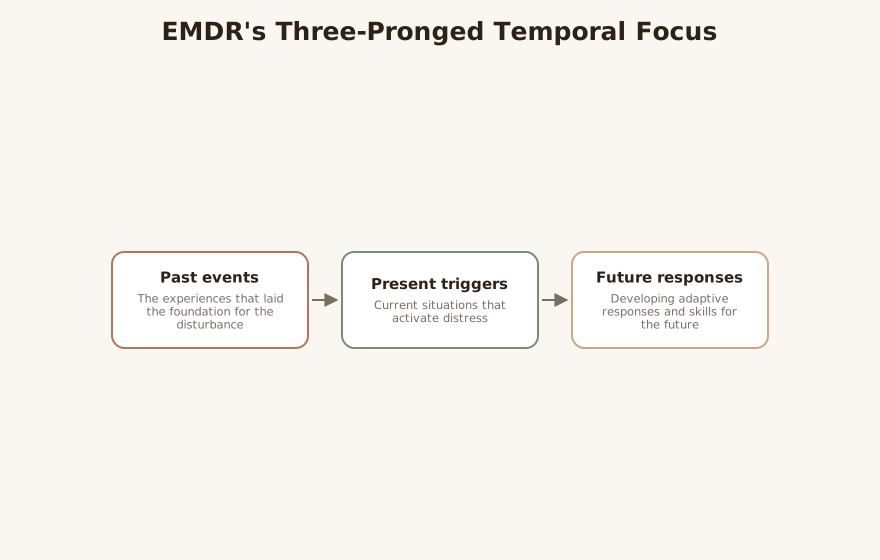
A second core principle is the three-pronged temporal focus of treatment: past events that laid the foundation for the disturbance, present situations that trigger distress, and the development of adaptive responses and skills for the future 4. A third principle is dual attention: the client holds the disturbing material in awareness while simultaneously attending to an external bilateral stimulus, a procedure intended to reduce the vividness and emotional charge of the memory 1. It is worth stating plainly for clinicians that whether the eye movements themselves are the active mechanism remains an open empirical question; the supporting meta-analytic literature has generally assumed that the bilateral stimulation activates processing without isolating that component from the rest of the protocol 3. LLM
Interventions & Techniques
The treatment is delivered across eight phases 1. Phase 1 is history-taking and treatment planning, in which the clinician identifies target memories and maps the past–present–future structure of the work 1. Phase 2 is preparation, in which the client is introduced to the procedures and equipped with self-regulation and stabilization resources before any reprocessing begins 1. Phase 3 is assessment of the target memory, where the clinician elicits the representative image, the negative cognition, a desired positive cognition, the associated emotion, and the body sensation 1.
Phases 4 through 7 carry out the reprocessing itself using standardized sets of bilateral stimulation while the client briefly attends to the target material 1. In practice this involves the desensitization of the targeted memory, installation of the more adaptive positive cognition, a body scan to detect residual somatic disturbance, and closure to return the client to a stable state at the end of each session LLM. Phase 8 is re-evaluation, in which the clinician reviews progress and treatment outcomes at the start of subsequent sessions and identifies remaining targets 1. A standard course is commonly described as roughly six to twelve sessions delivered one to two times weekly, although duration varies with complexity 1. Evidence from the meta-analytic literature suggests that sessions exceeding sixty minutes and therapist experience with trauma populations are associated with better outcomes, which has practical implications for scheduling and case assignment 3.
LLM-generated illustrative example (not a guideline): A clinician treating a single-incident motor-vehicle-collision survivor identifies the freeze-frame image of oncoming headlights as the target, the negative cognition “I am going to die,” and a desired cognition “I survived; it is over.” During Phase 4 sets of eye movements, the client free-associates through fragments of sound, fear, and bodily bracing; over successive sets the subjective distress rating falls and the adaptive cognition strengthens, after which a body scan confirms the residual chest tightness has cleared. LLM
Evidence Base
EMDR’s evidence base for PTSD is mature and best characterized as established 1. A 2014 meta-analysis of 26 randomized controlled trials published between 1991 and 2013 found that EMDR produced moderate effect sizes for PTSD symptoms (g = −0.66), depression (g = −0.64), and anxiety (g = −0.64), with a large effect on subjective distress (g = −0.96), and all confidence intervals excluded zero 3. Major clinical guidelines reflect this evidence: the APA Clinical Practice Guideline for PTSD includes EMDR among recommended treatments, while positioning it alongside cognitive-behavioral therapy, cognitive processing therapy, and prolonged exposure, which are emphasized as first-line options 1.
Honesty about the maturity of the evidence requires two clarifications. First, EMDR is not demonstrably superior to other trauma-focused psychotherapies: a 2024 systematic review and individual-participant-data meta-analysis (15 eligible RCTs; 8 studies and 346 patients in the IPD analysis) found no significant difference between EMDR and other psychological treatments in reducing PTSD symptom severity, in response and remission rates, or in dropout 7. The most defensible reading is that EMDR is one effective option among comparable trauma-focused approaches rather than a uniquely powerful one 7. Second, the older meta-analytic work carried meaningful limitations, including study heterogeneity, inconsistent outcome measures, and missing baseline data that may have biased effect estimates 3. The 2024 analysis also surfaced moderators worth noting clinically: unemployed clients showed worse post-treatment outcomes with EMDR, and male participants dropped out more often than female participants 7.
Populations & Indications
EMDR’s primary and best-supported indication is PTSD, and its standard targets are the disturbing memories that underlie current symptoms 1. Across the literature it has been applied to a broad range of trauma-exposed populations, including combat veterans, refugees, first responders, survivors of childhood abuse, and children and adolescents, reflecting the heterogeneity of populations represented in the trauma-treatment evidence base LLM. The AIP framework’s emphasis on past-event processing makes it a natural fit for both single-incident trauma and, with appropriate preparation, more complex presentations 4.
Beyond core PTSD symptoms, the supporting meta-analytic data show concurrent improvements in depression and anxiety, which is consistent with the comorbidity commonly seen in trauma-exposed clients 3. Clinicians should treat indications for problems beyond PTSD as extrapolation rather than equally established efficacy, and weight the strength of evidence accordingly when planning treatment LLM.
Problems-for-Work
The clearest problem-for-work is PTSD arising from a discrete, identifiable target memory, where EMDR’s eight-phase structure maps cleanly onto a circumscribed traumatic event 1. Acute stress disorder and adjustment-related disturbances following a recent event are plausible extensions of the same past-focused logic, prioritizing stabilization in Phase 2 before reprocessing 4. LLM
For depression and anxiety occurring alongside trauma, the documented concurrent symptom reductions support targeting the trauma memories that feed those secondary presentations rather than treating them in isolation 3. Specific phobia, panic, and grief can be conceptualized within AIP as disturbances anchored to identifiable distressing experiences or losses, addressed by selecting the originating memory as the target 4. LLM Complex trauma and dissociation warrant additional caution and extended preparation, and chronic pain is best framed as an exploratory application where any trauma-linked memory components are the appropriate targets, not a substitute for medical management LLM.
LLM-generated illustrative example (not a guideline): A first responder presenting with intrusive images, hyperarousal, and low mood after a fatal scene is conceptualized as PTSD with comorbid depressive symptoms. The clinician spends extra time in Phase 2 building grounding resources given occupational re-exposure risk, then reprocesses the index memory; over the course of treatment both intrusion and mood symptoms ease together, consistent with the concurrent improvements seen in the aggregate data. LLM
Contraindications, Cautions & Cultural Humility
EMDR is a reprocessing therapy that deliberately activates distressing material, so adequate Phase 2 stabilization is a prerequisite, particularly for clients with dissociation, severe affect dysregulation, or complex trauma histories 1. The eight-phase structure builds in preparation and closure precisely to contain within-session activation, and clinicians should not shortcut these phases 1. Acute risk, active suicidality, unmanaged substance use, and unstable living circumstances are general cautions for any activating trauma work and call for stabilization first LLM.
Equivalence with other trauma therapies means there is no obligation to use EMDR if another evidence-based modality is more accessible or better matched to the client, and clinicians should weigh client preference and the guideline emphasis on first-line cognitive-behavioral options 1. 7 The 2024 moderator findings invite humility about fit: worse outcomes among unemployed clients and higher male dropout suggest that socioeconomic stressors and engagement should be assessed and addressed rather than assumed away 7. Cultural humility extends to how trauma is narrated and which memories are treated as targets; the clinician should not impose a fixed interpretation of an experience but follow the client’s associations, which is consistent with the free-association character of the reprocessing phases LLM.
Treatment-Plan Suggestions & SMART Objectives
| Goal | SMART objective (example) | Mechanism |
|---|---|---|
| Reduce intrusive re-experiencing | Within 8 sessions, reduce client’s self-reported intrusion frequency by half on a standardized PTSD measure | Reprocessing of the target memory toward adaptive storage under the AIP model 4 |
| Lower memory-linked distress | Reduce subjective distress (SUD) rating for the index memory from 8/10 to 2/10 or less by Phase 4–7 completion | Dual-attention bilateral stimulation reducing memory vividness and emotional charge 1 |
| Strengthen adaptive self-belief | Increase Validity-of-Cognition rating for the positive cognition to 6–7/7 by end of installation | Installation phase consolidating an adaptive belief network 1 |
| Build affect-regulation capacity | Demonstrate two grounding/self-soothing skills reliably before reprocessing begins | Phase 2 preparation and stabilization 1 |
| Reduce comorbid depressive symptoms | Achieve a clinically meaningful drop on a depression measure over the treatment course | Concurrent symptom improvement documented alongside PTSD reduction 3 |
| Address present-day triggers | Identify and reprocess the top three current triggers by mid-treatment re-evaluation | Three-pronged present-focused targeting 4 |
| Consolidate gains and prevent relapse | At Phase 8 re-evaluation, confirm no residual SUD above 1/10 across treated targets and a clear body scan | Re-evaluation and body-scan verification of processing 1 |
Common Misconceptions
A frequent misconception is that the eye movements are the proven active ingredient. The supporting literature has generally assumed bilateral stimulation activates processing but has not isolated that component as the mechanism, so clinicians should describe it as the procedural hallmark, not an established causal driver 3. LLM A second misconception is that EMDR is meaningfully more effective than other trauma therapies; the best individual-participant-data evidence shows no significant difference from other psychological treatments on symptom severity, response, remission, or dropout 7.
A third misconception is that EMDR is “just exposure” with hand-waving. While it shares an exposure lineage, it differs in its brief attention to the memory, its reliance on free association, and its reduced emphasis on prolonged exposure and homework, organized around the AIP model 4. A fourth is that EMDR is a quick fix requiring no preparation; the protocol explicitly front-loads history-taking and stabilization across Phases 1 and 2 before any reprocessing 1. Finally, some assume EMDR is the universally preferred PTSD treatment, whereas major guidance positions cognitive-behavioral therapies as first-line and EMDR among recommended options to be matched to client need 1.
Training & Certification
The standardized clinical reference defining EMDR’s principles, protocols, and procedures is Shapiro’s text, now in its third edition, which anchors formal training curricula 5. The EMDR Institute, which Shapiro directed, is the historical training home of the method, and professional organizations such as ISTSS provide clinician-facing guidance on the therapy 2. 6 In practice, basic EMDR training is delivered as a structured, multi-part course covering the eight phases and standard protocols, after which clinicians may pursue further consultation and credentialing through recognized EMDR professional bodies LLM.
Because the protocol’s preparation and reprocessing phases require skilled containment of within-session activation, supervised consultation on early cases is the prudent standard, particularly before treating complex trauma or dissociative presentations LLM. Clinicians should verify that any training they undertake teaches the full eight-phase protocol as codified by Shapiro rather than an abbreviated “bilateral stimulation” technique stripped of its assessment, installation, and re-evaluation structure 1. 5
Key Terms
- Adaptive Information Processing (AIP) model: The theoretical model holding that pathology results when distressing experiences are processed inadequately, which EMDR is theorized to remediate 4.
- Bilateral stimulation: Rhythmic left–right stimulation (eye movements, taps, or tones) applied while the client attends to the target memory 1.
- Dual attention: Simultaneous attention to the disturbing internal material and an external bilateral stimulus during reprocessing 1.
- Target memory: The specific image, cognition, emotion, and body sensation identified in Phase 3 as the focus of reprocessing 1.
- Negative and positive cognitions: The maladaptive self-belief associated with the memory and the desired adaptive belief installed during treatment 1.
- Three-pronged protocol: The past–present–future structure addressing foundational events, current triggers, and future adaptive responses 4.
- Eight phases: History-taking, preparation, assessment, reprocessing (desensitization, installation, body scan, closure), and re-evaluation 1.
Resources & Further Reading
▶ Watch — a video introduction to this concept:
- APA Clinical Practice Guideline — EMDR Therapy for PTSD
- ISTSS Clinician’s Corner: EMDR Therapy — Francine Shapiro, PhD
- Efficacy of EMDR for PTSD: A Meta-Analysis of RCTs (PLOS ONE, 2014)
- Shapiro — EMDR: information processing in the treatment of trauma (PubMed)
- EMDR Therapy, 3rd Edition: Basic Principles, Protocols, and Procedures (EMDRIA listing)
- Francine Shapiro, Ph.D. — EMDR Institute
- EMDR vs other psychological therapies for PTSD: systematic review and IPD meta-analysis (2024, PubMed)
Reflective / Supervision Questions
- For a given client, can I articulate why EMDR is the appropriate choice relative to a first-line cognitive-behavioral therapy, beyond my own familiarity with the method? 1
- Have I completed adequate Phase 1 history-taking and Phase 2 stabilization, and how would I know my client is ready to begin reprocessing? 1
- How do I talk to clients about the eye-movement component honestly, given that its specific causal role is not established? 3 LLM
- For clients facing socioeconomic stressors or engagement barriers, how am I adapting preparation and structure in light of the moderator findings on poorer outcomes and higher dropout? 7
- When a target memory does not fully resolve at re-evaluation, how do I distinguish an incompletely processed target from a case formulation that needs revising? 4 LLM
- Am I delivering the full eight-phase protocol, or have I drifted toward an abbreviated bilateral-stimulation technique that omits assessment, installation, or re-evaluation? 1