
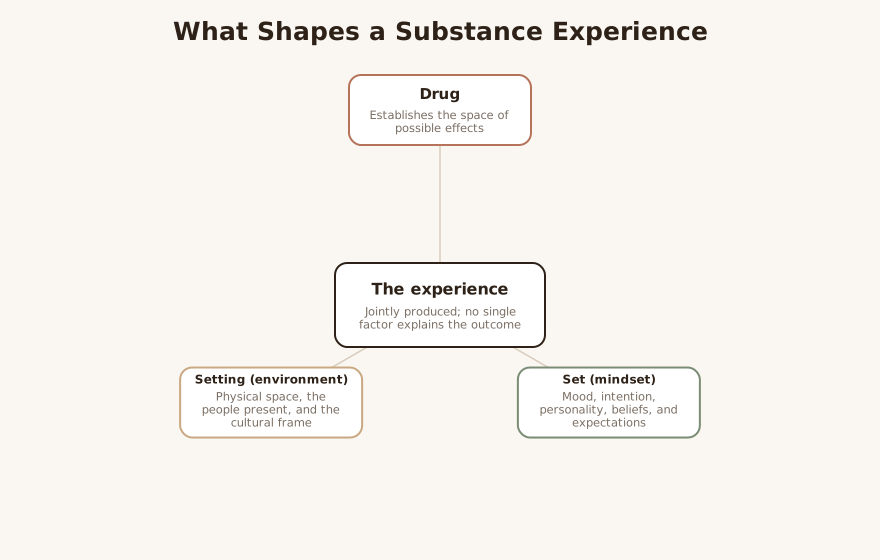
Set and setting is the principle that the effect of a psychoactive substance is determined not by its pharmacology alone but by two non-pharmacological factors: “set,” the mindset, intention, mood, and expectation a person brings to the experience, and “setting,” the physical, social, and cultural environment in which the substance is taken 4. The phrase compresses a deceptively large claim: that the same dose of the same drug can yield healing or terror, insight or panic, depending on conditions a clinician can actually shape 2. For therapists working in or adjacent to psychedelic-assisted treatment, it is the conceptual bridge between psychopharmacology and psychotherapy LLM.
Type & Discipline
Set and setting is a conceptual framework rather than a treatment modality in its own right LLM. It originates at the intersection of psychopharmacology and the anthropology of altered states, and it now functions as an organizing principle across the broader field of psychedelic science 2. The framework holds that pharmacological action and non-pharmacological context are inseparable contributors to a drug experience, such that the substance supplies a range of possible effects while set and setting select which of those possibilities are actualized 2. Because it is a principle rather than a protocol, it does not stand alone clinically; it is operationalized inside a therapeutic intervention, most prominently within psychedelic-assisted psychotherapy and its preparation–dosing–integration structure LLM. Understood this way, set and setting is less a thing a clinician does than a lens through which every element of a session — the room, the music, the relationship, the patient’s expectations — becomes a clinically active variable LLM.
Creators & Lineage
The phrase “set and setting” was popularized in the early 1960s by the Harvard psychologist Timothy Leary and his collaborators, who used it to describe the conditions governing psychedelic experience 3. The concept was given its most rigorous and enduring articulation by the psychiatrist Norman Zinberg, whose 1984 book Drug, Set, and Setting added a third term — “drug” — and argued that controlled, non-compulsive intoxicant use is best understood as the product of the interaction among all three 1. Zinberg’s central contribution was to show, through study of users in natural settings, that social rituals and sanctions — informal rules about how, when, where, and with whom a substance is used — function as the practical mechanism by which setting exerts control over drug effects and protects against harm 1. The historian Ido Hartogsohn later traced the genealogy of the idea across the twentieth century, showing that recognition of non-pharmacological influence long predates the 1960s coinage and recurs throughout the history of drug research 2. The lineage of the concept is therefore broad: it informs and is informed by psychedelic-assisted psychotherapy, the literature on expectancy effects, the centrality of the therapeutic alliance, and the transpersonal-psychology tradition that takes meaning and context seriously as agents of change 2.
Core Principles
The first principle is interactionism: drug, set, and setting jointly produce an experience, and no single factor is sufficient to explain the outcome 1. The drug establishes a space of possible effects, but which effects emerge is shaped by the person’s psychological state and their surroundings 2. The second principle is that “set” is itself layered, encompassing immediate mood and intention as well as more durable factors such as personality, prior experience, beliefs about the drug, and the expectations a person holds about what will happen 2. The third principle is that “setting” likewise operates at multiple scales, from the immediate physical environment (lighting, music, comfort, safety) to the interpersonal field (who is present and the quality of those relationships) to the broad cultural frame that assigns meaning to the substance and the act of taking it 2. A fourth principle, central to Zinberg’s account, is that informal social controls — rituals and sanctions — are the concrete vehicles through which setting regulates use and reduces the likelihood of adverse outcomes 1. Finally, the framework asserts that because these contextual factors are partly under deliberate control, they can be intentionally optimized to make beneficial experiences more likely and difficult ones less so 5.
Interventions & Techniques
Although set and setting is a principle rather than a technique, it translates into concrete clinical practices LLM. On the “set” side, preparation work aims to clarify intention, build trust, address fears, and shape realistic expectations before any substance is taken, since expectancy is one of the most malleable components of set 2. Psychoeducation and rapport-building reduce anticipatory anxiety and help the patient enter the experience with a stable, prepared frame of mind 5. On the “setting” side, practitioners deliberately engineer the environment: a comfortable, safe, and aesthetically calming space; curated music; the reassuring continuous presence of trusted guides; and removal of disruptive or threatening stimuli 5. Eyeshades and inward-directed music, for example, are environmental choices intended to support an internal focus during a dosing session 5. Zinberg’s framework adds a further, often overlooked technique: cultivating explicit rituals and shared norms around the experience, which give structure and meaning and thereby exert protective control 1. Across all of these, the integration phase that follows the experience can itself be read as a “setting” extended in time, a supportive context in which meaning is consolidated LLM.
Evidence Base
The maturity of the evidence here is best described as established at the level of principle and unsettled at the level of mechanism LLM. That non-pharmacological factors substantially shape drug experiences is one of the most durable and widely accepted ideas in the field, supported by Zinberg’s foundational empirical work on controlled use and by Hartogsohn’s historical demonstration that the same recognition recurs across a century of drug research 12. In this sense the framework is not a tentative hypothesis but a settled organizing assumption of psychedelic science 2. What remains genuinely difficult is the experimental task of isolating and quantifying the separate contributions of set, setting, and drug, precisely because the three interact and cannot be cleanly disentangled or independently randomized in human studies 2. Hartogsohn argues that this entanglement is not a temporary methodological gap but a structural feature: drug effects are in part constructed by context, so attempts to study a “pure” pharmacological effect are studying an abstraction that does not exist in lived use 2. Clinicians should therefore present set and setting as well-validated in its broad claim while being candid that precise dose–response-style statements about, say, how much of an outcome is attributable to setting versus molecule are not available LLM. The framework’s strength is conceptual and explanatory rather than derived from a body of randomized trials manipulating context as an isolated variable 2.
Populations & Indications
Set and setting is relevant to any population in which a psychoactive substance or intense altered state is involved, and it is most actively applied within psychedelic-assisted therapy LLM. The populations most often discussed include patients in psychedelic-assisted treatment for treatment-resistant depression, trauma survivors, individuals with substance use disorders, and terminally ill patients facing end-of-life anxiety, all of whom undergo experiences whose outcome the framework predicts will be shaped by mindset and environment 5. Zinberg’s original work extends the principle beyond the clinic to non-clinical, controlled recreational and ritual use, where social setting determines whether use remains stable and non-harmful 1. Beyond psychedelics specifically, the framework’s logic applies broadly to intoxicants in general, since Zinberg developed it to explain controlled use across substance classes 1. The indication, in clinical terms, is essentially universal within altered-state work: whenever a clinician can influence a patient’s preparation or environment, the framework indicates that doing so deliberately is part of competent practice LLM.
Problems-for-Work
The problems for which set and setting is most clinically salient are those addressed within psychedelic-assisted and substance-use contexts LLM. For treatment-resistant depression, the framework guides preparation and environment so that a dosing experience is more likely to yield a beneficial than a destabilizing trajectory 5. For end-of-life anxiety and existential distress, attention to a safe, meaningful setting and a prepared mindset supports a patient’s capacity to confront mortality within a supported state 5. For substance use disorders, Zinberg’s analysis of rituals and sanctions offers a direct lens on how the social setting of use can either entrench compulsive patterns or support controlled, lower-harm use 1. The framework is also the primary tool for understanding and reducing adverse drug reactions and difficult psychedelic experiences: because challenging experiences are strongly conditioned by an unstable mindset or a chaotic, unsafe environment, optimizing both is the principal preventive lever available 5.
LLM-generated illustrative example (not a guideline): A patient preparing for an investigational psilocybin session reports high anticipatory anxiety after reading frightening online accounts. The clinician works on “set” by addressing those expectations, normalizing fear, and clarifying intention, and on “setting” by walking the patient through the room, the music, and the continuous presence of two guides — measures aimed at making a difficult experience less likely LLM.
Contraindications, Cautions & Cultural Humility
As a principle rather than an intervention, set and setting has no contraindications of its own, but its application carries important cautions LLM. The most significant is that the framework can be misread as a guarantee: optimizing context reduces but does not eliminate the possibility of a difficult or adverse experience, and overconfidence in a “perfect” setting can lead to inadequate safety planning 5. A second caution is that the heightened suggestibility of altered states means that whatever the clinician builds into the set and setting — including their own beliefs, expectations, and framing — can be powerfully transmitted to the patient, which raises real risks of subtle coercion or the imposition of the clinician’s worldview 2. Cultural humility is intrinsic to the concept rather than an add-on: because “setting” explicitly includes the cultural frame that assigns meaning to a substance, the framework itself insists that meaning is culturally variable and must not be assumed 2. Hartogsohn’s history shows that the dominant cultural narrative of an era materially changes what drug experiences are like, which obligates clinicians to attend to a patient’s own cultural and spiritual frame rather than a generic template 2. Practitioners should also remember that the rituals and sanctions Zinberg identified as protective are community-specific, and importing a clinician’s preferred ritual may not carry the same meaning or protective force for a given patient 1.
Treatment-Plan Suggestions & SMART Objectives
The objectives below are illustrative and assume application within a lawful, structured therapeutic intervention LLM.
| Goal | SMART objective (example) | Mechanism |
|---|---|---|
| Stabilize “set” before an altered-state experience | Across 3 preparation sessions, patient articulates a clear intention and rates anticipatory anxiety as reduced on a 0–10 scale | Mindset and expectation shaping experience outcome 2 |
| Establish a safe, supportive “setting” | Patient and clinician finalize a written environment plan (space, music, supports present) before any session | Physical and social environment regulating effects 5 |
| Reduce likelihood of a difficult experience | Patient reports feeling prepared and safe on a structured pre-session checklist, with all flagged concerns addressed | Optimized context lowering adverse-experience risk 5 |
| Build protective ritual and norms around use | Patient identifies and adopts 2 personal rituals or guidelines structuring the experience | Social rituals and sanctions exerting control 1 |
| Strengthen meaning-making through context | Across integration, patient connects the experience to their own cultural or spiritual frame in 2 sessions | Cultural setting assigning meaning 2 |
| Address unhelpful expectations | Patient revises one inaccurate belief about the substance during preparation, verified by teach-back | Expectancy as a malleable component of set 2 |
| Support controlled use in a substance-use context | Patient maps the social settings that drive versus protect against compulsive use within 4 weeks | Setting and informal social controls over use 1 |
Common Misconceptions
A frequent misconception is that set and setting is a soft or secondary concern compared with the “real” pharmacology; the framework’s whole point is that context is a primary determinant of outcome, not a garnish 2. A second is that “setting” means only the physical room, when it equally encompasses the interpersonal field and the broad cultural frame in which an experience is embedded 2. A third is that the phrase originated as a 1960s slogan with little substance; in fact Zinberg developed it into a rigorous, evidence-grounded account of how controlled use is achieved and maintained 1. A fourth misconception is that a well-managed set and setting guarantees a good experience, whereas it shifts probabilities rather than removing risk 5. Finally, some treat the principle as specific to psychedelics, when Zinberg formulated it to explain intoxicant use across substance classes 1.
Training & Certification
There is no certification in “set and setting” as such, because it is a foundational concept embedded within broader training rather than a standalone credential LLM. Clinicians encounter it as core content in psychedelic-assisted therapy training programs and in substance-use professional education, where it is presented as a basic organizing principle 4. The ISSUP glossary, for instance, treats drug, set, and setting as fundamental vocabulary for substance-use professionals, indicating its status as entry-level conceptual knowledge in that workforce 4. Competence in applying the principle is therefore developed within the preparation, support, and integration competencies of whatever lawful intervention a clinician is trained in, and through familiarity with Zinberg’s primary account and the historical scholarship that situates it 12. Reading the original sources rather than relying on the slogan is itself part of responsible training LLM.
Key Terms
- Set — the internal dimension: the user’s mindset, mood, intention, personality, beliefs, and expectations entering the experience 2.
- Setting — the external dimension: the physical, social, and cultural environment in which a substance is taken 4.
- Drug — in Zinberg’s expanded model, the pharmacological agent itself, the third interacting factor alongside set and setting 1.
- Rituals and sanctions — informal social rules governing how, when, where, and with whom a substance is used, the practical mechanism by which setting exerts control 1.
- Expectancy — beliefs about what a drug will do, a particularly malleable component of set that shapes outcomes 2.
- Controlled use — non-compulsive, stable use that Zinberg argued is made possible by the interaction of drug, set, and setting 1.
Resources & Further Reading
▶ Watch — a video introduction to this concept:
- Zinberg NE. Drug, Set, and Setting: The Basis for Controlled Intoxicant Use (1984)
- Hartogsohn I. Constructing drug effects: A history of set and setting (2017)
- Set and setting — Wikipedia
- Drug, set and setting — ISSUP glossary
- What does ‘set and setting’ mean when using psychedelics? — Healing Maps
Reflective / Supervision Questions
- How do I distinguish, in my own practice, between optimizing a patient’s set and setting and inadvertently imposing my own expectations onto a highly suggestible person? 2
- When I prepare a patient’s “setting,” whose rituals and cultural meanings am I drawing on, and do they actually fit this patient’s frame rather than mine? 1
- How do I communicate that a well-managed set and setting lowers but does not eliminate the risk of a difficult experience, without either alarming or falsely reassuring the patient? 5
- Where in my current work with altered states or intense affect am I treating context as background rather than as a clinically active variable I can shape? LLM
- Given that set, setting, and drug cannot be cleanly separated, how do I stay honest with patients about what is known versus what is assumed when I explain why preparation and environment matter? 2