
Type & Discipline
Inner Healing Intelligence (IHI) is a clinical construct rather than a stand-alone modality: it names the premise that the psyche possesses an innate, self-organizing drive toward healing that emerges when habitual defenses relax, particularly within the non-ordinary states of consciousness occasioned by psychedelics 1. It sits within the discipline of transpersonal and psychedelic psychotherapy and belongs to the broader family of psychedelic-assisted therapy 5. The construct functions less as a testable mechanism and more as an organizing attitude that shapes how a therapist positions themselves relative to the client’s process 3. In its most influential operationalization, it underwrites a deliberately non-directive stance in which the therapeutic content and direction are informed primarily by the participant rather than steered by the clinician 2. As such it is best understood as a clinical philosophy or working assumption that travels across several psychedelic and somatic modalities, not as an intervention with its own independent evidence base LLM.
Creators & Lineage
The intellectual root of the construct is usually traced to the psychiatrist Stanislav Grof, a Czech-born American figure born in 1931 who became a principal developer of transpersonal psychology and a pioneer of research into non-ordinary states of consciousness for psychological healing and self-exploration 5. Grof framed the psyche through a “holotropic” principle — a movement toward wholeness — describing it as a self-organizing system that, given space and support, spontaneously brings forth the material most relevant for healing 6. His drug-free method, Holotropic Breathwork, combining accelerated breathing, evocative music, and bodywork, was built on the same trust that the organism knows what to surface and in what order 5. The construct is therefore an heir to both his early LSD work and the transpersonal tradition more broadly 5.
The phrase “inner healing intelligence” entered contemporary clinical usage chiefly through the Multidisciplinary Association for Psychedelic Studies (MAPS) treatment manual for MDMA-assisted psychotherapy, associated with Michael Mithoefer, where it became the conceptual backbone of the therapeutic stance 3. Adjacent lineages reinforce the same intuition: Internal Family Systems with its trust in an undamaged “Self,” and Carl Rogers’ actualizing tendency, which the construct can be read as metaphorically encapsulating — though proponents distinguish IHI’s sometimes spiritual framing from Rogers’ strictly psychological one 3. The EMDR adaptive information processing model, which holds that the brain naturally moves toward integrating experience into adaptive networks, is invoked in similar spirit 6.
Core Principles
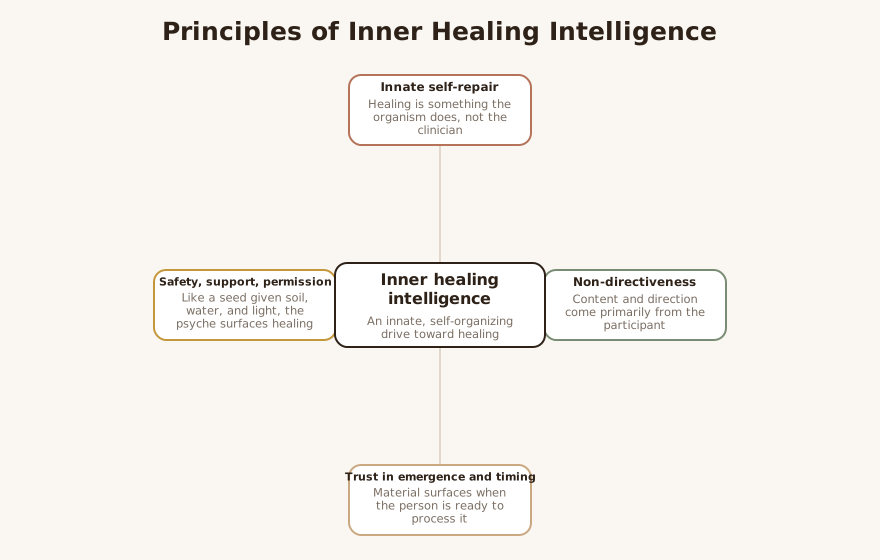
The first principle is innate self-repair: healing is something the organism does, not something the clinician imposes, analogous to the body’s capacity to close a wound or to immunotherapy that removes blocks to the body’s own defenses 13. Mithoefer’s framing is that the therapist is “just stimulating and removing blocks to the person’s own capacity to heal” 3. The seed-and-greenhouse metaphor recurs across the literature: just as a seed sprouts when given soil, water, and light, the psyche surfaces healing material when given safety, support, and permission 26.
The second principle is non-directiveness: because the inner intelligence is presumed to know what to surface and when, the therapeutic content and direction are informed primarily by the participant 2. The third is trust in emergence and timing — the conviction that difficult emotions or memories arise when the person is ready to process them, so the clinician’s task is to allow rather than steer 3. A corollary, emphasized in the MDMA-assisted literature, is that an overly active therapist can inadvertently bypass or overpower the person’s own inner healing intelligence 2. Finally, the construct is explicitly synergistic with the pharmacology: the relaxation of defenses and the trust-enhancing properties of substances such as MDMA are thought to create conditions under which the inner intelligence can operate more freely 1.
Interventions & Techniques
In practice the construct is enacted less through discrete techniques than through therapist posture across the standard preparation–dosing–integration arc of psychedelic-assisted work 6. During non-ordinary states the clinician typically supports an inward focus and intervenes only as needed, following the participant’s lead rather than introducing an agenda 2. Preparation establishes safety, intention, and trust in the process; integration translates emergent material into lasting change through journaling, talk therapy, movement, and connection to nature 6.
A distinctive elaboration comes from the academic literature on trauma work, where the therapist’s stance is theorized as “witnessing.” In MDMA-assisted therapy for trauma, the proposed active ingredient is the survivor’s experience of being witnessed in dissociated material, made possible by the drug’s enhancement of trust together with the therapist’s conviction in the inner healing intelligence 1. The title formulation “My Bad, You Got This” captures the paradoxical posture: the therapist openly acknowledges their own limitations and failures while affirming the participant’s capacity to heal, which is held to parallel relational-psychoanalytic repair of dissociative enactments 1. Across these applications, the operative “intervention” is the disciplined restraint of the clinician — creating conditions and then surrendering control rather than forcing outcomes 6.
Evidence Base
The evidence base for Inner Healing Intelligence as a construct is emerging and, crucially, indirect; clinicians should frame it honestly as such LLM. There is no direct empirical test of the proposition that an innate healing intelligence exists or that invoking it causes improvement; what exists is the outcome literature for the modalities that adopt the stance, principally MDMA-assisted psychotherapy for trauma, from which the construct’s proponents reason backward 1. The flagship theoretical contribution is a 2025 paper by Lawrence Fischman in Frontiers in Psychology, which argues that MDMA-assisted therapy’s effect on trauma arises from synergy between the drug’s pharmacology and the participant’s inner healing intelligence, operationalized through witnessing — but the paper itself concedes the term is “rather mysterious-sounding” and offers a conceptual model rather than a controlled test 1.
The construct is also actively contested. Mithoefer himself concedes that the term involves “a little bit of an anthropomorphisation” and acknowledges that critics call it “pseudoscientific” and “an article of faith” 3. The scholar Neşe Devenot characterizes the MAPS approach as a form of “faith-based healing,” noting that therapists are instructed to trust that difficult emotions emerge at optimal times without empirical validation 3. A further concern is that psychedelics enhance suggestibility and meaning-making, so priming participants with “inner healer” language may help generate such experiences rather than reveal a pre-existing process 3. Lived experience cuts both ways: one trial participant who became suicidal reported, “I don’t know where my inner healer is,” finding the concept vague and unhelpful 3. The honest summary is that IHI is a clinically influential stance with a plausible mechanistic story and indirect outcome support, but it is not an established, falsified-and-survived mechanism, and its strongest proponents acknowledge as much LLM.
Populations & Indications
The construct is most developed in adults undergoing psychedelic-assisted therapy, where it functions as the default working philosophy of the treatment frame 1. Its clearest application is in people with posttraumatic stress disorder treated within MDMA-assisted psychotherapy, the population for which the witnessing and inner-healing-intelligence model was elaborated 1. By extension within the broader psychedelic-therapy field, the stance is applied to adults with treatment-resistant depression, major depressive disorder, anxiety, substance use disorders, and end-of-life or existential distress, though direct construct-specific evidence in these groups is thin and inherited from the modalities rather than from IHI per se 5. Populations frequently named in this field include veterans and others in trauma recovery, for whom the relational experience of being witnessed is held to be therapeutically central 1. More speculatively, the seed-and-greenhouse logic generalizes to demoralization and trauma-related symptoms wherever a clinician chooses to foreground the client’s own restorative capacity LLM.
Problems-for-Work
The problem most directly addressed by the construct is posttraumatic stress disorder, where the inner healing intelligence is invoked to explain how a survivor can approach and integrate dissociated material once defenses relax and they feel witnessed 1.
LLM-generated illustrative example (not a guideline): A veteran with combat-related PTSD, within a sanctioned MDMA-assisted protocol, reaches a memory they have avoided for years; rather than interpreting or redirecting, the therapist holds steady, names that the client seems to know where they need to go, and lets the material unfold at the client’s pace until it can be integrated in later sessions LLM.
For trauma-related symptoms more broadly, the construct reframes the clinician’s job as removing blocks to an existing drive rather than installing new content 3. For existential and end-of-life distress, demoralization, and major depressive disorder, the same non-directive trust is extended on the rationale that the psyche will surface what most needs attention if given safety and permission — though here the application is hypothesis-generating rather than established 6. For substance use disorders and anxiety, the construct is borrowed from the surrounding psychedelic-therapy field rather than supported by IHI-specific data 5.
Contraindications, Cautions & Cultural Humility
The most serious caution is iatrogenic: a vague or absolute reliance on the construct can lead clinicians to disregard standard protocols, to under-respond to or reframe genuine adverse events as “healing work,” or to gaslight a distressed client by redefining their suffering as productive inner healing 3. The ‘Mel’ example — a suicidal participant who could not locate any “inner healer” — illustrates how the framing can fail, and even harm, when imposed on someone in acute crisis 3. Because psychedelics heighten suggestibility, the construct’s language can shape experience rather than simply describe it, which raises the stakes for careful, non-leading communication 3. A purely non-directive stance is therefore not a license for therapist passivity: active safety management remains essential, and an overly active therapist and an overly passive one are both failure modes 2.
Cultural humility is integral rather than ornamental here. The construct often carries spiritual framing — “Spirit, truth, unity,” an “inner champion” — and proponents themselves distinguish this from a strictly psychological reading 23. Clinicians should neither impose a spiritual interpretation on clients who do not hold one nor dismiss the meaning clients make in non-ordinary states, and should hold the anthropomorphizing metaphor lightly and transparently 3. Honest disclosure of the construct’s contested, faith-adjacent status is itself an ethical obligation LLM. Standard psychedelic-therapy exclusions and medical screening governing the underlying modalities continue to apply and are not relaxed by adopting this stance LLM.
Treatment-Plan Suggestions & SMART Objectives
The objectives below are illustrative and assume a sanctioned psychedelic-assisted context in which the construct is being used as a clinical stance LLM.
| Goal | SMART objective (example) | Mechanism |
|---|---|---|
| Build trust before non-ordinary-state work | Complete at least three preparation sessions establishing safety, intention, and rapport prior to any dosing | Therapeutic alliance and felt safety as preconditions for emergence |
| Support a non-directive processing stance | Across two dosing sessions, clinician documents following the participant’s lead with minimal redirection on at least 80% of process points | Trust that the inner intelligence surfaces relevant material |
| Strengthen the experience of being witnessed | Client reports, in integration, feeling witnessed in at least one previously dissociated memory by 1-month review | Witnessing repairs dissociative enactment in trauma |
| Integrate emergent material | Client completes structured integration practice (journaling or movement) after each session, reviewed across two follow-ups | Translation of insight into durable change |
| Protect against reframing of distress | Zero adverse events reframed as “healing”; all distress and safety concerns documented and addressed per protocol | Guards against iatrogenic harm from over-trusting the construct |
| Calibrate clinician activity level | Supervisor confirms balanced stance — neither overpowering nor passively withdrawn — across reviewed sessions | Avoids both bypassing and abandonment failure modes |
| Reduce posttraumatic symptom burden | Achieve a clinically meaningful reduction on a validated PTSD measure by post-treatment assessment | Defenses relax, enabling approach and integration of trauma |
Common Misconceptions
A first misconception is that inner healing intelligence is an established neurobiological mechanism; it is a clinical construct and working premise, indirectly supported and openly contested, not a tested causal mechanism 3. A second is that non-directiveness means the therapist does nothing — in fact, active safety management is required throughout, and pure passivity is itself a recognized failure mode 2. A third is that any difficult or adverse experience must be the healing intelligence at work; this reframing is precisely the harm vector critics warn against, and distress must be assessed on its own terms 3. A fourth is that the construct is uniquely psychedelic — its roots in Grof’s transpersonal psychology, Rogers’ actualizing tendency, and EMDR’s adaptive information processing show it is a much older intuition about self-righting capacity 36. Finally, some treat the term as purely literal; even its proponents acknowledge it involves anthropomorphization and should be held with epistemic humility 3.
Training & Certification
There is no free-standing certification in Inner Healing Intelligence, because it is a stance embedded within larger modalities rather than a discrete technique LLM. In practice the relevant competencies are acquired through training in the psychedelic-assisted therapies that adopt it — most prominently the MDMA-assisted psychotherapy framework associated with MAPS and Michael Mithoefer, whose manual operationalizes the construct 3. The experiential lineage of Grof’s transpersonal work and Holotropic Breathwork represents another pathway through which clinicians learn to trust non-ordinary-state emergence 5. Adjacent trainings in Internal Family Systems and in EMDR cultivate the same underlying disposition toward the client’s intrinsic capacity for repair, even outside psychedelic contexts 36. Clinicians should pursue these competencies only within sanctioned, supervised frameworks rather than informal routes LLM.
Key Terms
Inner healing intelligence (IHI) — the premise that the psyche has an innate, self-organizing drive toward wholeness that surfaces healing material when defenses relax and conditions of safety are met 12. Holotropic principle — Grof’s framing of the psyche as oriented toward wholeness and capable of spontaneously generating the material relevant to healing 6. Non-directive stance — a therapeutic posture in which content and direction are led primarily by the participant rather than the clinician 2. Witnessing — the therapist’s stance of acknowledging their own limitations while affirming and bearing witness to the client’s dissociated experience, theorized as the active ingredient in MDMA-assisted trauma work 1. Set and setting — the participant’s mindset and the physical, social, and cultural environment that jointly shape a non-ordinary-state experience 6. Integration — post-session work translating emergent insight into durable life change 6.
Resources & Further Reading
▶ Watch — a video introduction to this concept:
- Fischman, L. (2025). My Bad, You Got This: witnessing, therapist attitude and the synergy between psychedelics and inner healing intelligence — Frontiers in Psychology (PMC)
- Fischman, L. (2025). My Bad, You Got This — PubMed record
- Clare, S. (2018). Cultivating Inner Growth: The Inner Healing Intelligence in MDMA-Assisted Psychotherapy — MAPS Bulletin, Winter 2018
- Woolfe, S. (2024). What Exactly is ‘Inner Healing Intelligence’?
- Stanislav Grof — Wikipedia
- Trusting the Inner Healing Intelligence — Ceremonia
Reflective / Supervision Questions
- How would you describe the contested, faith-adjacent status of inner healing intelligence to a client drawn to it, without either over-selling or dismissing it LLM?
- When a client in a heightened, suggestible state experiences acute distress, what concrete criteria distinguish “material to be allowed” from an adverse event requiring active intervention LLM?
- How would you notice in yourself the two opposite failure modes — overpowering the client’s process versus withdrawing into passivity — and recalibrate LLM?
- Given that the construct can be used to reframe suffering as healing, what safeguards would you build into your documentation and supervision to prevent that misuse LLM?
- How do your own spiritual or secular commitments shape the meaning you might unconsciously impose on a client’s non-ordinary-state experience LLM?