
Type & Discipline
Harm Reduction Psychotherapy is a modality within psychotherapy, situated in the family of addiction treatments LLM. Its formalized expression, Integrative Harm Reduction Psychotherapy (IHRP), is described by its originator as a model that “integrates a strategic skills-building focus with an exploration of the multiple meanings of substance use and the importance of the therapeutic alliance” 1. It is integrative rather than single-school: it draws together psychodynamic exploration, motivational methods, and cognitive-behavioral and relapse-prevention skills under a harm-reduction philosophy 1. The defining feature for the practicing clinician is that abstinence is not a precondition of treatment; any change that reduces substance-related harm is regarded as clinically valuable 1.
This places the modality in deliberate contrast to abstinence-only frameworks LLM. Where traditional substance use treatment often requires a commitment to stop using as the entry fee for care, harm reduction meets people “where they are” and works with the goals the client actually holds 7. The approach is correspondingly broad in reach, intended to engage people who would otherwise be excluded from, or drop out of, conventional programs 1.
Creators & Lineage
The model is most closely associated with Andrew Tatarsky, a clinical psychologist who developed and named Integrative Harm Reduction Psychotherapy and authored the foundational article extending harm reduction into the psychotherapy office 1. Tatarsky is credited as the creator of IHRP and has been a central organizer of harm-reduction psychotherapy training and writing 5. He edited the early field-defining volume Harm Reduction Psychotherapy: A New Treatment for Drug and Alcohol Problems, which brought together clinicians articulating this stance 3.
Patt Denning is a co-developer of the broader harm reduction therapy tradition, and Jeannie Little is closely associated with its group and community applications LLM. The intellectual lineage also runs through G. Alan Marlatt, whose relapse-prevention work supplied much of the cognitive-behavioral skills architecture that harm reduction psychotherapy incorporates LLM. Tatarsky’s own account positions IHRP as a synthesis of these strands rather than an invention from nothing — a strategic, skills-oriented practice married to depth-oriented exploration of what substances mean to the person 1.
The model sits downstream of, and overlaps with, the wider public-health harm reduction movement that SAMHSA has since formalized into a national framework 4. SAMHSA’s articulation — empowering people who use drugs to “live healthy, self-directed, and purpose-filled lives” — names the same values that Tatarsky brought into individual psychotherapy 7.
Core Principles
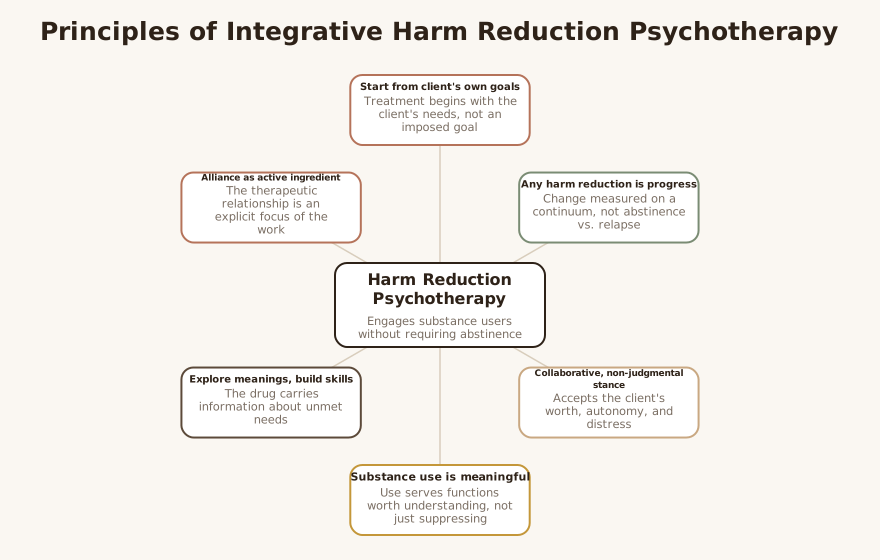
The first principle is that treatment starts from the client’s own needs and personal goals rather than from a goal the system imposes 1. From this follows the second: all change that reduces the harms associated with substance use can be regarded as valuable, so progress is measured on a continuum rather than as abstinence-versus-relapse 1. The clinical posture is collaborative and non-judgmental, accepting the client’s inherent worth and autonomy and showing compassion for their distress 7.
A third, distinctively psychotherapeutic principle is that substance use is meaningful — it serves functions for the person, and those functions are worth understanding rather than simply suppressing 1. IHRP therefore explores the multiple meanings of use alongside building concrete skills, treating the drug as carrying information about the person’s unmet needs 1. The therapeutic alliance is treated not as a backdrop but as an active ingredient and explicit focus of the work 1.
LLM-generated illustrative example (not a guideline): A client says nightly drinking is “the only thing that turns my head off.” Rather than challenging the drinking immediately, the clinician treats this as data about an unmet need for relief from hyperarousal, and works with the client on what the alcohol is doing for them before negotiating any change. LLM
Autonomy is foundational: the client retains the right to define goals, including goals other than abstinence, such as reducing use or improving quality of life 7. SAMHSA’s framing reinforces this — harm reduction respects client choice and is meant to empower people and their families 7.
Interventions & Techniques
In practice the clinician begins by meeting the client where they are and building trust as the precondition for any change work 7. Motivational interviewing is a core technique: a person-centered method for resolving ambivalence that enhances intrinsic motivation and uses the OARS skills — open questions, affirmations, reflective listening, and summarization 7. The stance is explicitly non-confrontational; the clinician avoids dismissiveness and the kind of confrontation that ruptures engagement 7.
Goal-setting is negotiated rather than prescribed. Clients are helped to identify goals related to reducing substance-related harm or improving quality of life, which may or may not include abstinence 7. Alongside this motivational and relational work, IHRP layers in a strategic, skills-building focus — the cognitive-behavioral and relapse-prevention component — so that clients gain concrete tools for managing high-risk situations 1. Running underneath both is the depth-oriented exploration of what the substance means and what needs it meets 1.
LLM-generated illustrative example (not a guideline): A clinician and a client who uses stimulants to function at work might map the specific situations that drive use, build a coping plan for the highest-risk windows, and simultaneously explore the longer-standing fear of being “not enough” that the stimulant temporarily silences. LLM
The therapeutic relationship itself is used as an intervention, with attention to alliance ruptures and repairs, because the alliance is held to be a primary vehicle of change in this model 1. Trauma-informed language is used to avoid retraumatization, particularly given how often trauma co-occurs with substance use 7.
Evidence Base
The evidence base for harm reduction psychotherapy should be characterized honestly as established in the sense of being a recognized, professionally codified approach with a clear theoretical model and a peer-reviewed clinical literature, rather than as a modality with a large randomized-controlled-trial base of its own LLM. Tatarsky’s foundational paper laid out the model and its rationale in the Journal of Substance Abuse Treatment, and the model has been illustrated in published case work, including a detailed account of treatment with a client presenting substance use, multiple trauma, and suicidality 12.
Much of the empirical support is borrowed from the component approaches it integrates — motivational interviewing and relapse-prevention methods carry their own substantial evidence in addiction care, and SAMHSA’s counseling guidance presents these as effective across diverse populations 7. The broader harm-reduction strategy now carries the institutional endorsement of SAMHSA’s national framework 4. Clinicians should be candid with referrers that IHRP’s strength is conceptual coherence and engagement of hard-to-reach clients, and that head-to-head outcome trials of the integrated package specifically are limited LLM.
Populations & Indications
The model was explicitly designed to extend the reach of treatment to people not served by abstinence-only care — those who are ambivalent, not yet ready to stop, or who have disengaged from conventional programs 1. It is therefore indicated for clients across the spectrum of substance use, including those whose goals are reduction or safer use rather than abstinence 7. SAMHSA’s guidance notes that the underlying motivational methods are particularly useful across diverse groups, including adolescents, veterans, people in criminal-justice settings, and those with co-occurring disorders 7.
Co-occurring presentations are a natural fit. The published case literature demonstrates application with complex comorbidity — substance use entangled with multiple trauma and suicidality — where an abstinence ultimatum would likely have driven the client out of care 2. Trauma-survivors in particular benefit from the trauma-informed, non-confrontational stance the model insists on 7.
Problems-for-Work
The most direct problem-for-work is active substance use itself, approached without an abstinence requirement so that the client can engage at whatever stage of readiness they occupy 1. A second is ambivalence about change, which is the explicit target of the motivational interviewing component 7. A third is treatment disengagement and dropout — the model exists in large part to keep people in care who would otherwise be filtered out 1.
LLM-generated illustrative example (not a guideline): For a client who has been discharged from two programs for “non-compliance,” the problem-for-work might be framed as re-engagement in treatment, with early sessions focused entirely on rebuilding a workable alliance before any use-reduction target is set. LLM
Co-occurring trauma and co-occurring suicidality are frequent problems-for-work, addressed within the same relational, trauma-informed frame 27. Shame and harsh self-criticism around use are also apt targets, since the model’s non-judgmental stance is designed to lower the shame that often fuels concealment and risk 7.
Contraindications, Cautions & Cultural Humility
Harm reduction psychotherapy is not a license to ignore acute risk LLM. When a client presents with imminent danger — for example active suicidality or medically dangerous use — safety stabilization takes priority, and the published case work itself centers on managing suicidality within the treatment rather than minimizing it 2. The non-abstinence stance does not mean the clinician withholds clinical concern; it means goals are negotiated, not imposed 7.
A genuine caution is clinician readiness. The model asks the therapist to tolerate ongoing use, ambivalence, and slow incremental change without retreating into confrontation, which can activate countertransference LLM. SAMHSA’s guidance reminds clinicians working with trauma and substance use to monitor their own mental health, seek support, and engage in self-care to manage secondary traumatic stress 7.
Cultural humility is intrinsic rather than additive here LLM. The approach is described as culturally sensitive precisely because the clinician centers the client’s cultural context and distinctive perspective rather than a standardized goal 7. Practitioners should also locate their work within local legal and program realities, since what counts as a permissible harm-reduction goal can be constrained by setting and jurisdiction LLM.
Treatment-Plan Suggestions & SMART Objectives
| Goal | SMART objective (example) | Mechanism |
|---|---|---|
| Re-engage a disengaged client | Client will attend 4 of 4 scheduled sessions over the next month and collaboratively set one self-chosen focus | Alliance-building and meeting the client where they are 7 |
| Resolve ambivalence about change | Client will complete a decisional-balance exploration of use and name one reason for change in their own words within 3 sessions | Motivational interviewing / OARS 7 |
| Reduce use-related harm | Client will identify their two highest-risk use situations and implement one safer-use or coping strategy in each within 6 weeks | Relapse-prevention skills within a harm-reduction frame 1 |
| Understand the function of use | Client will articulate at least two needs the substance meets for them by session 6 | Exploration of the meanings of use 1 |
| Lower use-related shame | Client will report a measurable decrease in self-criticism about use on a brief weekly self-rating over 8 weeks | Non-judgmental, compassionate stance 7 |
| Stabilize co-occurring risk | Client will co-create and use a written safety plan and review it at each session during periods of elevated risk | Trauma-informed safety work 2 |
| Set a client-defined use goal | Client will specify a personally meaningful reduction or quality-of-life target and track it weekly | Autonomy and negotiated goal-setting 7 |
Common Misconceptions
The most common misconception is that harm reduction “enables” use or abandons the goal of recovery LLM. In fact the model treats every harm-reducing change as valuable progress and keeps clients in care who would otherwise be lost, which can be a pathway toward — not away from — reduced use 1. A second misconception is that it is permissive or directionless; the model is structured, pairing depth exploration with a strategic skills-building agenda 1.
A third is that harm reduction means “no goals” — when in reality goals are explicitly set, just by the client rather than for the client 7. A fourth is that it is only a public-health distribution program (syringes, naloxone) rather than a form of psychotherapy; the framework spans a continuum from public-health services to formal clinical treatment 4. Finally, some assume it ignores risk, when the published clinical work centers precisely on holding serious risk such as suicidality within the treatment 2.
Training & Certification
There is no single universal licensing credential required to practice harm reduction psychotherapy; it is practiced by licensed mental health clinicians who add this orientation to their core training LLM. Structured training in the model is offered through Tatarsky’s professional work and writings, with the edited foundational volume and his teaching serving as primary entry points 35. Clinicians typically build competence in the component methods — motivational interviewing and relapse prevention chief among them — as described in SAMHSA’s counseling guidance 7.
For practitioners new to the stance, Tatarsky’s introductory presentation offers an accessible orientation to the philosophy and clinical posture before deeper training 6. As with any modality, supervision and consultation are advisable while developing fluency, especially given the countertransference demands of tolerating ongoing use LLM.
Key Terms
Integrative Harm Reduction Psychotherapy (IHRP): Tatarsky’s formalized model integrating skills-building, exploration of the meanings of use, and the therapeutic alliance 1. Meeting the client where they are: engaging the person at their actual stage of readiness without requiring abstinence as a precondition 7. Continuum of change: the principle that any reduction in substance-related harm is valuable progress 1. Meanings of use: the adaptive functions a substance serves for the person, made an explicit object of inquiry 1. Motivational interviewing / OARS: the person-centered method and skill set (open questions, affirmations, reflective listening, summarization) for resolving ambivalence 7. Negotiated goals: client-defined targets, which may be reduction or quality-of-life goals rather than abstinence 7.
Resources & Further Reading
▶ Watch — a video introduction to this concept:
- Tatarsky A. Harm reduction psychotherapy: extending the reach of traditional substance use treatment (J Subst Abuse Treat, 2003)
- Tatarsky A. Integrative harm reduction psychotherapy: a case of substance use, multiple trauma, and suicidality (2010)
- Tatarsky A (ed.). Harm Reduction Psychotherapy: A New Treatment for Drug and Alcohol Problems (book)
- SAMHSA Harm Reduction Framework
- Andrew Tatarsky, PhD — IHRP creator (official site)
- Harm Reduction Psychotherapy: An Introduction — Dr. Andrew Tatarsky (YouTube)
- SAMHSA TIP, Chapter 3 — Counseling Approaches for Promoting Harm Reduction (NCBI Bookshelf)
Reflective / Supervision Questions
- When a client chooses a goal other than abstinence, where do I notice resistance in myself, and is that resistance clinical or personal? LLM
- How do I distinguish “meeting the client where they are” from avoiding a difficult conversation about serious risk? 2
- What functions does this particular client’s substance use serve, and have I actually explored them — or only assumed them? 1
- Am I using the alliance as an active instrument of change, or treating it merely as rapport? 1
- How am I monitoring my own secondary traumatic stress when working with trauma and substance use together? 7
- Whose definition of “progress” is operating in this treatment plan — the client’s, the system’s, or mine? 7