
Type & Discipline
Harm reduction is not a single therapy but a philosophy and clinical stance rooted in public health, social justice, and addiction services. The National Harm Reduction Coalition defines it as “a set of practical strategies and ideas aimed at reducing negative consequences associated with drug use,” and equally as “a movement for social justice built on a belief in, and respect for, the rights of people who use drugs.” 1 SAMHSA frames it as an evidence-based, “practical and transformative” set of public-health strategies that empower people who use drugs and prioritize meeting people where they are without requiring abstinence. 3 Because it is a stance rather than a branded modality, harm reduction is best understood as something a clinician brings to an intervention — it shapes goal-setting, language, and what counts as progress, and it can be layered onto motivational, cognitive-behavioral, and trauma-focused work alike. LLM
The discipline sits at the intersection of public health and direct clinical care. Its measures of success are explicitly defined in terms of “quality of individual and community life and well-being” rather than necessarily abstinence, which distinguishes it sharply from the abstinence-only paradigms that dominated twentieth-century U.S. addiction treatment. 1 For practicing therapists, this means a client who reduces injection frequency, switches to a safer route, or simply stays alive and engaged is making clinically meaningful progress — not failing treatment. LLM
Creators & Lineage
Harm reduction as an organized practice emerged in the 1980s. One of the earliest formal frameworks was the Mersey Harm Reduction Model in Liverpool, England, which used outreach workers, education, and distribution of clean injecting equipment, and is credited with helping prevent a local HIV epidemic. 5 This British “Mersey model” became a template that influenced practice internationally, including in the United States. 5
In the United States, David Purchase is honored as a central figure in the harm reduction movement; the Harm Reduction Journal maintains a research archive dedicated to him, reflecting his standing in U.S. harm reduction history. 6 The American story is one of grassroots activism — often driven by people who use drugs and their advocates during the HIV/AIDS crisis — converging with public-health research over the following decades. 6
Within psychotherapy specifically, the lineage runs through clinicians who translated the public-health philosophy into office-based clinical practice. G. Alan Marlatt is associated with the relapse-prevention tradition and with applying harm-reduction principles to addictive behaviors, while Patt Denning and Jeannie Little are associated with the development of harm-reduction psychotherapy as a clinical approach. LLM These clinicians extended the stance from syringe-service settings into the consulting room, where the unit of work is the therapeutic relationship rather than a distribution program. LLM
Core Principles
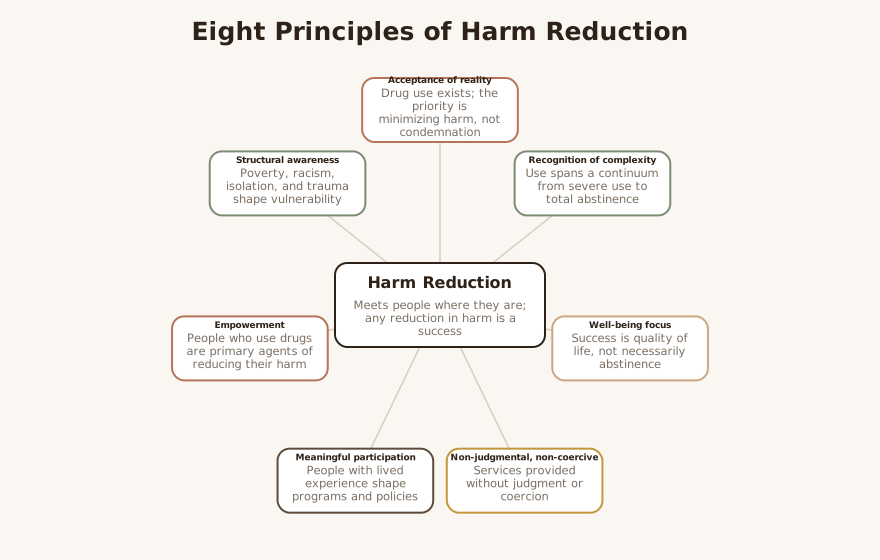
The National Harm Reduction Coalition articulates eight central principles, which together form the operational backbone of the stance: 1
- Acceptance of reality — drug use exists; the priority is minimizing harm rather than condemnation. 1
- Recognition of complexity — use spans a continuum “from severe use to total abstinence.” 1
- Well-being focus — success is measured by quality of life and well-being, not necessarily abstinence. 1
- Non-judgmental, non-coercive services — resources are provided without judgment or coercion. 1
- Meaningful participation — people with lived experience have a real voice in the programs and policies that serve them. 1
- Empowerment — people who use drugs are recognized as the primary agents of reducing their own harms, and peer education is supported. 1
- Structural awareness — poverty, class, racism, social isolation, past trauma, and discrimination shape both vulnerability and the capacity to cope. 1
- Honest assessment of harm — the approach does not minimize the “real and tragic harm and danger” associated with drug use. 1
The Recovery Research Institute frames the same ethos around non-judgmental engagement, dignity and respect, opposition to stigma, recognition that behavior change is incremental, and individual empowerment as the primary agent of change. 4 For clinicians, principle 8 is worth underlining: harm reduction is not minimization. Holding both realities — that use is dangerous and that the person deserves non-judgmental care — is the discipline’s defining tension. LLM
Interventions & Techniques
At the service level, the canonical interventions are well defined. Syringe services programs distribute sterile equipment and provide referrals to treatment, medical care, and overdose education; the SAMHSA TIP notes participants are about five times more likely to enter substance use disorder treatment than non-participants. 3 Naloxone distribution with overdose education equips people to reverse opioid overdoses, which reverse respiratory depression within roughly two to eight minutes of administration. 5 Fentanyl and xylazine test strips, safer-injection education (handwashing, sterile equipment, wound care), sexual-health services including PrEP/PEP, and linkage to medication for opioid use disorder round out the toolkit. 3 Supervised consumption spaces — legally sanctioned facilities where people use under medical supervision — are an established international intervention; Vancouver’s Insite, North America’s longest-running site, recorded zero overdose fatalities in 2017 despite 2,151 overdoses occurring on-site. 4 Opioid agonist therapy (methadone, buprenorphine) and managed alcohol programs extend the same logic to pharmacology and alcohol dependence. 5
At the clinical/counseling level, the technique set is recognizably motivational. The SAMHSA TIP identifies client-driven goal setting (reducing use or harm rather than mandating abstinence), open-ended questioning, strengths-based reflections, affirmations, progress tracking, and collaborative barrier identification. 3 Motivational interviewing serves as “a critical tool” for developing harm-reduction goals, and the OARS skills — Open questions, Affirmations, Reflective listening, Summarization — apply directly, with attention to eliciting change talk (desire, ability, reasons, need, commitment). 3
LLM-generated illustrative example (not a guideline): A client who injects heroin daily is not ready to stop but agrees that “I don’t want to die in my apartment alone.” The clinician uses reflective listening to affirm this, co-creates a plan to keep naloxone on hand and never use alone, and links the client to a syringe service. Three of those four moves reduce mortality risk without touching the question of abstinence. LLM
Evidence Base
The evidence base is best described as established for core services and contested for some newer policy-level interventions. For the core services, the data are strong and consistent. Syringe access programs “substantially reduce the rate of HIV/AIDS transmission among people who inject drugs without actually increasing rates of drug use.” 4 Needle exchange has been associated with reductions in HIV incidence on the order of 33% in New Haven and 70% in New York City. 5 The economic case is favorable: one Australian study found syringe access generated a return of roughly $1.3 to $5.5 for every $1 invested. 4 And the treatment-linkage finding is robust — participants are about five times more likely to enter addiction treatment. 3
Where the evidence is more contested is at the level of newer drug-policy interventions such as safer-supply programs and decriminalization. Critics argue that some harm-reduction strategies “promote the false notion that there are safe or responsible ways to use drugs,” and a 2025 British Columbia study found that safer supply and decriminalization “were associated with an increase in opioid overdose hospitalizations.” 5 Honest clinical practice means distinguishing the two tiers: the office-based stance and the core services rest on solid ground, while the population-level policy debate remains genuinely unsettled and politically charged. LLM SAMHSA’s 2023 Harm Reduction Framework is described as “the first document to comprehensively outline harm reduction and its role within the Department of Health and Human Services,” signaling federal-level institutionalization of the approach. 2
Populations & Indications
Harm reduction is indicated across a wide range of populations, and the SAMHSA TIP emphasizes effectiveness across diverse groups: adolescents, veterans, justice-involved individuals, and people with co-occurring mental disorders. 3 The most obvious population is people who inject or use drugs, for whom syringe access and overdose education directly address mortality and infection risk. 3 People with opioid use disorder are core indications given the availability of naloxone and agonist therapies. 3
The approach is especially apt for clients who are ambivalent about or not ready for abstinence, who have disengaged from abstinence-only programs, or who present with concurrent trauma. LLM The TIP notes that 46% of individuals with PTSD also have a substance use disorder, making trauma-informed harm reduction a natural fit for co-occurring presentations. 3 Safety planning for people engaged in survival economies, including sex work, is also named as a relevant application. 3 For marginalized populations experiencing historical or racial trauma, the structural-awareness principle makes harm reduction particularly well-suited to non-stigmatizing engagement. 3
Problems-for-Work
Overdose risk. For a client using opioids alone, the problem-for-work is fatal overdose; harm reduction addresses it through naloxone access, never-use-alone planning, and test strips, with the goal of survival rather than immediate cessation. 3
Injection-related infection. For a client sharing or reusing equipment, the problem is HIV/hepatitis transmission and soft-tissue infection; syringe services and safer-injection education directly reduce this. 4
Treatment ambivalence. For a client who has cycled through abstinence programs and disengaged, the problem-for-work is engagement itself; motivational interviewing within a harm-reduction frame keeps the person in care while readiness develops. 3
Continued high-risk use under trauma. For a client whose use is entangled with PTSD, pushing abstinence prematurely risks retraumatization; the problem-for-work becomes stabilizing safety and reducing risk while trauma work proceeds. 3
LLM-generated illustrative example (not a guideline): A veteran with PTSD drinks to sleep and has declined detox three times. Rather than re-prescribing abstinence, the clinician sets a harm-reduction objective — reducing nightly volume, eliminating driving after drinking, and pairing a sleep-hygiene plan with trauma-focused therapy — so risk falls while the therapeutic alliance survives. LLM
Contraindications, Cautions & Cultural Humility
Harm reduction has few absolute contraindications as a stance, but several cautions matter clinically. The SAMHSA TIP warns against confrontational language and against pushing detailed trauma disclosure, since both can retraumatize; counselors should minimize retraumatization risk through supportive environments. 3 Naloxone itself can precipitate acute withdrawal, so post-overdose linkage to medication-assisted treatment is essential. 3 A specific medical caution: harm-reduction messaging should never be allowed to obscure genuinely life-threatening situations requiring emergency care. LLM
Cultural humility is built into the philosophy rather than added on. The structural-awareness principle requires clinicians to consider how use connects to a client’s social environment, cultural context, and community identity, particularly for marginalized populations carrying historical or racial trauma. 3 1 Meaningful participation — ensuring people with lived experience shape the care they receive — is itself a corrective to clinician paternalism. 1 Clinicians should also be candid with clients that the broader policy environment is contested and that some interventions carry genuine debate, rather than overselling certainty. 5
Treatment-Plan Suggestions & SMART Objectives
| Goal | SMART objective (example) | Mechanism |
|---|---|---|
| Reduce overdose mortality | Client will carry naloxone and identify one never-use-alone strategy within 2 sessions | Overdose reversal access and reduced solitary-use risk 3 |
| Reduce infection risk | Client will use sterile equipment for 100% of injections and access a syringe service within 30 days | Sterile-equipment access reduces HIV/HCV transmission 4 |
| Increase treatment engagement | Client will attend 3 of 4 scheduled sessions over one month while abstinence remains optional | Motivational, non-coercive engagement sustains the alliance 3 |
| Reduce use-related harm | Client will reduce injection frequency from daily to ≤3×/week within 6 weeks | Incremental behavior change toward lower-risk use 4 |
| Build change talk | Client will articulate two personal reasons for change using OARS-elicited reflection by session 4 | Eliciting desire/reasons/need supports self-directed change 3 |
| Address co-occurring trauma | Client will pair a nightly safety plan with weekly trauma-informed sessions for 8 weeks | Stabilizes safety without premature abstinence demands 3 |
| Improve quality of life | Client will identify and act on one well-being goal (housing, employment, health) within 30 days | Well-being, not abstinence, as the success measure 1 |
Common Misconceptions
The most persistent misconception is that harm reduction enables or condones drug use. The Recovery Research Institute notes that critics incorrectly claim these strategies encourage use, but research does not support concerns that such programs increase substance use or crime in surrounding communities. 4 Syringe access in particular reduces HIV transmission “without actually increasing rates of drug use.” 4
A second misconception is that harm reduction is opposed to abstinence or to recovery. In fact the philosophy explicitly recognizes a continuum “from severe use to total abstinence,” so abstinence is one valid point on the spectrum rather than an excluded one. 1 A related confusion is treating harm reduction as identical to prevention; the Recovery Research Institute clarifies that most harm-reduction strategies fall “outside the purview of addiction prevention” because harm reduction accepts current use while working to minimize its harms. 4 Finally, some assume harm reduction minimizes danger — yet its own principles insist on honest acknowledgment of “real and tragic harm.” 1
Training & Certification
Harm reduction is a philosophy rather than a credentialed, single-track modality, so there is no one certifying body equivalent to a manualized therapy. LLM Practically, clinicians build competence by training in the techniques the approach draws on — motivational interviewing being the most directly applicable, per SAMHSA’s identification of MI as “a critical tool” for harm-reduction goal-setting. 3 SAMHSA’s Treatment Improvement Protocol on counseling approaches for promoting harm reduction is a primary practitioner-facing training resource. 3 Beyond clinical skills, competence requires familiarity with the core service interventions (syringe access, naloxone administration, test strips, treatment linkage) so clinicians can refer and coordinate effectively. 3 Organizations such as the National Harm Reduction Coalition disseminate the principles and practice standards that anchor the field. 1
Key Terms
- Meeting people where they are — engaging clients at their current readiness and circumstances rather than requiring abstinence as a precondition. 3
- Continuum of use — the recognition that drug use ranges from severe use to total abstinence, with reductions anywhere on the spectrum counting as progress. 1
- Syringe services program (SSP) — distributes sterile equipment and links participants to treatment and medical care. 3
- Naloxone — an opioid-overdose reversal agent that restores breathing within roughly two to eight minutes. 5
- Opioid agonist therapy (OAT) — methadone or buprenorphine used to reduce cravings without producing euphoria. 5
- Change talk — client language expressing desire, ability, reasons, need, or commitment to change. 3
- Protective behavioral strategies (PBS) — concrete tactics for limiting the consequences of substance use. 3
Resources & Further Reading
▶ Watch — a video introduction to this concept:
- Principles of Harm Reduction — National Harm Reduction Coalition
- SAMHSA’s Harm Reduction Framework (2023) — announcement
- Counseling Approaches for Promoting Harm Reduction — SAMHSA TIP (NCBI Bookshelf)
- Drug and Alcohol Harm Reduction — Recovery Research Institute
- Harm reduction — Wikipedia
- Harm reduction in the USA: research perspective and an archive to David Purchase — Harm Reduction Journal
Reflective / Supervision Questions
- When a client states an explicit goal that is not abstinence, how do I notice and manage my own urge to redirect toward cessation? LLM
- Which of my standard intake and progress-note language implicitly frames non-abstinence as failure, and how could I revise it to reflect a continuum of use? 1
- For a given client, can I name two harm-reduction objectives that would reduce mortality or infection risk this week, independent of their readiness to stop? 3
- How do I hold the dual reality that a client’s use is genuinely dangerous and that they deserve non-judgmental care, without collapsing into either minimization or moralizing? 1
- Where does the population-level policy evidence remain contested, and how do I communicate that uncertainty to clients honestly rather than overselling any single intervention? 5