
Type & Discipline
Internal Family Systems (IFS) is a model of psychotherapy and a theory of psychic structure within clinical psychology 6. It belongs to the parts-based, intrapsychic-systemic family of approaches, treating the mind as an internal system of interacting sub-personalities rather than a single unitary self 2. IFS is simultaneously a clinical method and a broader framework for understanding personality and relationships, and proponents describe it as extending beyond a single diagnostic technique into a way of understanding the person as a whole 7. For practicing therapists it is most usefully held as a transdiagnostic, experiential, relationally informed approach to working with inner conflict, protective behavior, and trauma-related material LLM.
Creators & Lineage
IFS was developed by Richard C. Schwartz, Ph.D., who is credited as the model’s creator and who founded the IFS Institute in Oak Park, Illinois, the organization that now trains and certifies practitioners 1. Schwartz currently holds an academic appointment as a Teaching Associate in Psychiatry at Cambridge Health Alliance, a Harvard Medical School affiliate, and has authored or co-authored numerous books and articles on the model, including No Bad Parts and the core clinical text Internal Family Systems Therapy 1. The second edition of that text, written with Martha Sweezy, is the standard contemporary reference for the model’s theory and technique 8.
Schwartz trained as a family systems therapist, and IFS is best understood as an application of systems thinking to the internal world: one of its foundational assumptions is that the internal system of parts operates according to the same systemic principles described in family therapy, and that internal and external systems mutually influence one another 2. This lineage connects IFS to family systems therapy and to the broader tradition of parts work and ego-state therapy, while its emphasis on protective structures defending against unbearable affect echoes psychodynamic ideas about defense LLM. What distinguishes IFS within this lineage is its explicit, non-pathologizing claim that the personality normally and healthily subdivides into parts, each with a positive intention 2.
Core Principles
IFS rests on a small set of stated assumptions: the mind naturally subdivides into parts; everyone possesses a Self capable of leadership; all parts have positive, non-extreme intentions even when their behavior is destructive; the internal system operates according to systems theory; and internal and external systems influence each other reciprocally 2. The clinically pivotal claim is that there are “no bad parts” — only parts forced into extreme protective roles by life experience 2.
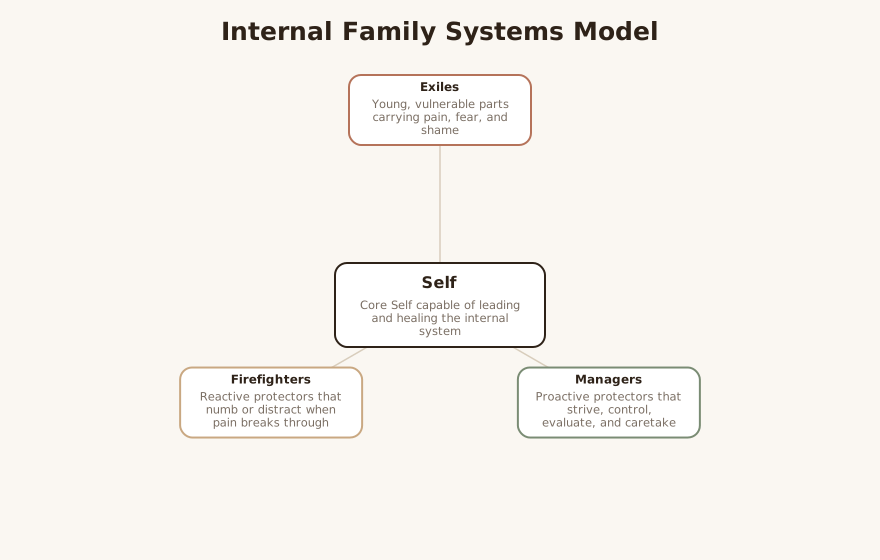
The model organizes parts into three functional groups. Exiles are young, vulnerable parts that carry pain, fear, and shame from past experience and are isolated (“exiled”) from the rest of the system to protect against that pain; when cut off they become increasingly desperate 2. Managers are proactive protectors that run daily life and try to prevent hurt or rejection through striving, controlling, evaluating, and caretaking 2. Firefighters are reactive protectors that activate when an exile’s pain breaks through, dousing it with distracting or numbing behaviors such as substance use, bingeing, or self-harm 2. Managers and firefighters are often polarized against one another, each escalating in response to the other 2.
The Self is conceptualized as distinct from the parts — a core that, when differentiated and “in the lead,” is competent, secure, self-assured, relaxed, and able to listen and respond 2. Self is commonly described through eight qualities, the “8 Cs”: confidence, calmness, creativity, clarity, curiosity, courage, compassion, and connectedness 6. A central therapeutic premise is that healing comes not from the therapist but from the client’s own Self once parts trust it enough to step back and allow access 5.
Interventions & Techniques
The overarching aim of IFS is to restore internal balance, elevate the Self to a position of trusted leadership, and free parts from extreme protective roles so they can contribute their natural strengths 2. Treatment is process-driven, generally beginning with whatever part is most present rather than following a fixed agenda 5.
Early work focuses on assessment and safety: the therapist maps the client’s parts and the sequences and polarizations among them, introduces the language of parts, and establishes a working relationship with protective parts before approaching exiles 2. A recurring move is asking protectors for permission to access the parts they guard, which respects the system’s defenses rather than overriding them 2. As the client accesses Self-energy — recognizable by the qualities of calm, curiosity, and compassion — they turn toward a part, listen to its fears and its protective intention, and develop a relationship with it from Self rather than from another reactive part 56. The model’s signature endpoint is unburdening, in which an exile, once witnessed and supported by Self, releases the extreme beliefs and emotions (“burdens”) it has carried 5.
LLM-generated illustrative example (not a guideline): A client who freezes before performance reviews notices a harshly self-critical voice (a manager) and an urge to call in sick (a firefighter). Rather than arguing with either, the therapist invites the client to ask the critic what it fears would happen if it stopped. The critic reveals it is protecting a younger part that once felt humiliated. From a more curious, less fused stance, the client begins to relate to that younger part directly LLM.
Evidence Base
IFS is an established and widely practiced model, but its controlled-trial evidence base is genuinely small and should be presented to clients and supervisees honestly 7. The strongest single study is a proof-of-concept randomized controlled trial in rheumatoid arthritis (Shadick et al., 2013): 79 adults were randomized to a nine-month IFS-based group intervention or to a mailed-education control, with 68 completing assessments 3. Posttreatment, the IFS arm showed improvements in self-assessed joint pain and physical function; at one-year follow-up, improvements in self-assessed joint pain, self-compassion, and depressive symptoms were sustained, whereas anxiety, self-efficacy, and objective disease activity were not 3. The authors framed it as demonstrating feasibility and acceptability and called for larger efficacy trials 3.
For trauma, the principal study is an uncontrolled pilot effectiveness trial of IFS for PTSD among survivors of multiple childhood traumas (Hodgdon et al., 2021), which reported reductions in PTSD and related symptoms but, as a pilot without a control group, cannot establish efficacy 4. A critical review from the Society for the Advancement of Psychotherapy notes that the literature contains only a handful of supporting studies — covering depression, rheumatoid arthritis pain, PTSD, and dissociation — and that these involved selective samples, a strikingly thin base given the model is roughly three decades old 7. The same review observes that the model’s popularity and the claims made for it have outpaced this evidence 7. IFS was designated an evidence-based practice in 2015, a listing that is real but should not be conflated with the depth of replicated RCT support seen for first-line trauma or mood treatments 6. The honest clinical summary: promising, plausible, increasingly studied, but not yet a maturely evidenced therapy 7.
Populations & Indications
In practice IFS is applied broadly. Reported and studied indications include depression, anxiety, panic, phobias, trauma, and substance use, as well as adjunctive use in physical health conditions such as rheumatoid arthritis 63. The model is widely used with adults who have trauma histories and complex PTSD, where the parts framework offers a vocabulary for fragmentation, protective behavior, and the coexistence of opposing impulses 4LLM. Clinicians also apply it to eating disorders and substance use, where firefighter behavior (bingeing, using) and manager behavior (restriction, control) map intuitively onto the model, and to chronic self-criticism, internal conflict, shame, and low self-esteem 2LLM. Its appeal across these populations is partly that the same conceptual structure — exiles, protectors, and a leading Self — can be used transdiagnostically LLM.
Problems-for-Work
- Self-criticism and shame: An entrenched inner critic is reframed as a protective manager rather than a defect, and the client is helped to relate to it and to the exile it guards from a Self-led stance 2LLM.
- Internal conflict / ambivalence: Polarized parts — for example, one part driving achievement and another demanding rest — are named and unblended so the client can hold both perspectives without being run by either 2LLM.
- Emotional dysregulation: Sudden floods of affect are understood as exiles breaking through, and impulsive numbing as firefighter activity; the work is to build enough Self-energy to be present to the feeling 26.
- Trauma and dissociation: Fragmented, walled-off experience is approached through protectors first, with exiled traumatic material witnessed and unburdened only after the system grants access 24.
- Substance use: Using behavior is engaged as a firefighter with a protective intention, opening a less shaming conversation about what pain it is trying to extinguish 2LLM.
Contraindications, Cautions & Cultural Humility
IFS may be unsuitable, or require substantial modification, for clients with active psychosis or paranoia, where literally describing the mind as containing autonomous “parts” can be disorganizing or can feed difficulties with reality testing 67. The Society for the Advancement of Psychotherapy review specifically flags concerns about applying IFS to people with psychosis and impaired reality testing, and also raises caution about the model’s intersection with recovered/false-memory issues — a reminder to avoid suggestive techniques and not to treat retrieved content as historical fact 7. Clinicians should also be alert that the model’s intuitive, marketable language has spread rapidly through social media, which can set up client expectations shaped more by popular content than by clinical evidence 7.
Cultural humility matters here in two ways. First, the framing of an internal “family” of parts and a sovereign “Self” carries individualist, Western assumptions about selfhood that may not map onto every client’s cultural understanding of mind, spirit, or community; the language should be offered, not imposed, and adapted to the client’s idiom LLM. Second, because the evidence base draws on selective samples, generalization to clients differing in culture, identity, and presentation is uncertain and should be held tentatively 7LLM.
Treatment-Plan Suggestions & SMART Objectives
| Goal | SMART objective (example) | Mechanism |
|---|---|---|
| Reduce fusion with the inner critic | Within 8 sessions, client will identify the critical part and report relating to it with curiosity in 3 of 5 logged episodes | Unblending / Self-leadership over a manager part 26 |
| Increase distress tolerance | Over 6 weeks, client will use a Self-led pause instead of a numbing behavior on at least 50% of urges, tracked daily | Recognizing firefighter activity and accessing Self-energy 26 |
| Process a trauma memory safely | Within 12 sessions, client will witness one exiled memory with no post-session dissociation lasting >1 hour | Protector permission then unburdening of an exile 24 |
| Reduce depressive self-judgment | Over 8 weeks, client will report a 30% drop on a depression self-report measure | Self-compassion and reduced exile burden, paralleling RCT findings 3 |
| Resolve internal ambivalence | Within 6 sessions, client will articulate the positive intention of two polarized parts in session | Mapping and de-escalating polarization 2 |
| Strengthen Self-leadership | Daily for 4 weeks, client will log one moment of acting from calm/curiosity/compassion | Building access to Self qualities (8 Cs) 6 |
| Decrease shame-driven avoidance | Within 10 sessions, client will re-engage one avoided activity while staying Self-led | Befriending the protector guarding a shame-carrying exile 2 |
Common Misconceptions
- “Parts are literally separate people or alters.” In IFS, parts are functional sub-personalities with intentions, not dissociative identities; the language is a clinical frame, not a claim that the client is multiple people 2LLM.
- “Some parts are bad and should be eliminated.” A foundational tenet is that every part has a positive intention and none should be destroyed — even destructive firefighters are protectors in an extreme role 2.
- “IFS is as evidence-supported as established trauma treatments.” Its controlled evidence is limited and drawn from selective samples; popularity exceeds the empirical base 7.
- “The therapist heals the client.” The model holds that healing comes from the client’s own Self once protectors allow access, with the therapist facilitating 5.
- “It works for everyone.” It can be destabilizing in psychosis or impaired reality testing and is not indicated indiscriminately 67.
Training & Certification
Formal IFS training is centralized through the IFS Institute, which Schwartz founded and which primarily offers professional training, multi-level training programs, certification, and online learning 1. The standard pathway involves sequential levels of training rather than a single workshop, and certification is administered by the Institute 1. Clinicians should integrate IFS within their existing scope of practice and licensure; the core clinical text by Schwartz and Sweezy is the recommended foundational reading alongside formal training 8LLM.
Key Terms
- Self: The core leadership entity, distinct from parts, characterized by qualities such as confidence, calm, curiosity, and compassion 26.
- Exiles: Young, vulnerable parts carrying pain, fear, or shame that are isolated from the system 2.
- Managers: Proactive protectors that control daily life to prevent hurt or rejection 2.
- Firefighters: Reactive protectors that activate to suppress an exile’s emerging pain, often through impulsive behaviors 2.
- Polarization: Two parts locked in escalating opposition to one another 2.
- Unburdening: The release of extreme beliefs and emotions an exile has carried, after it is witnessed by Self 5.
- Blending / unblending: A part dominating consciousness versus the client gaining enough separation from it to access Self 5LLM.
- 8 Cs: Confidence, calmness, creativity, clarity, curiosity, courage, compassion, connectedness 6.
Resources & Further Reading
▶ Watch — a video introduction to this concept:
- Richard C. Schwartz, Ph.D. — The Founder of Internal Family Systems (IFS Institute)
- The Internal Family Systems Model Outline (IFS Institute)
- A Randomized Controlled Trial of an IFS-based Intervention on Outcomes in Rheumatoid Arthritis — Shadick et al., 2013, J Rheumatol
- IFS Therapy for PTSD among Survivors of Multiple Childhood Trauma: A Pilot Effectiveness Study — Hodgdon et al., 2021
- What Is Internal Family Systems (IFS) Therapy? (Psychology Tools)
- Internal Family Systems Therapy (Psychology Today)
- Internal Family Systems: Exploring Its Problematic Popularity (Society for the Advancement of Psychotherapy, APA Div. 29)
- Internal Family Systems Therapy, 2nd ed. — Schwartz & Sweezy, Guilford Press
Reflective / Supervision Questions
- When a client’s destructive behavior is reframed as a protector with positive intent, how do I hold that stance without minimizing real-world risk or harm? LLM
- How do I distinguish authentic Self-energy in a client from a managerial part that mimics calm and compliance? LLM
- Given the limited controlled evidence, how do I describe IFS to clients in a way that is hopeful but does not overstate what the research supports? 7LLM
- With clients whose cultural framework does not center an individual “Self,” how might I adapt or set aside the model’s language? LLM
- How do I screen for psychosis or impaired reality testing before introducing parts language, and what would I use instead if it seems destabilizing? 67
- When approaching exiled trauma material, how do I confirm protectors have genuinely granted permission rather than been overridden? 2