
Type & Discipline
The Mystical Experience (Common-Core Model) is a psychological construct, not a treatment modality, and it belongs to the psychology of religion and the broader field of mysticism research 4. Its purpose is to take an experience that has historically been described as private and ineffable and render it operationally measurable across persons and traditions 4. The construct names a recurring cluster of phenomenological features — unity, a sense of sacredness, a noetic or “knowing” quality, deeply felt positive mood, transcendence of time and space, ineffability, and paradoxicality — that appear together with enough regularity to be treated as a single latent dimension 5. For clinicians, the relevance is twofold: it provides a validated vocabulary for what clients sometimes report after intense altered states, and it is the variable most consistently studied as a predictor of benefit in psychedelic-assisted therapy 6LLM.
A construct is a measurement bridge, not a therapy in itself LLM. Clinicians do not “do” mystical experience; they encounter it as something clients report, and they may use the model to understand, normalize, and help integrate those reports LLM.
Creators & Lineage
The lineage begins with William James, whose The Varieties of Religious Experience proposed that mystical states share identifiable marks — chiefly ineffability and a noetic quality — across religious contexts LLM. The philosopher Walter Stace sharpened this into the “common core” thesis: that beneath culturally specific interpretations lies a shared experiential structure, which he enumerated as a set of universal qualities including unity, sacredness, noetic insight, positive mood, transcendence of time and space, ineffability, and paradoxicality 5. Stace’s enumeration is the conceptual backbone of every instrument that followed 5.
Ralph Hood translated Stace’s philosophy into psychometrics, authoring the Mysticism Scale (M-Scale) in 1975 as an instrument to measure mystical experience independent of any particular religious tradition 4. Cross-cultural work later confirmed a stable three-factor structure for the scale in samples from both the United States and Iran, supporting the claim that the underlying dimensions are not merely an artifact of Western religiosity 3.
In parallel, Walter Pahnke brought the construct into experimental psychopharmacology with the 1962 “Good Friday Experiment,” in which theology students given psilocybin reported striking mystical experiences while placebo recipients did not 6. Decades later, Roland Griffiths and colleagues at Johns Hopkins revived this line of work, developing and validating the revised Mystical Experience Questionnaire (MEQ-30) and demonstrating that sufficient psilocybin doses reliably occasioned “complete mystical experiences” that participants ranked among the most personally meaningful events of their lives 16.
Core Principles
The model rests on a few load-bearing claims LLM. First, mystical experiences across traditions share a common phenomenological core rather than being wholly determined by the believer’s background 5. Second, that core is multidimensional but coherent — it decomposes into recognizable factors (unity, transcendence, ineffability, positive mood, sacredness, noetic quality) that nonetheless covary strongly enough to be summarized as a single construct 56. Third, the experience is measurable: self-report instruments can capture intensity and completeness retrospectively 41.
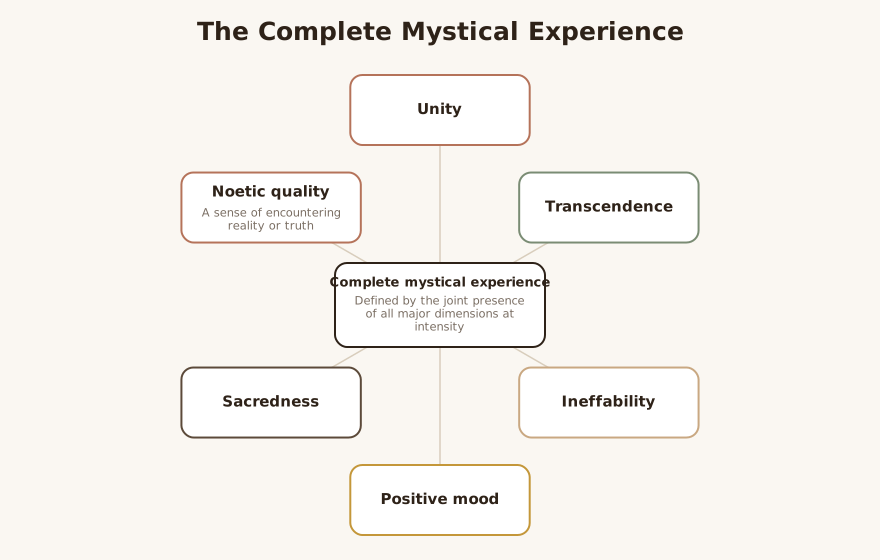
A central organizing idea is the “complete” mystical experience — the principle that a full mystical state is not any single feature in isolation (not unity alone, not positive mood alone) but the joint presence of all the major dimensions at meaningful intensity 5. Operationally, a participant is classified as having a complete mystical experience when they score above threshold across each of the major domains, not merely on one 6. This “all-domains” criterion is what distinguishes a structured construct from a vague sense of having had a powerful experience 5LLM.
The model is also explicitly trans-traditional: the construct is designed to apply whether the experience arose in prayer, meditation, near-death circumstances, spontaneous onset, or a psychedelic session 4LLM.
Interventions & Techniques
Because this is a construct rather than a modality, the relevant “techniques” are measurement and integration, not a protocol of its own LLM.
Measurement. Hood’s Mysticism Scale (Research Form D) is the foundational self-report instrument, designed to assess mystical experience across individuals regardless of religious tradition 4. In the psychedelic context, the MEQ-30 is the current standard: thirty statements rated on a 0–5 scale (“none” to “extreme”), organized into four factors — a mystical factor (which absorbs unity, sacredness, and noetic quality), positive mood, transcendence of time and space, and ineffability 51. The MEQ-30 was refined through factor analysis of large samples of psilocybin sessions and validated against the “complete mystical experience” criterion 21.
Clinical use of the construct. In practice, clinicians use these dimensions descriptively to help a client locate and name an experience that may otherwise feel unspeakable LLM. Integration work — helping a client make durable meaning of an intense altered state and translate it into changed behavior — is where the construct most often touches ordinary practice, even outside formal psychedelic trials LLM.
LLM-generated illustrative example (not a guideline): A client returns from a meditation retreat describing “dissolving into everything, and it felt more real than real life, but I can’t put it into words.” Rather than pathologizing this, the clinician maps it onto the model’s dimensions — unity, the noetic quality, ineffability — to validate the experience as a recognized phenomenon and to open a conversation about what meaning the client wants to carry forward LLM.
Evidence Base
Honesty requires separating two questions: is the construct well-measured, and is its causal role in outcomes established? LLM
On measurement, the evidence is established 1. The MEQ-30 emerged from factor analysis of large psilocybin-session datasets and was validated as a structurally sound, reliable instrument 21. Hood’s M-Scale has a replicated three-factor structure confirmed across two culturally distinct populations, which is a strong psychometric credential 3. As a tool for quantifying a previously elusive experience, the construct has earned its “established” status 45.
On outcomes, the picture is more cautious LLM. Across studies, higher mystical-experience intensity correlates with better clinical results — greater abstinence in addiction treatment, larger reductions in depression and anxiety, and durable gains in life satisfaction and well-being 65. Explainer sources cite striking figures, including high smoking-cessation rates and the finding that most participants ranked a single session among the most meaningful events of their lives more than a year later 56. But these relationships are correlational, and there is active debate over whether the mystical experience is the working mechanism or simply a marker of a strong, well-dosed, well-supported session LLM. Disentangling “the experience caused the change” from “intensity of drug effect and quality of setting caused both the experience and the change” is methodologically difficult and not yet resolved LLM.
Populations & Indications
The construct is most actively applied with adults in psychedelic-assisted therapy, where the MEQ-30 is used to characterize sessions and study who benefits 16. The original experimental populations were theology students and, later, healthy volunteers and patients in clinical trials 6. Within trial contexts, the strongest signals have appeared in addiction treatment and in distress related to serious or life-limiting illness, where mystical-type experiences track with reduced anxiety and depression 6.
Beyond formal trials, the model is clinically useful for any client who reports a spontaneous spiritual, peak, or anomalous experience — meditative, near-death, grief-related, or otherwise — and needs a non-pathologizing framework to understand it 4LLM. It is also a natural fit for existential and demoralization-focused work in palliative or oncology settings, where a sense of unity, sacredness, or meaning can be therapeutically significant 6LLM.
Problems-for-Work
The construct maps onto several concrete problems-for-work LLM:
- Death and existential anxiety. Mystical-type experiences correlate with reduced anxiety in patients facing serious illness, making the construct a frame for existential distress work 6. Application: helping a client metabolize a unitive experience into a steadier relationship with mortality LLM.
- Treatment-resistant depression. Mystical intensity has been associated with remission and symptom reduction in depression studies, including treatment-resistant presentations 5. Application: using integration sessions to consolidate insight into behavioral change LLM.
- Substance use disorders. Higher mystical scores track with better abstinence outcomes in addiction trials 56. Application: anchoring relapse-prevention plans to the meaning and motivation a client draws from the experience LLM.
- Integration of anomalous or spiritual-emergency experiences. Clients sometimes present frightened or destabilized after an overwhelming altered state LLM. Application: using the model’s dimensions to normalize the experience and reduce the fear that “something is wrong with me” 4LLM.
Contraindications, Cautions & Cultural Humility
The first caution is construct boundaries LLM. A high MEQ-30 score documents a phenomenology; it does not certify that an experience was benign, true, or therapeutic 1LLM. Intense altered states can also be frightening or destabilizing, and a “mystical” rating does not rule out a difficult or harmful trajectory LLM.
The second caution is importing a religious-philosophical frame uncritically LLM. Stace’s common-core thesis is perennialist — it assumes a single underlying experience beneath all traditions — and this assumption has been substantively critiqued by scholars who argue that culture shapes the experience itself, not merely its interpretation 5LLM. The cross-cultural confirmation of the M-Scale’s structure is reassuring but does not settle the deeper philosophical dispute 3LLM. Clinically, this means holding the client’s own meaning-making — religious, secular, or idiosyncratic — as primary, rather than translating their experience into the model’s universalizing language LLM.
A third caution concerns scope of practice and legality LLM. Outside of approved clinical trials or specific legal frameworks, facilitating psychedelic use is outside the scope of general practice; the construct can inform integration of experiences clients have already had, but it does not license clinicians to occasion them LLM. Cultural humility also extends to indigenous and traditional practices, whose ceremonial contexts the research construct abstracts away and should not be presumed to capture LLM.
Treatment-Plan Suggestions & SMART Objectives
| Goal | SMART objective (example) | Mechanism |
|---|---|---|
| Normalize an anomalous experience | Within 3 sessions, client will name their experience using at least three common-core dimensions and report reduced fear that “something is wrong” on a 0–10 scale | Psychoeducation and validation against a recognized construct 4 |
| Integrate a unitive/peak experience | Over 6 weeks, client will identify two concrete behavior changes they wish to carry from the experience and act on at least one weekly | Meaning-consolidation and behavioral translation 5LLM |
| Reduce existential/death anxiety | Within 8 sessions, client will report a 30% reduction on a self-rated death-anxiety measure | Mystical-type experience associated with reduced anxiety in serious illness 6 |
| Support depression recovery | Over 8 weeks, client will engage in a daily meaning-and-values practice and track mood at least 5 days/week | Insight-to-action consolidation linked to symptom reduction 5 |
| Strengthen abstinence motivation | Within 4 weeks, client will articulate how their experience supports recovery goals and complete a written relapse-prevention plan | Mystical intensity associated with abstinence outcomes 6 |
| Reduce spiritual-emergency distress | Within 2 sessions, client will use a grounding plan during destabilizing recurrences and rate distress reduction | Containment and normalization of overwhelming states LLM |
| Clarify personal (not imposed) meaning | Over 4 sessions, client will articulate their own interpretation of the experience in their own framework | Cultural humility; client-centered meaning-making 3LLM |
Common Misconceptions
“A mystical experience is just feeling good or feeling unity.” The construct’s whole point is that a complete experience requires the joint presence of multiple dimensions — unity, transcendence, ineffability, noetic quality, sacredness, and positive mood together — not any one in isolation 56.
“A high MEQ-30 score means the session worked.” The score measures phenomenology, and the link to outcomes is correlational; mystical intensity may be a marker of a strong session rather than the mechanism of change 6LLM.
“The common core proves all religions describe the same experience.” This is a contested philosophical thesis, not an empirical fact; the perennialist assumption behind Stace’s model is actively debated 5LLM.
“It only happens on psychedelics.” The construct and Hood’s scale were built to capture mystical experiences across contexts — meditative, spontaneous, near-death — regardless of how they arose 4.
Training & Certification
There is no certification in “mystical experience” as such, because it is a research construct rather than a credentialed modality LLM. Familiarity comes from the psychology-of-religion and mysticism-research literature — James, Stace, and Hood’s psychometric work — and from the psychedelic-science literature in which the MEQ-30 is the standard measure 41. Clinicians who wish to work with these experiences typically pursue training in psychedelic-assisted therapy and integration, which is where structured facilitation, safety, and the use of measures like the MEQ-30 are taught 6LLM. Use of Hood’s M-Scale or the MEQ-30 in research or assessment follows standard psychometric administration rather than a separate certification 4LLM.
Key Terms
- Common core (perennialism): the thesis that mystical experiences across traditions share an underlying experiential structure beneath cultural interpretation 5.
- Noetic quality: the sense that the experience conveys genuine, ultimate knowledge or insight, not mere emotion 5.
- Ineffability: the difficulty or impossibility of expressing the experience in words 5.
- Unity: a sense of oneness, either with the external world (extrovertive) or in a contentless inner state (introvertive) 5.
- Complete mystical experience: an experience scoring above threshold across all major dimensions rather than only one 6.
- MEQ-30: the revised 30-item Mystical Experience Questionnaire, the current standard self-report measure, organized into four factors 51.
- M-Scale: Hood’s Mysticism Scale, a tradition-independent instrument with a replicated three-factor structure 43.
Resources & Further Reading
▶ Watch — a video introduction to this concept:
- Validation of the revised Mystical Experience Questionnaire in experimental sessions with psilocybin (Barrett, Johnson & Griffiths)
- Factor Analysis of the Mystical Experience Questionnaire (MacLean, Leoutsakos, Johnson & Griffiths, 2012)
- Dimensions of the Mysticism Scale: Confirming the Three-Factor Structure in the United States and Iran
- The Mysticism Scale: Research Form D (Hood’s M-Scale)
- Mystical Experience: Meaningful, Measurable, Life Changing
- Psilocybin and Mystical Experiences: A Scientific Exploration
Reflective / Supervision Questions
- When a client reports a powerful unitive or noetic experience, how do I distinguish validating the phenomenology from endorsing a particular metaphysical claim about it? LLM
- Am I treating a high mystical-experience rating as evidence that change has occurred, or as one variable among many in a correlational picture? LLM
- How do I hold a client’s own religious or secular meaning-making as primary rather than translating it into a universalizing “common core” frame? LLM
- Where are the edges of my scope of practice with clients who have had — or want to seek — intense altered states, and when do I refer? LLM
- How do I support integration of a destabilizing or frightening “mystical” experience without either pathologizing it or minimizing its impact? LLM