
Type & Discipline
The therapeutic alliance, often used interchangeably with the term “working alliance,” is a transtheoretical construct within clinical psychology rather than a treatment modality in its own right 7. It belongs to the family of common factors — the elements shared across all bona fide psychotherapies that account for change independent of any specific technique 2. The construct describes the quality and character of the collaborative relationship between client and therapist as they engage in the work of treatment 4. It is not a school of therapy you practice; it is a relational process that operates within whatever modality you practice LLM.
Because the alliance is a process variable common to all approaches, it has become one of the most studied constructs in psychotherapy research, with meta-analyses spanning thousands of treatment dyads 1. Its enduring relevance comes from a simple finding that has survived decades of scrutiny: the quality of the alliance predicts how clients fare, regardless of the brand of therapy on the door 4.
Creators & Lineage
The alliance concept traces to psychodynamic origins. Freud (1913) first described the patient’s attachment to the analyst through the lens of transference; although transference was initially framed as an obstacle, the field gradually recognized a beneficial, reality-based attachment that helped treatment proceed 4. Elizabeth Zetzel (1956) named this the “therapeutic alliance,” defining it as the non-neurotic, non-transferential component of the patient–therapist relationship 4. Ralph Greenson (1965) refined the idea further, describing the “working alliance” as a reality-based collaboration between patient and therapist 4.
A parallel and ultimately convergent stream came from Carl Rogers, whose 1951 person-centered framework identified empathy, congruence (genuineness), and unconditional positive regard as the therapist-provided conditions for change 4. Rogers reframed the relationship not as a vehicle for analyzing transference but as the curative agent itself LLM.
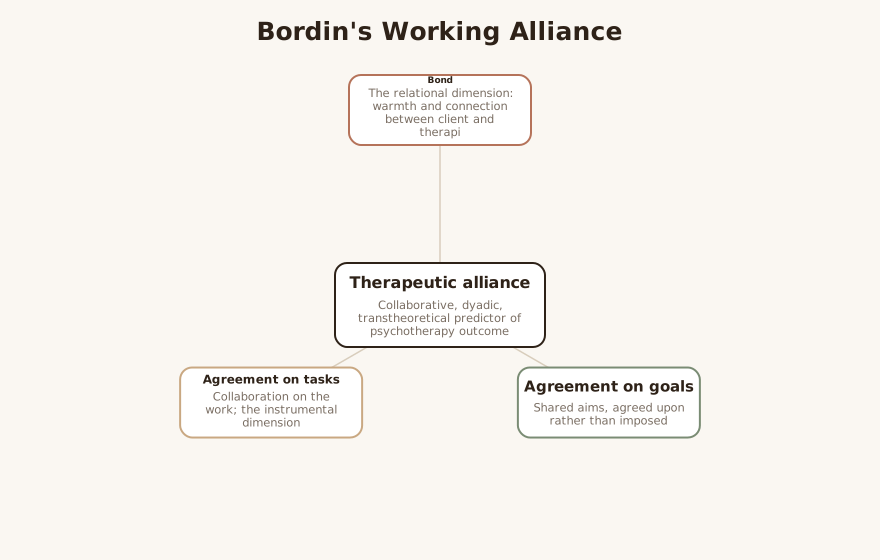
The construct reached its modern, pantheoretical form with Edward Bordin (1979), who proposed that the working alliance comprises three interdependent components: agreement on the goals of treatment, agreement on the tasks through which those goals are pursued, and the personal bond of reciprocal positive feeling between client and therapist 4. Bordin’s tripartite model is decisive because it applies across every orientation: any therapy, psychodynamic or behavioral, requires goal agreement, task agreement, and a working bond 7. Measurement followed the theory, with Horvath and Greenberg’s Working Alliance Inventory (1986) operationalizing Bordin’s three dimensions 4.
Core Principles
First, the alliance is collaborative and dyadic — it is co-constructed, not delivered by the therapist to a passive recipient 7. Bordin’s framework insists that goals and tasks be agreed upon, not imposed 4. Second, the alliance is transtheoretical: it predicts outcome whether the modality is cognitive-behavioral, psychodynamic, humanistic, or integrative 4.
Third, the alliance has both a relational dimension (the bond) and an instrumental dimension (collaboration on goals and tasks); strength in one does not guarantee strength in the other 7. A warm bond without shared goals can stall; clear goals without a bond can feel cold LLM. Fourth, the client’s perception of the alliance is the more powerful predictor — patient-rated alliance forecasts outcome more strongly than therapist-rated alliance, which has direct implications for how clinicians solicit feedback 4. Finally, the alliance is dynamic: it fluctuates across treatment, is strained by ruptures, and can be repaired — meaning it is an active target of clinical attention rather than a fixed trait of the dyad 3.
Interventions & Techniques
Although the alliance is a construct rather than a manualized protocol, the literature points to concrete therapist behaviors that build and maintain it. Collaboratively negotiating goals and tasks — making the work explicitly mutual — operationalizes Bordin’s model in session 4. Empathy, positive regard, and congruence remain foundational alliance-building behaviors descended directly from Rogers 2.
Responsiveness and attunement are central: tailoring pacing, language, and approach to the individual client’s characteristics, including cultural background, attachment style, gender identity, and spiritual beliefs 3. Appropriate, well-timed therapist self-disclosure and “immediacy” (sharing in-the-moment relational feelings) can strengthen the bond; one meta-analysis of 21 studies found therapist self-disclosure improved patients’ functioning and insight 3.
Two techniques deserve special emphasis. Routine outcome monitoring — using brief measures such as the Outcome Questionnaire-45.2, Outcome Rating Scale, or Session Rating Scale — surfaces clients who are at risk of deteriorating; clinicians who used feedback systems saw at-risk clients roughly twice as likely to achieve positive clinical change 3. Rupture repair addresses inevitable strains: confrontation ruptures (client anger or accusation) and withdrawal ruptures (client retreat or disengagement) are repaired by providing a clear treatment rationale, renegotiating goals, and inviting direct, mutual discussion of the discord 3.
LLM-generated illustrative example (not a guideline): A client who had grown quiet and “agreeable” for two sessions was, the clinician suspected, withdrawing. Rather than press the content, the clinician named the process — “I notice we’ve been moving quickly through things; I want to check whether the direction still feels right to you.” The client admitted the homework felt irrelevant, goals were renegotiated, and engagement returned LLM.
Evidence Base
The evidence base for the alliance–outcome relationship is established and among the most robust in psychotherapy research 4. The landmark meta-analytic synthesis by Flückiger and colleagues aggregated 60 independent samples comprising 6,061 participants and 125 effect sizes, yielding a moderate and highly consistent association between alliance and outcome (zero-order r ≈ .30) 1. Critically, the relationship survived adjustment for intake characteristics and for simultaneous treatment processes such as therapist adherence and competence, leading the authors to characterize the alliance as a reliable, process-based factor of therapy success that is independent of patients’ presenting characteristics 1.
The APA Division 12/29 Task Force on Evidence-Based Relationships concluded that the therapy relationship makes substantial and consistent contributions to outcome independent of the type of treatment, accounting for why clients improve at least as much as the particular method does 2. The Task Force rated the alliance in individual, youth, and family psychotherapy — alongside empathy, group cohesion, and collecting client feedback — as demonstrably effective, with goal consensus, collaboration, and positive regard rated probably effective 2.
Two honest caveats temper the enthusiasm. The relationship is correlational, and disentangling whether a strong alliance causes improvement or whether early symptom improvement produces a better-rated alliance remains a live methodological question, even as the moderating analyses argue for a genuine alliance contribution 1. And the effect, while remarkably consistent, is moderate, not overwhelming — the alliance is necessary but rarely sufficient on its own 5.
Populations & Indications
The alliance is indicated across essentially the entire psychotherapy population because it is a feature of the treatment relationship itself rather than a diagnosis-specific technique 2. The evidence spans adults, children and adolescents (youth psychotherapy), and family work, all of which the Task Force rated as demonstrably effective contexts for the alliance 2. Couples and family formats are likewise within scope, and clinical guidance increasingly extends alliance principles to telehealth delivery 3.
The construct holds across diagnostic categories and across treatment orientations, which is precisely what makes it a common factor: meta-analytic findings show the alliance predicts outcome independent of the variety of psychotherapy approaches and the outcome measures used 4. In practice this means the alliance is relevant whether you are treating depression with behavioral activation, anxiety with exposure, or relational difficulty with psychodynamic exploration LLM.
Problems-for-Work
Because the alliance cuts across diagnoses, it is implicated wherever clients present in distress 4. In major depressive disorder and anxiety disorders, a strong early alliance supports engagement with demanding tasks such as behavioral activation or exposure, where ambivalence is common LLM. In PTSD work, the bond and explicit task agreement carry clients through the destabilizing middle phase of trauma processing 4.
The alliance is most directly a problem-for-work in treatment dropout and disengagement: weak or ruptured alliances are a recognized pathway to premature termination, and routine monitoring of the alliance lets clinicians intervene before clients vote with their feet 3. In personality disorders and substance use disorders, where ambivalence, mistrust, and interpersonal reactivity are intrinsic to the presentation, the alliance is both harder to build and more consequential, demanding active rupture repair 3.
LLM-generated illustrative example (not a guideline): With a client in early recovery from alcohol use who arrived visibly defensive, the clinician deferred relapse-prevention worksheets for one session and instead established shared, client-named goals. The reduction in perceived coercion lowered the client’s guardedness and made later structured work possible LLM.
Finally, poor treatment adherence, ruptures in therapy, and undifferentiated general psychological distress are all served by treating the alliance as an explicit object of clinical attention rather than a background assumption 2.
Contraindications, Cautions & Cultural Humility
The alliance has no contraindications in the usual sense — there is no client for whom a working relationship is inadvisable LLM. The cautions concern how the alliance is interpreted and pursued. A common error is mistaking client compliance or pleasantness for a strong alliance; surface agreeableness can mask a withdrawal rupture, which is precisely why client-rated feedback matters more than the therapist’s impression 4. Conversely, a warm bond should not be treated as evidence the work is on track if goals and tasks are not genuinely shared 7.
Cultural humility is integral, not adjunctive. The Task Force explicitly frames responsiveness — tailoring the relationship to the client’s culture, spirituality, preferences, attachment style, and stage of change — as part of evidence-based practice 2. Alliance-building behaviors that read as warm in one cultural frame may read as intrusive in another, so clinicians attune to the individual rather than apply a generic warmth script 3. Self-disclosure, in particular, is a double-edged technique: helpful when calibrated, alliance-damaging when it centers the therapist’s needs LLM.
Treatment-Plan Suggestions & SMART Objectives
| Goal | SMART objective (example) | Mechanism |
|---|---|---|
| Establish shared treatment goals | Within 3 sessions, client and clinician will co-author a written list of 3 prioritized goals, reviewed and endorsed by the client | Bordin’s goal-agreement component of the working alliance 4 |
| Strengthen collaborative task agreement | By session 4, client will rate task relevance ≥ 4/5 on a session rating measure for 2 consecutive sessions | Task-agreement component; reduces dropout risk 3 |
| Detect and repair ruptures early | Clinician will administer a brief alliance/session-rating measure each session and address any score drop ≥ 2 points within the same session | Routine outcome monitoring; rupture repair 3 |
| Build the relational bond | Over 6 weeks, client will report feeling “understood by my therapist” ≥ 4/5 on alliance items at 3 checkpoints | Empathy, positive regard, congruence 2 |
| Increase responsiveness to client characteristics | Clinician will document one explicit adaptation (pacing, language, or cultural tailoring) per client per month | Responsiveness / attunement 3 |
| Reduce disengagement risk | Client will attend ≥ 8 of next 10 scheduled sessions, with any missed session followed by a collaborative re-engagement discussion | Alliance as protection against premature termination 3 |
| Improve feedback-informed care | Client will complete a standardized outcome measure (e.g., ORS) at ≥ 90% of sessions over 8 weeks | Feedback systems double the rate of recovery for at-risk clients 3 |
Common Misconceptions
A first misconception is that the alliance is merely “rapport” or “being nice” — bedside warmth that precedes the real clinical work. In fact the construct is structured: it requires explicit agreement on goals and tasks, not just a pleasant bond 4. Second, clinicians sometimes treat the alliance as a fixed property of the dyad (“we have good chemistry”) rather than a fluctuating process that ruptures and is repaired across treatment 3.
Third, a strong alliance is sometimes positioned as an alternative to evidence-based techniques, as though one must choose between the relationship and the method. The Task Force is explicit that combining evidence-based relationships with evidence-based treatments produces the best outcomes; they are complementary, not competing 2. Fourth, many clinicians over-trust their own read of the alliance, when the client’s rating is the stronger predictor — a gap that argues for systematic feedback rather than clinical intuition alone 4. Finally, the moderate effect size is sometimes inflated into a claim that “only the relationship matters”; the honest reading is that the alliance is a powerful, reliable contributor among several, not the whole of therapy 1.
Training & Certification
There is no certification in “the therapeutic alliance” because it is a construct rather than a discrete modality; competence is cultivated through general clinical training and supervision rather than a standalone credential LLM. The skills that build it — empathic attunement, collaborative goal-setting, rupture repair, and responsiveness — are core elements of foundational psychotherapy training across orientations 2.
Practical skill development is increasingly tied to feedback-informed treatment, in which clinicians learn to administer and respond to brief alliance and outcome measures such as the Working Alliance Inventory, Outcome Rating Scale, and Session Rating Scale 3. Familiarity with the major alliance instruments — the Working Alliance Inventory, California Psychotherapy Alliance Scales, Helping Alliance Questionnaire, and Vanderbilt Therapeutic Alliance Scale — orients clinicians to how the construct is operationalized and measured 4. Supervision focused on identifying and repairing ruptures, often using session recordings, is a recognized vehicle for deliberate practice in this area 3.
Key Terms
- Working alliance: Bordin’s pantheoretical construct comprising agreement on goals, agreement on tasks, and the personal bond 4.
- Bond: The affective, reciprocal positive relationship between client and therapist 4.
- Goal agreement / task agreement: The instrumental, collaborative dimensions of the alliance — shared aims and shared methods 4.
- Common factors: Elements shared across all therapies that contribute to outcome independent of specific techniques 2.
- Rupture: A strain or breakdown in the alliance; confrontation ruptures involve client anger, withdrawal ruptures involve client retreat 3.
- Rupture repair: The process of restoring the alliance through rationale, renegotiation, and direct discussion 3.
- Routine outcome monitoring / feedback-informed treatment: Systematic in-session measurement of alliance and progress to guide care 3.
- Responsiveness: Tailoring the relationship and treatment to individual client characteristics and culture 2.
Resources & Further Reading
▶ Watch — a video introduction to this concept:
- The alliance in adult psychotherapy: A meta-analytic synthesis (Flückiger, Del Re, Wampold & Horvath)
- Evidence-based therapy relationships: research conclusions and clinical practices (APA Division 12/29 Task Force)
- Better relationships with patients lead to better outcomes (APA Monitor CE Corner)
- Therapeutic alliance and outcome of psychotherapy: Historical excursus, measurements, and prospects (Frontiers in Psychology)
- The therapeutic alliance: why it matters and what it is (Therapy Meets Numbers)
- Therapeutic alliance (Wikipedia)
- Therapeutic/Working Alliance (Encyclopedia of Clinical Psychology)
Reflective / Supervision Questions
- Whose rating of the alliance am I relying on in this case — mine or the client’s — and how would I know if they diverge 4?
- Where in my caseload have I assumed a strong alliance from client pleasantness, possibly masking a withdrawal rupture 3?
- Are the goals and tasks in this treatment genuinely co-authored, or have I imposed them under the cover of a warm bond 4?
- When a rupture occurred recently, did I address the relational strain directly, or did I press on with content 3?
- How am I adapting my relational stance to this client’s culture, attachment style, and preferences, and where might my default style be a poor fit 2?
- Am I treating the alliance as a substitute for evidence-based technique, or am I integrating both as the literature recommends 2?