
Type & Discipline
Bowen Family Systems Theory (BFST) is a comprehensive theory of human emotional functioning rather than a single therapeutic technique 5. It sits within the discipline of psychiatry and family therapy and belongs to the intergenerational/systemic family of approaches 1. Its defining premise is that the family is best understood as a single emotional unit, so that the functioning of any one member can only be fully understood in relation to the whole system 6. Clinically, this means the unit of analysis is the relationship system across generations, not the individual in isolation 1.
Although BFST is most often associated with work involving whole families, its concepts apply equally to couples, individuals, and even non-family systems such as work and social groups 1. The theory is descriptive and explanatory first; the clinical method that follows from it is comparatively spare, emphasizing the therapist’s understanding and stance over a manualized set of procedures LLM.
Creators & Lineage
The theory was developed by psychiatrist Murray Bowen, who articulated it in his own clinical and research voice over several decades 5. The foundational observations came from research conducted at the National Institute of Mental Health between 1954 and 1959, where Bowen studied families in which a member had been diagnosed with schizophrenia 6. From watching the intense emotional interdependence in those families, Bowen generalized to a theory of how anxiety is generated, contained, and transmitted in all families 6.
BFST emerged out of, and partly in reaction to, psychoanalysis, retaining attention to early relationships and multigenerational influence while shifting the explanatory frame from intrapsychic conflict to systemic process LLM. It is one of the major schools of family systems therapy and is conceptually a cousin to structural family therapy, with which it shares an emphasis on relational organization while differing in method and vocabulary LLM. Bowen also incorporated Walter Toman’s research on sibling position into the theory’s account of personality and relationship patterns 6. The broader intellectual current of general systems thinking — the idea that systems have emergent, self-regulating properties — runs through the framework LLM.
Core Principles
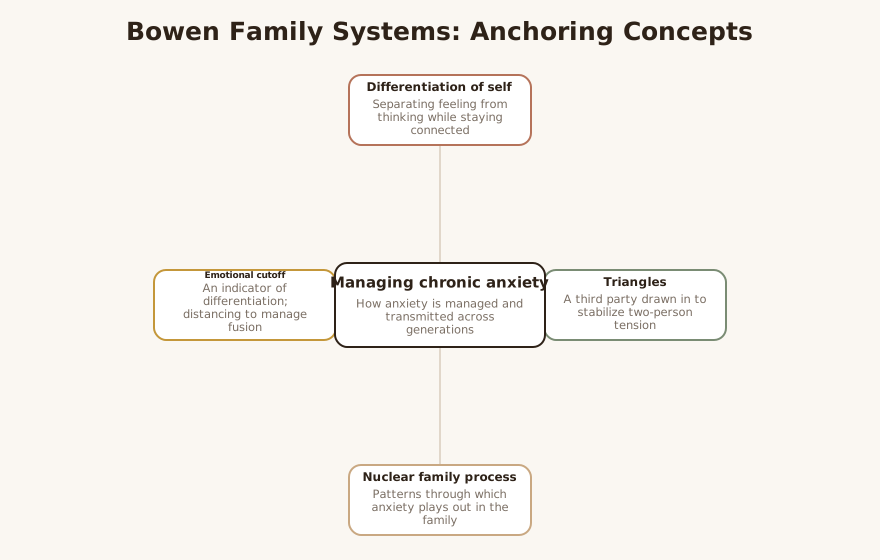
BFST is built on eight interlocking concepts, and the theory’s power lies in how they connect rather than in any one alone 1. The two anchoring concepts are differentiation of self and triangles, and the page that introduces the theory lists them at the head of the eight 1.
Differentiation of self describes a person’s capacity to maintain a clear sense of self and thoughtful functioning while remaining emotionally connected to others, rather than being governed by the emotional reactivity of the system 2. Better-differentiated people can separate feeling from thinking and choose their behavior under stress, while less-differentiated people are more fused with others and more driven by automatic emotional reactions 2. Differentiation is commonly operationalized through four indicators: the ability to take a clear “I” position, emotional reactivity, fusion with others, and emotional cutoff 6.
Triangles are the theory’s basic unit of an emotional system: when tension between two people rises, a third party is drawn in to stabilize it, which spreads the anxiety rather than resolving it 6. Nuclear family emotional process describes the patterns through which families absorb anxiety, classically taking the form of marital conflict, dysfunction in one spouse, impairment in a child, or emotional distance 6. The family projection process is the mechanism by which parents transmit their own emotional difficulty onto a child, often through a sequence in which a parent’s fear shapes how the child is interpreted and treated 6.
Multigenerational transmission process holds that levels of differentiation and characteristic emotional patterns pass down across generations, sometimes intensifying in particular family lines 6. Emotional cutoff refers to managing unresolved attachment by reducing or severing contact, which lowers anxiety in the short term but tends to increase it over time 6. Sibling position draws on Toman’s work to describe how birth-order roles shape personality and relational fit 6. Finally, societal emotional process extends the same dynamics to the functioning of society at large 1.
Interventions & Techniques
BFST translates into a recognizable clinical method even though it is not a procedure-driven model LLM. The therapist’s primary instrument is a calm, differentiated, non-reactive stance, sometimes described as remaining a thoughtful presence within the family’s emotional field rather than being absorbed into it LLM.
A central clinical tool is the genogram, a multigenerational family map used to track relationship patterns, levels of functioning, cutoffs, and recurring themes across three or more generations 6. Building the genogram is itself an intervention, because it invites family members to observe their system from a step back LLM.
Other characteristic moves include detriangling — the therapist refusing to take sides or be recruited into the family’s triangles while staying connected to each person — and coaching individuals toward differentiation by helping them define a self, manage their own reactivity, and re-engage cut-off relationships thoughtfully LLM. Bowen-informed work often proceeds through directing communication through the therapist to lower reactivity and asking research-oriented, curiosity-driven questions rather than offering interpretations LLM. Much of the work targets the most motivated or best-differentiated family member, on the premise that a shift in one person can change the whole system LLM.
LLM-generated illustrative example (not a guideline): A clinician working with a mother who reflexively allies with her teenage son against her husband might, instead of refereeing, help the mother notice the triangle, hold a steady non-anxious stance, and coach the parents to address each other directly — loosening the triangle rather than resolving the surface dispute LLM.
Evidence Base
The honest summary is that BFST is an established and widely taught framework whose empirical maturity is uneven across its concepts LLM. “Established” here means clinically influential and durable, not that the full theory has strong randomized-trial support LLM.
Differentiation of self is by a wide margin the most empirically studied construct in the theory, to the point of warranting a dedicated scoping review of the literature 3. That review treats differentiation as the theory’s core construct and maps how it has been measured and studied across a substantial body of work 4. The construct is supported by validated self-report measurement and a research literature linking lower differentiation to higher anxiety and poorer adjustment and higher differentiation to better psychological and relational functioning LLM. Much of this work is cross-sectional and correlational, which limits causal claims LLM.
By contrast, the more sweeping concepts — multigenerational transmission, societal emotional process, and aspects of sibling position — remain largely conceptual and have attracted far less rigorous empirical testing LLM. Clinicians should present BFST to colleagues and supervisors as a rich explanatory model with a well-studied central construct, not as an empirically validated treatment package in the way that, for example, manualized trauma protocols are LLM.
Populations & Indications
BFST is applicable wherever emotional interdependence drives presenting problems, which is most clearly the case with families, couples, and multigenerational family systems 1. Because the concepts apply to individuals embedded in relationship systems, the theory is also used in individual work with adults, where a single person is coached on their functioning within their family of origin 1.
It is particularly indicated for people with relationship difficulties — recurring conflict, reactivity, and patterns that repeat across relationships and generations LLM. The framework is well suited to presentations where the “problem” lives in the relationships rather than cleanly in one person, and where understanding family history and process meaningfully reframes the complaint LLM.
Problems-for-Work
BFST gives clinicians a coherent lens for a range of relational and anxiety-driven presentations LLM.
- Relationship conflict and marital conflict map directly onto nuclear family emotional process, where chronic anxiety surfaces as escalating conflict 6.
- Family dysfunction and enmeshment are read as fusion and low differentiation across the system 2.
- Triangulation is named explicitly in the theory and is a frequent focus, for instance when a child is recruited into parental tension 6.
- Emotional cutoff describes both estrangement itself and the anxiety-management function it serves 6.
- Intergenerational trauma can be conceptualized through multigenerational transmission and family projection, tracing how distress and reactivity pass down family lines 6.
- Differentiation difficulties and codependency are framed as low differentiation — being governed by others’ emotional states and struggling to define a self 2.
- Anxiety disorders are understood within the theory as expressions of chronic anxiety in the relationship system, though clinicians should not treat this as a substitute for evidence-based anxiety treatment LLM.
LLM-generated illustrative example (not a guideline): An adult presenting with anxiety and a pattern of abruptly ending friendships might be helped to see emotional cutoff as a recurring strategy, and to experiment with staying connected and differentiated through discomfort rather than withdrawing LLM.
Contraindications, Cautions & Cultural Humility
BFST has no formal contraindications in the way a medication does, but several cautions matter clinically LLM. Where there is active intimate-partner violence, abuse, or acute safety risk, a systemic framing that distributes responsibility across the relationship can be harmful; safety and accountability must take precedence over neutrality LLM. The therapist’s prized non-reactive, detriangled stance should never translate into minimizing harm or treating an abusive dynamic as a symmetrical “two-person process” LLM.
The theory’s most overreaching concepts — especially societal emotional process and the prescriptive use of sibling position — should be held loosely and not presented as established fact LLM. Cultural humility is essential: BFST’s ideals of differentiation and an autonomous “I” position were articulated within a particular Western, individualist frame, and clinicians should be careful not to pathologize interdependence, collectivist family structures, or culturally normative closeness as “enmeshment” or “low differentiation” LLM. The construct is best applied as the capacity to be both a self and connected, defined in collaboration with the client’s own values rather than against a single cultural template LLM.
Treatment-Plan Suggestions & SMART Objectives
| Goal | SMART objective (example) | Mechanism |
|---|---|---|
| Reduce emotional reactivity under stress | Within 8 sessions, client will identify 3 personal triggers and demonstrate one self-regulation strategy in 2 in-session conflict discussions | Strengthening differentiation by separating thinking from automatic emotional reactivity 2 |
| Decrease triangulation in the family | Within 10 sessions, parents will address 2 specific disagreements directly without involving the child, reported in session | Detriangling so anxiety is held by the original dyad rather than spread to a third party 6 |
| Map and understand family patterns | By session 3, client will complete a three-generation genogram identifying at least 2 recurring relational patterns | Externalizing the system to enable observation rather than enactment 6 |
| Address emotional cutoff | Within 12 sessions, client will re-initiate respectful contact with one estranged family member and debrief the outcome | Reducing chronic anxiety maintained by cutoff while preserving a differentiated stance 6 |
| Strengthen “I” position | Within 6 sessions, client will state a personal value or limit to a key family member in a planned conversation | Defining a self while staying emotionally connected 2 |
| Reduce fusion in the couple | Within 10 sessions, each partner will name 2 areas of independent functioning maintained without partner approval | Lowering fusion that drives reactivity and conflict 2 |
| Clarify relational roles and expectations | By session 4, client will describe how their family-of-origin role shapes a current relationship pattern | Using multigenerational transmission to make implicit patterns explicit 6 |
Common Misconceptions
A frequent error is equating differentiation with detachment, independence, or emotional distance; the construct is specifically the capacity to remain a self while staying connected, and cutting off is a sign of low, not high, differentiation 2. Another is treating differentiation as a fixed trait or a finish line, when it is better understood as an ongoing capacity that fluctuates with anxiety LLM.
Clinicians sometimes assume BFST is only for whole-family sessions, but its concepts are routinely applied in individual and couples work 1. A further misconception is that any closeness or interdependence is “enmeshment”; the theory targets anxiety-driven fusion, not connection itself, and conflating the two risks cultural insensitivity LLM. Finally, the breadth and intuitive appeal of the eight concepts can be mistaken for empirical confirmation; the framework’s reach exceeds its evidence base for most of its concepts LLM.
Training & Certification
There is no single licensing credential that one earns in “Bowen therapy”; BFST is a theoretical orientation practiced by already-licensed mental health professionals LLM. Specialized training is offered through Bowen-oriented training centers, most notably the institution founded around Bowen’s own work that continues to teach the eight concepts 1. Such programs typically combine didactic study of the theory, supervised clinical application, and structured work on the trainee’s own family of origin, since differentiation of the therapist’s self is treated as central to competent practice LLM. The Murray Bowen Archives Project preserves Bowen’s own writing and lectures and is a primary resource for studying the theory in his own words 5.
Key Terms
- Differentiation of self: capacity to maintain a clear self and thoughtful functioning while staying emotionally connected, rather than being governed by reactivity 2.
- Triangle: a three-person configuration that stabilizes tension between two people by drawing in a third 6.
- Nuclear family emotional process: the patterns (conflict, spousal dysfunction, child impairment, distance) through which a family absorbs anxiety 6.
- Family projection process: transmission of a parent’s emotional difficulty onto a child 6.
- Multigenerational transmission process: passage of differentiation levels and emotional patterns across generations 6.
- Emotional cutoff: managing unresolved attachment by reducing or severing contact 6.
- Sibling position: the influence of birth-order role on personality and relationships, drawing on Toman’s research 6.
- Societal emotional process: extension of family emotional dynamics to society at large 1.
- Genogram: a multigenerational family map used to track patterns across three or more generations 6.
Resources & Further Reading
▶ Watch — a video introduction to this concept:
- Introduction to the Eight Concepts — The Bowen Center for the Study of the Family 1
- Differentiation of Self — The Bowen Center for the Study of the Family 2
- Differentiation of self: A scoping review of Bowen Family Systems Theory’s core construct — Clinical Psychology Review 3
- Differentiation of self: A scoping review (APA PsycNet record) 4
- A Short Introduction to Bowen Theory, in His Own Words — Murray Bowen Archives Project 5
- What Is Bowen Family Systems Theory? 8 Core Concepts — ScienceInsights 6
Reflective / Supervision Questions
- Where in your current caseload are you being drawn into a triangle, and what would a more detriangled stance look like? LLM
- How does your own family-of-origin reactivity show up when a client’s system mirrors your own? LLM
- Are you framing a client’s culturally normative closeness as “enmeshment,” and how would you check that assumption with the client’s own values? LLM
- For a given client, which concepts are you applying as well-supported (differentiation) versus speculative (societal process), and are you transparent about that distinction? LLM
- When you feel pressure to take sides in a couple or family, what is the system trying to manage through you? LLM
- How would you recognize when a systemic framing is obscuring a safety or accountability issue that requires a different response? LLM