
Type & Discipline
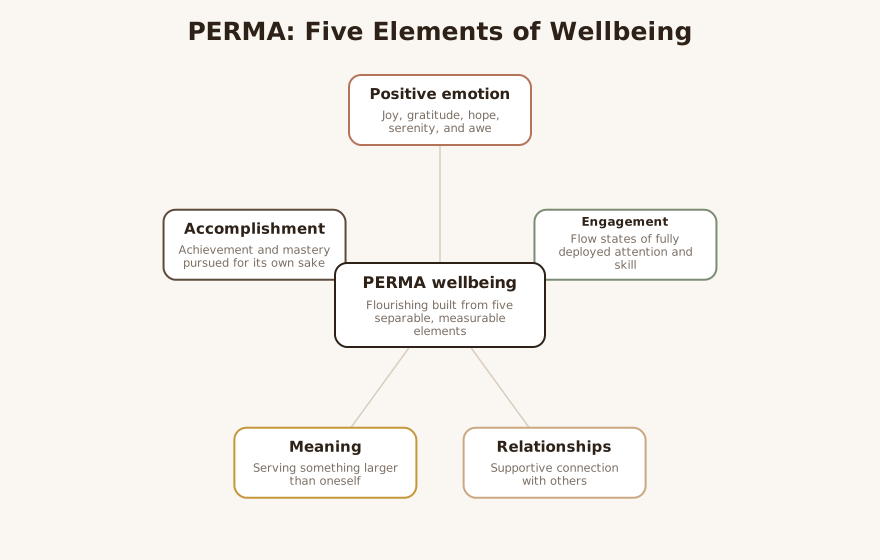
PERMA is a theory of wellbeing within positive psychology, not a psychotherapy modality in its own right 5. It proposes that flourishing is a composite of five distinct elements — Positive emotion, Engagement, Relationships, Meaning, and Accomplishment — each of which can be defined, measured, and cultivated independently 2. For the practicing clinician, the most useful way to hold PERMA is as an organizing framework: a map of the territory of “the good life” that can be layered onto an existing evidence-based treatment rather than a manualized protocol to be delivered on its own LLM.
The discipline it belongs to — positive psychology — was launched by Martin Seligman during his 1998 American Psychological Association presidency, explicitly to rebalance a field that had historically concentrated on relieving suffering rather than building what is good 2. PERMA is the mature, multidimensional model that this movement arrived at after roughly a decade of work 5. It sits in the wellbeing theory family alongside related constructs such as flow and self-determination, and it is frequently operationalized through a self-report instrument, the PERMA-Profiler 5.
Creators & Lineage
PERMA was introduced by Martin Seligman in his 2011 book Flourish: A Visionary New Understanding of Happiness and Well-being 15. Flourish marks a deliberate revision of Seligman’s earlier Authentic Happiness theory, in which the goal of positive psychology was framed as increasing life satisfaction, decomposed into positive emotion, engagement, and meaning LLM. Seligman came to regard “happiness” and “life satisfaction” as too thin a target — overly tied to momentary mood — and reframed the goal of the field as wellbeing, with flourishing as the gold standard and PERMA as its measurable constituents 5.
The model is openly synthetic, drawing on several adjacent traditions LLM. The Engagement element borrows directly from Mihaly Csikszentmihalyi’s concept of flow — complete absorption in a challenging activity matched to one’s skill 54. The Relationships element is captured in the late Christopher Peterson’s often-quoted summary of positive psychology, “Other people matter” 5. The emphasis on intrinsic over extrinsic goals — that growth and connection yield more wellbeing than money or fame — echoes the self-determination theory tradition, though PERMA is not a strict derivative of it 4LLM. The instrument most associated with the model, the PERMA-Profiler, was developed by Julie Butler and Margaret Kern as a 23-item measure that assesses the five domains plus negative emotion, loneliness, and physical health 5.
Core Principles
The foundational claim is that wellbeing is plural, not singular 5. Rather than one master variable (happiness), flourishing is built from five separable building blocks, and a person can be high on some and low on others 2. Seligman specifies that each element must satisfy three criteria to earn its place in the model: it must (1) be pursued for its own sake rather than only as a means to another element, (2) be definable and measurable independently of the other four, and (3) contribute to wellbeing in its own right 2.
A second principle is that these elements are buildable — they are skills and habits, not fixed traits, and therefore legitimate targets for intervention, coaching, and training 2. A third is that wellbeing is measurable, which is what licenses the public-policy and organizational ambitions Seligman attaches to it 1.
The five elements, briefly 24:
- Positive emotion — feelings such as joy, gratitude, hope, serenity, amusement, and awe about past, present, and future; broader than momentary happiness 24.
- Engagement — flow states in which attention and skill are fully deployed and self-consciousness drops away 24.
- Relationships — connection, support, and the sense of being loved and valued by others 2.
- Meaning — belonging to and serving something larger than the self; the sense that one matters 2.
- Accomplishment — mastery, achievement, and competence pursued for their own sake 2.
Interventions & Techniques
PERMA itself does not prescribe a fixed set of techniques; it organizes wellbeing-building activities under whichever element they primarily serve LLM. In practice, clinicians and coaches map specific positive-psychology exercises onto the five domains 4.
- Positive emotion is targeted through gratitude practices (gratitude journals and gratitude letters), savoring, mindfulness, and cultivating hope and optimism 24.
- Engagement is supported by identifying signature character strengths — often via the VIA strengths survey — and structuring activities so that challenge matches skill, the precondition for flow 4.
- Relationships are built through deliberate investment in connection, active-constructive responding to others’ good news, and acts of compassion and cooperation 24.
- Meaning is fostered by linking daily effort to valued causes, careers, creative work, or spiritual commitments — anything that connects the person to something beyond themselves 4.
- Accomplishment is supported by goal-setting (including SMART goals), tracking and celebrating progress, and orienting toward intrinsic goals over extrinsic ones 4.
LLM-generated illustrative example (not a guideline): A clinician working with a recently retired client who reports feeling “flat” might use a PERMA review to discover that the client’s Positive emotion and Accomplishment have collapsed since leaving work, while Relationships remain intact. Rather than treating “low mood” generically, they co-design a weekly volunteer commitment (Meaning), resume a woodworking hobby that reliably produces flow (Engagement), and keep a brief done-list (Accomplishment). LLM
Evidence Base
Maturity: established as a framework, with mixed and still-maturing psychometric support for the five-factor structure. PERMA is among the most widely cited and applied wellbeing frameworks in positive psychology, organizational, and educational settings 5. That said, “widely used” is not the same as “validated as five independent factors,” and the clinician should hold the distinction LLM.
The most instructive caution comes from psychometric work on the PERMA-Profiler. In one study of 502 high-school students in Qatar, the hypothesized five-factor model showed poor fit, while a single-factor model with item covariances fit best (CFI = 0.98, RMSEA = 0.06), with the authors noting “substantial overlap” across the P, E, R, M, and A subscales 3. Subscale reliabilities were generally strong (Positive emotion α = 0.91, Meaning α = 0.90, Accomplishment α = 0.85, Relationships α = 0.78), but the Engagement subscale was weak (α = 0.57) — a recurring finding across PERMA research 3. In that sample, PERMA scores were positively predicted by socioeconomic status and academic performance and negatively correlated with internalizing and externalizing problems 3.
The practical reading for clinicians: the individual elements are meaningful and measurable, but the empirical case that they are five cleanly separable factors — as the theory requires — is contested, and engagement in particular measures poorly 3. The model is best treated as a robust heuristic for assessment and goal-setting, not as a precisely calibrated instrument LLM. Study limitations — cross-sectional design, a single non-clinical adolescent sample, low response rate — further limit how far any one finding should generalize to adult clinical populations 3.
Populations & Indications
PERMA was designed for the general population and has been applied across the lifespan and across settings rather than for a specific diagnosis 2. Its most common applications are with employees and workplaces, students and schools, coaching clients, and communities, where leaders and educators use it to assess and enhance wellbeing and performance 4. The PERMA-Profiler and its workplace and online variants are used in these settings as both outcome measures and “therapeutic discussion starters” 4.
In clinical contexts, PERMA is most apt as an adjunct for people who are languishing or sub-syndromal — those who are “not sick” but not flourishing — and as a complement to standard treatment for people with depression, where deficits in positive emotion, engagement, and accomplishment are often prominent 4LLM. It is an indication-by-deficit framework: the profile shows you which element is depleted, and that becomes the target LLM.
Problems-for-Work
Because PERMA is organized around the components of flourishing, its natural problems-for-work are the absences of each element LLM.
- Low wellbeing / languishing — the canonical target; a PERMA review identifies which of the five domains is most depleted and concentrates effort there 2LLM.
- Anhedonia and low positive emotion — addressed through savoring and gratitude practices that rebuild the capacity for pleasant feeling 4LLM.
- Disengagement / boredom — addressed by restructuring activities so challenge matches skill, restoring flow 4LLM.
- Social isolation — addressed through deliberate relationship-building and responsiveness to others 2LLM.
- Lack of meaning / purpose — addressed by reconnecting effort to causes, roles, or values larger than the self 4LLM.
- Low life satisfaction and burnout — addressed by rebalancing across all five elements rather than over-relying on Accomplishment alone, a common pattern in burnout 4LLM.
- Depression and anxiety — approached as adjuncts that build positive resources alongside symptom-focused treatment, not as replacements for it 4LLM.
Contraindications, Cautions & Cultural Humility
PERMA is a low-risk framework, but several cautions are real LLM. First, it is not a treatment for acute or severe psychopathology and should never displace first-line, evidence-based care for major depression, suicidality, trauma, psychosis, or substance use disorders LLM. Used naively, a relentless focus on “flourishing” can shade into toxic positivity — inviting clients to override or invalidate legitimate distress — which the clinician must actively guard against LLM.
Second, the construct validity caution from the psychometric literature applies clinically: because the five factors overlap heavily and engagement measures poorly, profile scores should be used as conversation starters and directional cues, not as precise diagnostic readouts 3LLM.
Third, cultural humility is essential. PERMA’s emphasis on individual achievement, self-directed meaning, and personal positive emotion reflects a largely Western, individualistic conception of the good life, and elements such as Meaning and Relationships may be configured very differently in collectivist, religious, or non-Western contexts LLM. Available validation work spans varied populations — including, for example, adolescents in Qatar — but findings from one cultural and developmental group do not transfer automatically to another, and clinicians should let clients define what each element means for them rather than imposing the model’s framing 3LLM.
Treatment-Plan Suggestions & SMART Objectives
| Goal | SMART objective (example) | Mechanism |
|---|---|---|
| Increase positive emotion | Client will complete a gratitude journal 3 evenings per week for 6 weeks, recording 3 specific items per entry | Savoring and gratitude broaden positive affect 24 |
| Restore engagement | Client will schedule two 45-minute flow-eliciting activities (matched challenge-to-skill) weekly for 4 weeks and rate absorption 0–10 | Flow states reduce self-focus and rebuild engagement 4 |
| Strengthen relationships | Client will initiate one supportive contact with a chosen person each week for 8 weeks and practice active-constructive responding | Connection amplifies positive emotion and provides support 2 |
| Build meaning | Client will identify one valued cause and contribute 2 hours weekly for 6 weeks, then reflect on sense of mattering | Serving something larger than self increases meaning 24 |
| Increase accomplishment | Client will set one weekly intrinsic goal, track completion on a done-list, and review progress in session for 6 weeks | Mastery and progress generate pride and competence 4 |
| Map the wellbeing profile | Client will complete the PERMA-Profiler at intake and again at week 8 to identify the most depleted element | Multidimensional measurement guides targeted effort 5 |
| Counter languishing | Client will choose the two lowest PERMA elements and complete one tailored activity for each weekly for 6 weeks | Rebalancing depleted domains lifts overall flourishing 2 |
| Sustain gains (PERMA+) | Client will add one sleep-hygiene and one physical-activity target alongside their primary PERMA goal for 4 weeks | Optimism, activity, nutrition, and sleep support resilience 4 |
Common Misconceptions
“PERMA is a therapy.” It is a theory of what wellbeing is made of, not a manualized treatment; it is delivered through other interventions such as positive psychotherapy or coaching 5LLM.
“PERMA is about being happy.” Seligman moved away from happiness as the target precisely because it is too narrow; the goal is flourishing, of which positive emotion is only one of five parts 5.
“The five elements are proven to be independent.” The theory requires them to be measurable independently, but psychometric studies repeatedly find heavy overlap and a strong general factor, so independence is an aspiration more than an established fact 23.
“More of every element is always better.” The model is about a balanced profile; over-investing in Accomplishment at the expense of Relationships, for instance, is a classic burnout pattern 4LLM.
Training & Certification
There is no clinical license or certification in “PERMA therapy,” because PERMA is a framework rather than a regulated treatment LLM. The University of Pennsylvania’s Positive Psychology Center offers PERMA workshops and broader positive-psychology education, and Penn’s Master of Applied Positive Psychology is the field’s flagship academic credential 2. Practitioners typically acquire PERMA fluency through positive-psychology coursework, continuing-education workshops, and self-study of Flourish and the surrounding literature, then integrate it into whatever evidence-based modality they are already licensed to practice 12LLM. Familiarity with the PERMA-Profiler and its scoring is the main practical “tooling” competency 5.
Key Terms
- Flourishing — the gold-standard state of high wellbeing across multiple elements, contrasted with languishing 5.
- Wellbeing (vs. happiness) — the revised, plural target of positive psychology that replaced life-satisfaction as the goal 5.
- Flow — complete absorption in a challenging activity matched to skill; the basis of the Engagement element, from Csikszentmihalyi 54.
- Three criteria — pursued for its own sake, independently measurable, and contributes to wellbeing; the test each element must pass 2.
- PERMA-Profiler — the 23-item Butler & Kern self-report measure of the five elements plus negative emotion, loneliness, and physical health 5.
- PERMA+ — an extension adding factors such as optimism, physical activity, nutrition, and sleep 4.
- “Other people matter” — Christopher Peterson’s compression of the Relationships element and of positive psychology generally 5.
Resources & Further Reading
▶ Watch — a video introduction to this concept:
- Flourish: A Visionary New Understanding of Happiness and Well-being (Seligman, 2011)
- PERMA Theory of Well-Being and PERMA Workshops — Penn Positive Psychology Center
- A PERMA model approach to well-being: a psychometric properties study (PMC11290191)
- The PERMA Model: Your Scientific Theory of Happiness — PositivePsychology.com
- PERMA model — Wikipedia
- The New Era of Positive Psychology — Martin Seligman (TED)
Reflective / Supervision Questions
- When I use PERMA with a client, am I treating it as an organizing map for an evidence-based treatment, or am I drifting into delivering it as if it were a complete therapy? LLM
- Given that the five elements overlap heavily in the data, am I over-interpreting small differences between a client’s subscale scores? 3LLM
- How do I guard against the framework sliding into toxic positivity that invalidates a client’s legitimate distress? LLM
- For this particular client, how do they define Meaning and Relationships — and does my reading of their PERMA profile reflect their cultural frame or mine? LLM
- Which single element is most depleted for this client, and is my treatment plan actually concentrated there, or spread thinly across all five? 2LLM
- When is PERMA an appropriate adjunct, and when is a client’s presentation severe enough that wellbeing-building should wait until first-line symptom treatment is established? LLM