
Type & Discipline
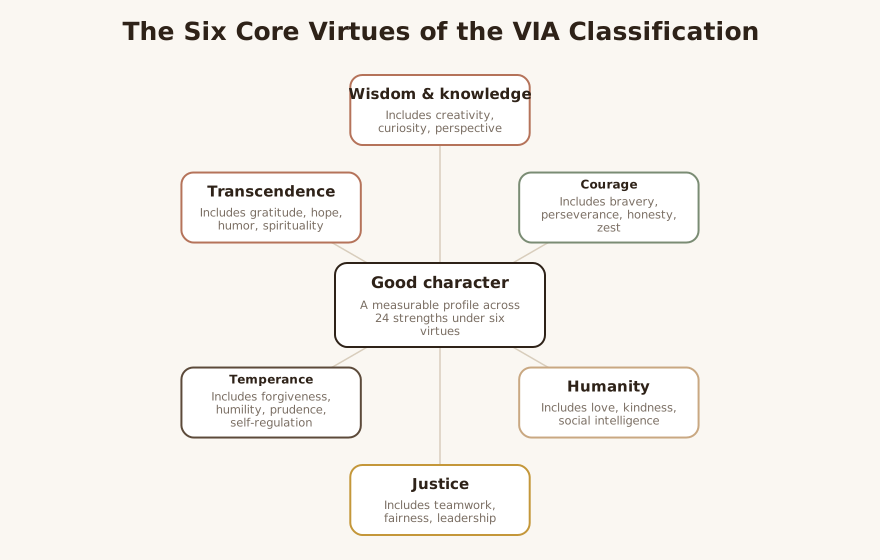
The VIA Classification of Character Strengths and Virtues is a taxonomy and measurement framework from the field of positive psychology rather than a discrete psychotherapy 2. It catalogs 24 character strengths that are organized conceptually under six broad, cross-culturally recurring virtues: wisdom, courage, humanity, justice, temperance, and transcendence 4. The acronym “VIA” originally stood for “Values in Action,” and the framework was designed explicitly as a positive counterpart to the diagnostic-and-pathology orientation of the DSM, classifying what is right with people rather than what is wrong 6. For a practicing clinician, the most accurate framing is that VIA is a shared language and an assessment system that can be embedded inside an evidence-based therapy, not a standalone modality with its own protocol LLM.
The classification belongs to the broader project Peterson and Seligman described as building a “manual of the sanities” — a structured account of human flourishing that could be studied scientifically 6. Because it is a measurement and conceptual framework, its clinical value comes from how it is operationalized within recognized treatment, supervision, coaching, and self-reflection contexts LLM.
Creators & Lineage
The VIA Classification was developed by Christopher Peterson and Martin Seligman and published in 2004 as the handbook Character Strengths and Virtues: A Handbook and Classification through Oxford University Press and the American Psychological Association 1. Seligman, widely regarded as a founder of the positive psychology movement, and Peterson, the project’s lead scientist until his death in 2012, convened a large group of scholars to survey philosophical and religious traditions across cultures and history in search of consensus virtues 6. The handbook is frequently described as a deliberate counterpart to the DSM, intended to give the science of positive traits the kind of common nomenclature that diagnostic manuals gave psychopathology 6.
The framework’s intellectual lineage runs through several streams LLM. From virtue ethics it inherits the six high-order virtues and the assumption that good character is composed of identifiable, cultivable traits rather than a single global quality 6. From humanistic psychology and well-being theory it inherits the conviction that psychology should study thriving and not only suffering, a commitment central to positive psychology as a discipline 2. The ongoing scientific stewardship of the classification — including efforts to refine its factor structure and clarify how the 24 strengths relate to the six virtues — has been carried forward by later researchers such as McGrath and colleagues 2.
Core Principles
The central claim of the VIA framework is that good character is plural and measurable: it is best described not as a single trait but as a profile across 24 distinct strengths 4. These 24 strengths are grouped under six virtues — wisdom and knowledge, courage, humanity, justice, temperance, and transcendence — that the authors argued recur across cultural and philosophical traditions 4. The strengths include, for example, creativity, curiosity, love of learning, perspective, bravery, perseverance, honesty, zest, love, kindness, social intelligence, teamwork, fairness, leadership, forgiveness, humility, prudence, self-regulation, appreciation of beauty, gratitude, hope, humor, and spirituality 4.
A defining concept is that of “signature strengths” — the handful of strengths an individual most strongly identifies with, that feel authentic and energizing to use 5. The framework holds that everyone possesses all 24 strengths to varying degrees, so the clinical and developmental task is not to acquire missing virtues but to recognize, prioritize, and deploy the strengths a person already has 5. Strengths are understood as more state-influenced and developable than fixed personality traits, which is what makes them a plausible target for intervention and coaching LLM.
Methodologically, the framework rests on self-report measurement. The associated instrument, the Values in Action Inventory of Strengths (VIA-IS), is a questionnaire that ranks an individual’s 24 strengths from most to least characteristic, and it has been completed by millions of people worldwide 6. The framework also distinguishes the conceptual six-virtue structure from the empirical factor structure that emerges from the data, an active area of research because the six theorized virtues do not map cleanly onto the dimensions that statistical analyses recover 2.
Interventions & Techniques
Because VIA is a framework rather than a manualized therapy, its “interventions” are activities and conversational moves that integrate strengths language into care LLM. The most common starting point is assessment: a client completes the VIA-IS or an abbreviated version, producing a rank-ordered profile that becomes material for discussion 6. Identifying signature strengths gives the clinician and client a vocabulary for what is already working 5.
The signature strengths-based interventions that have grown up around the framework include using a top strength in a new way each day, spotting strengths in oneself and others, and reframing problems through the lens of a relevant strength 5. These practices originated in positive psychology and are typically delivered as structured exercises or homework 2. Other VIA-adjacent practices documented in the explanatory literature include strengths-spotting in relationships and using the strengths profile to set goals aligned with what a person finds energizing 5.
LLM-generated illustrative example (not a guideline): A clinician working with a demoralized mid-career nurse reviews her VIA profile and notes that “perspective” and “humor” rank high while “self-regulation” ranks low. Rather than only targeting the deficit, the therapist helps her schedule one shift per week where she deliberately uses humor with colleagues, then uses that experience of agency as a foothold to behaviorally activate around sleep and exercise LLM.
Two cautions belong here. First, the technique most clinicians will actually use is conversational and integrative — weaving strengths language into CBT case conceptualization, behavioral activation, or motivational interviewing — rather than running a freestanding strengths protocol LLM. Second, the evidence for specific strengths exercises is more variable than enthusiasm for them suggests, so they are best framed as adjuncts LLM.
Evidence Base
The maturity of the VIA framework is best characterized as established as a measurement and conceptual system, while the clinical-outcome evidence for strengths-based interventions is more mixed and still developing 2. The classification itself is well-validated as a taxonomy: the VIA-IS has been administered to millions of respondents and has generated a substantial body of research on its structure, correlates, and cross-cultural applicability 6. A dedicated research literature, including a special collection of papers on VIA theory, research, and practice, documents associations between character strengths and outcomes such as life satisfaction and well-being 3.
The most honest summary is that the framework has strong construct and measurement credentials but ongoing structural debates 2. McGrath and Brown describe continued work to clarify how the 24 strengths aggregate — whether into the original six virtues or into a smaller number of empirically derived factors — which means the theory’s higher-order organization is still being refined rather than settled 2. For clinicians, the practical implication is that the 24-strength inventory is on firmer empirical ground than the six-virtue superstructure LLM.
On intervention efficacy, the literature supports character-strengths work as associated with increases in well-being and decreases in distress, but effect sizes and durability vary across studies and populations 3. Strengths interventions should therefore be offered as complements to first-line treatments for diagnosable disorders, not as substitutes LLM. The VIA Institute itself frames the work as a “science of character,” reflecting a research-grounded but still-evolving evidence base 7.
Populations & Indications
The framework was designed for the general population and has been applied broadly across the lifespan and across settings 4. Among adults, it is used in clinical, coaching, and organizational contexts to build self-efficacy and meaning 2. Adolescents and students are a major application area, where strengths language supports identity development and engagement 5. Employees and organizations use strengths profiling for team development and to clarify how individual contributions fit a shared purpose 5.
People in wellness coaching are a natural fit because the framework is non-pathologizing, accessible, and action-oriented, which suits a coaching frame LLM. Within psychotherapy, strengths work is most indicated for clients whose presenting concerns include erosion of a positive self-concept or a sense of meaning — for example low self-esteem, demoralization, burnout, lack of purpose, low life satisfaction, and languishing — where naming and mobilizing existing strengths can restore a sense of agency LLM. It is also used adjunctively with people carrying diagnoses such as major depressive disorder and anxiety, where it complements rather than replaces evidence-based treatment LLM.
Problems-for-Work
The following are common clinical problems where a strengths lens can add value, with brief application notes LLM.
- Low self-esteem and demoralization. A rank-ordered profile gives concrete, externally generated evidence of competence that can counter global negative self-appraisal; the clinician helps the client gather real-world examples of each top strength in action 5.
- Burnout. Re-engaging signature strengths in daily work can restore intrinsic motivation and a sense of fit when a role has become depleting LLM.
- Lack of meaning or purpose and languishing. The transcendence-cluster strengths (gratitude, hope, spirituality, appreciation of beauty) provide entry points for meaning-oriented conversation and goal-setting 4.
- Low life satisfaction. Character strengths have documented associations with life satisfaction and well-being, making strengths activities a reasonable adjunct for clients reporting flat or diminished satisfaction 3.
- Major depressive disorder and anxiety. Used alongside CBT or behavioral activation, strengths spotting can support behavioral experiments and counter the attentional negativity bias common in these conditions LLM.
LLM-generated illustrative example (not a guideline): A college student presenting with languishing and low life satisfaction completes the VIA-IS and finds “curiosity” and “love of learning” at the top. Within an acceptance-and-values framework, the therapist links these strengths to a values-consistent action — auditing one course outside her major — and tracks mood and engagement across two weeks as a behavioral experiment LLM.
Contraindications, Cautions & Cultural Humility
The VIA framework has no hard contraindications because it is an assessment-and-language tool, but several cautions are clinically important LLM. The most significant is the risk of toxic positivity: a premature pivot to strengths can feel invalidating to a client in acute distress, grief, or trauma, and can communicate that the clinician does not want to hear about suffering LLM. Strengths work is best introduced after rapport and adequate validation, and it should never displace risk assessment or treatment of an active disorder LLM.
A second caution concerns measurement limits. The VIA-IS is a self-report instrument, which makes it vulnerable to social desirability, limited self-insight, and state effects, so a profile should be treated as a conversation starter rather than an objective verdict on a person’s character 6. Clinicians should also remember that the higher-order virtue structure is still empirically contested, so they should hold the six-virtue map loosely 2.
On cultural humility, the framework’s authors argued for cross-cultural universality of the six virtues, but the meaning, valuation, and expression of specific strengths vary across cultures and contexts 6. A strength such as self-assertion-flavored “leadership” or “bravery” may be read very differently across collectivist and individualist contexts, and what counts as virtuous is not culture-neutral LLM. The ongoing scientific debate about whether the classification’s structure replicates across populations is itself a reminder to apply it with cultural and individual sensitivity rather than as a fixed standard 2.
Treatment-Plan Suggestions & SMART Objectives
| Goal | SMART objective (example) | Mechanism |
|---|---|---|
| Increase self-efficacy in a client with low self-esteem | Within 4 weeks, client will identify her top five signature strengths and document one real-world example of each, reviewed in session | Counters global negative self-appraisal with concrete competence evidence 5 |
| Reduce burnout in an employee | Over 6 weeks, client will use one signature strength in a new way at work weekly and rate energy 0–10 before and after | Restores intrinsic motivation and role fit through strengths use LLM |
| Build meaning for a client reporting languishing | Within 8 weeks, client will complete a daily gratitude or hope practice 5 days/week and report shifts in sense of purpose | Engages transcendence-cluster strengths linked to meaning 4 |
| Support mood adjunctively in MDD | Over 4 weeks, client will pair one strengths-spotting task with each behavioral-activation assignment | Reorients attentional bias and reinforces activation LLM |
| Improve life satisfaction | Within 6 weeks, client will set two goals aligned with top strengths and track satisfaction weekly | Leverages documented strength–satisfaction associations 3 |
| Increase relational connection | Over 4 weeks, client will practice strengths-spotting in one important relationship 3x/week and log responses | Builds positive relational attention and appreciation 5 |
| Stabilize a positive self-concept in an adolescent | Across 6 sessions, student will articulate how a signature strength shows up in school, family, and peers | Supports identity development through strengths language 5 |
Common Misconceptions
A frequent misconception is that VIA is a standalone treatment with proven efficacy comparable to established therapies; in reality it is a measurement and conceptual framework whose intervention evidence is mixed and still developing 2. A related error is treating the VIA-IS as a diagnostic instrument; it is a self-report ranking of relative strengths, not a clinical diagnostic test, and the framework was conceived as a complement to, not a substitute for, the DSM’s account of disorder 6.
Another misconception is that the six virtues are empirically established as the definitive structure of character; the higher-order organization remains under active investigation and does not map neatly onto data-derived factors 2. Clinicians also sometimes assume that low-ranked strengths are deficits to be fixed, when the framework’s own emphasis is on identifying and deploying signature strengths a person already has 5. Finally, the framework is sometimes read as culture-neutral, but the universality claim is about broad virtue categories, not about how specific strengths are valued or expressed in a given community 6.
Training & Certification
There is no licensure tied to using the VIA framework, and any appropriately trained clinician can incorporate strengths language into practice within their existing scope LLM. The primary scholarly reference for serious study is the original Peterson and Seligman handbook, which documents the rationale, the 24 strengths, and the measurement approach 1. The VIA Institute on Character maintains the official strengths list and public-facing educational materials, including the free assessment and an accessible “Science of Character” overview 47.
Clinicians wanting a structured introduction can begin with the institute’s strengths resources and the explanatory positive-psychology literature, then move to the peer-reviewed work on structure and application for a more critical understanding of the evidence 452. Because outcome evidence is still maturing, ongoing reading of the research literature is the most useful form of “continuing education” here rather than any single certificate LLM.
Key Terms
- Character strength — one of 24 measurable, positively valued traits that the framework treats as components of good character 4.
- Virtue — one of six broad, cross-culturally recurring categories (wisdom, courage, humanity, justice, temperance, transcendence) under which the 24 strengths are grouped 4.
- Signature strengths — the strengths an individual most identifies with and finds authentic and energizing to use 5.
- VIA-IS (Values in Action Inventory of Strengths) — the self-report questionnaire that produces a rank-ordered profile of a person’s 24 strengths 6.
- Manual of the sanities — the authors’ description of the classification as a positive counterpart to the DSM 6.
Resources & Further Reading
▶ Watch — a video introduction to this concept:
- Character Strengths and Virtues: A Handbook and Classification (Peterson & Seligman, 2004) 1
- Using the VIA Classification to Advance a Psychological Science of Virtue (McGrath & Brown, 2020, Frontiers in Psychology) 2
- Editorial: VIA Character Strengths — Theory, Research and Practice (PMC8060440) 3
- The 24 Character Strengths (VIA Institute on Character) 4
- What Are Character Strengths & Virtues? (PositivePsychology.com) 5
- Values in Action Inventory of Strengths (Wikipedia) 6
- The Science of Character (VIA Institute, video) 7
Reflective / Supervision Questions
- When I introduce strengths language with a distressed client, how do I confirm I have validated their suffering first rather than steering prematurely toward the positive? LLM
- Am I treating a client’s VIA profile as a conversation starter or am I over-reifying a self-report ranking as objective truth about their character? 6
- How do the specific strengths I tend to praise reflect my own cultural assumptions about what is virtuous, and how might they land differently for this client? 6
- For this client, is strengths work serving as a genuine adjunct to evidence-based treatment of their diagnosis, or is it quietly substituting for it? 2
- How would I document this strengths work so that it is clearly nested within a recognized billable modality and its treatment goals? LLM