
Type & Discipline
Active-constructive responding (ACR) is a communication technique, not a freestanding model of therapy. LLM It sits within relationship science and positive psychology, the research traditions that study how close relationships are built and maintained rather than only how they break down. 3 The core idea is that relationships are strengthened not just by managing conflict well but by how partners respond when one of them brings home good news. 3 In the literature, the act of telling someone about a positive event is called capitalization, and ACR names the most beneficial way a listener can respond to it. 3 Because it is a discrete, teachable behavior, ACR is best understood as a clinical skill that can be embedded inside a recognized therapy rather than billed as a therapy of its own. LLM
Creators & Lineage
The construct comes from the work of social psychologist Shelly Gable and her collaborators, most influentially Harry Reis, whose 2004 paper “What do you do when things go right?” formalized the model. 1 Their research drew on the broader study of capitalization — the observation that sharing good news with others amplifies the well-being benefits of the event beyond the event itself. 1 Martin Seligman later popularized ACR for a general and clinical audience in Flourish, arguing that couples work should attend to strengthening good relationships and not only to repairing distress. 45 The lineage thus runs from positive psychology and capitalization research into adjacent relationship-science frameworks such as attachment theory and the Gottman Method, which similarly emphasize responsiveness and the ratio of positive to negative interactions. LLM
Core Principles
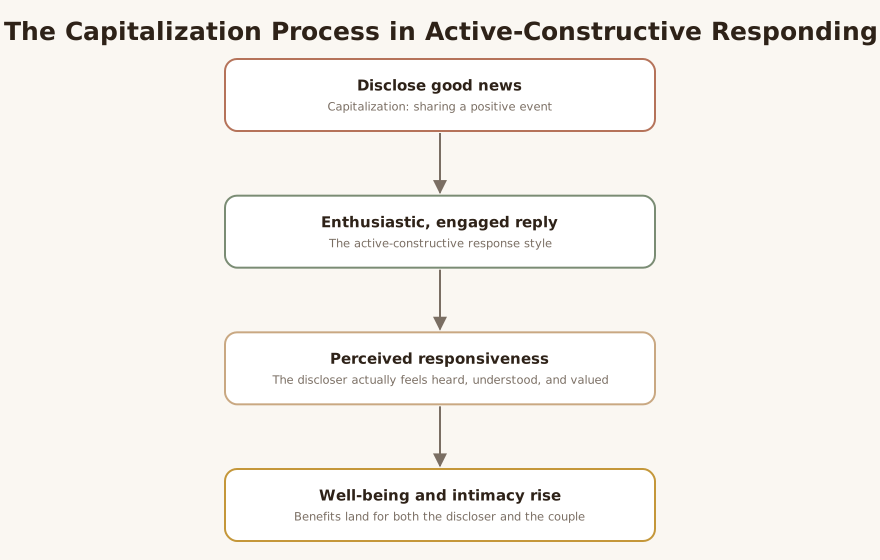
The first principle is that responding well to good news matters at least as much as responding well to bad news. 3 Gable’s program of research found that partner responses to positive events tend to predict relationship well-being better than responses to negative events. 3 The second principle is capitalization: disclosing a positive event is associated with greater positive emotion and life satisfaction on the day it is shared, above and beyond the impact of the event itself. 16 The third principle is perceived partner responsiveness — the discloser must actually feel heard, understood, and valued for the benefit to land, not merely receive words of praise. 2 When a partner responds with genuine enthusiasm and engagement, both the discloser’s well-being and the couple’s intimacy increase. 12 These effects are observable in everyday life, where people disclose the majority of their best daily experiences to a partner. 3
Interventions & Techniques
The organizing tool is Gable’s two-by-two model of response styles, crossing active versus passive with constructive versus destructive. 5 Active-constructive is enthusiastic, specific, engaged support — putting down the phone, making eye contact, and celebrating the news. 53 Passive-constructive is understated and lukewarm: “That’s nice,” while continuing to read. 53 Active-destructive points out the downsides of the good news, such as the new costs or risks it brings. 56 Passive-destructive ignores the news entirely or changes the subject. 56 Only the active-constructive style is associated with relationship commitment, satisfaction, intimacy, and trust. 5
In session, the practical techniques are concrete and rehearsable. The listener demonstrates that they genuinely heard the discloser, recognizes the news’s significance, acknowledges the effort behind it, and joins in celebration. 6 Nonverbal engagement matters: smiling, eye contact, and warm body language signal authenticity. 5 Elaborative questions (“What was that moment like?”) invite the discloser to relive and re-experience the positive emotion, which is part of how capitalization works. 5 Clinicians often assign a low-stakes behavioral homework — a single day of deliberate ACR — to build the habit. 5
LLM-generated illustrative example (not a guideline): A partner says, “I got shortlisted for the promotion.” An active-constructive reply is, “That’s huge — tell me how you found out, I want every detail.” A passive-constructive reply is a flat “Oh, good.” Coaching a client to notice that gap, and to choose the engaged version, is the heart of the intervention. LLM
Evidence Base
The descriptive science here is mature and well-replicated. Gable and colleagues’ foundational work spanned four studies across adolescents and adults using surveys, daily-diary methods, and follow-up over time, and found that capitalization predicted positive affect and that partner responses to good news predicted relationship outcomes — in some analyses more reliably than responses to bad news, including up to about two months later. 16 Dyadic, intensive-longitudinal replications support the same pattern: in a study of 99 couples coping with early-stage breast cancer, capitalization attempts and perceived partner responsiveness uniquely predicted daily intimacy for both members, independent of how they responded to negative events. 2
Honesty requires a clear caveat. What is established is the phenomenon — that responsive reactions to good news track with better relationships. 3 What is not yet established to the same standard is that training clients in ACR is a proven causal treatment with durable, generalizable outcomes; much of the evidence is correlational or observational rather than from randomized intervention trials. LLM Clinicians should treat ACR as an empirically grounded skill to teach, not as a manualized evidence-based therapy. LLM
Populations & Indications
ACR is most directly indicated for couples and romantic partners, the population in which it was developed and most often studied. 1 It extends naturally to families and to the parent-child relationship, where responding warmly to a child’s good news models the same dynamic. LLM It applies broadly to anyone in close relationships, including friendships, given how often people capitalize with those they are close to. 3 The evidence in medically stressed couples suggests it remains relevant even when a relationship is also coping with serious illness, where everyday positive moments still build intimacy. 2 It is a reasonable adjunct for clients presenting with emotional disconnection, loneliness, or a sense that the relationship has gone flat despite low overt conflict. LLM
Problems-for-Work
ACR maps onto several common presenting problems. For low relationship satisfaction and emotional disconnection, the work targets the missed micro-opportunities to connect over good news that erode intimacy over time. 3 For poor communication, the response-styles model gives a couple shared, non-blaming language for what is going wrong. 5 For intimacy difficulties, capitalization offers a low-threat route to closeness because it works through positive rather than vulnerable or conflictual disclosure. 2 For loneliness, deliberately seeking and savoring shared positive moments can rebuild felt connection. 1
LLM-generated illustrative example (not a guideline): A couple in low-conflict but distant cohabitation reports they “just coexist.” Rather than starting with conflict drills, the clinician has each track one piece of good news daily and practice an active-constructive reply, surfacing how often the bid was previously met with a passive shrug. LLM
Contraindications, Cautions & Cultural Humility
ACR is low-risk, but it is not always the right first move. LLM When a relationship is marked by abuse, coercive control, or active safety concerns, communication-skills coaching is contraindicated as a primary intervention and may be unsafe. LLM Where a client is in acute distress or grief, pushing positivity can feel invalidating, so timing and clinical judgment matter. LLM
Cultural humility is essential because the original evidence base has real limits. The dyadic capitalization replication, for example, was conducted in a sample that was roughly 86% White, well-educated, and very long-married, which constrains how confidently the findings generalize. 2 Norms for emotional expressiveness, enthusiasm, and praise vary across cultures and families, so “enthusiastic” support must be calibrated to what reads as genuine and responsive to that client, since perceived responsiveness — not a fixed display script — is the active ingredient. 2 Clinicians should avoid imposing a high-affect, mainstream-US expressive style as the universal standard. LLM
Treatment-Plan Suggestions & SMART Objectives
| Goal | SMART objective (example) | Mechanism |
|---|---|---|
| Increase active-constructive responses | Partner will respond active-constructively to at least 1 shared positive event per day, logged daily for 2 weeks | Capitalization amplifies positive affect and intimacy 1 |
| Reduce passive/destructive responses | Client will identify and reduce passive-destructive responses (ignoring/changing subject) to 0 in tracked interactions over 3 weeks | Non-constructive styles undermine satisfaction and trust 5 |
| Improve perceived partner responsiveness | Discloser will rate “felt understood/valued” at >=4/5 on >=70% of shared good-news events by week 4 | Perceived responsiveness drives intimacy gains 2 |
| Build elaborative engagement | Listener will ask >=1 open elaborative question per capitalization attempt in 3 consecutive sessions of role-play | Re-experiencing the event extends its benefit 5 |
| Strengthen nonverbal warmth | Partner will demonstrate eye contact and stop competing activity during good-news sharing in 80% of observed instances | Nonverbal cues signal authentic engagement 5 |
| Reduce emotional disconnection | Couple will report >=1 shared positive moment of felt closeness per day across a 2-week diary | Everyday positive events predict daily intimacy 2 |
| Generalize the skill | Client will apply ACR with a child or friend and report outcomes in 2 sessions | Capitalization operates across close relationships 3 |
Common Misconceptions
The most frequent error is conflating capitalization with ACR: capitalization is what the discloser does (sharing good news), while ACR is the optimal way the listener responds — a matched pair, not synonyms. 35 A second misconception is that “any positive reaction will do”; in fact passive-constructive lukewarm support is associated with worse outcomes than its mildness suggests, because it fails to signal genuine responsiveness. 5 A third is that responding to bad news is what holds couples together, when the research repeatedly shows responses to good news are often the stronger predictor of relationship health. 3 A fourth is treating ACR as performance: scripted enthusiasm without genuine engagement misses the mechanism, which is the discloser actually feeling understood and valued. 2
Training & Certification
There is no certifying body or credential specific to active-constructive responding; it is a technique taught within broader training, not a licensed therapy. LLM Clinicians typically encounter it through positive-psychology coursework, continuing education, or self-study of the primary literature and accessible secondary explainers. 45 The original research papers provide the conceptual foundation, while practitioner resources offer ready-to-use role-plays and homework structures. 15 Competence is best developed by integrating ACR into a modality the clinician is already trained and licensed to deliver. LLM
Key Terms
Capitalization — sharing a positive event with another person, which extends the well-being benefits beyond the event itself. 1 Active-constructive responding (ACR) — responding to shared good news with genuine enthusiasm and engaged interest, the optimal style. 5 Response styles model — Gable’s two-by-two of active/passive crossed with constructive/destructive. 5 Perceived partner responsiveness — the discloser’s sense of being understood, validated, and cared for, which mediates the benefit. 2 Passive-constructive / active-destructive / passive-destructive — the three suboptimal response styles associated with poorer relationship outcomes. 5
Resources & Further Reading
▶ Watch — a video introduction to this concept:
- Gable, Reis, Impett & Asher (2004), “What do you do when things go right?” — PubMed
- Capitalizing on everyday positive events predicts daily intimacy and well-being in couples (PMC)
- Positive Relationships — Noba Project
- Flourish — Martin Seligman (Simon & Schuster)
- What is Active Constructive Responding? — PositivePsychology.com
- Good news: sharing and responding — University of Rochester Medical Center
Reflective / Supervision Questions
- How do I, as a clinician, respond when clients bring good news into session — do I model active-constructive responding or rush back to the problem? LLM
- When a couple reports low conflict but persistent distance, do I screen for missed capitalization opportunities before assuming the issue is conflict? LLM
- How do I distinguish genuine perceived responsiveness from a client performing scripted enthusiasm? LLM
- How am I calibrating “enthusiastic” support to the client’s cultural and family norms rather than to a default expressive style? LLM
- Where might ACR coaching be contraindicated for this dyad, given safety, power dynamics, or acute distress? LLM
- How will I document and frame this skill so it is delivered within a recognized billable modality rather than as a standalone service? LLM