
Type & Discipline
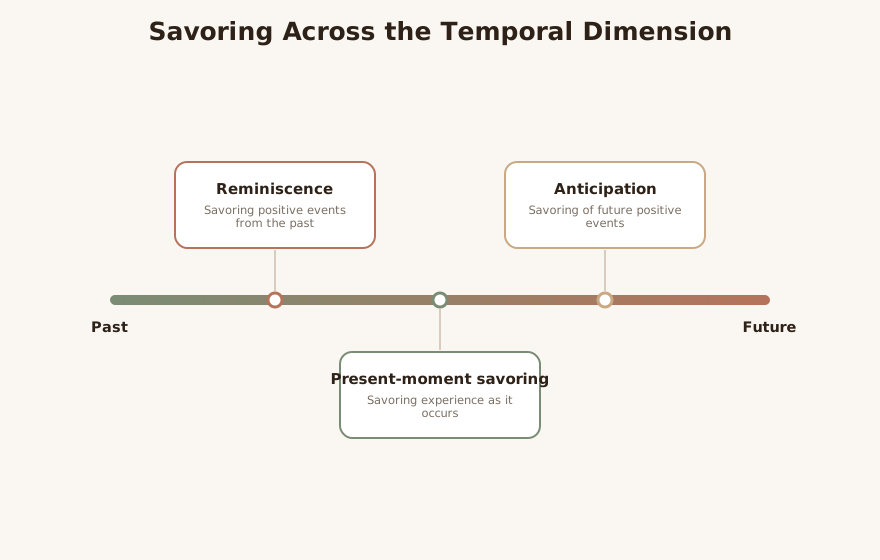
Savoring is a technique and a psychological capacity within positive psychology, not a free-standing therapy in its own right 1. It names the set of processes through which a person attends to, appreciates, and prolongs a positive experience, and the corresponding belief that one is able to do so 1. Bryant and Veroff frame savoring as the positive-affect counterpart to coping: where coping is what a person does to manage adversity and negative emotion, savoring is what a person does to generate, sustain, and deepen positive emotion 1. The construct is deliberately broad, spanning three time orientations — savoring the past through reminiscence, savoring the present through in-the-moment enjoyment, and savoring the future through anticipation 5. For clinicians it functions as a targeted, teachable skill that can be embedded inside an established modality rather than as a stand-alone protocol you deliver on its own LLM. Its clinical value is that it addresses a side of affective life that symptom-reduction work often leaves untouched: not the presence of distress, but the capacity to register and hold onto what is good LLM.
Creators & Lineage
The modern model of savoring was developed by Fred Bryant and Joseph Veroff, whose 2007 book Savoring: A New Model of Positive Experience consolidated two decades of their research into a unified framework 1. Bryant’s earlier work distinguished perceived control over positive outcomes from perceived control over negative ones, which seeded the idea that managing good feelings is a distinct competency from managing bad ones 5. The 2007 book introduced the temporal structure of past, present, and future savoring and the distinction between savoring as a process and the beliefs people hold about their savoring ability 1. The Penn Authentic Happiness resource, associated with Martin Seligman’s positive psychology program, presents the model as a core contribution to the field’s study of positive experience 5.
Savoring sits within the broader lineage of positive psychology and is conceptually adjacent to broaden-and-build theory, which supplies a rationale for why cultivating and prolonging positive emotion should be therapeutic rather than merely pleasant LLM. It overlaps substantially with mindfulness-based interventions, since present-moment savoring requires the same sustained, non-distracted attention to immediate experience 4. It is also frequently integrated into positive psychotherapy and into cognitive behavioral therapy as a positive-affect-building component alongside behavioral activation LLM. The construct has continued to develop, and a 2021 review in Frontiers in Psychology surveys the current state of theory and research and maps directions for future work 2.
Core Principles
The foundational principle is that the capacity to enjoy positive experiences is an active skill, not a passive reaction — positive feelings can be amplified, extended, and deepened through deliberate attention and behavior 1. Savoring is organized along two main dimensions 1. The first is the temporal dimension: anticipation of future positive events, savoring of present-moment experience, and reminiscence about positive events from the past 5. Each orientation has its own mechanisms; anticipating a pleasant event and reliving it afterward can each extend the affective benefit of a single experience well beyond the moment it occurs LLM. The second dimension distinguishes the focus of attention — savoring directed inward toward one’s own internal experience versus outward toward the world and others — and a related contrast between cognitive, reflective savoring and more immediate, absorptive experiential savoring 1.
A second principle is the distinction between savoring beliefs and savoring processes 1. Savoring beliefs are a person’s perceived capacity to enjoy positive experiences across the three time frames, while savoring processes are the specific strategies actually used in the moment 1. This matters clinically because someone may hold the belief that they cannot enjoy things — a belief especially common in depression — independent of whether they have ever practiced concrete savoring strategies LLM. A third principle is that certain mental habits dampen positive emotion rather than amplify it: prematurely shifting attention to problems, telling oneself the good feeling will not last, or suppressing expression all cut savoring short 4. Greater Good’s distillation of the research frames practical savoring as a set of countermeasures to these dampening habits — sharing positive experiences with others, taking mental photographs, staying present, and avoiding the reflex to move on too quickly 4.
Interventions & Techniques
Savoring techniques are concrete, brief, and easily assigned as between-session practice 3. A core set runs across the three time orientations. For the present, clinicians teach deliberate sensory absorption — slowing down to attend fully to a pleasant experience through sight, sound, taste, touch, and smell, often for a defined interval such as a single mindful minute with a daily activity 3. For the past, reminiscence techniques use photographs, mementos, or guided recall to relive positive memories, and structured positive-event journaling captures good experiences so they can be revisited 4. For the future, anticipation techniques ask clients to look forward to and mentally rehearse upcoming positive events, extending their affective reach before they arrive 5.
Several specific strategies recur in the literature. Sharing a positive experience with another person, sometimes called capitalizing, is one of the most reliable amplifiers 4. Memory-building — consciously taking a “mental photograph” to store an experience for later recall — strengthens later reminiscence 4. Sharpening perceptions by focusing on specific elements and deliberately blocking out distractions intensifies present enjoyment 4. Behavioral expression — smiling, laughing, voicing pleasure — tends to prolong the positive state, while suppression shortens it 4. Counter to these, clinicians help clients notice and interrupt kill-joy thinking: the automatic reminders of problems, comparisons, or impermanence that truncate good feelings 4. Positive-psychology practitioners often package these into structured exercises and worksheets a clinician can adapt to the individual client 3.
LLM-generated illustrative example (not a guideline): A therapist working with a client recovering from burnout assigns a nightly two-minute present-savoring practice tied to an existing daily ritual — a cup of tea. The client attends to warmth, aroma, and taste, deliberately setting aside the mental to-do list, and notes one detail to recall the next day. The framing is explicit: the aim is to rebuild the capacity to register pleasure that chronic stress has flattened, not to add another task LLM.
Evidence Base
The honest evidence picture has two layers, and conflating them overstates the case LLM. The construct and its measurement are well-established: Bryant and Veroff developed validated instruments, including the Savoring Beliefs Inventory and the Ways of Savoring Checklist, and a substantial body of correlational research links higher savoring capacity with greater happiness, life satisfaction, and well-being and with lower depressive symptoms 1. The model is theoretically mature, widely cited, and integrated across positive-psychology research, which justifies the “established” label for savoring as a construct 2. The 2021 Frontiers in Psychology review documents this progress while explicitly calling for further development of theory and research, indicating an active rather than settled field 2.
The clinical-intervention evidence is more modest and still developing LLM. Much of the strongest evidence is cross-sectional and correlational, which cannot establish that teaching savoring causes symptom change 2. Savoring is also frequently delivered as one component within multi-component positive-psychology or positive-psychotherapy packages, so isolating its specific contribution is difficult LLM. Clinicians should therefore present savoring as a well-grounded construct with promising but not definitive evidence as a stand-alone treatment, particularly for moderate-to-severe disorders, and position it as an adjunct that targets the low-positive-affect side of presentations like depression rather than as a primary intervention 2. The 2021 review’s emphasis on future directions is itself a signal that important questions — including for whom, in what dose, and through what mechanism savoring works best — remain open 2.
Populations & Indications
Savoring is most clinically apt where a deficit of positive affect or a diminished capacity to enjoy is central to the presentation, rather than only an excess of negative affect LLM. Adults with depression, and especially those whose depression features anhedonia and low positive affect, are a primary indication, because savoring directly targets the blunted-reward, reduced-enjoyment dimension that symptom-reduction approaches can leave intact 1. People with anhedonia outside a full depressive episode — for instance in the aftermath of chronic stress — similarly stand to benefit from rebuilding the capacity to register pleasure LLM. People with chronic stress and those experiencing burnout often present with a narrowed, problem-focused attentional style that crowds out positive experience, which savoring is designed to counter LLM.
The construct also generalizes to well-being promotion beyond disorder 3. Couples can use shared and reminiscence-based savoring to strengthen connection and relationship satisfaction LLM. Older adults are a natural fit for reminiscence-oriented savoring, drawing on a rich store of past positive experience LLM. People with chronic illness may use savoring to sustain quality of life and positive affect in the presence of ongoing limitation, where eliminating the stressor is not possible LLM. Across these groups savoring is an adjunctive skill and a rationale for cultivating positive experience, not a diagnosis-specific protocol LLM.
Problems-for-Work
In major depressive disorder with anhedonia and low positive affect, the work is rebuilding the capacity to notice and prolong small positive experiences, often starting with very brief present-moment savoring to counter the belief that nothing is enjoyable 1. In low mood and subclinical low positive affect, savoring practices add a positive-affect-building component to behavioral activation, so the client is not only doing more but also extracting and extending the reward from what they do LLM. In chronic stress and burnout, the work is interrupting a chronically problem-focused attentional style and deliberately reclaiming moments of recovery and pleasure, alongside the structural changes burnout actually requires 4. In low life satisfaction, reminiscence and anticipation practices broaden the client’s affective time horizon beyond a flat present 5.
In grief and adjustment disorder, savoring can be used carefully and later in the work to help a client reconnect with positive memories and re-engage with present life without negating the loss LLM. In relationship-focused work with couples, shared savoring and capitalizing on each other’s good news build positive connection LLM.
LLM-generated illustrative example (not a guideline): A clinician treating an older adult with an adjustment disorder following relocation introduces a weekly reminiscence practice using a photo album, pairing each positive memory with one present-day detail the client appreciates. The aim is to bridge a valued past and a still-unfamiliar present, building positive affect without dismissing the genuine difficulty of the transition LLM.
Contraindications, Cautions & Cultural Humility
Because savoring is a skill rather than a procedure with physical risk, the cautions concern timing, framing, and fit LLM. The most common error is deploying savoring in a way that invalidates real distress, loss, or injustice; pressing a grieving or acutely depressed client to “focus on the good” can read as dismissal and tip into a form of forced positivity that shames legitimate pain LLM. Savoring is generally poorly timed in acute grief, crisis, or fresh trauma, and belongs more to a stabilization-and-growth phase than to an acute one LLM. A client who holds strong negative savoring beliefs may experience early savoring attempts as failures, so starting small and normalizing difficulty matters 1. Savoring should not displace evidence-based treatment for moderate-to-severe disorders, where it is an adjunct rather than a substitute 2.
Cultural humility is important here LLM. Norms about expressing positive emotion vary widely; in some cultural contexts overt displays of pleasure or pride are discouraged, and outward, expressive savoring strategies may not fit LLM. Some traditions emphasize equanimity or non-attachment over the active intensification of positive feeling, and a client’s worldview may frame “holding on” to pleasure differently than the model assumes LLM. Clinicians should also recognize that structural realities — poverty, discrimination, unsafe environments, demanding caregiving — genuinely limit access to savorable experience, and no savoring practice substitutes for changing those conditions LLM. The skill should be offered collaboratively and tailored, never prescribed as a corrective to a client’s “failure” to appreciate their life LLM.
Treatment-Plan Suggestions & SMART Objectives
| Goal | SMART objective (example) | Mechanism |
|---|---|---|
| Build present-moment savoring | Client completes a 2-minute sensory savoring practice with one daily activity on 5 of 7 days for 4 weeks | Trains deliberate absorption to amplify and prolong present positive affect 4 |
| Counter anhedonia via positive events | Client records one positive event daily and one detail of why it mattered for 3 weeks | Re-engages noticing of reward to rebuild diminished positive affect 1 |
| Reduce kill-joy thinking | Client identifies and reframes dampening thoughts in 70% of logged savoring attempts over 4 weeks | Interrupts attention-shifting habits that truncate positive emotion 4 |
| Strengthen reminiscence | Client engages in a guided positive-memory recall using photos or mementos twice weekly for 6 weeks | Extends the affective benefit of past experience through reliving 5 |
| Use anticipation | Client identifies and mentally rehearses one upcoming positive event each week for 6 weeks | Extends positive affect forward in time before the event occurs 5 |
| Increase shared savoring | Client shares one positive experience with another person on 4 of 7 days for 4 weeks | Uses social sharing/capitalizing to intensify and sustain positive emotion 4 |
| Revise savoring beliefs | Client rates perceived capacity to enjoy experiences weekly and reviews evidence with clinician for 6 weeks | Targets savoring beliefs distinct from savoring behavior 1 |
Common Misconceptions
The first misconception is that savoring is the same as mindfulness; present-moment savoring shares mindfulness’s sustained attention, but savoring is specifically oriented toward intensifying and prolonging positive experience and includes past- and future-directed strategies that mindfulness practice does not emphasize 1. A second is that savoring means denying or avoiding negative emotion; the model treats savoring as the positive-affect counterpart to coping, not a replacement for it, and the two coexist 1. A third is that savoring is passive enjoyment that requires no skill; the central claim of the model is that it is an active, learnable capacity with identifiable strategies and beliefs 1. A fourth is treating savoring as a strongly evidenced stand-alone treatment for depression; the construct is well-established but the clinical-intervention evidence is more modest and often embedded in multi-component packages 2. A fifth is assuming savoring is only about the present moment, when anticipation and reminiscence are equally part of the model 5. Finally, some assume that more intensity is always better, when in fact the dampening habits people use — including the belief that a good feeling cannot last — are often the real obstacle, and removing them matters as much as adding new practices 4.
Training & Certification
There is no certification in savoring itself, because it is a research-based technique rather than a proprietary modality LLM. Clinicians typically encounter it through positive-psychology coursework, through Bryant and Veroff’s primary book and papers, and through accessible practitioner explainers and exercise collections 13. Practitioners who want to deliver savoring within a structured framework usually train in an adjacent approach — positive psychotherapy, mindfulness-based interventions, or cognitive behavioral therapy with a positive-affect component — and apply savoring as a targeted skill within it LLM. No additional scope of practice is created by using savoring; competence in the host modality the clinician is already credentialed in remains the relevant qualification LLM. The practical path is to understand the model well enough to teach its strategies, distinguish savoring beliefs from behavior, and frame the evidence honestly, including its limits as a stand-alone intervention 2.
Key Terms
Savoring — the capacity to attend to, appreciate, and prolong positive experiences, and the active processes used to do so 1. Savoring beliefs — a person’s perceived capacity to enjoy positive experiences across past, present, and future 1. Savoring processes — the specific in-the-moment strategies a person uses to generate, intensify, or extend positive emotion 1. Anticipation — future-oriented savoring; looking forward to and mentally rehearsing an upcoming positive event 5. Reminiscence — past-oriented savoring; reliving positive memories through recall, photographs, or mementos 5. Capitalizing / sharing — telling another person about a positive experience as a way of intensifying and sustaining it 4. Dampening / kill-joy thinking — habits such as shifting to problems, comparing, or telling oneself the feeling will not last, which cut savoring short 4. Savoring Beliefs Inventory — a validated self-report measure of perceived savoring capacity developed by Bryant 1.
Resources & Further Reading
▶ Watch — a video introduction to this concept:
- Savoring: A New Model of Positive Experience (Bryant & Veroff, 2007) — Routledge
- Current Progress and Future Directions for Theory and Research on Savoring (Frontiers in Psychology, 2021) — PMC
- Savoring in Positive Psychology: 21 Tools to Appreciate Life — PositivePsychology.com
- 10 Steps to Savoring the Good Things in Life — Greater Good Science Center, UC Berkeley
- Savoring: A New Model of Positive Experience — Authentic Happiness, University of Pennsylvania
Reflective / Supervision Questions
- When you introduce a savoring practice, how do you confirm the client experiences it as a meaningful skill rather than as a dismissal of their pain or a demand to perform happiness? LLM
- How do you judge whether a client is stable enough for savoring work, versus still needing acute symptom-focused or crisis intervention? LLM
- When you teach savoring, are you attending to savoring beliefs as well as behavior, or assuming that practicing the strategies will be enough on its own? LLM
- In which of your cases might active intensification of positive emotion collide with a client’s cultural or spiritual values around equanimity, restraint, or non-attachment? LLM
- Are you presenting savoring’s evidence honestly — a well-established construct but a more modest stand-alone clinical evidence base — or letting it drift into an overclaimed cure? LLM
- What would tell you that savoring is not helping a particular client, and what would you turn to instead? LLM