
Type & Discipline
Positive Psychotherapy (PPT) is a manualized, individual or group psychotherapy that sits within clinical psychology and belongs to the family of positive psychology interventions 3. Unlike a single technique, it is a structured, session-by-session treatment protocol designed to be delivered over roughly fourteen sessions 5. Its defining premise is a reorientation of the clinical target: rather than treating distress only by reducing deficits and symptoms, PPT works by deliberately building positive emotion, engagement, and meaning 1.
This makes PPT a deficit-and-asset model rather than a purely deficit model LLM. The clinician still attends to presenting symptoms, but the explicit theory of change is that strengthening positive resources buffers against and competes with psychopathology, rather than that symptom removal alone will produce well-being 1. For a practicing therapist, the most useful framing is that PPT operationalizes positive psychology into something a clinician can actually schedule, sequence, and document across a course of care LLM.
A naming caution is worth flagging immediately. The term “Positive Psychotherapy” also denotes an older, separate humanistic-psychodynamic method developed by Nossrat Peseschkian in Germany beginning in the late 1960s, organized around a “balance model” of four life dimensions and a five-stage process 8. That tradition is conceptually distinct from the positive-psychology-based PPT described here, which derives from Seligman, Rashid, and Parks 8. This article concerns the Seligman/Rashid model exclusively LLM.
Creators & Lineage
PPT was introduced in a 2006 American Psychologist paper by Martin Seligman, Tayyab Rashid, and Acacia Parks, working out of the University of Pennsylvania’s Positive Psychology Center 1. Seligman is the figure most associated with founding the positive psychology movement, and Tayyab Rashid is the clinician most responsible for translating that science into a treatment protocol 4. The work was later consolidated into the Positive Psychotherapy: Clinician Manual (Rashid & Seligman, Oxford University Press, 2018), which is the canonical practitioner reference 4.
Its intellectual lineage runs directly through positive psychology and Seligman’s well-being theory, including the PERMA framework — Positive emotion, Engagement, Relationships, Meaning, and Accomplishment LLM. PPT also draws on the VIA classification of character strengths as its assessment backbone, and it shares structural DNA with cognitive behavioral therapy: it is brief, manualized, exercise-driven, and uses homework between sessions 5. It has since been positioned not only as a treatment for symptomatic disorders but as a well-being and recovery-oriented approach 2.
Core Principles
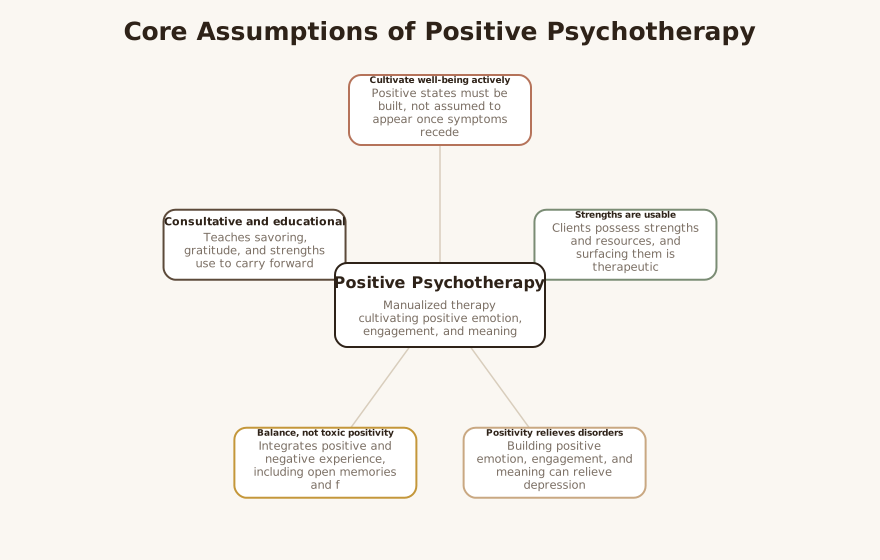
PPT rests on a small set of assumptions that distinguish it from symptom-focused therapies LLM. First, well-being is not merely the absence of distress; positive states must be actively cultivated, not assumed to appear once symptoms recede 1. Second, clients possess strengths and resources that are clinically usable, and surfacing these is itself therapeutic 4. Third, building positive emotion, engagement, and meaning can relieve disorders such as depression, which the founding studies set out to test directly 1.
Crucially, PPT is not relentless positivity LLM. The model explicitly works with the integration and balance of positive and negative experience, including dedicated work on difficult or “open” memories and on forgiveness, so that clients learn to hold both rather than suppress the negative 5. GoodTherapy frames the modality precisely as using strengths to promote balance, not to deny pain 6. This balance principle is the single most important corrective for clinicians who fear PPT amounts to toxic positivity LLM.
A final principle is consultative and educational: clients are taught skills (savoring, gratitude, strengths use) that they can carry forward independently, consistent with a wellbeing/recovery orientation rather than indefinite dependence on the therapist 2.
Interventions & Techniques
PPT is delivered as a sequenced arc of roughly fourteen sessions, often described in three movements: building positive resources and strengths, then working with the balance of good and difficult experiences, and finally consolidating meaning, relationships, and legacy 5. The protocol notes a mid-therapy check and acknowledges that the sequence varies by therapist and setting 5.
Representative sessions and their associated exercises include 5:
- Positive Introduction — the client writes a one-page true story in which they were at their best, demonstrating a personal strength with a positive ending.
- Signature Strengths — identification of character strengths via self-report, supplemented by ratings from two people who know the client well.
- Signature Strengths Profile / SMART goals — translating identified strengths into concrete behavioral goals.
- Good vs. bad experiences and open memories — working with negative or “open-book” memories rather than avoiding them.
- Forgiveness — including letter-writing toward a perceived transgressor (written, not necessarily sent).
- Gratitude journal and the Gratitude Visit — building awareness of, and directly expressing, gratitude.
- Satisficing vs. maximizing, Hope and optimism, and Positive communication — including active-constructive responding to others’ good news.
- Savoring — deliberately slowing and attending to positive experience.
- Gift of time, positive legacy, and the full life — consolidating meaning and relationships.
LLM-generated illustrative example (not a guideline): A clinician treating a client with anhedonic depression opens with the Positive Introduction. The client, who insists “there’s nothing good to say about me,” struggles to write the story, then recalls staying late to help a frightened new coworker. Naming “kindness” as a signature strength gives the dyad a foothold to build a behavioral activation plan around — not as cheerleading, but as a concrete, repeatable use of an existing capacity LLM.
Evidence Base
PPT’s evidence maturity is best described as established but uneven: it has genuine randomized support in depression and a broadening but thinner base elsewhere LLM. The founding 2006 work reported three findings of clinical note 1. Web-based positive psychology exercises relieved depressive symptoms for at least six months, outlasting a placebo whose effect faded within a week, with effects described as particularly striking in more severe depression 1. Group-delivered PPT significantly reduced mild-to-moderate depression through one-year follow-up 1. And, most notably for clinicians, individual PPT for major depressive disorder produced higher remission rates than treatment as usual and treatment as usual plus medication 1.
Beyond the founding trial, PPT has been applied and studied across a range of conditions — including anxiety, and in more challenging populations such as psychosis, suicidal ideation, and borderline personality disorder — and is reported to reduce depression and anxiety while improving life satisfaction 5. It has also been articulated as a wellbeing approach to recovery for people with more serious mental illness 2. A clinician should weight these wider applications more cautiously than the depression findings: they reflect a smaller and more heterogeneous literature, and the foundational randomized evidence is concentrated in depression LLM.
Populations & Indications
PPT was built and tested first with adults presenting with depression, and that remains its strongest indication 1. It is delivered in both individual outpatient and group formats, with group delivery specifically validated for mild-to-moderate depression 1. The Oxford manual frames PPT as adaptable across populations and explicitly “not one size fits all,” with documented application to adolescents and to multicultural contexts 4.
In practice, PPT is most clearly indicated for outpatient clients with depression, subclinical or residual depressive symptoms, anxiety disorders, and the broad band of languishing — low life satisfaction, anhedonia, pessimism, low self-esteem, and a felt absence of meaning — where the client is symptomatic enough to want help but where pure symptom-reduction has stalled 5. It also has a natural fit with recovery-oriented work, where the goal is a life worth living rather than only symptom suppression 2.
Problems-for-Work
- Major depressive disorder / residual symptoms — the primary indication; signature-strengths work and gratitude/savoring exercises target the anhedonic, low-positive-affect core that often persists after symptom-focused treatment 1.
- Anhedonia — savoring and active-constructive responding directly rehearse the capacity to register and amplify positive experience 5.
- Anxiety disorders — hope/optimism and balance work can be paired with exposure or cognitive work to rebuild approach motivation 5.
- Languishing and low life satisfaction — the “full life” and positive legacy sessions give structure to clients who are not in crisis but feel stuck or empty 5.
- Pessimism and low self-esteem — the Positive Introduction and strengths feedback from loved ones provide concrete, externally corroborated evidence against global negative self-views 5.
- Lack of meaning — meaning, relationships, and legacy work address the M and R of PERMA explicitly LLM.
LLM-generated illustrative example (not a guideline): A high-functioning adult reports no crisis but persistent flatness and “going through the motions” — a languishing presentation. PPT’s gratitude visit and gift-of-time exercises are sequenced to re-engage relationships, while the full-life session reframes vague dissatisfaction into a workable conversation about meaning LLM.
Contraindications, Cautions & Cultural Humility
PPT is not a crisis intervention and should not displace evidence-based acute care for active suicidality, psychosis, mania, or severe trauma symptoms; even where PPT has been studied in such populations, it functions as part of a broader treatment plan, not a standalone substitute LLM. The largest clinical risk is misapplication as forced positivity. Because the protocol deliberately includes work with negative and open memories and with forgiveness, the clinician must resist invalidating a client’s distress — the model’s own balance principle requires holding the negative, not papering over it 56.
Cultural humility is built into the modality’s stated stance: PPT positions itself as adaptable across cultures and explicitly rejects a one-size-fits-all delivery 4. In practice this means strengths, gratitude, and savoring should be elicited in the client’s own cultural and relational frame rather than imposed from a Western individualist template, and the clinician should be alert that constructs like “optimism” or “achievement” carry different weight across communities LLM. The name itself is a source of confusion to manage with referrers and clients, given the unrelated Peseschkian tradition that shares the label 8.
Treatment-Plan Suggestions & SMART Objectives
| Goal | SMART objective (example) | Mechanism |
|---|---|---|
| Increase positive affect / reduce anhedonia | Client completes a daily gratitude journal (3 entries) for 4 of 7 days each week over 6 weeks | Builds attention to positive experience; rehearses positive emotion (PERMA-P) 5 |
| Identify and use signature strengths | Client completes a strengths assessment plus ratings from 2 close others within 2 sessions, then applies one strength in a new way weekly for 4 weeks | Surfaces usable assets; corroborated feedback counters negative self-view 5 |
| Improve life satisfaction / reduce languishing | Client reports a measurable rise on a life-satisfaction or well-being measure by session 12 | Targets meaning, engagement, and relationships across the protocol 2 |
| Strengthen relationships | Client practices active-constructive responding in at least 3 conversations weekly for 4 weeks | Enhances positive relating (PERMA-R) 5 |
| Reduce depressive symptoms | Client achieves a clinically meaningful drop on a depression measure (e.g., PHQ-9) by session 14 | PPT shown to raise remission rates vs. usual care in MDD 1 |
| Process and rebalance negative memory | Client completes the open-memory and forgiveness exercises by session 7 without symptom exacerbation | Integrates negative with positive rather than suppressing it 5 |
| Build savoring capacity | Client deliberately savors one daily positive experience, logged 5 days/week for 4 weeks | Amplifies and prolongs positive affect 5 |
Common Misconceptions
“PPT is just thinking positive.” No — the protocol explicitly works with negative and open memories, forgiveness, and the integration of good and bad experience; its organizing aim is balance, not denial 56.
“It’s the same as Peseschkian’s Positive Psychotherapy.” No — that is a separate German humanistic-psychodynamic tradition built on a four-dimension balance model; the modality here derives from Seligman, Rashid, and Parks and from positive psychology 8.
“It has no real outcome data.” The founding randomized work reported higher remission rates than treatment as usual in major depression and durable web-based and group effects, so the depression evidence is more than anecdotal — even if the wider claims rest on a thinner base 1.
“It’s only for people who aren’t really ill.” While best evidenced in depression, PPT has been extended to recovery-oriented work in more serious presentations as part of broader care 25.
Training & Certification
PPT is learned primarily through its manual rather than a single gatekeeping credential LLM. The core practitioner text is the Positive Psychotherapy: Clinician Manual by Rashid and Seligman (Oxford University Press, 2018), which lays out the session sequence and exercises and is the natural starting point for a licensed clinician adopting the approach 4. Tayyab Rashid maintains practitioner-facing resources and has disseminated the approach publicly, including a TEDx talk introducing its strengths orientation 7. Because PPT is delivered within standard psychotherapy practice, clinicians should integrate it under their existing license and scope, using the manual and accompanying materials as the procedural reference 4.
Key Terms
- PPT — Positive Psychotherapy; a manualized, ~14-session treatment building positive emotion, engagement, and meaning 15.
- PERMA — Seligman’s well-being model: Positive emotion, Engagement, Relationships, Meaning, Accomplishment LLM.
- Signature strengths — a client’s most characteristic character strengths, identified by self-report plus others’ ratings and applied deliberately 5.
- Positive Introduction — the opening exercise: a true story of the client at their best 5.
- Active-constructive responding — an enthusiastic, engaged way of responding to another’s good news, used to strengthen relationships 5.
- Open/open-book memories — unresolved negative memories that PPT works with rather than avoids 5.
- Languishing — a state of low well-being without acute disorder, a natural PPT target 5.
Resources & Further Reading
▶ Watch — a video introduction to this concept:
- Seligman, Rashid & Parks (2006), American Psychologist — the founding paper (PubMed)
- Positive Psychotherapy: A wellbeing approach to recovery (APA PsycNet record)
- Positive Psychotherapy — The Wiley Handbook of Positive Clinical Psychology
- Positive Psychotherapy: Clinician Manual (Rashid & Seligman, Oxford, 2018) — author page
- What is Positive Psychotherapy? (Benefits & Model) — PositivePsychology.com
- Positive Psychotherapy: Using Strengths to Promote Balance — GoodTherapy
- What Are You Good At? — Tayyab Rashid at TEDxUTSC (video)
- Positive psychotherapy — Wikipedia (note: covers both traditions)
Reflective / Supervision Questions
- When I introduce strengths or gratitude work, am I genuinely building balance, or am I inadvertently signaling that the client’s distress is unwelcome in the room? 6
- For this client, is the depression evidence enough to justify PPT as a primary approach, or should it augment a more strongly evidenced treatment given a presentation outside the best-studied band? 1
- How do this client’s cultural and relational context reshape what “strengths,” “optimism,” or “meaning” should mean — and am I eliciting these rather than importing them? 4
- Am I documenting PPT exercises against a clear diagnostic target and functional goal, so the work is both clinically coherent and defensible? LLM
- Where in the session arc does this client most need to slow down — the resource-building phase, the balance/forgiveness work, or the meaning-and-legacy consolidation? 5