
Type & Discipline
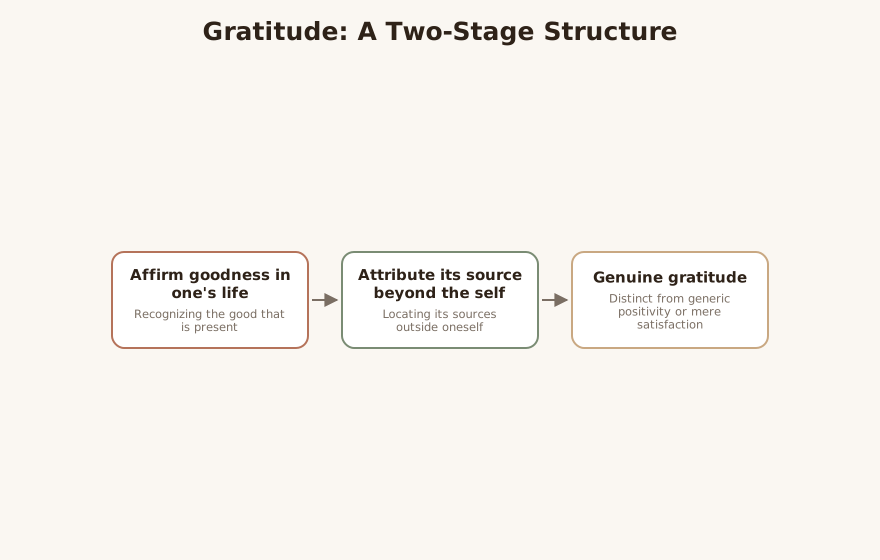
Gratitude is a construct within positive psychology, not a standalone treatment modality LLM. It is most rigorously defined as a two-stage process: first, an affirmation of goodness in one’s life, and second, the recognition that the sources of that goodness lie at least partly outside oneself 4. Because the second stage situates benefit in the actions of others, gratitude is fundamentally relational and is often described as a relationship-strengthening emotion 4. Researchers study it on three levels: as a transient emotional state, as a longer mood, and as a stable dispositional trait that varies between people 1. Clinicians most often encounter it operationalized as a cultivable practice rather than a fixed quality, which is what makes it a candidate for intervention rather than merely an outcome to measure 5. Understanding which level you are targeting—a momentary state, a habitual practice, or a trait—shapes both the technique you choose and the change you can realistically expect LLM.
Creators & Lineage
The modern empirical study of gratitude is associated chiefly with Robert Emmons and Michael McCullough, whose collaborative work in the early 2000s gave the field both its dominant conceptual model and its primary measure 1. Their edited volume, The Psychology of Gratitude, helped consolidate gratitude as a legitimate subject of scientific psychology rather than a purely moral or theological category 6. The construct sits within the broader positive-psychology movement and draws conceptually on Barbara Fredrickson’s broaden-and-build theory, which holds that positive emotions widen momentary thought-action repertoires and build durable personal resources over time 5. Gratitude also overlaps with the character-strengths tradition, in which it appears as one of the cataloged virtues, and with well-being therapy, an intervention framework that deliberately cultivates positive psychological functioning rather than only reducing symptoms LLM. This lineage matters clinically: it locates gratitude alongside other strengths-based approaches rather than as a discrete school of therapy LLM.
Core Principles
The first principle is the two-stage structure—affirming goodness, then attributing it beyond the self—which distinguishes genuine gratitude from generic positivity or mere satisfaction 4. Second, gratitude is conceived as both trait and state, so a person can be dispositionally grateful yet still benefit from deliberate state-level practice 1. McCullough and colleagues described the grateful disposition along four facets: intensity (how strongly gratitude is felt), frequency (how often), span (how many life domains evoke it), and density (how many people one feels grateful to for a given outcome) 1. Third, gratitude is relational and prosocial: it tends to strengthen social bonds and motivate helping behavior, which is part of why its benefits extend beyond mood 4. Fourth, the construct is held to be trainable—benefits are thought to be accessible even to people without a naturally grateful temperament through structured practice 4. A clinician should treat these as testable assumptions, not guarantees, given the modest size of intervention effects discussed below LLM.
Interventions & Techniques
Gratitude techniques are simple, low-cost, and easily embedded in other treatments LLM. The most studied is the gratitude journal or “counting blessings,” in which a client periodically lists things they are grateful for; in the foundational experimental work this was contrasted with listing hassles or neutral events 2. The gratitude letter and gratitude visit involve writing—and ideally reading aloud—a detailed letter of thanks to a benefactor, an exercise associated with increased happiness and reduced depressive symptoms 5. Three Good Things asks clients to record three positive events each day and reflect on their causes 5. Mental subtraction invites the client to imagine the absence of a valued person or circumstance, sharpening appreciation by counterfactual contrast 5. Gratitude meditation and brief verbal expressions of thanks round out the toolkit 5. Notably, the meta-analytic evidence suggests that combining several gratitude techniques outperforms any single one, which argues for a layered rather than monotherapeutic approach 3.
LLM-generated illustrative example (not a guideline): A clinician treating a client with persistent low mood pairs Three Good Things with a weekly gratitude letter, asking the client to attend specifically to who contributed to each good event—engaging the relational second stage rather than cataloging pleasant circumstances alone LLM.
Evidence Base
The maturity here requires an honest split. As a construct, gratitude is well established: it is reliably measured, conceptually distinct, and embedded in a large literature 1. As an intervention, the effects are real but modest. The most comprehensive synthesis to date—a 2025 meta-analysis spanning 145 papers, 163 samples, 727 effect sizes, and 24,804 participants across 28 countries—found that gratitude interventions produced only a small overall increase in well-being (Hedges’ g = 0.19) 3. Effects were larger for positive affect than for reducing negative affect, larger when multiple techniques were combined, and larger in randomized trials than in weaker designs 3. Crucially, gratitude interventions did not reliably outperform other positively valenced activities, meaning the gains may not be specific to gratitude itself 3. Effects also varied widely by country—substantial in some settings, non-significant in Japan, France, and India—and country-level individualism/collectivism did not explain the variation 3. The earlier experimental work reported well-being and some physical-functioning benefits from counting blessings, but clinicians should weight the larger, more recent synthesis accordingly 2.
Populations & Indications
Gratitude practices are most clearly indicated for adults seeking general well-being enhancement, where they offer a low-burden adjunct to other care 5. There is empirical interest in people with depression, given associations between gratitude and reduced depressive symptoms, though the modest and possibly non-specific effect sizes counsel against treating gratitude as a primary intervention for major depression 3. The foundational studies sampled both healthy undergraduates and adults living with chronic neuromuscular disease, supporting cautious use with people managing chronic illness 2. Older adults, caregivers, and students appear frequently in the literature as populations for whom brief, self-administered practices are practical and acceptable 5. Across these groups, gratitude is best framed as a complement that may improve positive affect and relational connection rather than as a stand-alone remedy for a diagnosed disorder LLM. Indication should rest on the client’s current capacity to engage with positive material, not solely on diagnosis LLM.
Problems-for-Work
For anhedonia and low positive affect, gratitude techniques are a reasonable target because their strongest measured effect is on positive affect specifically 3. For negativity bias and rumination, deliberately directing attention toward benefits and their sources offers a structured counterweight to habitual negative scanning 4. For low life satisfaction, regular practice has been linked to gains in subjective well-being, the construct life satisfaction belongs to 2. For loneliness, the relational stage of gratitude—recognizing what others contribute—can be leveraged to rebuild a sense of connection, consistent with gratitude’s described role in strengthening bonds 4. For burnout and stress in caregivers and clinicians, brief practices are attractive precisely because they are low-effort and self-administered 5. For low self-esteem, mental subtraction and gratitude letters can shift attention from perceived deficits toward received goods LLM.
LLM-generated illustrative example (not a guideline): With a burned-out caregiver, a clinician introduces a two-minute end-of-shift gratitude note focused on one supportive interaction, aiming to interrupt the day’s accumulated stress rather than to resolve the structural demands driving the burnout LLM.
Contraindications, Cautions & Cultural Humility
Gratitude is generally low-risk, but it is not universally appropriate, and clinicians should avoid imposing it 5. In acute grief, fresh trauma, or active depressive crisis, premature prompts to “find the good” can read as invalidating and may rupture the alliance, so timing and framing matter LLM. The cross-cultural data are a direct caution against assuming portability: intervention effects were significant in some countries and non-significant in others, and the usual cultural explanations did not account for the difference—so a practice that helps one client may do little for another 3. Because effects did not exceed those of other positive activities, a clinician should not privilege gratitude over a client’s own preferred sources of positive engagement 3. Watch, too, for clients who use gratitude to suppress legitimate anger or need (“I shouldn’t complain”); the goal is to widen affect, not to police it LLM. Offer gratitude as one option among several and calibrate to the client’s values LLM.
Treatment-Plan Suggestions & SMART Objectives
| Goal | SMART objective (example) | Mechanism |
|---|---|---|
| Increase positive affect | Client will complete a Three Good Things log on at least 5 of 7 evenings weekly for 4 weeks, rating daily mood 5. | Directs attention to benefits, the domain with the strongest measured effect 3. |
| Reduce rumination | Client will redirect to a benefit-and-source entry within 10 minutes of noticing a rumination spiral, logged 3x/week for 6 weeks 4. | Supplies a competing attentional focus to negative scanning 4. |
| Rebuild connection (loneliness) | Client will write and deliver one gratitude letter to a chosen person within 3 weeks 5. | Activates the relational, prosocial stage of gratitude 4. |
| Counter low self-esteem | Client will complete two mental-subtraction reflections per week for 4 weeks, noting valued people/circumstances 5. | Counterfactual contrast highlights received goods over deficits LLM. |
| Buffer caregiver stress | Client will record one end-of-shift gratitude note daily, 5 days/week, for 1 month 5. | Brief, self-administered practice fits high-demand routines 5. |
| Raise life satisfaction | Client will maintain a weekly gratitude journal for 8 weeks and re-rate satisfaction at midpoint and end 2. | Repeated benefit-affirmation linked to subjective well-being gains 2. |
| Strengthen practice durability | Client will combine journaling with one weekly relational gratitude act for 6 weeks 3. | Combined interventions show larger effects than single techniques 3. |
Common Misconceptions
A frequent misconception is that gratitude is simply optimism or positive thinking; the two-stage definition specifies an outward attribution to sources beyond the self, which generic positivity lacks 4. Another is that gratitude is a fixed personality trait you either have or do not—whereas the literature treats it as both trait and trainable state 1. Clinicians sometimes overstate the magnitude of benefit; the best current evidence shows small effects that may not exceed those of other positive activities, so framing gratitude as a powerful stand-alone treatment is not supported 3. A related error is assuming universal effectiveness: the cross-cultural variability in the meta-analysis directly contradicts a one-size-fits-all expectation 3. Finally, some equate gratitude with denial or forced cheerfulness, but cultivating appreciation does not require suppressing distress, and using it that way works against its intended broadening function LLM.
Training & Certification
There is no certifying body or formal credential specific to gratitude practice, because it is a construct and technique set rather than a licensed modality LLM. Competence comes instead from grounding in positive-psychology frameworks—broaden-and-build theory, character strengths, and well-being-oriented intervention—within which gratitude techniques are taught 5. Primary-source familiarity is valuable: the conceptual model and the GQ-6 disposition measure originate in the McCullough, Emmons, and Tsang work, and the edited volume The Psychology of Gratitude offers a consolidated scholarly overview 16. Practically oriented clinicians can draw on accessible syntheses and exercise libraries from reputable centers to learn protocol details such as the gratitude visit or mental subtraction 5. Because the techniques are simple, the harder skill is judgment—knowing when, with whom, and how to introduce gratitude without invalidating distress—which is developed through supervision rather than certification LLM.
Key Terms
- Affirmation of goodness: the first stage of gratitude, recognizing benefits and positives in one’s life 4.
- External attribution of sources: the second stage, acknowledging that the goodness comes at least partly from outside oneself 4.
- Grateful disposition: the stable trait-level tendency to experience gratitude across situations 1.
- GQ-6: a brief self-report measure of dispositional gratitude developed in the foundational work 1.
- Four facets (intensity, frequency, span, density): dimensions describing how the grateful disposition is expressed 1.
- Counting blessings: the journaling paradigm contrasting gratitude with hassles or neutral events 2.
- Mental subtraction: imagining the absence of a valued thing to heighten appreciation 5.
- Broaden-and-build: the theory that positive emotions widen thought-action repertoires and build lasting resources 5.
Resources & Further Reading
▶ Watch — a video introduction to this concept:
- The Grateful Disposition: A Conceptual and Empirical Topography (McCullough, Emmons & Tsang, 2002)
- Counting Blessings Versus Burdens (Emmons & McCullough, 2003, JPSP)
- A Meta-Analysis of the Effectiveness of Gratitude Interventions on Well-Being Across Cultures (PNAS, 2025)
- Gratitude: Definition — Greater Good Science Center, UC Berkeley
- What Is Gratitude and Why Is It So Important? (PositivePsychology.com)
- The Psychology of Gratitude (Emmons & McCullough, eds.)
- Why Gratitude Works (Greater Good, video)
Reflective / Supervision Questions
- For this specific client, am I introducing gratitude because it fits their values and capacity, or because it is easy and I default to it? LLM
- Given the modest and culturally variable evidence, have I set realistic expectations with the client about what gratitude practice can and cannot do? 3
- Am I attending to the relational second stage of gratitude, or have I let the exercise collapse into generic positive thinking? 4
- Could a gratitude prompt be landing as invalidation given the client’s current grief, trauma, or crisis state, and how would I know? LLM
- If a client’s preferred positive activity differs from gratitude, am I willing to follow their lead, knowing the evidence does not privilege gratitude over other positive practices? 3
- How am I tracking whether the practice is actually shifting positive affect, rather than assuming benefit from adherence alone? 3