
Type & Discipline
Self-Determination Theory (SDT) is a broad, empirically grounded theory of human motivation, personality development, and well-being 1. It sits within motivation psychology and the wider family of well-being and self-regulation theories, and it has been applied across education, healthcare, work, sport, and parenting 3. Rather than asking only how much motivation a person has, SDT asks about the quality and source of that motivation — whether behavior is experienced as volitional and self-endorsed or as controlled and pressured 1. For clinicians, this reframing matters because the form of a client’s motivation, not merely its intensity, predicts whether change endures 7. SDT is best understood as a meta-theory composed of six interrelated mini-theories that together specify the conditions under which people thrive 1.
Creators & Lineage
SDT was developed by Edward Deci and Richard Ryan, beginning with Deci’s experimental work on rewards in the early 1970s 5. Deci’s 1971 studies showed that tangible external rewards could undermine intrinsic motivation for an already-interesting task, while verbal praise and positive feedback tended to enhance it — a finding that anchored the theory’s distinction between controlling and informational events 5. The framework was formally consolidated when Deci and Ryan published Intrinsic Motivation and Self-Determination in Human Behavior in the mid-1980s 5. The most comprehensive contemporary statement of the theory is Ryan and Deci’s 2017 volume, Self-Determination Theory: Basic Psychological Needs in Motivation, Development, and Wellness 4.
The theory’s intellectual lineage runs through humanistic psychology, which contributed its emphasis on growth, self-actualization, and the person’s own evaluative standpoint, while SDT added a program of controlled experimentation and needs research 5. SDT in turn became a primary theoretical scaffold for motivational interviewing (MI), with practitioners attributing MI’s effects to the autonomy-supportive atmosphere it creates, allowing clients to locate their own source of motivation rather than absorbing external pressure 5. These connections — to humanistic roots and to motivational treatment — make SDT especially legible to therapists trained in client-centered traditions LLM.
Core Principles
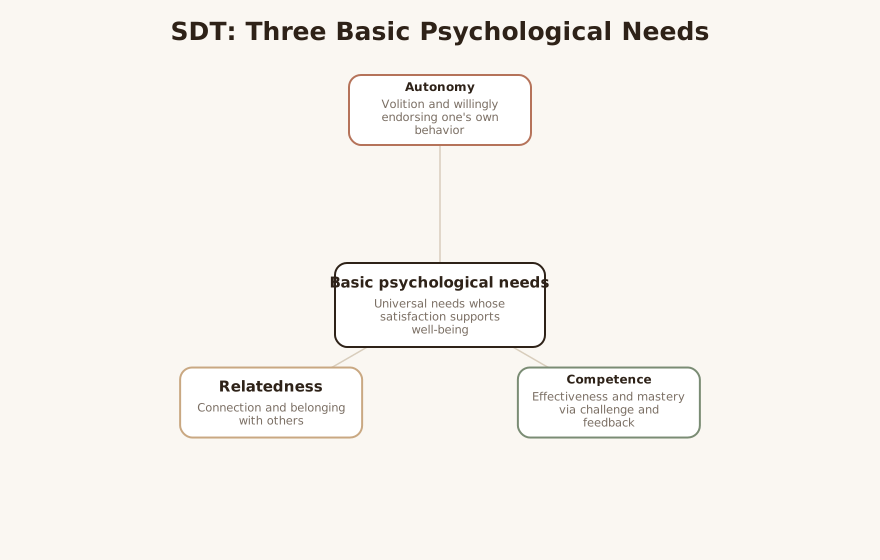
At the center of SDT are three basic psychological needs that are proposed to be universal: autonomy, competence, and relatedness 1. Autonomy is the experience of volition and initiative — the sense that one is willingly endorsing one’s own behavior rather than feeling controlled or compelled 7. Competence is the experience of effectiveness and mastery, supported by optimal challenges, structure, and feedback 7. Relatedness is the sense of connection and belonging with others, fostered by empathic, caring engagement 7. The theory holds that to the extent these needs are ongoingly satisfied, people develop and function well and experience wellness, whereas when they are thwarted, ill-being and non-optimal functioning follow 1.
The second pillar is the motivation continuum 1. SDT distinguishes intrinsic motivation — doing something for its own sake, out of inherent interest and enjoyment — from extrinsic motivation, behavior that is instrumental toward an outcome separate from the activity itself 1. Crucially, extrinsic motivation is not a single thing; it spans an internalization continuum from less to more autonomous regulation 1. As people internalize the value of a behavior, their regulation moves toward greater autonomy and the behavior is enacted more volitionally 1.
Social contexts shape this process 1. Cognitive Evaluation Theory addresses how rewards and controls affect intrinsic motivation, predicting that controlling events erode it while informational events that support competence can enhance it 1. This explains the well-documented overjustification or undermining effect: when an external reward is introduced for an activity a person already enjoys, the perceived reason can shift from “I do this because I enjoy it” to “I do this for the reward,” diminishing the original intrinsic motivation 5. Autonomy-supportive environments — those that acknowledge the person’s perspective and minimize pressure — tend to sustain motivation and well-being, whereas controlling environments thwart autonomy and reduce both 6.
Interventions & Techniques
SDT is a theory rather than a manualized treatment, but it specifies a clear and clinically usable stance often summarized as autonomy support 7. The clinician supports autonomy by grasping and acknowledging the person’s wishes, preferences, and perspectives, and by refraining from trying to control or pressure them 7. In practice this means offering meaningful choice, providing a rationale for recommendations, eliciting the client’s own reasons for change, and minimizing controlling language such as “should” and “must” LLM. URMC frames the clinician’s role as providing evidence-based information while supporting the client’s psychological needs, so that the person discovers sustainable change rather than complying with short-term external incentives 7.
Competence support is delivered through structure, optimal challenge, and clear, non-judgmental feedback that builds a sense of effectiveness 7. Relatedness support is conveyed through warmth, empathy, and unconditional positive regard, so that the therapeutic relationship itself becomes a vehicle for need satisfaction 7. Because verbal praise and competence-affirming feedback can enhance rather than undermine intrinsic motivation, clinicians can reinforce progress informationally — naming what the client did effectively — without converting an intrinsically engaging activity into a means to an external end 5. SDT also informs how goals are framed: goal contents theory contrasts intrinsic aspirations such as growth and relationships with extrinsic aspirations such as wealth and image, with differential effects on wellness, suggesting that helping clients connect change to intrinsic values is therapeutic in itself 1.
LLM-generated illustrative example (not a guideline): A clinician working with a client ambivalent about reducing alcohol use resists prescribing a quit date. Instead they ask, “What would matter to you about cutting back, in your own words?” and reflect the client’s answer about being present for their children. By tying the behavior to an intrinsic value the client already holds and offering a menu of next steps rather than a single mandate, the clinician supports autonomy and competence simultaneously. LLM
Evidence Base
SDT’s evidence base is mature and the theory is best characterized as established 3. It has generated thousands of publications and dedicated research infrastructure across multiple domains 3. A recent meta-review examining roughly 60 meta-analyses reported strong support for the validity of the framework across organizational psychology, healthcare, parenting, and education 3. APA describes SDT as the product of a quarter century — now several decades — of human motivation research, and documents concrete applied outcomes, including educational redesigns that reduced course failure rates 3.
Honesty about limits is warranted LLM. Critics, including Steven Reiss, have argued that SDT suffers from a lack of clear operational definitions of intrinsic and extrinsic motivation, unreliability of some measurement, and inadequately designed experiments 5. The undermining effect, while robustly demonstrated, depends on reward type and context — tangible, controlling rewards undermine intrinsic motivation, whereas informational feedback can enhance it — so blanket claims that “rewards are bad” overstate the evidence 5. Much of the clinical literature also rests on autonomy-support being correlated with better outcomes; clinicians should treat SDT as a strong organizing framework rather than a single tested protocol LLM.
Populations & Indications
SDT applies wherever motivation and engagement are at stake, which is most of clinical practice LLM. It has been studied and applied with students, athletes and performers, employees and organizations, and people in behavior-change programs 3. In healthcare specifically, it informs work with people managing chronic illness and anyone facing sustained health behavior change, because autonomously motivated individuals are more likely to achieve their health goals over time 7. Clients in motivational treatment — the population for whom MI was designed — are a natural fit, given SDT’s role as MI’s theoretical foundation 5.
The theory is especially indicated when presenting problems involve low or fragile motivation, ambivalence about change, or a history of externally imposed treatment that has not held 7. It is equally relevant to well-being-focused work, since need satisfaction is linked to vitality and effective functioning while need thwarting is linked to ill-being 1. Because the three needs are framed as universal, SDT offers a common motivational language across diagnoses and settings LLM.
Problems-for-Work
Low motivation and disengagement. SDT reframes apparent “unmotivated” presentations as questions of motivation quality and need frustration rather than character; the clinical task is to locate where autonomy, competence, or relatedness is being thwarted and to restore support 1. A client who has stopped attending a values-based activity may be experiencing controlled rather than absent motivation LLM.
Treatment nonadherence and health behavior change. When recommendations are experienced as controlling, internalization stalls; supporting autonomy and providing rationale moves regulation toward identified or integrated forms that sustain adherence 7. Autonomously motivated patients more reliably reach health goals over time 7.
Burnout and low life satisfaction. Chronic need thwarting — pressure without volition, demands without competence support, isolation without relatedness — maps onto ill-being and reduced wellness, making need restoration a coherent target 1. Reconnecting work or recovery to intrinsic aspirations rather than extrinsic image goals supports satisfaction 1.
Anhedonia and avolition. While SDT is not a treatment for specific symptoms, its emphasis on rekindling interest-driven, intrinsically rewarding activity provides a motivational rationale for behavioral engagement strategies LLM.
Substance use disorders. As the theoretical engine behind MI, SDT supports an autonomy-respecting stance that helps clients find their own reasons to change rather than complying under pressure 5.
Contraindications, Cautions & Cultural Humility
SDT is a framework, not a stand-alone treatment, so it does not replace evidence-based protocols where those are indicated; autonomy support complements rather than substitutes for trauma, mood, or psychotic-disorder treatments LLM. Autonomy support should never be misread as a license to withhold structure or clinical recommendations — competence support requires clear guidance and feedback, and abdicating direction can itself thwart needs 7. In situations involving acute risk, mandated treatment, or safety concerns, the clinician’s duty to act may constrain choice, and autonomy support is then applied within those non-negotiable limits LLM.
A caution from the empirical literature is that the constructs can be measured inconsistently and the intrinsic-versus-extrinsic distinction is not always crisp, so clinicians should apply SDT flexibly rather than treating any single self-report scale as definitive 5. Regarding cultural humility, SDT claims autonomy as a universal need, but autonomy in SDT means volition and self-endorsement, not independence or individualism; a person can autonomously endorse collectivist or family-centered values LLM. Clinicians should take care to honor each client’s own framework of meaning when supporting autonomy, eliciting what volitional engagement looks like for that person rather than importing a Western ideal of self-reliance LLM.
Treatment-Plan Suggestions & SMART Objectives
| Goal | SMART objective (example) | Mechanism |
|---|---|---|
| Strengthen autonomous motivation for change | Within 6 weeks, client will articulate, in their own words, two intrinsic reasons for the target behavior in 3 consecutive sessions | Internalization toward identified/integrated regulation 1 |
| Improve treatment adherence | Over 8 weeks, client will complete a collaboratively chosen between-session task in at least 6 of 8 weeks | Autonomy support increases sustained goal pursuit 7 |
| Increase sense of competence | Within 4 weeks, client will identify and report one experience of effectiveness per week using a structured log | Competence need satisfaction via optimal challenge and feedback 7 |
| Reduce reliance on external pressure | By session 10, client will reframe one “I should” statement into a values-based “I choose to” statement weekly | Shift in perceived locus of causality 5 |
| Enhance relatedness/support | Over 6 weeks, client will initiate one meaningful social contact per week and review it in session | Relatedness need satisfaction supports well-being 1 |
| Align goals with intrinsic values | Within 5 sessions, client will rank personal aspirations and select one intrinsic goal to pursue | Goal contents shift from extrinsic to intrinsic aspirations 1 |
| Address burnout/low vitality | Over 8 weeks, client will reintroduce two intrinsically enjoyable activities and rate vitality weekly | Need restoration counters need thwarting and ill-being 1 |
Common Misconceptions
A frequent misconception is that SDT says all extrinsic motivation is harmful or that rewards always backfire LLM. In fact, extrinsic motivation spans a continuum, and well-internalized extrinsic regulation can be highly autonomous; only tangible, controlling rewards reliably undermine intrinsic motivation, while informational feedback and praise can enhance it 5. A second misconception equates autonomy with independence or selfishness, when SDT defines autonomy as volition and self-endorsement that is fully compatible with deep relatedness and shared values 7. A third holds that SDT is “just being nice” or non-directive to a fault; in practice it pairs autonomy support with genuine structure and competence-building feedback 7. Finally, some treat SDT as a single intervention; it is more accurately a motivational meta-theory that informs how any number of interventions are delivered 1.
Training & Certification
There is no licensure or certification in SDT itself, and the theory is taught primarily through its primary literature and applied scholarship rather than a credentialing body LLM. The Center for Self-Determination Theory maintains the canonical statement of the theory and its mini-theories for practitioners and researchers 1. Clinicians seeking grounding typically begin with Ryan and Deci’s foundational 2000 article and their comprehensive 2017 text 24. Because SDT underpins motivational interviewing, clinicians often encounter and operationalize SDT principles through MI training and supervision, which provides a structured route to autonomy-supportive skills 5. Practitioner-oriented summaries can orient teams quickly before they engage the primary sources 6.
Key Terms
Autonomy — the experience of volition and willingly endorsing one’s own behavior, as opposed to feeling controlled or compelled 7.
Competence — the experience of mastery and effectiveness, supported by optimal challenge and feedback 7.
Relatedness — the sense of connection and belonging with others 7.
Intrinsic motivation — engaging in a behavior for its own sake, out of interest and enjoyment 1.
Extrinsic motivation — behavior that is instrumental toward an outcome separate from the activity itself 1.
Internalization continuum (Organismic Integration Theory) — the progression of extrinsic regulation from external and introjected through identified and integrated, toward increasing autonomy 6.
Cognitive Evaluation Theory — the mini-theory explaining how rewards and controls undermine or enhance intrinsic motivation 1.
Undermining (overjustification) effect — the reduction of intrinsic motivation when a controlling external reward is introduced for an already-enjoyed activity 5.
Autonomy support — a relational stance that acknowledges the person’s perspective and minimizes pressure to support volitional motivation 7.
Resources & Further Reading
▶ Watch — a video introduction to this concept:
- Theory — selfdeterminationtheory.org (official site) 1
- Ryan & Deci (2000), Self-Determination Theory and the Facilitation of Intrinsic Motivation (PDF) 2
- APA — Self-determination theory: A quarter century of human motivation research 3
- Ryan & Deci (2017), Self-Determination Theory: Basic Psychological Needs in Motivation, Development, and Wellness 4
- Self-determination theory — Wikipedia 5
- Self Determination Theory and How It Explains Motivation — PositivePsychology.com 6
- Self-Determination Theory of Motivation — URMC, University of Rochester 7
Reflective / Supervision Questions
- For a client described as “unmotivated,” which of the three needs — autonomy, competence, or relatedness — is most thwarted in their current context, and what would supporting it look like in session? LLM
- Where in my own practice do I use controlling language (“should,” “have to”) that may shift a client’s perceived locus of causality from internal to external? 5
- How do I distinguish genuine autonomy support from simply being non-directive or withholding needed structure and feedback? 7
- When a client autonomously endorses values that differ from my own assumptions about a “healthy” goal, how do I honor their framework while staying clinically responsible? LLM
- How might I help a client connect a difficult behavior change to an intrinsic aspiration they already hold, rather than to an extrinsic outcome? 1