
Type & Discipline
SMART Goals is a goal-writing heuristic rather than a standalone treatment modality 1. The acronym stands for Specific, Measurable, Achievable, Relevant, and Time-bound, and it offers a checklist for converting a vague intention into an actionable, trackable objective 4. It originated in management and organizational science and has since migrated into coaching, education, rehabilitation, and behavioral health 3. In clinical work it functions as a structuring convention that shapes how treatment goals are written, not as a theory of change about why people improve LLM. For practicing therapists this distinction matters: SMART is a formatting discipline that can be layered onto whatever evidence-based modality you are already delivering LLM. It is best understood as a transferable tool, comparable to a measurement scale or a session-agenda template, rather than as a school of therapy in its own right LLM.
Creators & Lineage
The SMART acronym is generally attributed to George T. Doran, who introduced it in a 1981 article in Management Review titled “There’s a S.M.A.R.T. way to write management’s goals and objectives” 1. Doran’s original letters were not identical to the version most clinicians use today: he wrote Specific, Measurable, Assignable, Realistic, and Time-related 3. Over the following decades the mnemonic was widely adapted, and the now-standard rendering substituted Achievable for Assignable, Relevant for Realistic, and Time-bound for Time-related 4. Numerous variants persist, including SMARTER (adding Evaluated and Reviewed) and SMARTIE (adding Equity and Inclusion), reflecting the heuristic’s flexibility and its lack of a single canonical definition 3. The conceptual lineage traces to management by objectives, the mid-twentieth-century practice of cascading organizational aims into concrete, accountable targets LLM. Within behavioral health, SMART found a natural home alongside behavioral activation, solution-focused brief therapy, and motivational interviewing, all of which prize concrete, observable, client-defined targets over abstract aspiration LLM. It is worth holding lightly that no clinical figure “owns” SMART; it is a borrowed convention, and its authority comes from intuitive usefulness rather than from a clinical research program LLM.
Core Principles
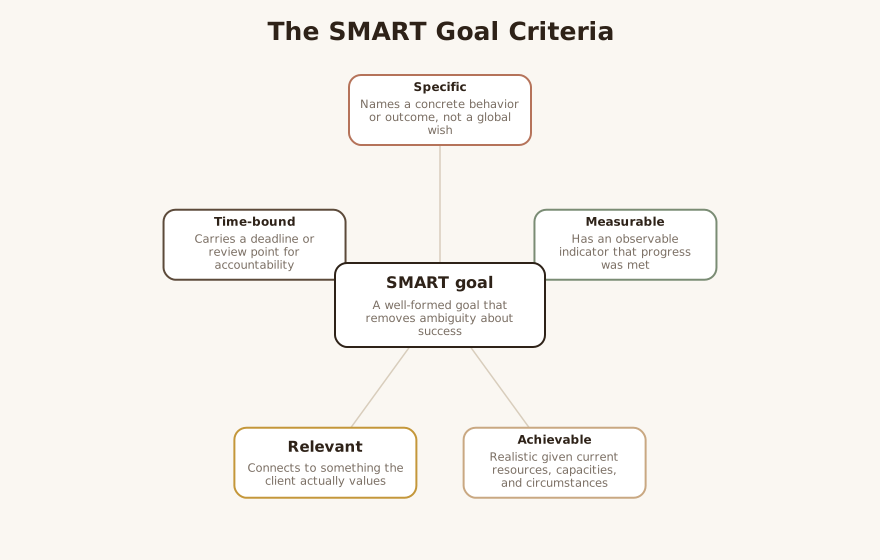
The core principle is that a well-formed goal removes ambiguity about what counts as success and when it has been reached 4. Specific means the goal names a concrete behavior or outcome rather than a global wish, so “go for a walk three times this week” replaces “be more active” 5. Measurable means there is an observable indicator of progress, allowing both client and clinician to know whether the goal was met 4. Achievable means the goal is realistic given the client’s current resources, capacities, and circumstances, calibrated to stretch without inviting predictable failure 5. Relevant means the goal connects to something the client actually values, anchoring effort to meaning and motivation 4. Time-bound means the goal carries a deadline or review point, which creates a natural prompt for accountability and reassessment 5. Underlying all five is a single mechanism: specificity and feedback reduce the cognitive load of acting and make progress visible, which can support motivation and a sense of self-efficacy LLM. The heuristic is deliberately content-free, applying equally to exercise, medication adherence, social re-engagement, or exposure practice LLM.
Interventions & Techniques
In practice, applying SMART is a collaborative reformulation exercise in which the clinician helps the client translate a broad concern into a written, testable objective LLM. A common technique is to start from the client’s stated wish and interrogate it against each letter in turn, asking what specifically, how measured, how realistic, why it matters, and by when 4. Clinicians often pair SMART with a brief written record, since externalizing the goal supports recall and review between sessions 5. Another technique is goal-laddering, in which a daunting aim is decomposed into a sequence of smaller SMART sub-goals that are individually achievable LLM. The time-bound element naturally schedules a review, so the next session can open with whether the goal was met, partially met, or revised, feeding a continuous loop of refinement LLM. Scaling questions borrowed from solution-focused practice (“on a scale of 0 to 10, where are you now, and what would one point up look like?”) integrate smoothly, providing a measurable anchor LLM. The clinician’s skill lies less in the acronym itself than in keeping the goal client-owned, sized correctly, and tied to lived values rather than to clinician expectations LLM.
LLM-generated illustrative example (not a guideline): A client says, “I want to stop being so isolated.” Working through the letters, this becomes: “I will text one friend to arrange a coffee, and attend it, within the next ten days.” It is specific (text one friend, attend), measurable (it happened or it did not), achievable (one contact, not a full social calendar), relevant (the client values connection), and time-bound (ten days). LLM
Evidence Base
Honesty about the evidence is important here, because the popularity of SMART can be mistaken for empirical validation LLM. SMART is established in the sense of being ubiquitous and widely adopted across coaching, rehabilitation, and clinical settings, but that ubiquity reflects intuitive appeal and ease of teaching rather than a robust trial literature for the acronym itself 3. Critics note that the SMART framework lacks a clear theoretical or empirical foundation and that its effectiveness appears context-dependent 3. In some domains, notably physical activity, evidence suggests that vague or challenging goals can outperform highly specific ones, which directly complicates any blanket claim that SMART goals are superior 3. Whatever clinical benefit SMART confers is most plausibly borrowed: from the broader goal-setting literature and from modalities such as behavioral activation, where structured, graded, concrete activity scheduling has independent support LLM. The defensible position for clinicians is that SMART is a reasonable, low-risk structuring tool that operationalizes good practice, not an intervention with its own demonstrated mechanism of change LLM. Treat it as scaffolding for evidence-based work, not as the evidence-based work itself LLM.
Populations & Indications
SMART is broadly applicable to anyone engaged in goal-directed treatment, which is much of the caseload in outpatient behavioral health LLM. It is particularly useful for adults setting treatment goals at intake, where it disciplines the planning conversation into something concrete and reviewable 5. People with depression often benefit when SMART is embedded in behavioral activation, because small, specific, time-bound activity goals counter the global, all-or-nothing thinking that fuels inertia LLM. Clients in rehabilitation, whether physical, occupational, or substance-use focused, are frequently served by SMART because functional recovery lends itself to measurable, staged milestones LLM. Coaching clients and people pursuing behavior change outside a diagnosed disorder use SMART routinely, and the heuristic transfers cleanly across these non-clinical contexts 4. It suits clients who feel directionless or overwhelmed, because the act of narrowing a goal to one achievable next step can itself be relieving LLM. As a general rule, SMART indicates wherever the work involves translating intention into action and tracking whether action occurred LLM.
Problems-for-Work
SMART addresses a cluster of action- and planning-related problems that recur across diagnoses LLM. For goal-setting difficulties, the heuristic provides explicit criteria that turn a foggy aim into a workable target 4. For procrastination and task paralysis from overwhelm, decomposing a large goal into a small, specific, time-bound first step lowers the activation threshold for starting LLM. For low motivation and avolition, especially in depression, the Relevant criterion ties effort to personal values while the Achievable criterion guards against goals so large they confirm hopelessness LLM. For behavioral activation in depression, SMART supplies the structure to schedule and track graded activity in observable terms LLM. For lack of direction, the process of writing even one SMART goal can restore a sense of agency LLM. For low self-efficacy, deliberately sizing early goals to be achievable engineers small wins that can rebuild confidence over time LLM.
LLM-generated illustrative example (not a guideline): A client with depression and marked avolition cannot face “get my life back together.” Within a behavioral activation frame, this is reduced to one SMART goal: “Shower and get dressed before noon on Monday, Wednesday, and Friday this week.” The success here is not the showering per se but the recovery of a tracked, achievable win that the next session can build on. LLM
Contraindications, Cautions & Cultural Humility
SMART has no formal contraindications, but it is easy to misuse in ways that harm the alliance LLM. The most common error is the clinician imposing goals that meet the acronym but not the client’s values, producing compliant-sounding objectives the client never owned LLM. Over-specification can also pathologize ordinary ambivalence; some clients need exploratory, less measurable work before any concrete goal is appropriate, and forcing SMART prematurely can feel coercive LLM. The Measurable and Time-bound criteria can inadvertently set up failure experiences for clients with fluctuating conditions, fatigue, executive dysfunction, or unpredictable life circumstances, so deadlines should be held flexibly and reframed as review points rather than tests LLM. Caution is warranted with perfectionistic or self-critical clients, for whom missed metrics can reinforce shame rather than motivate LLM. Cultural humility is essential: notions of individual goal-setting, future time orientation, and personal achievement are culturally situated, and a heuristic born in Western corporate management should not be assumed to fit every client’s relationship to planning, family obligation, or agency LLM. The clinician’s job is to offer SMART as a collaborative option, adapt or abandon it when it does not fit, and never let the format override the person LLM.
Treatment-Plan Suggestions & SMART Objectives
| Goal | SMART objective (example) | Mechanism |
|---|---|---|
| Increase daily activity in depression | Walk outdoors for 10 minutes on 3 named days this week | Graded, measurable activation counters inertia and avolition LLM |
| Reduce procrastination on an avoided task | Spend 15 minutes on the tax paperwork on Tuesday evening | A small, time-bound first step lowers the activation threshold LLM |
| Rebuild social connection | Initiate one social contact and follow through within 10 days | Specific, achievable target restores a sense of agency LLM |
| Improve medication adherence | Take prescribed dose at 8am daily, tracked on a phone log | Measurable tracking creates feedback and accountability LLM |
| Restore basic self-care routine | Complete morning hygiene before noon on 3 days this week | Achievable wins rebuild self-efficacy after a depressive trough LLM |
| Re-engage a valued hobby | Practice the instrument for 20 minutes on Saturday | Relevance to values anchors effort to intrinsic motivation LLM |
| Reduce overwhelm from a large project | Break the project into 3 sub-tasks and finish task one by Friday | Decomposition into sub-goals reduces task paralysis LLM |
Common Misconceptions
A frequent misconception is that SMART is itself a therapy or an evidence-based intervention; it is a goal-writing format that supports other treatments LLM. A second is that more specificity is always better, when in fact some goals, particularly in physical activity, may be served by looser or more challenging framing 3. A third is that the letters have a single fixed meaning, whereas the acronym has drifted from Doran’s original Assignable and Realistic to the now-common Achievable and Relevant, with many further variants in circulation 3. Clinicians sometimes assume the goal must come from the clinician, but the heuristic works best when the client supplies the content and the clinician supplies the structure LLM. Another error is treating the Time-bound deadline as a hard pass/fail test rather than a scheduled review, which converts a motivational tool into a source of shame LLM. Finally, some treat SMART as sufficient on its own, when its value depends entirely on being embedded in a coherent, evidence-based treatment plan LLM.
Training & Certification
There is no certification, credential, or licensing body for SMART Goals, and none is needed LLM. The heuristic is taught informally across management, coaching, education, and clinical training, and most clinicians absorb it through supervision, treatment-planning curricula, and documentation requirements rather than through any formal course LLM. Numerous explainer resources describe the criteria and provide worked examples sufficient for competent use 4. The relevant clinical competency is not memorizing the acronym but knowing how to embed it skillfully within a genuine modality, sizing goals appropriately, keeping them client-owned, and recognizing when goal-setting is premature LLM. Supervision is the natural venue for developing this judgment, particularly around pacing and cultural fit LLM.
Key Terms
Specific — the goal names a concrete behavior or outcome rather than a vague aspiration 4. Measurable — the goal has an observable indicator so progress can be verified 4. Achievable — the goal is realistic given the client’s current resources and circumstances 5. Relevant — the goal connects to something the client values 4. Time-bound — the goal carries a deadline or review point 5. Assignable / Realistic / Time-related — the original terms in Doran’s 1981 formulation, later revised in popular usage 3. Management by objectives — the organizational practice of cascading aims into concrete accountable targets, the conceptual ancestor of SMART LLM. Goal-laddering — decomposing a large aim into a sequence of smaller, individually achievable sub-goals LLM.
Resources & Further Reading
▶ Watch — a video introduction to this concept:
- Doran, G. T. (1981). There’s a S.M.A.R.T. way to write management’s goals and objectives. Management Review.
- SMART criteria — Wikipedia
- SMART Goals — MindTools
- What are SMART Goals? — TechTarget WhatIs
Reflective / Supervision Questions
- When I write a treatment goal, whose goal is it really, the client’s or mine, and how would I know the difference? LLM
- Am I using SMART to clarify the client’s intention, or to impose premature structure on work that still needs exploration? LLM
- For this particular client, does the Time-bound deadline function as a supportive review point or as a pass/fail test that risks shame? LLM
- How does this client’s cultural relationship to planning, future orientation, and individual achievement shape whether SMART fits? LLM
- Have I sized the early goals to be genuinely achievable so the client experiences a win, especially where self-efficacy is low? LLM
- Which evidence-based modality is this SMART goal embedded within, and would the goal still be coherent if I named that modality aloud? LLM