
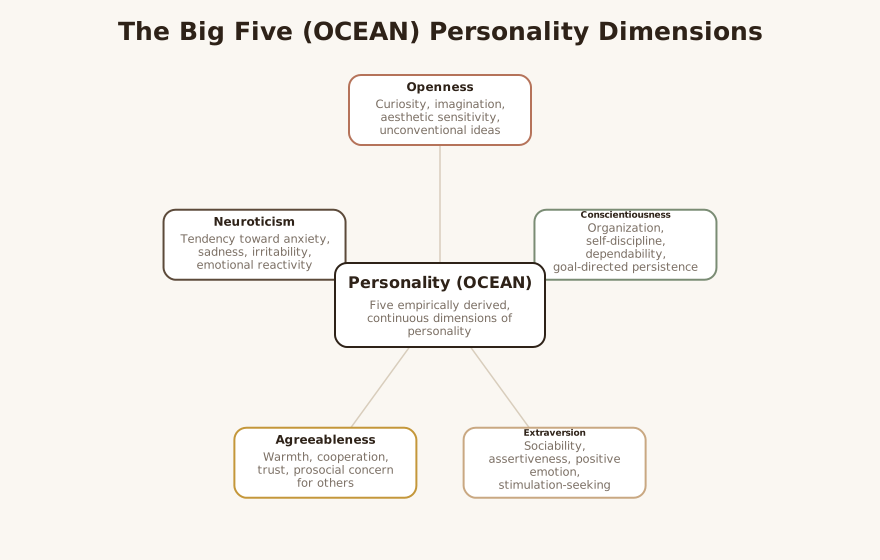
The Big Five, also called the Five-Factor Model (FFM), organizes the structure of human personality into five broad, continuous dimensions captured by the acronym OCEAN: Openness, Conscientiousness, Extraversion, Agreeableness, and Neuroticism 1. For practicing clinicians it functions less as a treatment in itself and more as a shared, evidence-based language for describing how clients differ and why those differences matter for therapy LLM. This article summarizes the model, its clinical applications, and its honest limits.
Type & Discipline
The Big Five is a dimensional trait framework within personality psychology, not a theory of pathology, a school of psychotherapy, or a diagnostic taxonomy 1. It belongs to the broader tradition of trait personality theory, which holds that relatively stable individual differences can be located along measurable continua rather than sorted into discrete types 3. Each of the five domains is a spectrum on which any person falls somewhere between two poles, so the model is fundamentally dimensional rather than categorical 3. This dimensional orientation is precisely what makes it useful clinically, because it mirrors how symptoms and traits actually distribute in clinical populations LLM.
Creators & Lineage
The model’s lineage runs through the lexical hypothesis — the idea that the most important individual differences become encoded in everyday language — and through decades of factor-analytic work on trait adjectives 3. Paul Costa and Robert McCrae are the figures most closely associated with consolidating and operationalizing the Five-Factor Model, including its development as a research and assessment program 5. Their work, alongside that of lexical researchers such as Lewis Goldberg and reviews by McCrae and Oliver John, helped converge a fragmented field on a common five-factor structure 1. The FFM is a descendant of earlier trait theories and sits adjacent to Hans Eysenck’s PEN model and the later six-factor HEXACO model, which adds an Honesty-Humility dimension LLM. McCrae and John framed the model explicitly as an integrative framework intended to bring order to competing personality systems 1.
Core Principles
Each domain captures a cluster of correlated tendencies 1. Openness reflects intellectual curiosity, imagination, aesthetic sensitivity, and willingness to entertain unconventional ideas 3. Conscientiousness reflects organization, self-discipline, dependability, and goal-directed persistence 3. Extraversion reflects sociability, assertiveness, positive emotionality, and stimulation-seeking 3. Agreeableness reflects warmth, cooperation, trust, and prosocial concern for others 3. Neuroticism reflects the tendency to experience negative affect — anxiety, sadness, irritability, and emotional reactivity to stress 3.
A central principle is that these traits are continuous and normally distributed, so most people fall near the middle rather than at extremes 3. The traits show meaningful rank-order stability across the lifespan while still permitting gradual normative change, and a large multi-sample analysis confirmed that personality does change in ways relevant to development 2. Critically, the same study found that a person’s baseline trait level remained at least as predictive of outcomes as the amount they changed, underscoring both the stability and the malleability of traits 2. Each broad domain also decomposes into narrower facets, allowing finer-grained description when needed 1.
Interventions & Techniques
The Big Five is not administered as an intervention; rather, clinicians use it to inform formulation and to tailor existing interventions LLM. In practice this typically begins with structured trait assessment using a validated inventory, after which results are integrated with history and presenting concerns 4. Practitioners then use the profile to anticipate strengths and risks, to set realistic expectations for change, and to match therapeutic style to the client 4. PositivePsychology.com describes applying OCEAN profiles to coaching, self-awareness work, and relational and occupational contexts 4.
LLM-generated illustrative example (not a guideline): A client high in Neuroticism and low in Extraversion who presents with social anxiety might be approached with extra attention to the therapeutic alliance, graded exposure paced to their reactivity, and explicit normalizing of negative affect as a trait tendency rather than a personal failing LLM.
Trait-informed technique selection is a clinical-reasoning move, not a manualized protocol, so the evidence supports the underlying interventions rather than “Big Five therapy” as such LLM.
Evidence Base
The maturity of the Big Five is best described as established. The five-factor structure has been replicated across many samples, instruments, and languages, and McCrae and John reviewed its convergence and applications decades ago 1. The traits predict consequential life outcomes, and recent work using seven longitudinal datasets totaling nearly 82,000 participants showed that both baseline trait levels and trait changes relate to outcomes such as health, educational attainment, unemployment, marriage, and divorce 2. That same study tempered the enthusiasm for change, finding that effects for trait change were never larger than effects for static trait levels and that change-based associations were fewer 2.
The honest framing for clinicians is that the model is robustly descriptive and predictive but not strongly explanatory: it tells us how people differ and what those differences forecast, not the mechanisms that produce them LLM. It is also a normal-range model, so its direct mapping onto categorical disorders is partial and inferential LLM.
Populations & Indications
Big Five assessment has been studied and applied across adults, adolescents, couples, organizational and occupational populations, forensic populations, and general clinical populations 4. In adults and adolescents it supports self-understanding and treatment matching, while in couples it offers a vocabulary for understanding complementary and clashing dispositions 4. Organizational and occupational use is among the most established applied areas, informing vocational fit and team dynamics 4. Forensic application typically focuses on risk-relevant traits such as low Agreeableness and low Conscientiousness, though such use demands caution given the stakes LLM. Across general clinical populations, the model is most useful as an adjunct to diagnosis rather than a replacement for it LLM.
Problems-for-Work
The model maps onto many presenting problems in a way that supports formulation LLM. High Neuroticism is a transdiagnostic risk marker that ties together neuroticism-related anxiety, major depressive disorder, and emotional dysregulation, and naming this shared vulnerability can organize an otherwise sprawling symptom picture LLM. The personality disorders and maladaptive personality traits connect to the Big Five because the DSM-5 Alternative Model of Personality Disorders describes pathology along five maladaptive domains — negative affectivity, detachment, antagonism, disinhibition, and psychoticism — that correspond conceptually to high Neuroticism, low Extraversion, low Agreeableness, low Conscientiousness, and high Openness respectively LLM.
LLM-generated illustrative example (not a guideline): For a client with relationship conflict, a couples clinician might use trait language to reframe a partner’s low Agreeableness and low Conscientiousness not as deliberate provocation but as dispositional style, opening room for negotiated structure rather than blame LLM.
Low conscientiousness and impulsivity inform work on procrastination, treatment adherence, and substance-related behavior, while interpersonal difficulties are often illuminated by the Agreeableness and Extraversion axes 4. Vocational and career indecision is a natural fit, since occupational application of OCEAN is well developed 4.
Contraindications, Cautions & Cultural Humility
The most important caution is that the Big Five is not a diagnostic instrument and a trait profile must never be used to assign or rule out a psychiatric diagnosis on its own LLM. Because it is a normal-range model, elevated trait scores describe disposition, not disorder, and over-interpretation risks pathologizing ordinary variation LLM. Trait labels can also become self-limiting if a client treats a score as a fixed verdict, whereas the evidence shows traits do change over time 2.
Cultural humility is essential because the model’s lexical and factor-analytic foundations rest heavily on Western, educated samples, and trait expression and the meaning of behaviors vary across cultures 3. A score on Extraversion or Agreeableness should be interpreted against the client’s cultural context rather than a universal norm, and clinicians should hold normative comparisons lightly LLM. Forensic and high-stakes uses warrant particular restraint given the consequences of misclassification LLM.
Treatment-Plan Suggestions & SMART Objectives
| Goal | SMART objective (example) | Mechanism |
|---|---|---|
| Reduce Neuroticism-linked reactivity | Client will use a paced-breathing or grounding skill at the onset of distress at least once daily for 4 weeks, logging use and intensity | Down-regulates negative-affect reactivity central to the Neuroticism domain 3 |
| Increase adaptive Conscientiousness | Client will complete and review a weekly structured task plan for 6 consecutive weeks, achieving 80% completion | Builds organization and goal-directed persistence captured by Conscientiousness 3 |
| Improve interpersonal warmth (Agreeableness) | Client will initiate one cooperative, perspective-taking behavior with a partner per day and record outcomes for 4 weeks | Strengthens cooperation and prosocial concern tied to Agreeableness 3 |
| Expand social engagement (Extraversion) | Client will engage in two planned social-approach activities weekly for 8 weeks, rating anticipatory vs. actual distress | Targets approach behavior and positive emotionality in the Extraversion domain 3 |
| Reduce impulsivity (low Conscientiousness) | Client will apply a 10-minute delay-and-evaluate step before flagged impulsive purchases or decisions, 5 days/week for a month | Inserts deliberation to offset low self-discipline LLM |
| Build trait-informed insight | Client will articulate two personal trait strengths and two growth edges from their profile by session 4 | Uses dimensional self-knowledge to support change 4 |
| Support vocational decision-making | Client will map three career options against their trait profile and values, producing a ranked shortlist within 6 weeks | Aligns occupational fit with established OCEAN applications 4 |
| Stabilize mood vulnerability | Client will track mood and triggers daily for 30 days and identify three recurring antecedents | Operationalizes Neuroticism-linked vulnerability for intervention LLM |
Common Misconceptions
A frequent misconception is that the Big Five is a typology like the Myers-Briggs, when in fact it is dimensional and places people on continua rather than in boxes 3. Another is that traits are fixed for life, whereas longitudinal data show meaningful change over time even if baseline levels remain strongly predictive 2. Some assume that higher scores are inherently “better,” but trait desirability is context-dependent and any pole can be adaptive or costly depending on demands LLM. Finally, clinicians sometimes treat the model as diagnostic, but it describes normal-range personality structure rather than disorder 1.
Training & Certification
There is no licensure or certification in “the Big Five” as a therapy, because it is a framework rather than a treatment modality LLM. Clinicians develop competence through graduate coursework in personality and assessment, supervised practice interpreting validated inventories, and familiarity with the original integrative literature 1. Applied resources oriented to practitioners describe how to use OCEAN profiles responsibly in coaching and clinical contexts 4. Many specific personality inventories require purchaser qualification levels, so clinicians should confirm they meet the publisher’s user requirements before administering a proprietary measure LLM.
Key Terms
Trait: a relatively stable dimension of individual difference along which people vary continuously 3. Facet: a narrower component within a broad domain, allowing finer description 1. Lexical hypothesis: the premise that salient individual differences become encoded in natural language 3. Dimensional model: a structure that locates people on continua rather than in discrete categories 3. Rank-order stability: the degree to which people maintain their relative standing on a trait over time 2. Five-Factor Model: the specific five-domain structure consolidated by Costa and McCrae 5.
Resources & Further Reading
▶ Watch — a video introduction to this concept:
- McCrae & John (1992): An Introduction to the Five-Factor Model and Its Applications
- Wright & Jackson (2023): Do changes in personality predict life outcomes?
- Big Five Personality Traits: The 5-Factor Model (Simply Psychology)
- Using the Big Five Personality Traits (OCEAN) in Practice (PositivePsychology.com)
- Paul Costa and Robert McCrae and the Five-Factor Model (Social Sci LibreTexts)
Reflective / Supervision Questions
- How might my own trait profile bias the way I interpret a client’s Extraversion or Agreeableness scores LLM?
- When I use trait language with a client, am I opening room for change or inadvertently handing them a fixed label 2?
- For this client, does the Big Five formulation add clinical value beyond the diagnosis, or am I using it decoratively LLM?
- How does my client’s cultural context reshape what a given trait elevation actually means 3?
- Where does this normal-range model end and where must categorical diagnostic assessment take over 1?