
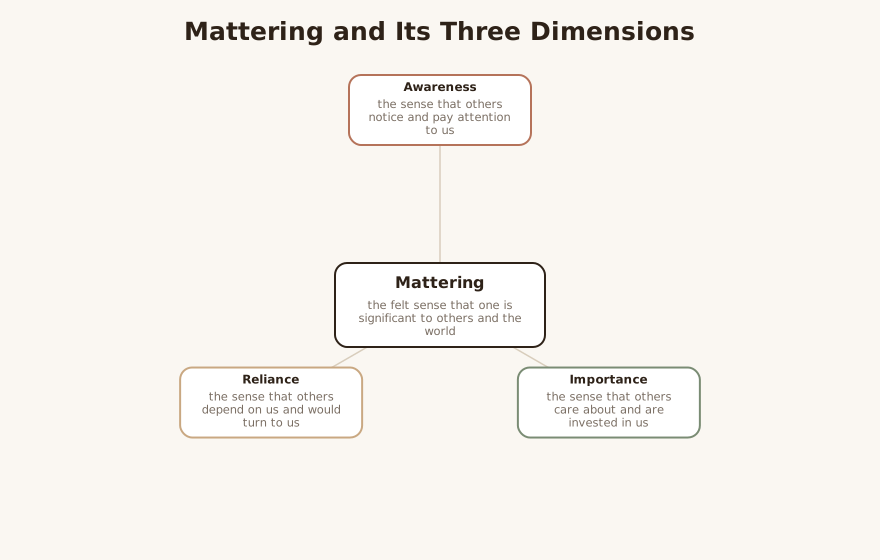
Few clinical intuitions are as durable as the sense that a client’s distress is bound up with whether they believe they count to anyone. “Mattering” gives that intuition a name and a structure: it is the perception that one is a significant part of the world, that others notice us, depend on us, and would be distraught if we were gone 6. The construct is attractive to clinicians precisely because it is specific where related ideas are vague—it is not the same as having relationships, nor the same as self-esteem, but a felt appraisal of one’s significance to others that can be assessed and, plausibly, targeted 6. This article treats mattering as what it is: a well-measured psychological construct with a robust correlational evidence base, not a packaged therapy LLM.
Type & Discipline
Mattering is a psychological and sociological construct—an inferred, measurable perception—rather than a theory of treatment or a therapeutic technique LLM. It emerged from social psychology and the sociology of the self, where its founding question was how an individual’s belief that they are significant to others bears on mental health 5. Rosenberg and McCullough framed it as a feeling about one’s place in the social world, anchored initially in adolescents’ sense of how much they mattered to their parents 5. It has since been adopted across community psychology, counseling, and quality-of-life research, where it functions as an explanatory variable linking social connection to well-being 6.
The disciplinary origin matters for how a clinician should hold the construct. Because it began as basic social-psychological science about the self, most of what is known about mattering is correlational and cross-sectional rather than the product of clinical trials LLM. Its value in the consulting room is therefore formulatory: it names a specific perceptual deficit that can organize a case conceptualization and inform treatment planning, without itself constituting an evidence-based modality LLM.
Creators & Lineage
The construct is conventionally traced to Morris Rosenberg and B. Claire McCullough, whose paper “Mattering: Inferred Significance and Mental Health Among Adolescents” was presented to the American Sociological Association in 1979 and published in subsequent form 51. They defined mattering as “the feeling that one is an object of interest to parents, that one is important to parents, that one is an object of concern, that one’s opinions count, and that one is wanted” 5. Working across several large adolescent samples, they reported that “feelings that one matters are associated with many dimensions of mental health,” that mattering to parents predicted global self-esteem independently of the child’s perception of parental attitudes, and that adolescents involved in juvenile delinquency tended to report feeling they did not matter to their parents 5.
Rosenberg himself was the author of the most widely used self-esteem scale, and mattering grew out of, while remaining distinct from, that self-esteem tradition LLM. The construct was later elaborated by Gregory Elliott and colleagues, who articulated mattering as comprising distinct dimensions and extended it beyond the parent-child relationship to mattering in the wider social world 6. More recently, Gordon Flett has positioned mattering as an essential construct and an essential way of life, foregrounding its clinical relevance and introducing the inverse pole of anti-mattering 2. Conceptually, mattering sits alongside self-esteem theory, Baumeister’s need to belong, the community-psychology notion of a sense of community, and Joiner’s interpersonal theory of suicide, all of which converge on the idea that perceived significance to others is protective LLM.
Core Principles
The first principle is that mattering is perceived and inferred, not objective. It is the individual’s belief about their significance to others—“the feeling that one is an object of interest”—so a person can matter a great deal in fact and still not feel that they do 5. As the breast-cancer literature puts it, what is at stake is whether people “perceive others care about us, would seek advice from us, and would be distraught if we were no longer in the world” 6.
The second principle is that mattering is multidimensional. A longer mattering scale resolves into “three dimensions: awareness, importance and reliance” 6. Awareness is the sense that others notice and pay attention to us; importance is the sense that others care about and are invested in us; and reliance is the sense that others depend on us and would turn to us 6. A brief measure captures these through items such as “How important are you to others?”, “How much do others pay attention to you?”, “How much do other people depend upon you?”, and “How much would you be missed if you went away?” 6. These facets can dissociate clinically: a client may feel cared about yet entirely un-relied-upon, which points the work in a different direction than a client who feels invisible LLM.
The third principle is that mattering is distinct from, though correlated with, neighboring constructs. Empirically it correlates strongly with self-esteem and with the presence of meaning, and moderately and negatively with depression, yet it remains associated with quality of life, self-esteem, positive affect, and meaning even after social support is statistically controlled 6. This is the key conceptual claim for clinicians: mattering carries explanatory weight beyond simply “having support,” so a client can be objectively supported and still suffer a mattering deficit 6.
The fourth principle is that the absence of mattering is itself a state with consequences. When people “feel that they do not matter to others—that no one acknowledges them or relies on them—they must cope with the feeling of irrelevance” 6. Flett’s work develops this negative pole explicitly as anti-mattering, the sense of being insignificant or overlooked, captured by a dedicated Anti-Mattering Scale 3. Conceptually, irrelevance is not merely low mattering but an active, distressing appraisal that a clinician can hear in a client’s language LLM.
Interventions & Techniques
Mattering does not come with a manualized protocol, but its structure suggests a set of clinical moves that can be embedded in established therapies LLM. The most basic is dimensional assessment: rather than asking globally whether a client feels they matter, the clinician probes awareness, importance, and reliance separately, because these facets dissociate and each implies a different intervention 6LLM. A client who scores low only on reliance—who feels cared about but needed by no one—may benefit from cultivating roles in which others genuinely depend on them, whereas a client low on awareness needs experiences of being noticed 6LLM.
A second technique is making mattering explicit in the therapeutic relationship. Because mattering is inferred from others’ attention and concern, the therapist’s reliable, attentive presence is itself a corrective datum, and naming the client’s significance—within the bounds of honest relationship—can begin to challenge an entrenched appraisal of irrelevance 6LLM. A third is behavioral construction of reliance and contribution: structured opportunities to be needed, such as caregiving, mentoring, mutual-aid, or community roles, supply the kind of evidence that an “I don’t matter” belief resists in the abstract LLM. A fourth is cognitive work on the anti-mattering appraisal, treating “no one would miss me” or “I am irrelevant” as testable beliefs rather than facts, consistent with how the negative pole is conceptualized 3LLM. These are techniques within modalities, not a freestanding treatment LLM.
LLM-generated illustrative example (not a guideline): A retired client reports a wide social circle but persistent emptiness. A dimensional probe shows intact awareness and importance—people call, people care—but reliance has collapsed since retirement: no one depends on him for anything. Rather than encouraging “more socializing,” the clinician helps him take on a volunteer role with real responsibility, targeting the specific facet that is missing LLM.
Evidence Base
Mattering is established as a construct, and that phrasing should be read precisely. There is a substantial, replicated body of psychometric and correlational research showing that mattering can be measured reliably and that it relates in expected ways to mental health 6. In women recovering from breast cancer, a brief mattering scale showed high internal consistency and correlated positively with self-esteem, presence of meaning, and positive affect, and negatively with depression, retaining associations with well-being even after controlling for social support 6. The founding adolescent research likewise tied mattering to self-esteem and multiple dimensions of mental health, and to lower delinquency 5. The construct has been extended and formalized as an essential one for understanding well-being 2, with a validated instrument for its negative pole, anti-mattering, linked to distress 3.
The honest caveat is that “established construct” is not “established therapy.” There is no manualized, trial-tested “mattering therapy,” and the evidence base is largely cross-sectional and correlational, which constrains causal claims LLM. Correlations of mattering with self-esteem and meaning are strong enough that some of what mattering scales capture overlaps with those constructs, even though incremental validity beyond social support has been shown 6. Findings should also be read cautiously: the same breast-cancer study noted that women who had not received psychological therapy reported higher mattering than those who had, which is a correlational artifact of who seeks help, not evidence that therapy lowers mattering 6. The construct is mature and useful for formulation; it is not a substitute for a treatment with its own outcome trials LLM.
Populations & Indications
Mattering is indicated wherever distress is organized around perceived insignificance, and several populations are especially apt LLM. Adolescents are the founding population, for whom mattering to parents is tied to self-esteem and to staying out of delinquency, making it a natural lens for youth presentations 5. Older adults are a high-yield group because retirement, bereavement, and role loss frequently strip away reliance—the sense of being depended upon—even when affection remains intact LLM. College students face a developmental transition in which mattering to a new community is uncertain, a context in which the construct has been heavily studied LLM.
Socially isolated individuals and people with depression are indicated because the feeling of irrelevance is both a risk factor for and a maintaining feature of low mood, and mattering correlates negatively with depression 6LLM. Cancer survivors and the medically ill are a documented application, where mattering to others is linked to quality of life 6. Community members and marginalized groups are a distinctive case: mattering can be threatened not only interpersonally but at the level of whether one’s group is seen to count in the wider society, which links the construct to experiences of social exclusion LLM. The clearest indication for invoking mattering is a presentation in which a client can be objectively connected yet still convinced they make no difference to anyone 6LLM.
Problems-for-Work
Mattering supplies a precise vocabulary for a cluster of presenting problems LLM.
- Depression and worthlessness. Low mattering correlates with depression, and the appraisal “I am irrelevant” supplies content for the worthlessness at the core of many depressive presentations 6LLM.
- Suicidal ideation. Where a client voices that “no one would miss me,” the work targets the perceived absence of mattering directly, drawing on the documented “feeling of irrelevance” rather than treating it as an empirical given 6LLM.
- Loneliness and social disconnection. A client may have ties yet feel they do not register on anyone; separating awareness, importance, and reliance locates which facet is failing 6.
- Demoralization and hopelessness. A collapse in reliance—no longer being needed—often drives the “what’s the point” quality of demoralization, especially after role loss LLM.
- Low self-esteem. Because mattering to others predicts self-esteem independently of perceived attitudes, restoring a sense of significance can be an indirect lever on self-worth 5LLM.
- Meaninglessness. Mattering correlates with the presence of meaning, so building experiences of significance can feed a client’s sense that their life counts for something 6LLM.
LLM-generated illustrative example (not a guideline): A college freshman describes herself as “background noise” in every group—people are friendly, but she is convinced she could vanish unnoticed. The clinician treats “no one would notice if I disappeared” as a belief to be tested, and assigns a small group role with a defined responsibility so that her absence would, concretely, be felt. The target is anti-mattering, not shyness LLM.
Contraindications, Cautions & Cultural Humility
The first caution is conceptual: mattering is an inferred perception, so the clinical target is the appraisal, not the objective social fact 5. Reassuring a client that they “obviously matter” can backfire, because the belief is resistant to argument and may be experienced as invalidation; the work is to build experiences that supply new evidence rather than to debate the old conclusion LLM. A second caution is against conflating mattering with self-esteem or social support and assuming that raising one automatically raises the others; the constructs are correlated but distinct, and a client can have support yet lack mattering 6.
A third caution concerns reliance. Cultivating the sense of being depended upon is powerful, but for clients prone to over-functioning, caregiving burnout, or relationships organized around being needed, indiscriminately boosting reliance can entrench unhealthy patterns; the aim is reciprocal significance, not indispensability LLM. Where suicidal risk is present, statements about not mattering should be treated as risk-relevant and assessed directly, not reframed away LLM.
Cultural humility is essential because what it means to matter, and to whom, is culturally patterned. Rosenberg and McCullough’s original frame centered mattering to parents, and the salient referents of significance differ across individualist and collectivist contexts, where mattering to family, elders, or community may carry more weight than mattering as an individual 5LLM. For members of marginalized groups, a felt sense of not mattering may be an accurate read of real social exclusion rather than a distortion to be corrected, and treating structurally rooted invisibility as a purely cognitive error would compound the harm LLM. The clinician’s task is to honor the reality a client names while still working where appraisal and opportunity can change LLM.
Treatment-Plan Suggestions & SMART Objectives
| Goal | SMART objective (example) | Mechanism |
|---|---|---|
| Assess mattering by dimension, not globally | Within 2 sessions, client completes a mattering map rating awareness, importance, and reliance separately | Distinguishes dissociable facets so the deficit is located precisely 6 |
| Build reliance after role loss | Within 6 weeks, client takes on one role in which another person genuinely depends on them, weekly | Targets the “depended upon” facet of mattering 6 |
| Test the anti-mattering belief | Over 4 sessions, client gathers and logs three instances that contradict “no one would notice if I were gone” | Treats the feeling of irrelevance as a testable appraisal 6 |
| Increase experiences of being noticed | Within 4 weeks, client initiates and records two interactions in which they are sought out by name | Supplies evidence for the awareness facet 6 |
| Link mattering to meaning | Over 8 weeks, client identifies one contribution that makes a difference to others and acts on it twice monthly | Mattering correlates with presence of meaning 6 |
| Address worthlessness in depression | By week 6, client reframes one global “I don’t matter” statement into a facet-specific, workable statement | Low mattering tracks depressive worthlessness 6 |
| Strengthen mattering to parents/family (adolescents) | Within 6 weeks, adolescent and a caregiver complete two structured activities centered on the youth’s significance | Parental mattering predicts self-esteem and lower delinquency 5 |
| Reduce suicide-relevant irrelevance | Within 2 sessions, clinician assesses “no one would miss me” directly and builds one connection where the client is missed | The feeling of irrelevance is a distressing, addressable appraisal 6 |
Common Misconceptions
The most common misconception is that mattering is simply having relationships or social support. The empirical record separates them: mattering predicts well-being even after social support is controlled, so a client surrounded by people can still suffer a mattering deficit 6. A second misconception is that mattering is just another word for self-esteem; in fact mattering to others predicts self-esteem independently of the child’s perception of parental attitudes, marking it as a distinct, upstream variable 5. A third is that mattering is a single global feeling, when it resolves into awareness, importance, and reliance, facets that can move independently 6. A fourth is that if a client objectively matters, the work is done; because mattering is inferred, the appraisal can lag far behind the facts, and the perception is the target 5. A final misconception is that “not mattering” is merely the absence of mattering, when it functions as an active state—the feeling of irrelevance—now operationalized as anti-mattering 63.
Training & Certification
There is no certification in mattering, and none would be appropriate, because it is a construct rather than a credentialed treatment LLM. Clinicians typically meet it within graduate coursework in social and developmental psychology, counseling, and community psychology, and within the well-being and quality-of-life literatures where it is increasingly prominent 2LLM. Practical competence comes from learning to assess mattering dimensionally and to recognize the language of irrelevance, then importing those skills into whatever evidence-based modality the clinician already practices 6LLM. Validated instruments—including brief mattering scales and the Anti-Mattering Scale—are available for clinicians who wish to measure the construct formally 63.
Key Terms
- Mattering: the perception that one is significant to others—noticed, important, relied upon, and missed if gone 6.
- Mattering (Rosenberg & McCullough): “the feeling that one is an object of interest to parents, that one is important to parents, that one is an object of concern, that one’s opinions count, and that one is wanted” 5.
- Awareness: the sense that others notice and pay attention to us, one of the three dimensions of mattering 6.
- Importance: the sense that others care about and are invested in us 6.
- Reliance: the sense that others depend on us and would turn to us 6.
- Feeling of irrelevance: the distress that follows from believing no one acknowledges or relies on you 6.
- Anti-mattering: the negative pole of the construct—the sense of being insignificant or overlooked—measured by the Anti-Mattering Scale 3.
- Inferred significance: the idea that mattering is a perceived, inferred appraisal rather than an objective social fact 5.
Resources & Further Reading
▶ Watch — a video introduction to this concept:
- Mattering: Inferred Significance and Mental Health Among Adolescents (Rosenberg & McCullough) — Semantic Scholar
- Mattering: Inferred Significance and Mental Health Among Adolescents — ERIC ED179903
- An Introduction, Review, and Conceptual Analysis of Mattering as an Essential Construct and an Essential Way of Life (Flett) — SAGE
- The Anti-Mattering Scale: Development, Psychometric Properties and Associations With Well-Being and Distress (Flett et al.) — SAGE
- Mattering — Springer Encyclopedia of Quality of Life and Well-Being Research
- Psychometric properties of a brief mattering-to-others scale in women recovering from breast cancer — PMC
Reflective / Supervision Questions
- When a client says they feel they “don’t matter,” have I assessed which facet—awareness, importance, or reliance—is actually failing, or am I treating it as one global feeling? 6
- Am I distinguishing a mattering deficit from a self-esteem or social-support deficit, given that a client can be supported and esteemed yet still feel insignificant? 6
- For this client, is the sense of not mattering a distortion to be tested, or an accurate read of real exclusion that I should not argue away? 5LLM
- When I hear “no one would miss me,” am I assessing it as risk-relevant and building concrete experiences of being missed, rather than reframing it prematurely? 6LLM
- How does this client’s cultural context define who they are supposed to matter to, and am I importing an individualistic referent where family or community significance is what counts? 5LLM
- Am I cultivating reciprocal significance, or inadvertently reinforcing a client’s pattern of mattering only by being indispensable? LLM