
Type & Discipline
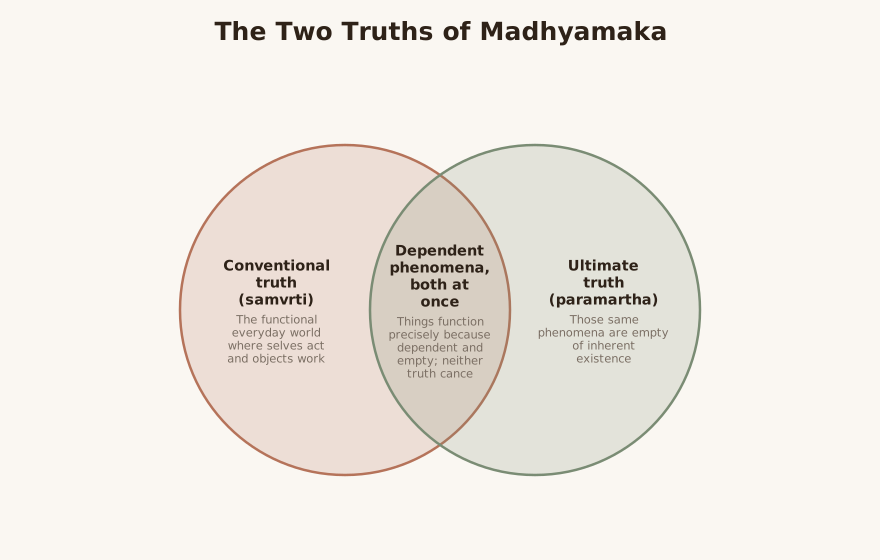
The two truths, satyadvaya, is a foundational doctrine of Indian Buddhist philosophy rather than a standalone, manualized psychotherapy 6. Its native home is Madhyamaka epistemology, the school founded by Nagarjuna, where it organizes a single distinction: conventional or concealing truth (samvrti-satya) and ultimate or highest truth (paramartha-satya) 1. Conventional truth is the truth of the everyday, functional world of persons, objects, causes, and language; ultimate truth is the way those same phenomena ultimately are, namely empty of inherent existence (svabhava) 5. The doctrine’s defining clinical interest is that these are not two competing worlds but two truths about one reality, neither of which cancels the other 2.
For the clinician it is most useful to treat the two truths not as a billable modality but as an epistemological frame that can be cultivated within recognized mindfulness- and acceptance-based therapies LLM. The frame is precise rather than mystical: it says a client’s depression, self-concept, or feared outcome can be fully real and workable at the conventional level while being, at the ultimate level, dependently arisen and empty of any fixed essence LLM. Holding both registers at once is the whole point, and the distinctive contribution of the doctrine is its refusal to collapse one truth into the other 7.
Creators & Lineage
The decisive figure is Nagarjuna, working in India around 150 to 250 CE, who gave the two truths their classical formulation in the Mulamadhyamakakarika 1. His pivotal statement is that the Buddha’s teaching rests on two truths, the conventional and the ultimate, and that those who do not understand the distinction between them do not understand the profound truth of the Buddha’s message 3. Nagarjuna ties the two truths directly to emptiness and dependent origination: to exist conventionally is precisely to arise in dependence on causes and conditions, and to arise dependently is to be empty of inherent existence, so the conventional and the ultimate are two faces of one insight 1.
The lineage’s most influential interpreter is Candrakirti, the seventh-century commentator whose Prasangika reading became the dominant account, especially in Tibetan Buddhism 2. Candrakirti develops the relationship between the truths and the dependence of ultimate insight on conventional means, holding that the ultimate can only be pointed to through conventional designation and ordinary language 1. His commentary shapes how later traditions understand samvrti itself, including the sense in which conventional truth is “concealing”: ordinary cognition takes phenomena to have an intrinsic nature they in fact lack, so the conventional both functions reliably and obscures the ultimate 6.
Contemporary scholarship has sharpened the picture and is honest about its difficulty LLM. Westerhoff’s philosophical introduction reconstructs Madhyamaka as a coherent position rather than mere paradox, and the collaborative volume known as the Cowherds explicitly catalogues competing models of what conventional truth even is, treating the question as live and contested rather than settled 7. For clinical work the lineage that matters runs from this classical doctrine into the mindfulness- and acceptance-based therapies that, without using the vocabulary, distinguish the literal content of experience from the perspective that holds it lightly LLM. Acceptance and Commitment Therapy’s defusion and self-as-context work, Metacognitive Therapy’s separation of a thought from the meta-level stance toward it, and constructivist and narrative therapies’ treatment of identity as authored rather than given all carry a family resemblance to the two-truths structure LLM.
Core Principles
The first principle is the distinction itself: there are two truths, conventional and ultimate, and the Buddha’s teaching is framed in terms of both 1. Conventional truth (samvrti-satya) is the truth of the world as it is transacted in everyday life, where selves act, objects function, and statements are true or false in ordinary ways; ultimate truth (paramartha-satya) concerns how those phenomena ultimately exist, which is as empty of inherent nature 5. Clinically, this licenses the move of taking a symptom seriously as a real, functioning feature of the client’s conventional life while not treating it as a fixed essence LLM.
The second principle is that the two truths do not cancel each other 2. Emptiness is not a denial of the conventional world but a description of how it exists; things still arise, function, and matter precisely because they are dependent and empty rather than in spite of it 5. The doctrine is therefore a middle way between reifying the conventional into permanent essences and nihilistically dissolving it into nothing, and it preserves the full reality of ordinary functioning at the conventional level 6.
The third principle is the dependence of the ultimate on the conventional 1. Because the ultimate is beyond ordinary conceptual grasp, it can only be approached, taught, and realized through conventional designation, language, and practice; one climbs to the ultimate by the ladder of the conventional 3. This is why the tradition insists that conventional truth is not simply error to be discarded, but the indispensable means by which the ultimate is disclosed 7.
The fourth principle is that the nature of conventional truth is genuinely contested, and the doctrine should not be presented as tidier than it is 7. Interpreters disagree about whether conventional truth is a single stratum or layered into the merely conventional and the correctly conventional, and about how a Madhyamika can affirm conventional truths while denying inherent existence; the Cowherds present this as two or more competing models rather than one settled answer 7. The honest clinical stance inherits this humility: the frame is rich and useful, not a finished system to wield with false certainty LLM.
Interventions & Techniques
Because the two truths is a doctrine and a contemplative orientation rather than a protocol, it is worked with through practices embedded in standard therapy LLM. The foundational technique is the deliberate holding of both registers at once: naming a distressing experience as conventionally real and worth attending to, while also viewing it as dependently arisen and empty of fixed essence 5. The clinical translation is a guided shift between perspectives on the same material, validating the experience at one level and loosening its felt solidity at another LLM.
A second technique uses the conventional-as-functional principle to validate rather than dismiss LLM. Because emptiness “describes how things exist” and does not deny that they exist, the clinician can affirm the full conventional reality of a client’s grief, anxiety, or self-judgment, which protects the work from the cold, invalidating tone that contemplative reframes can otherwise carry 5. The aim is to make the ultimate-truth move land as relief rather than as a denial of the client’s experience LLM.
A third technique deploys the dependence of the ultimate on the conventional as a pacing principle 1. Since the ultimate is reached only through ordinary language and designation, the clinician introduces the loosening of fixity gradually and through the client’s own conventional terms, rather than asserting “it’s all empty” as a destabilizing claim 3. This keeps the work grounded in the everyday self the doctrine itself affirms LLM.
LLM-generated illustrative example (not a guideline): A client says, “I am a failure — that’s just the truth.” Within an acceptance-based session, the clinician first honors the conventional reality of the feeling: the pain, the missed goal, the real consequences all exist and matter. Then, gently, they look together at whether “a failure” names a fixed essence the client is, or a conditioned judgment that arises in some contexts and conditions and not others. The client begins to hold “failure” as a conventional verdict — true enough to grieve, not fixed enough to be a metaphysical fact about who he is LLM.
In routine practice these techniques are delivered through the surrounding evidence-based modality: as cognitive defusion and self-as-context work within Acceptance and Commitment Therapy, as detached mindfulness and meta-level work within Metacognitive Therapy, or as re-authoring within narrative therapy LLM.
Evidence Base
The two truths should be described honestly as an established doctrine within Madhyamaka Buddhist philosophy, not as a clinically validated intervention 6. The word “established” refers to its standing as a defining doctrine of Nagarjuna’s school, central to Indian and Tibetan Buddhist thought and intensively studied in contemporary academic philosophy, and not to any body of efficacy research 1. There is no manualized two-truths therapy, no validated two-truths measure, and no randomized controlled trial of the doctrine as a discrete treatment LLM.
What carries the clinical weight is the family of mindfulness- and acceptance-based therapies into which the doctrine’s structure is embedded, and it is those modalities — not the two truths as such — that hold the more robust outcome literature LLM. The doctrine’s contribution is conceptual: it supplies a rigorous, non-nihilistic account of how a client’s experience can be simultaneously real and workable at one level and non-fixed at another, which is precisely the stance that defusion, decentering, and metacognitive distancing aim to cultivate 5. Because the scholarly literature itself treats the nature of conventional truth as genuinely contested, clinicians should present the frame as a generative model rather than as settled doctrine, and should never offer it to clients or supervisees as a freestanding proven treatment 7.
Populations & Indications
The two truths as a clinical frame is well suited to adults whose distress is organized around treating conventional, conditioned experience as fixed and ultimate 5. People with rigid cognitive styles are a natural fit, because the doctrine directly distinguishes the functional everyday register from the assumption of inherent, unchangeable essence, giving a principled basis for loosening black-and-white verdicts 6. Advanced meditators and clients already in mindfulness-based therapy are an obvious match, since the two-register structure formalizes the decentering they are already practicing LLM.
Adults in existential distress can be helped by the doctrine’s middle-way refusal of both nihilism and rigid essentialism, which offers a way to hold groundlessness without sliding into “nothing matters” 2. People with depression, whose self-concept and future often harden into seemingly ultimate facts (“I am worthless,” “nothing will change”), may benefit from the conventional-versus-ultimate distinction as a way to take the pain seriously while questioning its claim to be a fixed truth LLM. Clinicians and therapists themselves are an indicated population, since the frame is a useful supervisory and self-supervisory lens for noticing when one has reified a client’s diagnosis or identity LLM. As with any contemplative frame, suitability depends on the client’s stability, openness, and worldview rather than on diagnosis alone LLM.
Problems-for-Work
The two truths speaks most directly to suffering sustained by mistaking a conventional, conditioned construction for an ultimate, fixed fact LLM. For cognitive fusion and overidentification with thoughts, the frame supplies the rationale for stepping back: a thought is conventionally present and may even be conventionally accurate, yet it is not the ultimate, inherent reality the fused mind takes it to be 5.
LLM-generated illustrative example (not a guideline): A client ruminates on the thought “everyone will eventually leave me.” Within a metacognitive frame, the clinician helps her separate the conventional fact that the thought arises and feels compelling from the further claim that it is an ultimate truth about reality. The thought stays — it is conventionally real — but it loses its status as a settled verdict, which loosens the rumination’s grip LLM.
For cognitive rigidity and black-and-white thinking, naming the difference between a conventional judgment and an ultimate fixed essence directly targets the absolutism that drives all-or-nothing verdicts 6. For rumination, perceiving a repetitive thought as a conventionally arising, dependently conditioned event rather than an ultimate truth reduces identification with its content 5. For identity disturbance, the conventional-self-versus-no-fixed-self structure lets a client treat a hardened self-image as a real but conditioned construction rather than an intrinsic core 2. For existential distress, the middle way between eternalism and nihilism offers footing that is neither rigid certainty nor collapse 2. For major depressive disorder, the frame can help a client hold depressive cognitions as conventionally vivid yet not ultimately authoritative, used strictly as an adjunct within an evidence-based depression treatment LLM.
Contraindications, Cautions & Cultural Humility
The central caution is spiritual bypass: using “it’s all empty anyway” or “that’s only conventionally true” to override a client’s real and legitimate distress LLM. The doctrine’s own structure forbids this, because conventional truth is genuinely true and the conventional world genuinely functions; emptiness “describes how things exist” rather than denying that they exist, so dismissing a client’s pain as “merely conventional” misreads the teaching 5. The whole value of the two truths for clinicians lies in validating the conventional even as the ultimate is disclosed LLM.
The most serious clinical hazard is nihilistic misreading LLM. The doctrine is explicitly a middle way that refuses both eternalism and the annihilationist view that nothing is real, yet a vulnerable client can hear “nothing ultimately exists” as “nothing matters” or “I don’t exist,” which can deepen hopelessness, depersonalization, or derealization 2. Because work that thins the felt solidity of self and thought can shade into dissociation, the ultimate-truth register requires careful screening and grounding for clients with histories of trauma, psychosis, or fragile self-structure, and the conventional register — the affirmation of the everyday functioning self — should anchor the work for them LLM. The frame is poorly matched to acute crisis, active psychosis, acute suicidality, and severe instability, where structure, safety planning, and stabilization take priority over any philosophical reframing LLM.
Cultural humility is essential because the two truths is a specifically Buddhist doctrine embedded in a religious account of wisdom and liberation, and its interpretation is contested even within the tradition 7. Clinicians should neither strip it of those origins in a way that misrepresents it nor impose it as a universal prescription, recognizing that for some clients it will resonate with their own practice while for others it may conflict with religious commitments to an enduring soul or a single substantial reality LLM. The respectful stance is to offer the psychological mechanism — a flexible, two-register relationship to experience — while honoring each client’s tradition and language LLM.
Treatment-Plan Suggestions & SMART Objectives
| Goal | SMART objective (example) | Mechanism |
|---|---|---|
| Reduce fusion with a fixed self-verdict | Within 8 sessions, client will examine 1 absolute self-statement per week, distinguishing what is conventionally true from what it claims as fixed essence, and report any shift | Conventional truth is real but not ultimate 5 |
| Decrease rumination | Over 6 weeks, client will practice observing a recurring thought as a conventionally arising, dependently conditioned event 5 times weekly | Thoughts as conditioned, not ultimate, arisings 5 |
| Soften black-and-white thinking | Within 8 sessions, client will reframe 2 all-or-nothing judgments per week by naming their conventional context and conditions | Distinction between conditioned judgment and fixed essence 6 |
| Loosen rigid identity | Within 10 sessions, client will describe the self-image as a real but authored construction, listing 3 conditions on which it depends | Conventional self without a fixed core 2 |
| Steady existential groundlessness | Within 10 sessions, client will articulate the middle way between “everything is fixed” and “nothing matters,” and note any felt change | Middle way between eternalism and nihilism 2 |
| Hold depressive cognitions more lightly | Over the episode of care, client will treat 1 depressive prediction per session as conventionally vivid yet not ultimately authoritative | Two registers of truth on one experience 7 |
| Anchor insight in everyday function | Within 6 sessions, client will pair each two-truths reflection with one concrete grounding action affirming conventional life | Ultimate disclosed through the conventional 1 |
| Build a sustainable distancing practice | Over the episode of care, client will sustain a brief weekly inquiry separating a thought’s conventional presence from its claimed ultimacy | Gradual, language-mediated realization 3 |
Common Misconceptions
The most consequential misconception is that the two truths ranks one truth above the other so that the conventional is simply false LLM. The doctrine holds that both are genuinely truths, and that the conventional both functions reliably and serves as the indispensable means by which the ultimate is disclosed, so it is not error to be discarded 7. A second misconception is that ultimate truth means nothing exists; emptiness “describes how things exist” rather than denying that they exist, and the doctrine is a middle way that refuses nihilism 5. A third is that the two truths are two separate worlds; they are two truths about one and the same reality, the conventional and the ultimate nature of the very same phenomena 2. A fourth is that the doctrine is paradox-mongering or incoherent; contemporary philosophical reconstruction treats Madhyamaka as a defensible position, even as it acknowledges that the precise nature of conventional truth remains genuinely contested 7. A fifth is that intellectual assent is enough, when the tradition holds that the ultimate is realized through practice and is approached gradually through conventional means rather than grasped as a slogan 3.
Training & Certification
There is no license or certification in “the two truths”; it is a doctrine engaged by licensed mental health professionals who incorporate its frame within their existing scope and modalities LLM. The most direct routes to clinical competence are training in the mindfulness- and acceptance-based therapies that operationalize a two-register relationship to experience — Acceptance and Commitment Therapy, Metacognitive Therapy, and mindfulness-based approaches — each with its own established training pathway LLM. Clinicians who wish to engage the doctrine seriously benefit from grounding in its source tradition, including Nagarjuna’s formulation of the two truths, Candrakirti’s Prasangika interpretation, and the contemporary scholarship that treats conventional truth as a contested question, so that they represent it accurately rather than as a decontextualized wellness slogan 1. Understanding that the ultimate is taught and realized only through the conventional helps clinicians pace the work and avoid destabilizing reframes 3. As with any contemplative integration, clinicians should represent their competence and scope honestly and avoid implying religious or spiritual authority they do not hold LLM.
Key Terms
Satyadvaya (the two truths) — the Madhyamaka doctrine that the Buddha’s teaching rests on two truths, conventional and ultimate, and that understanding their distinction is essential to understanding the teaching 1. Samvrti-satya (conventional / concealing truth) — the truth of the everyday functional world of selves, objects, causes, and language, which both operates reliably and obscures the ultimate by taking phenomena to have an intrinsic nature they lack 6. Paramartha-satya (ultimate / highest truth) — the way phenomena ultimately exist, namely empty of inherent existence, approached only through conventional means 5. Svabhava (inherent existence) — the self-constituting essence that phenomena are said to lack at the ultimate level 5. Madhyamaka (the middle way school) — Nagarjuna’s school, defined by emptiness and the two truths, steering between eternalism and nihilism 2. Prasangika — the interpretive line associated with Candrakirti that became dominant, especially in Tibetan Buddhism 2. Middle way — the refusal of both the reification of permanent essences and the annihilationist denial of all reality 6. Two models of conventional truth — the contemporary recognition that interpreters disagree about what conventional truth is, treated as competing models rather than one settled account 7.
Resources & Further Reading
▶ Watch — a video introduction to this concept:
- The Theory of Two Truths in India (Stanford Encyclopedia of Philosophy)
- Two truths doctrine (Wikipedia)
- Nagarjuna’s Madhyamaka: A Philosophical Introduction (Oxford University Press)
- Jan Westerhoff: Nagarjuna and Madhyamaka (Wisdom Podcast)
- Nagarjuna’s Two Truths Theory: Conventional Truth and Ultimate Truth (Medium)
- Two Truths (Springer reference)
- Two Truths: Two Models (Oxford Scholarship Online)
Reflective / Supervision Questions
- When I introduce the two truths to a client, am I validating the conventional reality of their distress before pointing to its non-fixed nature, or am I deploying “it’s only conventionally true” as a slogan that bypasses real pain LLM?
- Am I clearly distinguishing ultimate truth from nihilism, so the client does not hear “nothing exists” or “nothing matters” and slide toward hopelessness or depersonalization LLM?
- Am I pacing the ultimate-truth register through the client’s own conventional language and grounding, rather than asserting destabilizing claims to a vulnerable client LLM?
- Where am I, as the clinician, treating this client’s diagnosis or identity as an ultimate fixed essence rather than a real but conditioned, conventional construction LLM?
- Am I honoring the specifically Buddhist origins of this doctrine and its genuinely contested interpretation, rather than presenting a tidy, decontextualized wellness version LLM?
- Am I representing the evidence honestly — as an established philosophical doctrine without a freestanding clinical trial base, used as a frame within evidence-based modalities LLM?