
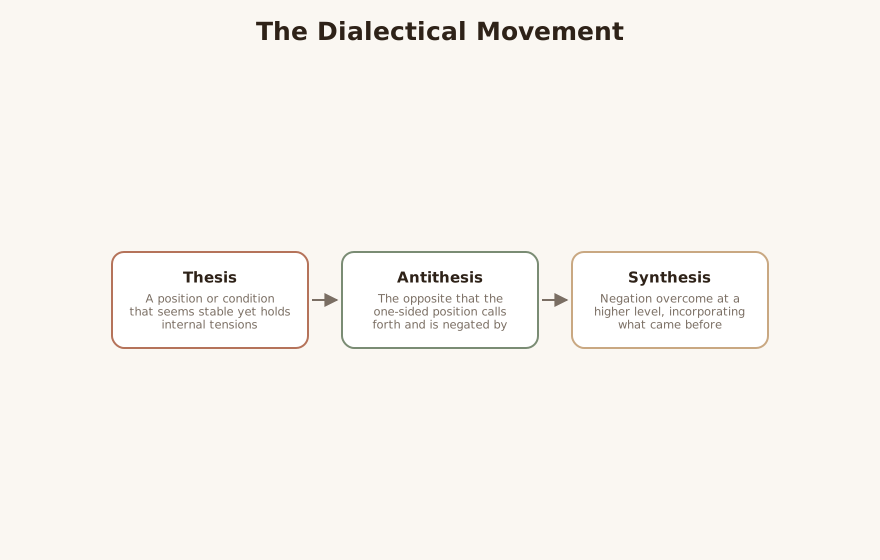
Dialectics is not a treatment, and it is important to say so at the outset. It is a philosophical worldview about how reality is structured and how change happens, and for clinicians its relevance is almost entirely indirect: it is the conceptual ancestor of the “dialectical” in dialectical behavior therapy and a useful lens for thinking about contradiction, ambivalence, and rigidity in clients. This article treats the philosophy honestly on its own terms and then makes the clinical bridge explicit, flagging clearly where established philosophy ends and clinical inference begins. LLM
Type & Discipline
Dialectics is a topic within philosophy, most often associated with logic, metaphysics, and method, and the term itself originally referred to a method of disputation or reasoned dialogue between opposing positions. 4 In its classical sense, dialectic was a form of discourse in which two or more people holding different views attempt to reach truth through reasoned argument rather than rhetoric or persuasion alone. 4 In the modern philosophical tradition that concerns us here, dialectics names something larger: an account of how concepts, history, or material reality develop through the tension and resolution of opposites. 1 Within the family of process philosophy, dialectics treats reality not as a collection of static things but as a dynamic in which contradiction is generative rather than merely an error to be eliminated. 1
Creators & Lineage
The dialectical method has ancient roots in the question-and-answer reasoning associated with Socrates and Plato, where opposing claims were tested against one another to expose contradiction and move toward truth. 4 The modern form most relevant to clinicians comes from Georg Wilhelm Friedrich Hegel, whose dialectics describes a developmental, self-moving process in which a concept generates its own opposition and is then carried into a higher, more adequate stage. 1 Hegel’s dialectics is idealist in that it concerns the unfolding of thought, reason, or “spirit,” and it is characteristically driven by the way a one-sided or limited concept produces a contradiction that forces development toward a richer understanding. 1
Karl Marx took up Hegel’s dialectical method but inverted its idealism, relocating the engine of dialectical development from ideas to material and economic conditions. 2 This materialist reworking, developed with Friedrich Engels and later systematized under the label “dialectical materialism,” holds that contradictions within material reality, especially the social and economic relations of production, drive historical change. 2 In dialectical materialism, matter is primary and ideas are understood as reflections of material conditions, so that the laws of dialectics are taken to govern nature, society, and thought alike. 3 The tradition formalized several principles, including the transformation of quantity into quality, the unity and struggle of opposites, and the negation of the negation, as general descriptions of how change occurs. 5 It is worth noting for accuracy that “dialectical materialism” as a named doctrine was elaborated more by Engels and later Marxist theorists than coined by Marx himself, and the term became a defining feature of subsequent Marxist philosophy. 3
In clinical lineage, this philosophical stream is the acknowledged source of the “dialectical” framing in dialectical behavior therapy, where the central dialectic of acceptance and change echoes the philosophical idea that apparently opposed positions can be held together and integrated rather than forcing a winner. LLM Related intellectual currents that clinicians will recognize, including constructivism and systems theory, share with dialectics a rejection of fixed, isolated entities in favor of relationship, context, and ongoing process. LLM
Core Principles
The first principle is that reality is constituted by interrelated opposites rather than by independent, self-contained things, so that any one-sided position tends to be limited and to call forth its own opposite. 1 A concept or condition that seems stable contains, on this view, internal tensions or contradictions that destabilize it and push toward development. 1 In the Marxist version, these contradictions are located in material and social reality, and the “unity and struggle of opposites” names the idea that opposing forces coexist within a single system and that their conflict is the source of change. 5
A second principle is that change is not merely gradual and additive but can be qualitative and transformative, captured in the formulation that accumulating quantitative changes can produce a sudden change in quality or kind. 5 A third principle is negation and its overcoming: a position is negated by its opposite, and that negation is in turn negated, yielding a further stage that does not simply return to the start but incorporates what came before at a higher level. 5 The popular shorthand for this movement, “thesis, antithesis, synthesis,” is a useful teaching device but is, as discussed below, a later schematization rather than Hegel’s own preferred language. 6
For clinicians, the load-bearing idea distilled from all of this is simple to state: two things that look contradictory can both be true, and growth often comes from holding the tension between them rather than collapsing prematurely to one side. LLM
Interventions & Techniques
Dialectics itself prescribes no clinical techniques; it is a method of reasoning and a metaphysics, not a therapy. 4 What clinicians borrow are stances and moves that translate the philosophical posture into the consulting room, and these are best understood as adaptations rather than direct applications of Hegel or Marx. LLM
The most important translated technique is dialectical synthesis: when a client is stuck between two opposed positions, the therapist looks for the kernel of truth in each and searches for a higher-order framing that honors both, rather than adjudicating which side is correct. LLM A second move is the deliberate balancing of acceptance and change, validating the client’s present reality and the reasons it makes sense while simultaneously holding that change is necessary and possible. LLM A third is dialectical questioning, in which the therapist gently surfaces the contradiction a client is living, not to refute the client but to let the tension itself motivate movement, an approach that mirrors the classical use of dialectic to expose and work through opposing views. 4
LLM-generated illustrative example (not a guideline): A client says, “If I forgive my father, I’m betraying the child I was; if I don’t, I’ll stay angry forever.” Rather than steering toward forgiveness or away from it, the clinician reflects both truths and asks what a stance might look like that protects the wounded younger self and loosens the grip of anger. The work is to build a synthesis the client can inhabit, not to win an argument. LLM
Evidence Base
Honesty requires distinguishing two questions. As a philosophy, dialectics is established and durable: it has a long, well-documented intellectual history, is the subject of extensive scholarly analysis, and remains a standard topic in the study of Hegel, Marx, and the modern dialectical tradition. 1 Its maturity as philosophy is not in question, even though specific doctrines such as dialectical materialism are contested and have been criticized within philosophy itself. 3
As a clinical intervention, however, dialectics has no independent evidence base, because it is not a standalone treatment and was never designed to be evaluated as one. LLM The empirical support that clinicians sometimes attribute to “dialectics” belongs properly to the manualized therapies that incorporate a dialectical stance, not to the philosophy in the abstract. LLM The accurate summary is therefore: the philosophy is established; its clinical value is as a coherent organizing framework and a component of evidence-supported modalities, not as a treatment with trials of its own. LLM
Populations & Indications
Because dialectics is a framework rather than a protocol, its clinical “indications” are really the populations and presentations for whom a both-and, tension-holding stance is especially useful, and these should be read as clinical reasoning rather than established philosophy. LLM Adults presenting with rigid, either-or thinking often benefit from a dialectical framing that legitimizes contradiction and reduces the pressure to resolve it prematurely. LLM People with borderline personality disorder, for whom intense emotional swings and polarized self-states are common, are the population in whom a dialectical stance has been most thoroughly operationalized clinically. LLM
Couples and families are natural settings for a dialectical lens, since relational conflict frequently takes the shape of opposed positions that each contain partial truth, mirroring the philosophical idea that opposites are interrelated rather than simply right and wrong. 1 Groups can use the framework to normalize disagreement and model synthesis, and clients experiencing pervasive cognitive rigidity may find that the explicit naming of “two things can be true” loosens fixed positions. LLM
Problems-for-Work
Black-and-white thinking is the paradigmatic target, and the dialectical principle that one-sided positions generate their own contradictions gives the clinician a non-pathologizing way to introduce gray. 1 With cognitive rigidity, the clinician uses the both-and stance to expand the client’s range of acceptable positions; for example, helping a perfectionistic client hold “my work is good enough” and “I want to improve it” at the same time. LLM
Emotional dysregulation is addressed indirectly: the acceptance-and-change synthesis lets a client both validate an intense feeling and commit to acting differently, rather than treating validation and change as enemies. LLM In interpersonal conflict, the therapist looks for the kernel of legitimacy on each side, consistent with the philosophical claim that opposites are bound together in a single relationship. 5 Ambivalence and identity disturbance lend themselves to dialectical work because each involves coexisting opposites; for instance, a client who feels “I am both the caretaker and the one who needs care” can be helped to integrate rather than oscillate. LLM Psychological inflexibility, broadly, is met by the core move of holding tension long enough for a workable synthesis to emerge. LLM
Contraindications, Cautions & Cultural Humility
The first caution is conceptual honesty: clinicians should not present a philosophical worldview as if it were an empirically validated treatment, and should be transparent that the dialectical stance is a framework borrowed from philosophy. LLM A dialectical approach can be misused to paper over genuine harm, treating “both sides have a point” as a way to avoid naming abuse, injustice, or risk; here the clinician must remember that not every opposition has a balanced synthesis and that validation is not the same as false equivalence. LLM
There is also a political and historical dimension to keep in view. Dialectical materialism is inseparable from Marxist political theory and was the official philosophy of several states, so the vocabulary carries strong ideological associations that some clients may find alienating or charged. 2 Cultural humility therefore means using the clinical stance, holding opposites, validating partial truths, integrating rather than choosing, without importing political doctrine, and remaining alert that the very idea of resolving contradiction through synthesis reflects particular intellectual traditions and may not map onto every client’s worldview. 3 Finally, the abstract language of thesis and antithesis can be confusing or off-putting; plain-language framing is almost always preferable in session. LLM
Treatment-Plan Suggestions & SMART Objectives
| Goal | SMART objective (example) | Mechanism |
|---|---|---|
| Reduce black-and-white thinking | Within 8 weeks, client will identify and reframe at least 3 either-or beliefs into both-and statements in session, documented on a thought log | One-sided positions generate contradictions that resolve through integration 1 |
| Increase distress tolerance | Over 6 sessions, client will hold a validated feeling and a change-oriented action plan for one trigger situation without abandoning either | Acceptance-and-change synthesis applied to affect LLM |
| Improve couple conflict resolution | Within 10 sessions, partners will each articulate the legitimate concern in the other’s position in 4 of 5 recurring disputes | Opposites are interrelated within one system 5 |
| Resolve ambivalence about a decision | Within 4 sessions, client will map the truths on both sides of one ambivalence and state an integrated next step | Synthesis preserves and incorporates both positions 6 |
| Strengthen integrated identity | Over 12 weeks, client will describe at least 2 “contradictory” self-states as parts of one coherent self in narrative | Negation of the negation incorporates prior stages at a higher level 5 |
| Reduce psychological inflexibility | By session 8, client will demonstrate flexible response to 3 rigid rules by generating an alternative that honors the underlying value | Holding tension to expand response range LLM |
| Build perspective-taking in groups | Over 6 group sessions, member will reflect another’s opposing view accurately before responding in at least 3 exchanges | Classical dialectic as reasoned exchange between opposing views 4 |
Common Misconceptions
The most common misconception is that Hegel taught a tidy “thesis–antithesis–synthesis” formula; in fact this triadic schema is a later schematization, popularly associated with Heinrich Moritz Chalybäus and others, and Hegel rarely used those terms in that mechanical way. 6 Hegel’s own dialectic is better understood as a developmental movement in which a concept’s internal limitation drives it forward, not a rigid recipe applied from outside. 1
A second misconception is conflating Hegelian and Marxist dialectics; Marx retained the dialectical method but reversed Hegel’s idealism, grounding development in material conditions rather than the unfolding of thought. 2 A third is treating “dialectical materialism” as straightforwardly Marx’s own coinage and doctrine, when it was substantially elaborated by Engels and later Marxists. 3 For clinicians, the most important misconception to retire is that “dialectical” in therapy means the same thing as the philosophy itself; the clinical usage is a focused borrowing of the both-and, synthesis-seeking stance, not an endorsement of any complete philosophical or political system. LLM
Training & Certification
There is no certification in “dialectics” as a clinical credential, because it is a philosophical framework rather than a treatment with a governing body. LLM Clinicians who want to develop the dialectical stance most rigorously do so by training in modalities that operationalize it, where supervised practice, fidelity standards, and structured curricula exist. LLM For grounding in the philosophy itself, the appropriate “training” is reading the primary and reference literature; the Stanford Encyclopedia of Philosophy entry on Hegel’s dialectics is a strong scholarly starting point, and the dialectical materialism entries provide the Marxist development. 1 3
Key Terms
Dialectic — originally a method of disputation or reasoned dialogue between opposing positions aimed at reaching truth. 4 Thesis, antithesis, synthesis — a schematized triad describing development through a position, its opposite, and their integration; a teaching shorthand, not Hegel’s literal method. 6 Synthesis — a resolution that incorporates and preserves elements of the opposed positions at a higher level rather than discarding either. 6 Dialectical materialism — the Marxist doctrine that contradictions in material and social reality drive change, treating matter as primary and ideas as reflections of material conditions. 3 Unity and struggle of opposites — the principle that opposing forces coexist within a single system and that their conflict generates change. 5 Negation of the negation — the idea that a position is negated and that negation is itself overcome, yielding a higher stage. 5 Transformation of quantity into quality — the principle that accumulated incremental changes can produce abrupt qualitative change. 5
Resources & Further Reading
▶ Watch — a video introduction to this concept:
- Hegel’s Dialectics — Stanford Encyclopedia of Philosophy 1
- Dialectical materialism — Encyclopaedia Britannica 2
- Dialectical materialism — Routledge Encyclopedia of Philosophy 3
- Dialectic — Wikipedia 4
- Dialectical materialism — Wikipedia 5
- Thesis, Antithesis, Synthesis — Encyclopedia (MDPI) 6
Reflective / Supervision Questions
- When a client presents an either-or dilemma, do I reflexively help them choose a side, or do I genuinely search for the truth in both positions before moving toward synthesis? LLM
- Where in my caseload am I using “both things can be true” appropriately, and where might I be using it to avoid naming harm, risk, or injustice that does not have a balanced middle? LLM
- How clearly do I distinguish, for myself and in my documentation, between the dialectical stance as an organizing principle and the evidence-supported modality I am actually delivering and billing? LLM
- Am I importing abstract or politically loaded language into session when plain-language framing would serve the client better, and am I checking whether the assumption that contradictions should be synthesized fits this particular client’s worldview? 3