
Type & Discipline
Contemplative Psychotherapy is an integrative psychotherapeutic modality that braids Tibetan Buddhist psychology with Western humanistic and clinical traditions 6. It sits at the intersection of clinical psychology and Buddhist psychology, and it is most precisely understood as a view and a way of being with clients rather than a manualized protocol 2. The approach blends a 2,500-year-old contemplative wisdom lineage with Western clinical frameworks, drawing most heavily on humanistic and person-centered roots 6. In contemporary practice it belongs to the broader family of Buddhist-integrative psychotherapies, alongside Buddhist-informed counseling, mindfulness-based interventions, and compassion-focused work 1.
What distinguishes it from generic “mindfulness in therapy” is its starting axiom about human nature and its insistence that the clinician’s own ongoing meditation practice is part of the treatment, not an optional self-care add-on 2. For a practicing therapist, the most useful framing is that Contemplative Psychotherapy supplies a relational stance and a set of attentional skills that can be layered onto, or can inform, the modalities you are already credentialed to deliver LLM.
Creators & Lineage
The modality emerged from sustained dialogue between the Tibetan Buddhist teacher Chögyam Trungpa Rinpoche and Western mental health professionals during the 1970s 6. This collaboration culminated in 1978 with the founding of the Contemplative Psychotherapy Department at Naropa University in Boulder, Colorado 6. The psychiatrist and psychoanalyst Edward M. Podvoll, a student of Trungpa, was the founding figure who built the program and translated the contemplative view into a clinical training 6.
Karen Kissel Wegela is the most prominent contemporary voice carrying the lineage forward, both through her long teaching tenure at Naropa and through her widely used text Contemplative Psychotherapy Essentials (2014) 3. The intellectual lineage therefore runs from Trungpa’s transmission of Tibetan Buddhist psychology, through Podvoll’s clinical formalization, into a present-day training and literature consolidated by Wegela and by edited scholarly volumes such as Brilliant Sanity: Buddhist Approaches to Psychotherapy 12. The naming convention itself is part of the lineage: “brilliant sanity” is the term coined within the Naropa tradition for the client’s innate health 5.
Core Principles
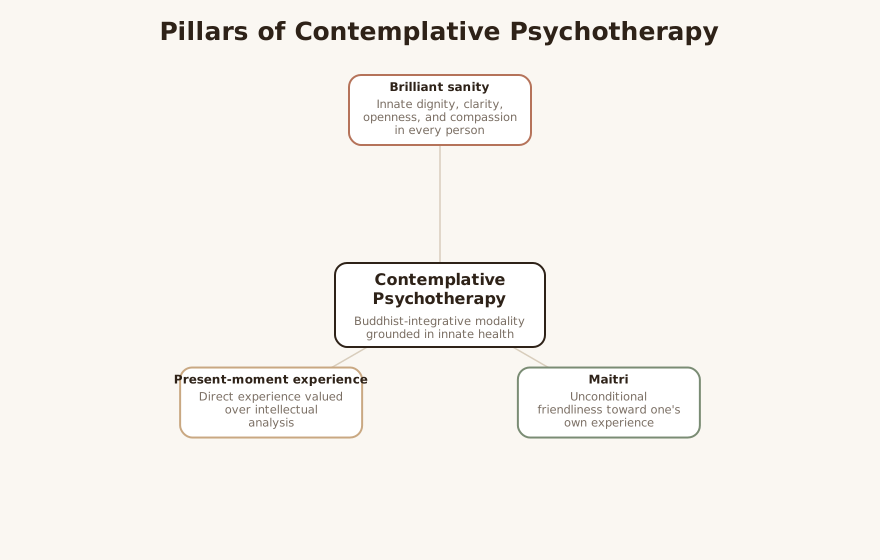
The central doctrine is brilliant sanity — the conviction that every person possesses an innate dignity, clarity, openness, and compassion, even when those qualities are temporarily obscured by confusion or distress 6. Wegela frames this not as something the therapist installs but as “who we already are,” accessible whenever a person relaxes 2. The clinical implication is a decisive reorientation: the therapist’s task is to help clients reconnect with an existing capacity for wisdom rather than to repair a deficit or eliminate pathology 5.
The second pillar is maitri, usually translated as unconditional friendliness or loving-kindness toward one’s own experience 2. Wegela is careful to note that maitri “doesn’t necessarily mean you like it” — it means being willing to be with and to see oneself as one actually is, which she positions as an antidote to the self-aggression pervasive in Western culture 2. Maitri is thus both an inner stance the clinician cultivates and a capacity the client is invited to grow toward their own pain, shame, and reactivity 2.
A third principle is the primacy of present-moment, direct experience over intellectual analysis 5. Therapists tend to ask “what are you noticing in your body right now?” rather than dwelling on narrative reconstruction, on the premise that basic sanity can only be contacted in the present 5. A fourth is the relational mechanism the tradition calls exchange — the recognition that therapist and client mutually and palpably influence one another’s emotional states, making a genuine, authentic relationship central to healing 5. This dovetails with the broader psychotherapy finding that the alliance is among the strongest predictors of outcome 5.
Finally, the tradition holds that the therapist’s own mind is the primary instrument 2. A sustained personal meditation practice is considered essential, both to cultivate the presence and compassion clients need and to keep the clinician from confusing their own material with the client’s 5.
Interventions & Techniques
In session, the core “technique” is a quality of presence: staying with the client’s direct experience, including pain and not-knowing, without rushing to fix symptoms 2. Clinicians work somatically and in the present, repeatedly bringing attention to bodily sensation and felt experience as it arises 5. Rather than trying to eliminate difficult emotions, the practitioner brings curiosity, mindfulness, and loving-kindness to them, treating emotions as carrying intelligence to be understood 2.
Outside the consulting room, Maitri Space Awareness is the signature contemplative training practice 6. It familiarizes practitioners with the full range of emotional states and fosters genuine humor and compassion toward oneself and others, cultivating relaxation and fearlessness in clinical work 6. At Naropa it is introduced early in training and is built on intensive residential retreats combining meditation instruction, walking meditation, periods of silence, and community work practice 7.
A further distinctive clinical structure is Body-Speech-Mind supervision, in which the client’s experience and the therapeutic dynamics are brought directly into group supervision rather than discussed only abstractly 6. Personal sitting meditation underpins all of these, functioning as ongoing professional development of the clinician’s instrument 2.
LLM-generated illustrative example (not a guideline): A therapist working with a self-critical client notices the client’s jaw tightening as she describes “failing again.” Rather than reframing the cognition immediately, the therapist slows down and asks what she is noticing in her body right now, then gently invites her to bring a friendlier, more spacious attitude toward the tightness itself — modeling maitri toward the very reaction the client has been at war with LLM.
Evidence Base
Honesty about maturity is important here. As a training tradition and conceptual framework, Contemplative Psychotherapy is well established: it has a nearly five-decade institutional home, a graduate program, a substantial clinical literature, and edited scholarly volumes synthesizing Buddhist approaches to psychotherapy 16. In that sense it is mature and coherent LLM.
As an empirically validated, standalone treatment, however, the controlled-outcome evidence is thin LLM. The reference literature does not document randomized trials or effect sizes specific to Contemplative Psychotherapy as a discrete intervention, and the Wikipedia overview contains no discussion of an empirical evidence base or formal effectiveness studies 6. Much of its plausible benefit borrows credibility from adjacent, better-studied constructs — mindfulness, loving-kindness practice, and the therapeutic alliance — rather than from head-to-head trials of the modality itself 5. Clinicians should therefore present it to clients as an integrative, relationship-centered approach informed by contemplative practice, not as an evidence-based protocol on par with, say, CBT for panic disorder LLM.
Populations & Indications
The modality is generally practiced with adults and is well suited to people seeking integration of spiritual or contemplative dimensions into their psychological work 4. It is commonly applied with people experiencing anxiety, depression, and chronic stress, where its present-moment and acceptance-oriented stance can interrupt the struggle against symptoms 4. Its emphasis on maitri makes it especially relevant for clients dominated by self-criticism, shame, and difficulty with self-acceptance 2.
It also has natural relevance for trauma survivors and for clients facing existential distress, where the recognition of an undamaged “brilliant sanity” can be both stabilizing and meaning-restoring — provided pacing and safety are respected 5. Finally, because the approach treats the clinician’s mind as the instrument, its practices have particular value for clinicians themselves who are experiencing burnout or compassion fatigue 2.
Problems-for-Work
- Generalized anxiety disorder and rumination: Present-moment body awareness and a non-eliminative stance toward worry can loosen the habit of fusing with anxious thought 5.
- Major depressive disorder: Contacting brilliant sanity reframes the client as fundamentally healthy rather than defective, countering depressive self-narratives 5.
- Self-criticism and shame: Maitri is directly indicated — the deliberate cultivation of friendliness toward one’s own experience as an antidote to self-aggression 2.
- Emotional reactivity: Bringing curiosity and mindfulness to emotions, rather than suppressing them, builds tolerance and discernment 2.
- Existential distress: The view that wisdom and dignity are innate offers a non-religious source of meaning and steadiness 5.
- Burnout and compassion fatigue (clinicians): Sustained personal practice and maitri toward oneself protect the therapist’s instrument 2.
LLM-generated illustrative example (not a guideline): With a depressed client who insists “there’s nothing good in me,” a clinician using this lens does not argue the point. Instead they help the client notice a single moment of present clarity — the warmth of a coffee cup, a flicker of humor — as direct evidence of a sanity that the depression has obscured but not erased LLM.
Contraindications, Cautions & Cultural Humility
Contemplative Psychotherapy is not a crisis-stabilization or acute-risk modality, and its present-moment, experiential techniques should be used cautiously with clients in acute trauma activation, dissociation, or active psychosis, where unstructured interoceptive attention can flood rather than ground LLM. Standard meditation-safety caveats apply: silent, intensive practice is not appropriate for everyone and can intensify distress in vulnerable clients, so titration and grounding take precedence over depth LLM.
Cultural humility is essential because the modality is explicitly rooted in Tibetan Buddhist cosmology and language 6. Concepts such as maitri, bodhisattva, and bardo carry religious meaning, and importing them uncritically risks both appropriation and a poor fit for clients of other faiths or of none 7. The doctrine of universal “basic goodness” or brilliant sanity, while clinically generative, should not become a way of bypassing real harm, oppression, or the need for concrete safety planning LLM. Clinicians should secularize and translate the language to the client’s worldview, obtain informed consent about the contemplative framing, and avoid implying that meditation alone substitutes for indicated medical or evidence-based care LLM.
Treatment-Plan Suggestions & SMART Objectives
| Goal | SMART objective (example) | Mechanism |
|---|---|---|
| Reduce reactivity to anxious thoughts | Client will practice a 5-minute present-moment body-awareness exercise 5 days/week and log episodes of non-fused responding to worry over 8 weeks | Present-moment direct experience displaces fusion with worry 5 |
| Increase self-compassion / reduce shame | Client will identify and reframe 3 self-critical statements per week using a maitri (“friendly toward what is”) stance, reviewed in session, over 6 weeks | Maitri as antidote to self-aggression 2 |
| Improve emotional tolerance | Client will bring curiosity and mindful attention to one strong emotion per week without acting on or suppressing it, reported in 8 consecutive sessions | Emotions met with curiosity rather than elimination 2 |
| Strengthen present-moment grounding | Client will complete a daily brief grounding-into-the-body practice and rate present-moment contact (0–10) for 30 days | Sanity is contacted in the present moment 5 |
| Restore sense of intact self-worth | Client will record one daily observation of personal clarity, humor, or competence (“evidence of brilliant sanity”) for 4 weeks | Recognition of innate dignity/health 6 |
| Reduce clinician burnout | Clinician will maintain a personal sitting practice ≥4 days/week and reflect on countertransference in supervision monthly for one quarter | Therapist’s mind as instrument; maitri toward self 2 |
| Deepen therapeutic alliance | Within first 4 sessions, collaboratively articulate and document a shared, authentic working relationship and review alliance at session 4 and 8 | Exchange and alliance as primary change agents 5 |
Common Misconceptions
A frequent misconception is that Contemplative Psychotherapy is simply “meditation instead of therapy” or a teacher-student dharma relationship; in fact it is a clinical psychotherapy in which the therapist’s practice supports presence while the work remains relational and client-centered 2. Another is that brilliant sanity means denying pathology or pain — Wegela explicitly frames the work as a willingness to experience pain and not-knowing, not to paper over it 2. A third is that maitri means liking or approving of one’s experience, when it specifically means being willing to be with experience as it is, regardless of liking 2. Clinicians also sometimes assume it is interchangeable with secular mindfulness-based interventions; it overlaps but is distinguished by its explicit view of innate health and its Buddhist-psychological framing 6. Finally, the absence of large trials is sometimes read as the approach being “untested” wholesale, when more accurately it is an established tradition whose discrete outcome evidence is simply underdeveloped LLM.
Training & Certification
The modality’s institutional home and primary training pathway is Naropa University, which offers a Master of Arts in Clinical Mental Health Counseling with a contemplative concentration and describes itself as the only such MA from a Buddhist-inspired accredited institution 7. The Buddhism-Inspired Contemplative Counseling track is a 71-credit, three-year program that sequences counselor identity and basic skills in year one, advanced clinical and contemplative practice in years two and three, and a contemplative internship in the final year 7. Training is built on intensive residential retreats and the early introduction of Maitri Space Awareness, alongside Body-Speech-Mind group supervision 67.
There is no single proprietary “certification” that gates practice of the stance itself; rather, clinicians become qualified through this graduate training, through Wegela’s Contemplative Psychotherapy Essentials and related literature, and through their own sustained meditation practice and supervision 23. For already-licensed clinicians, the realistic path is to study the literature, establish a personal practice, and integrate the view into existing scope rather than seeking a separate license LLM.
Key Terms
- Brilliant sanity: The innate dignity, clarity, openness, and compassion held to be every person’s fundamental nature, even when obscured 6.
- Maitri: Unconditional friendliness — willingness to be with and see oneself as one is, distinct from liking one’s experience 2.
- Maitri Space Awareness: A contemplative training practice familiarizing practitioners with emotional states to build compassion, relaxation, and fearlessness 6.
- Exchange: The mutual emotional influence between therapist and client that makes the authentic relationship central to healing 5.
- Body-Speech-Mind supervision: A group supervision structure bringing the client’s experience and therapeutic dynamics directly into the room 6.
- Basic goodness: A closely related term for the inherent health and worth of the person 5.
Resources & Further Reading
▶ Watch — a video introduction to this concept:
- Brilliant Sanity: Buddhist Approaches to Psychotherapy (Kaklauskas et al., eds.)
- Interview with Karen Kissel Wegela — Naropa University
- Contemplative Psychotherapy Essentials: Enriching Your Practice with Buddhist Psychology (Wegela, 2014)
- Contemplative Psychotherapy: Benefits, Techniques & How It Works — GoodTherapy
- You’re Basically Good: The Benefits of Contemplative Psychotherapy — Lion’s Roar
- Contemplative psychotherapy — Wikipedia
- Maitri / Buddhism-Inspired Contemplative Counseling MA — Naropa University
Reflective / Supervision Questions
- Where in my caseload do I implicitly treat a client as broken rather than as fundamentally healthy, and how would my interventions change if I held the view of brilliant sanity? LLM
- What is my own relationship to maitri — can I be with my own difficult states without liking them — and how does that capacity show up in the room? 2
- When a client is in pain, do I move toward the discomfort and not-knowing, or do I reflexively try to fix and eliminate symptoms? 2
- How robust is my personal contemplative practice, and how does its presence or absence affect my ability to stay grounded and avoid confusing my material with my client’s? 5
- When I use Buddhist-derived concepts, am I imposing a worldview or translating skillfully to fit this client’s culture, faith, and consent? 7
- Am I being honest with clients and myself about the difference between an established contemplative tradition and an empirically validated protocol? LLM