
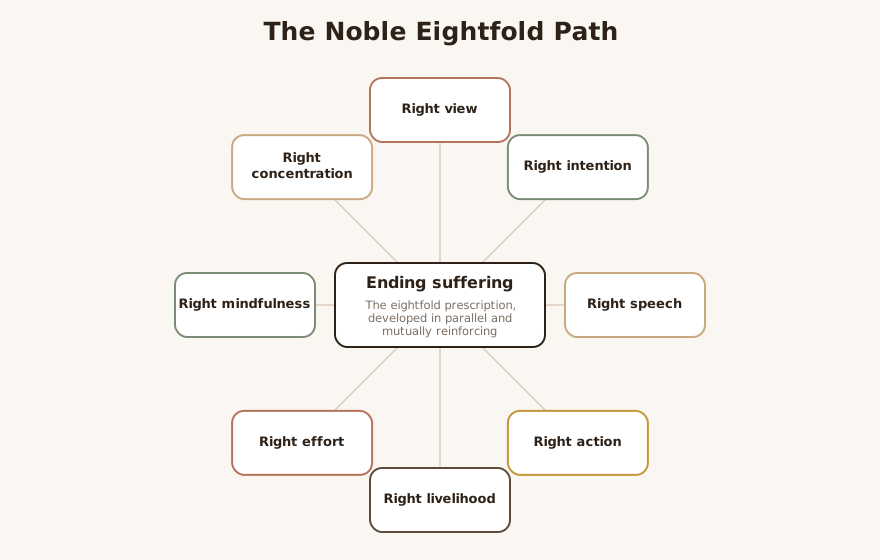
The Noble Eightfold Path is one of the oldest and most influential frameworks for human flourishing, and fragments of it now sit inside several of the evidence-based therapies clinicians use every day LLM. This article presents the Path on its own terms, then translates it into a form practicing therapists can use with appropriate caution and cultural humility LLM.
Type & Discipline
The Noble Eightfold Path is a religious and philosophical framework rather than a clinical protocol, drawn from Buddhist doctrine 1. It is the fourth of the Four Noble Truths — the truth of the way leading to the cessation of suffering — and so functions as the practical, prescriptive arm of the entire Buddhist teaching 2. Where the first three Noble Truths diagnose suffering, its origin, and its possible end, the Eightfold Path is the treatment plan 2. In Buddhist iconography it is represented by the eight-spoked dharma wheel, signifying eight mutually supporting factors rather than a sequence of steps 3. For a clinical audience it is most accurately classified as a values-and-skills scaffold with a contemplative lineage, not as a psychotherapy in the modern sense LLM.
Creators & Lineage
The Path is attributed to Siddhartha Gautama, the historical Buddha, who is traditionally said to have set it out in his first discourse after his awakening, the “Setting in Motion of the Wheel of the Dharma” 3. The Buddha framed it explicitly as a “middle way” between sensual indulgence and harsh self-mortification, the two extremes he had personally rejected 1. Across the centuries the eight factors have been systematically grouped into three higher trainings, an organizing structure that later commentators made central to how the Path is taught 2. In the modern English-speaking world, the Buddhist monk Bhikkhu Bodhi produced one of the most widely cited expositions, framing the Path as a graduated course of training toward the end of suffering 2. Contemporary insight-meditation centers such as Spirit Rock continue to teach the eight factors as a living practice rather than a historical artifact 6.
The clinical lineage relevant to therapists runs through the secular adaptation of Buddhist contemplative practice LLM. Mindfulness-Based Stress Reduction extracted and operationalized elements closely related to right mindfulness and right concentration; Acceptance and Commitment Therapy independently arrived at a values-and-committed-action emphasis that rhymes with right intention, right action, and right livelihood; and Dialectical Behavior Therapy explicitly drew on contemplative practice in its mindfulness and “wise mind” modules LLM. None of these therapies is the Eightfold Path, but each carries recognizable structural echoes of it LLM.
Core Principles
The eight factors are right view, right intention (sometimes rendered right thought or right resolve), right speech, right action, right livelihood, right effort, right mindfulness, and right concentration 1. The word translated as “right” (samma) connotes “complete,” “whole,” or “skillful” rather than the moralistic right-versus-wrong of conventional English, and this nuance matters for clinical use 5. The factors are traditionally gathered into three trainings: wisdom (right view and right intention), ethical conduct (right speech, right action, and right livelihood), and mental discipline or concentration (right effort, right mindfulness, and right concentration) 2.
Two structural principles distinguish the Path from a checklist LLM. First, the factors are non-sequential and mutually reinforcing: one does not perfect right view before beginning right mindfulness, but rather develops all eight in parallel, each strengthening the others 3. Second, right view appears first because some orienting understanding of how suffering arises is needed before the other factors can be cultivated deliberately, yet that view itself deepens as practice matures 2. Right intention concerns the underlying motivations one brings to action — traditionally renunciation, good will, and harmlessness — making it the bridge between understanding and conduct 2. The ethical-conduct factors translate intention into interpersonal and occupational behavior, while the concentration factors train the quality of attention itself 4.
Interventions & Techniques
On its own terms the Path is practiced through study and reflection (cultivating right view), ethical commitments around honest and non-harming speech and action, and meditation that develops sustained, stable attention 4. Right mindfulness is classically trained through the four foundations of mindfulness — attention to body, feelings, mind-states, and mental phenomena — while right concentration refers to progressively deepening states of meditative absorption 3. Right effort is described as a fourfold endeavor: preventing unwholesome states from arising, abandoning those that have arisen, cultivating wholesome states, and maintaining those already present 2.
For clinicians, the usable “techniques” are the secularized descendants of these practices rather than the religious practices themselves LLM. Mindfulness of breath and body, present-moment attention training, values clarification, and deliberate cultivation of intention before action all have direct analogues in the Path and can be delivered within established modalities without importing religious content LLM. A therapist might, for example, frame an Acceptance and Commitment Therapy values conversation as a secular form of clarifying “right intention,” or frame a Dialectical Behavior Therapy interpersonal-effectiveness skill as a structured form of “right speech,” provided the client is comfortable with the analogy LLM.
LLM-generated illustrative example (not a guideline): A client in early recovery keeps relapsing after conflicts at work. The therapist, working within Acceptance and Commitment Therapy, borrows the Path’s distinction between intention and action: before the next difficult conversation, the client names the intention (“I want to be heard without harming the relationship”) and then chooses speech and action consistent with it. This reframes an impulsive pattern as a place where attention and intention can be trained. LLM
Evidence Base
The Noble Eightfold Path is “established” in the sense of being a doctrinally central, two-and-a-half-millennia-old framework with an enormous textual and lived tradition behind it 2. It is emphatically not “established” in the sense of being a manualized, randomized-controlled-trial-tested clinical intervention, because it was never designed to be one LLM. Clinicians should be precise about this distinction: the empirical support that exists belongs to the secular programs that adapted fragments of the Path, not to the Path delivered as a therapy LLM.
The provided sources are doctrinal, reference, and educational rather than clinical-trial literature, so this article makes no efficacy claims about treating any disorder by teaching the Path LLM. What can be said honestly is that the contemplative practices most associated with right mindfulness and right concentration have been operationalized into interventions that carry their own evidence base, and that the Path supplies a coherent rationale and value structure that some clients find motivating LLM. Therapists should present it as a framework and a set of skill analogues, not as a treatment with outcome data attached to it LLM.
Populations & Indications
The Path-derived approach is most apt for adults seeking meaning or values clarification, for whom the wisdom and ethical-conduct trainings offer a vocabulary for living deliberately 4. It can resonate with people in recovery from addiction, where right effort’s structure of abandoning unwholesome states and cultivating wholesome ones maps onto relapse-prevention work LLM. Individuals with chronic stress and practitioners of mindfulness-based programs are natural fits, given the direct lineage from right mindfulness and right concentration to secular mindfulness training 4. People experiencing existential distress may find the framework’s explicit address to the nature and end of suffering meaningful 2. Finally, clinicians and helping professionals themselves often use the Path as a personal practice and a guard against burnout, since right livelihood speaks directly to ethical work 6.
Problems-for-Work
The Path offers reframes for several common presenting problems, always as adjunctive scaffolding rather than primary treatment LLM. For generalized anxiety disorder and rumination, right mindfulness supplies a present-moment anchor that interrupts future-oriented worry loops LLM. For major depressive disorder, right effort’s cultivation of wholesome states aligns with behavioral activation, while right intention can counter the motivational collapse of depression LLM. For substance use disorder, the ethical-conduct factors and right effort structure a values-based reason to change beyond symptom reduction LLM.
For emotional dysregulation and low distress tolerance, the concentration trainings cultivate the capacity to observe affect without immediately acting on it LLM. For impulsivity, the deliberate insertion of right intention between stimulus and response creates a behavioral pause LLM. For moral injury, the ethical-conduct factors and the non-condemning sense of “skillful” versus “unskillful” action can support repair without collapsing into shame LLM. For chronic stress and existential distress, the Path provides an integrating narrative that situates day-to-day suffering within a coherent account of why it arises and how it eases 2.
Contraindications, Cautions & Cultural Humility
The most important caution is appropriation: the Path is a sacred religious framework, and lifting its language into therapy without acknowledgment can be experienced as disrespectful by clients of Buddhist heritage and as misleadingly “spiritual” by secular clients LLM. Clinicians without training in Buddhist practice should avoid presenting themselves as teachers of the Path and should generally work through the secular, evidence-based modalities that adapted it LLM. The translation of samma as “right” can read as moralistic or shaming to clients who hear it as right-versus-wrong, so the “skillful” framing should be made explicit 5.
There are clinical contraindications to the contemplative components specifically: intensive meditation and sustained interoceptive attention can destabilize some clients, including those with trauma histories, active psychosis, or severe dissociation, and these practices should be titrated or deferred accordingly LLM. Imposing a values framework on a client in acute crisis, or one whose religious commitments conflict with Buddhist concepts, risks rupture and is inappropriate without consent LLM. Cultural humility here means offering the framework as one option among many, naming its origins, and following the client’s lead rather than prescribing a worldview LLM.
Treatment-Plan Suggestions & SMART Objectives
The table below illustrates how Path-derived ideas can be operationalized inside established modalities; these are examples, not a standardized protocol LLM.
| Goal | SMART objective (example) | Mechanism |
|---|---|---|
| Reduce reactivity to distress | Client will practice 10 minutes of daily present-moment attention 5 days/week for 4 weeks, logging adherence | Right mindfulness / attention training (via mindfulness-based skills) |
| Clarify guiding values | Client will identify 3 core values and one aligned action per week across 6 sessions | Right intention / values clarification (via Acceptance and Commitment Therapy) |
| Interrupt impulsive conflict | Client will use a “name the intention” pause before 2 difficult conversations weekly for 3 weeks | Right intention + right speech as a stimulus-response pause |
| Strengthen relapse prevention | Client will list and practice 1 wholesome-state behavior to replace each identified high-risk cue over 4 weeks | Right effort (cultivate/maintain wholesome states) |
| Reduce rumination | Client will redirect attention to a body anchor within 5 minutes of noticing a worry loop, daily for 2 weeks | Right mindfulness as attentional re-anchoring |
| Address moral injury | Client will articulate one skillful repair action and complete it within 3 sessions | Ethical-conduct factors reframed as skillful vs. unskillful action |
| Improve interpersonal effectiveness | Client will apply a structured honest-and-non-harming speech skill in 3 logged interactions weekly | Right speech (via Dialectical Behavior Therapy interpersonal skills) |
Common Misconceptions
A frequent misconception is that the eight factors are sequential stages to be completed in order; in fact they are cultivated simultaneously and mutually reinforce one another 3. Another is that “right” implies a rigid moral code of permitted and forbidden acts, when the underlying term points toward what is skillful, complete, or conducive to the end of suffering 5. Clients and clinicians sometimes assume the Path is exclusively about meditation, but mindfulness and concentration are only one of three trainings, alongside wisdom and ethical conduct 2. It is also commonly reduced to a self-help wellness routine, obscuring that it is the practical culmination of an entire soteriological system, the fourth of the Four Noble Truths 1. Finally, the secular mindfulness many clients have encountered is not the Eightfold Path itself but a partial, deliberately de-religionized extraction from it LLM.
Training & Certification
There is no clinical certification in the Noble Eightfold Path, because it is a religious and philosophical framework rather than a licensed therapy LLM. Traditional transmission occurs through study with qualified Buddhist teachers and sustained personal practice, and centers such as Spirit Rock offer practice guides and retreats for those who wish to engage it directly 6. Bhikkhu Bodhi’s exposition is a standard text for serious students seeking a systematic treatment of all eight factors 2. Clinicians who wish to integrate the secular skill-analogues should instead pursue formal training in the established modalities that carry an evidence base and a credentialing pathway — mindfulness-based programs, Acceptance and Commitment Therapy, or Dialectical Behavior Therapy — and treat their own contemplative practice as personal rather than professional credentialing LLM.
Key Terms
Samma (“right”): the qualifier on each factor, better understood as skillful, complete, or whole than as morally correct 5. Four Noble Truths: the doctrinal frame within which the Path is the fourth truth, the way to the cessation of suffering 2. Middle Way: the Path’s positioning between sensual indulgence and self-mortification 1. Three trainings: the grouping of the eight factors into wisdom, ethical conduct, and mental discipline 2. Right view: orienting understanding of suffering and its cessation that both precedes and is deepened by practice 2. Right effort: the fourfold work of preventing, abandoning, cultivating, and maintaining mental states 2. Four foundations of mindfulness: the classical objects of right mindfulness — body, feelings, mind, and mental phenomena 3.
Resources & Further Reading
▶ Watch — a video introduction to this concept:
- Eightfold Path — Encyclopaedia Britannica
- The Noble Eightfold Path: The Way to the End of Suffering — Bhikkhu Bodhi (Access to Insight)
- Noble Eightfold Path — Wikipedia
- The Noble Eightfold Path: Meaning and Practice — Tricycle
- What is the Buddhist Eightfold Path? (The 8 Elements) — Mindworks
- The Noble Eightfold Path — Spirit Rock Meditation Center
Reflective / Supervision Questions
- When you borrow language from the Noble Eightfold Path in session, are you naming its origin and offering it as one option, or presenting it as a neutral technique LLM?
- How do you distinguish, for a given client, between the evidence-based skill (e.g., mindfulness training) and the religious framework it was extracted from LLM?
- What is your own relationship to contemplative practice, and how might it bias you toward over-prescribing it LLM?
- For which clients might intensive attention training be destabilizing rather than grounding, and how would you screen for that LLM?
- Does framing a problem as “unskillful” rather than “wrong” change how shame shows up for your client, and have you checked whether the client experiences it that way LLM?