
Type & Discipline
Pratityasamutpada, usually rendered in English as dependent origination, dependent arising, conditioned arising, or interdependent co-arising, is a foundational Buddhist philosophical doctrine rather than a standalone, manualized psychotherapy 2. Its native home is Buddhist metaphysics, where it names a single organizing principle: phenomena arise in dependence on causes and conditions, and nothing exists independently or by its own essence 1. The Sanskrit term compresses the idea of “arising depending on,” implying that things grow from a basis only when the requisite conditions are present 1. For the clinician it is most useful to treat dependent origination not as a billable modality but as a causal, phenomenological frame that can be cultivated within recognized mindfulness- and acceptance-based therapies LLM.
The doctrine is captured in a compact formula that recurs across the canonical sources: “When this exists, that comes to be. With the arising of this, that arises. When this does not exist, that does not come to be. With the cessation of this, that ceases” 2. The same formula appears in the academic literature as “This being, that becomes; from the arising of this, that arises. This not being, that does not become; from the ceasing of this, that ceases” 1. What makes the principle clinically interesting is its implication that experience is a web of conditioned events rather than a collection of fixed, self-existing things, so that changing a condition changes what arises 4. This is the same root doctrine that the modern teaching of interbeing later restates in accessible language, and clinicians familiar with that article will recognize dependent origination as its philosophical source LLM.
Creators & Lineage
Dependent origination has no single author in the modern sense; it is attributed to the historical Buddha, Gautama, and is presented in the early tradition as something he discovered and taught as the heart of his realization 1. The Buddha is recorded as equating it with his entire teaching in the saying “Who sees dependent arising sees the Dharma; who sees the Dharma sees dependent arising,” which marks the doctrine as central rather than peripheral 1. In the early accounts the Buddha discovers dependent arising alongside the Four Noble Truths, presenting it as the explanation of “the arising of the whole great mass of unsatisfactoriness” and of how that mass ceases when ignorance ceases through wisdom 1.
The doctrine is shared across all Buddhist schools, which is part of why it functions as a common denominator of Buddhist thought rather than the property of one sect 2. Its most influential philosophical development came from Nagarjuna, the second-century founder of the Madhyamaka school, who reinterpreted dependent origination as a non-realist principle and tied it explicitly to emptiness 1. Nagarjuna’s compressed verse, “Dependent arising we declare to be emptiness. It is a dependent concept; just that is the middle path,” reframed the doctrine so that to arise dependently is to be empty of intrinsic, independent existence 1. In his hands dependent origination describes conventionally designated causal processes that are empty of inherent essence and depend on mind for their intelligibility, rather than describing ultimately real, self-standing entities 1.
The lineage that matters most for contemporary clinical work runs from this classical doctrine into the mindfulness- and acceptance-based therapies of Buddhist psychology, and into the contemplative restatements such as interbeing and interdependence LLM. Acceptance and Commitment Therapy, Mindfulness-Based Cognitive Therapy, and contemplative psychotherapy all carry a family resemblance to dependent origination without using the term, because each works with the conditioned, arising-and-passing nature of inner experience LLM.
Core Principles
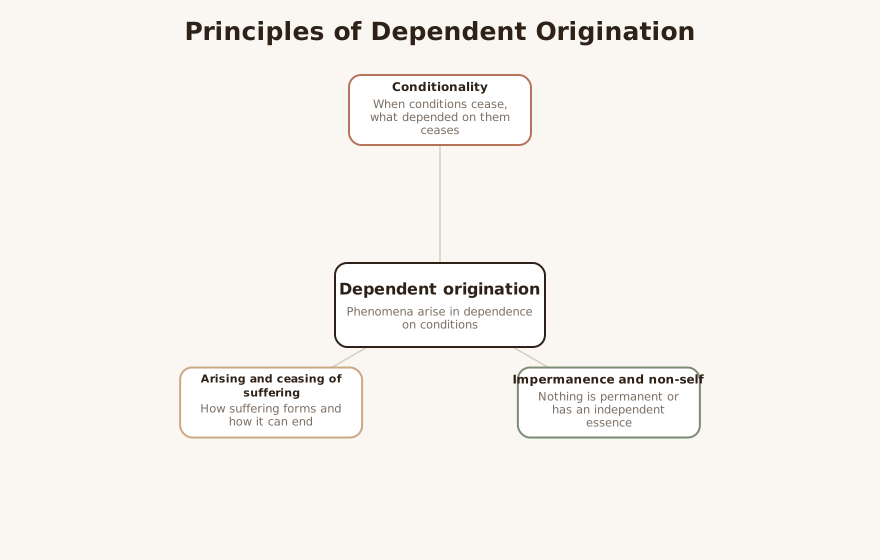
The first principle is conditionality: nothing arises without conditions, and when the conditions cease, what depended on them ceases 2. This is the meaning of the standard formula, which presents causality as “a relationship between events” in which conditions must be present for effects to arise, rather than as random occurrence or as the action of a fixed essence 2. Clinically, this reframes a symptom or a state of mind as something conditioned and therefore alterable, not as a fixed feature of the person 5.
The second principle is that dependent origination entails impermanence and non-self 2. Because everything is dependently originated, nothing is permanent and nothing possesses an independent essence; the doctrine fundamentally rejects the need for a permanent self to explain experience, offering instead a model of interdependent processes 2. The early texts associate dependent origination directly with not-self and with emptiness, so that the absence of a fixed, separate self is a consequence of the principle rather than a separate teaching 2.
The third principle is that the doctrine charts how suffering arises and, crucially, how it can cease 1. Dependent origination explains how suffering arises through conditioned experience and how it ceases through wisdom, with ignorance and craving functioning as the root conditions that sustain the cycle 1. This is what makes it more than metaphysics: it is a map of a self-perpetuating process with identifiable points of intervention 5.
The fourth principle is the middle way 1. Dependent arising functions as a philosophical middle path between eternalism, the belief in a permanent transmigrating self, and annihilationism, the denial of any continuity, replacing ontological speculation with practical investigation of how experience is conditioned 1. The same source notes that dependent arising serves as a middle way that avoids both eternalism and nihilism, recognizing that things exist dependently while lacking independent essence 4.
A fifth principle, drawn from the applied literature, is that the chain is severable: “the entire chain ceases when even one link is severed,” which turns a description of bondage into a theory of liberation 5. The most accessible point of intervention is identified as the link between feeling and craving, where mindfulness allows a practitioner to observe sensations “without automatically fueling craving or aversion” 5.
Interventions & Techniques
Because dependent origination is a principle rather than a protocol, it is worked with through contemplative practices that can be embedded in standard therapy LLM. The foundational practice is investigative or analytic meditation in which the doctrine is used as a framework for examining the conditioned nature of experience, comparable to examining the constituents of self or the sense spheres 1. The academic account is explicit that the teaching functions as both doctrine and meditative method, preparing the practitioner for liberating insight into the conditioned nature of experience and the possibility of ending suffering 1.
The most clinically tractable technique targets the feeling-to-craving link directly 5. Here the practitioner learns to notice the bare sensation or feeling-tone of an experience and to interrupt the automatic movement from feeling into craving or aversion, observing sensations “without automatically fueling craving or aversion” 5. This is the precise hinge where dependent origination maps onto mindfulness-based clinical practice, because it locates a concrete, trainable gap between stimulus and reaction 5.
A second technique is the contemplation of conditions, in which a client traces a distressing state back to the conditions that gave rise to it, discovering that it is “structured, causal, and self-perpetuating” rather than fixed or essential 5. This contemplation has an ethical and relational extension: recognizing that another person’s anger “arises from ignorance and craving, not from a fixed, malevolent essence” softens judgment into compassion, and recognizing that one’s own habits of mind “arose from conditions you did not fully choose” redirects energy from self-punishment toward awareness and deliberate change 5.
LLM-generated illustrative example (not a guideline): A client describes a familiar spiral: a coworker glances at her, she feels a flush of unpleasant sensation, and within seconds she is gripped by the craving to be reassured and the aversion to being judged. Within a mindfulness-based session, the clinician helps her slow the sequence down to its links, so she can rest attention on the bare unpleasant feeling for a few breaths before the craving fires, discovering experientially that the feeling does not have to recruit the whole storm that usually follows LLM.
In routine practice these techniques are delivered through the surrounding evidence-based modality, for example as a defusion-and-acceptance exercise within Acceptance and Commitment Therapy, as attitudinal, decentering awareness within Mindfulness-Based Cognitive Therapy, or as insight-oriented contemplative work within contemplative psychotherapy LLM.
Evidence Base
Dependent origination should be described honestly as an established doctrine within Buddhist philosophy, not as a clinically validated intervention 2. The word “established” here refers to its standing as a foundational teaching shared across all Buddhist schools and central to the tradition’s account of suffering, not to any body of efficacy research 2. There is no manualized dependent-origination therapy, no validated dependent-origination measure, and no randomized controlled trial of the doctrine as a discrete treatment LLM.
What carries the clinical weight is the family of mindfulness- and acceptance-based therapies into which the doctrine’s practices are embedded, and it is those modalities, not dependent origination as such, that hold the more robust outcome literature LLM. The defensible clinical stance is therefore to use dependent origination as an explanatory and experiential frame, a way of helping a client perceive distress as conditioned, severable, and impermanent, delivered inside an evidence-based modality, while never presenting it to clients or supervisees as a freestanding proven treatment LLM. The tradition itself frames the doctrine as something that must be realized through investigative practice rather than merely understood intellectually, which means any clinical use depends on the quality of the mindfulness practice it is paired with 1.
Populations & Indications
Dependent origination as a clinical frame is well suited to adults whose distress is organized around fixed, essentializing stories about themselves, others, or their symptoms LLM. Mindfulness practitioners who already have a contemplative practice can deepen it with dependent origination as a perspective, since the doctrine is taught as something realized through meditation rather than adopted as a belief 1. People with anxiety are indicated where worry treats a feared outcome as fixed and certain, because the doctrine reframes the feared state as conditioned and impermanent and locates a workable gap between feeling and reactive craving 5.
People experiencing existential distress are addressed by the doctrine’s reframing of the self as a web of interdependent processes rather than an isolated, permanent essence, which can loosen the grip of a felt sense of separateness and meaninglessness 2. Clients in contemplative therapy are a natural fit, since the frame is native to the contemplative traditions those therapies draw on LLM. People with depression may benefit from the recognition that low mood and self-critical narratives “arose from conditions you did not fully choose,” which can redirect energy from self-punishment toward deliberate, compassionate change 5. As with any contemplative frame, suitability depends on the client’s stability, openness, and worldview rather than on diagnosis alone LLM.
Problems-for-Work
Dependent origination speaks most directly to suffering that is sustained by automatic reactivity and by fixed, essentializing perception LLM. For craving and attachment, the work targets the feeling-to-craving link itself, training the client to observe a sensation without automatically fueling the craving that usually follows it 5.
LLM-generated illustrative example (not a guideline): A client in early recovery notices that an advertisement triggers a wave of pleasant anticipation, then an urgent craving. Within an acceptance-based frame, the clinician helps him recognize the wave as a conditioned link that arose and will pass, so that he can stay with the rising sensation, name it as impermanent, and let it crest without acting, rather than treating the craving as a command LLM.
For rumination and worry, the contemplation of conditions reframes a repetitive thought as a conditioned, self-perpetuating chain that “ceases when even one link is severed,” shifting the client from arguing with the content to interrupting the process 5. For reactivity and aversion, the feeling-to-craving practice provides a concrete place to insert a pause between an unpleasant feeling and the reflex to push it away 5. For self-criticism, recognizing that one’s habits of mind arose from conditions one did not fully choose can soften harsh self-judgment into curiosity and deliberate change 5. For depression and anxiety, the reframing of symptoms as conditioned and impermanent counters the despairing or catastrophic sense that a state is fixed and total 5. For existential distress and cognitive fusion, perceiving the self and its thoughts as dependently arisen rather than as solid, essential facts can loosen identification with distressing content 2.
Contraindications, Cautions & Cultural Humility
The central caution is the risk of spiritual bypass: using “everything is impermanent” or “the self is empty” to override a client’s real and legitimate distress LLM. Telling a grieving or frightened client that their pain is “just a conditioned arising” can invalidate a genuine experience and pressure premature letting-go, and because the tradition itself insists the doctrine must be realized through sustained practice rather than asserted intellectually, deploying it as a reassuring slogan is a misuse 1. The doctrine’s value is that it makes suffering tractable, not that it makes suffering unimportant 5.
Dependent-origination language is also poorly matched to acute crisis, active psychosis, acute suicidality, and severe instability, where structure, safety planning, and stabilization take priority over any contemplative reframing LLM. Contemplations that thin the felt boundaries of the self, including the non-self and emptiness dimensions of the doctrine, require careful screening and grounding for clients with histories of trauma, dissociation, or fragile self-structure, for whom such practices can shade into derealization rather than insight LLM. The teaching that “the self is made of non-self elements” is a contemplative realization to be approached gradually, not a destabilizing claim to be argued at a vulnerable client 2.
Cultural humility is essential because dependent origination is a specifically Buddhist doctrine, woven into a religious account of rebirth, karma, and liberation, and clinicians should neither strip it of those origins in a way that misrepresents it nor impose it as a universal spiritual prescription 2. For some clients the frame will resonate with their own faith or practice; for others it may conflict with religious commitments to a permanent soul, a creator, or the reality of an enduring self LLM. The respectful stance is to offer the psychological mechanism, a more flexible and less essentializing relationship to experience, while honoring each client’s tradition and language LLM.
Treatment-Plan Suggestions & SMART Objectives
| Goal | SMART objective (example) | Mechanism |
|---|---|---|
| Reduce reactive craving | Within 8 sessions, client will practice pausing at the feeling-to-craving link 4 times weekly, observing a sensation for 2 minutes without acting on the urge that follows | Severing the feeling-to-craving link 5 |
| Decrease rumination and worry | Over 6 weeks, client will log 5 instances weekly of noticing a repetitive thought as a conditioned chain and redirecting attention to the present | Seeing thought as conditioned and severable 5 |
| Soften reactivity and aversion | Within 10 sessions, client will insert a deliberate pause between an unpleasant feeling and the reflex to push it away, 3 times weekly | Mindful gap between feeling and reaction 5 |
| Reduce self-criticism | Over 8 weeks, client will reframe 2 self-critical episodes weekly in terms of the conditions that produced the habit rather than a fixed flaw | Recognizing habits as conditioned, not essential 5 |
| Loosen cognitive fusion | Within 8 sessions, client will practice observing a distressing thought as a dependently arisen event rather than a solid fact, daily | Perceiving experience as conditioned and impermanent 2 |
| Ease existential distress | Within 10 sessions, client will articulate 3 ways their sense of self depends on a web of conditions and others | Reframing self as interdependent process 2 |
| Build investigative awareness | Over the episode of care, client will sustain a brief weekly contemplation tracing one distressing state back to its conditions | Dependent origination as meditative method 1 |
| Apply the middle-way stance | Within 6 sessions, client will practice meeting one fixed belief about a feared outcome as neither permanent nor nonexistent but as conditioned | Middle way between eternalism and nihilism 1 |
Common Misconceptions
The most consequential misconception is that dependent origination is a vague, feel-good idea that “everything is connected”; in the source tradition it is a precise causal principle stating that phenomena arise only in dependence on conditions and cease when those conditions cease 2. A second is that the twelve links describe a simple linear chain of dominoes, when the tradition holds that “the relationship between links is not considered to be a linear causal process” but involves mutual dependence across multiple conditions 4. A third is that the doctrine implies the self does not exist at all; rather, it denies a permanent, independent self while affirming the self as a real but thoroughly conditioned process 2. A fourth is that it is bleak determinism; the applied literature stresses the opposite, that because suffering is “structured, causal, and self-perpetuating,” the chain can be interrupted and is therefore a source of agency, not fatalism 5. A fifth is that intellectual understanding suffices, when the tradition insists the doctrine must be directly realized through investigative practice to do its transformative work 1.
Training & Certification
There is no license or certification in “dependent origination”; it is a doctrine engaged by licensed mental health professionals who incorporate its frame within their existing scope and modalities LLM. The most direct routes to clinical competence are training in the mindfulness- and acceptance-based therapies that operationalize present-moment, non-reactive awareness, namely Mindfulness-Based Cognitive Therapy and Acceptance and Commitment Therapy, together with grounding in contemplative psychotherapy, each with its own established training pathway LLM. Clinicians who wish to engage the doctrine seriously benefit from grounding in its source tradition, including the Buddha’s formulation, the twelve links, and Nagarjuna’s equation of dependent origination with emptiness and the middle way, so that they represent it accurately rather than as a decontextualized wellness slogan 1. Familiarity with how the doctrine grounds impermanence and non-self helps clinicians avoid distorting it in transmission 2. As with any contemplative integration, clinicians should represent their competence and scope honestly and avoid implying religious or spiritual authority they do not hold LLM.
Key Terms
Pratityasamutpada (dependent origination / dependent arising) – the Buddhist principle that all phenomena arise in dependence on causes and conditions, and that nothing exists independently 1. The standard formula – “When this exists, that comes to be… When this does not exist, that does not come to be,” expressing conditionality as a relationship between events 2. The twelve nidanas (links) – the canonical sequence running from ignorance through to aging-and-death that illustrates how suffering perpetuates in cyclic existence 3. Avidya (ignorance) – the root condition, the not-knowing of suffering and its causes, that begins the chain 1. Tanha (craving) – the link, arising from feeling, whose interruption is the most accessible point of intervention 5. Anatta (non-self) – the insight, entailed by dependent origination, that there is no permanent, independent self 2. Sunyata (emptiness) – the absence of intrinsic, independent existence; Nagarjuna equates “whatever arises dependently” with emptiness 4. The middle way – the path between eternalism and annihilationism, recognizing that things exist dependently while lacking independent essence 1. Reverse dependent origination – the cessation sequence in which the fading of ignorance leads to the cessation of each subsequent link, producing liberation 2.
Resources & Further Reading
▶ Watch — a video introduction to this concept:
- Dependent Arising — St Andrews Encyclopaedia of Theology
- Pratītyasamutpāda — Wikipedia
- Twelve Links of Dependent Origination — Rigpa Wiki
- Pratityasamutpada — Encyclopedia of Buddhism
- The Principle of Interdependence in Buddhism: Dependent Origination — Philosophy Institute
- Pratītyasamutpāda: The Buddhist Concept of Dependent Origination — HD Asian Art
Reflective / Supervision Questions
- When I introduce dependent origination to a client, am I offering an experiential, investigative practice, or am I deploying “everything is impermanent” as a slogan that bypasses their real distress LLM?
- Am I helping the client locate the workable gap between feeling and reactive craving, or am I lecturing on metaphysics that stays abstract and unusable LLM?
- Am I screening for trauma, dissociation, and fragile self-structure before offering non-self or emptiness contemplations that could shade into derealization LLM?
- Am I honoring the specifically Buddhist origins of this doctrine and my client’s own worldview, rather than presenting a decontextualized wellness version LLM?
- Am I representing the evidence honestly, as a doctrine established within Buddhist philosophy but lacking a freestanding clinical trial base, used as a frame within evidence-based modalities LLM?
- Where am I, as the clinician, treating this client’s difficulty as a fixed essence rather than a conditioned, changeable process, and how might that perception shape the work LLM?