
Type & Discipline
Mindful Self-Compassion (MSC) is a structured, manualized training program rather than a school of psychotherapy or an open-ended theoretical framework 3. It sits at the intersection of clinical and positive psychology, drawing on mindfulness traditions and on the empirical study of self-compassion to teach a learnable emotional skill rather than to treat a specific disorder 2. In its standard form it is delivered as an eight-week group course, with weekly sessions of roughly two to three hours plus a half-day retreat, modeled in format on Mindfulness-Based Stress Reduction 3. The program’s defining content is the cultivation of three interlocking components of self-compassion — self-kindness, a sense of common humanity, and mindfulness — applied to the moments when a person struggles, fails, or suffers 4. For clinicians it is best understood as a transdiagnostic, resource-building intervention: it targets the relationship a person has with their own suffering rather than any single symptom cluster, which is why it generalizes across many presentations LLM. Importantly, MSC was designed primarily as a community and wellness program for the general public, and its adaptation into individual psychotherapy is a related but distinct activity that requires clinical framing 3.
Creators & Lineage
MSC was co-developed by Kristin Neff and Christopher Germer, who first taught the program together and published the foundational outcome study in 2013 1. Kristin Neff is the researcher who operationalized self-compassion as a measurable psychological construct, defining its three components and creating the self-report instrument that anchors most of the field’s empirical work 2. Christopher Germer is a clinical psychologist and longtime mindfulness teacher who brought the therapeutic and contemplative practice expertise, integrating self-compassion into clinical work and co-authoring the program’s training curriculum 4. Neff’s popular account of the construct, the 2011 book Self-Compassion: The Proven Power of Being Kind to Yourself, brought the ideas to a wide audience and remains a common entry point for clinicians and clients alike 5.
The program’s lineage is explicitly mindfulness-based: its eight-week-plus-retreat architecture is adapted from Mindfulness-Based Stress Reduction, the secular mindfulness curriculum that established this delivery format 3. Conceptually, self-compassion theory itself was shaped in part by contemplative traditions and by Neff’s reading of how Buddhist psychology frames suffering and kindness, which she then translated into testable Western psychological terms 2. The construct and the program are adjacent to, but distinct from, Compassion-Focused Therapy, an independently developed psychotherapy that also centers compassion and shame but arises from an evolutionary and attachment-informed model of emotion-regulation systems LLM. MSC also shares conceptual territory with the acceptance and mindfulness wing of contemporary cognitive-behavioral approaches, including acceptance and commitment therapy, in its emphasis on a non-avoidant, accepting stance toward painful inner experience LLM.
Core Principles
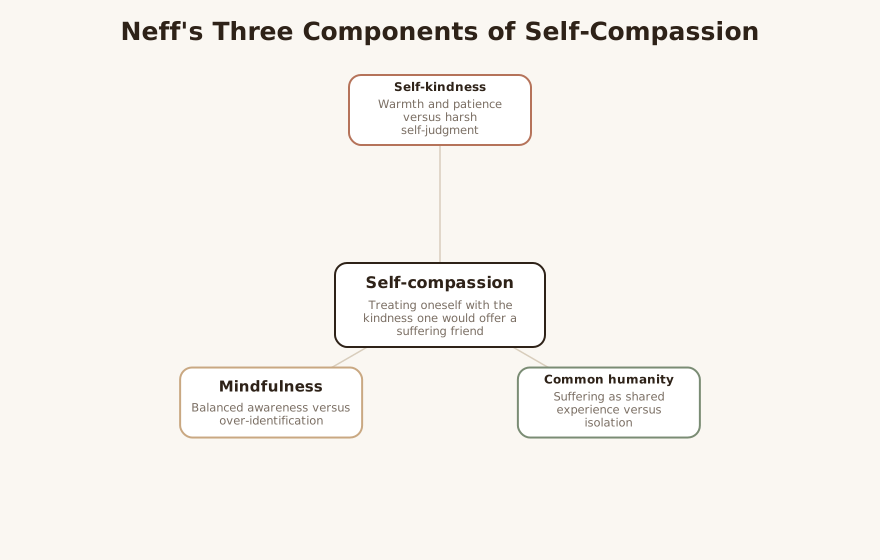
The organizing idea is that self-compassion means treating oneself with the same kindness, care, and understanding one would readily offer a good friend who is suffering 2. Neff’s model decomposes this into three components, each defined against its opposite 2. The first is self-kindness versus self-judgment: meeting one’s own failures and inadequacies with warmth and patience rather than harsh self-criticism 7. The second is common humanity versus isolation: recognizing that suffering, imperfection, and failure are part of the shared human experience rather than something that happens only to oneself, which counters the isolating sense that one is uniquely flawed 7. The third is mindfulness versus over-identification: holding painful thoughts and feelings in balanced awareness rather than suppressing them or being swept away and consumed by them 7. Self-compassion, in this framing, requires all three operating together 2.
A central and clinically useful distinction is between self-compassion and self-esteem 6. Self-esteem depends on evaluating oneself positively, often through comparison with others and contingent on success, which makes it fragile precisely when a person fails or falls short — the moment they most need support 6. Self-compassion, by contrast, is available unconditionally because it is not an evaluation of worth at all; it is a way of relating to oneself that does not require being above average or succeeding 6. Neff also describes self-compassion as having both a tender, soothing side and a fierce, protective, motivating side, correcting the misreading that it is merely soft or passive 2. The program treats self-compassion as a trainable capacity rather than a fixed trait, which is the premise that makes an eight-week course coherent: people can deliberately increase how compassionately they respond to their own difficulties 2.
Interventions & Techniques
MSC is taught through a sequence of formal meditations, short informal practices for daily life, experiential exercises, and group discussion, scaffolded across the eight weeks 3. A signature informal practice is the self-compassion break, a brief three-step sequence used in a moment of difficulty: acknowledging the pain mindfully (“this is a moment of suffering”), recalling common humanity (“suffering is part of life”), and offering oneself kindness, often paired with a soothing touch such as a hand over the heart 4. Formal meditations include loving-kindness and compassion meditations directed toward oneself and others, and practices for working with difficult emotions in the body 3. The curriculum also teaches affectionate or soothing touch, the use of compassionate self-talk to replace a harsh inner critic, and writing exercises such as composing a letter to oneself from the perspective of a compassionate friend LLM.
A distinctive technique is working explicitly with backdraft, the program’s term for the phenomenon in which offering oneself kindness can paradoxically surface old pain — grief, unmet need, or trauma-related affect — that the self-criticism had been holding at bay LLM. Teachers normalize this, slow the pace, and emphasize that practice should titrate to what feels manageable, which is one reason MSC is taught with attention to safety and self-pacing 3. The program also distinguishes practice “to feel better” from practice “to be present with what is,” cautioning against using self-compassion as a covert strategy to make pain disappear LLM.
LLM-generated illustrative example (not a guideline): A client who berates herself after a minor mistake at work is guided through a self-compassion break in session — naming the sting (“this really hurts”), noting that everyone makes mistakes, and placing a hand on her chest while offering a phrase like “may I be kind to myself right now.” Rather than arguing with the self-critical thought, the work shifts her relationship to it, and she reports the criticism loosening its grip without her having to prove it false LLM.
Evidence Base
The honest label is established: self-compassion is a robustly studied construct and MSC is a manualized program with controlled-trial support, though the literature is younger and smaller than that for first-line treatments such as cognitive-behavioral therapy LLM. The foundational evidence is the 2013 randomized controlled trial by Neff and Germer, which followed a pilot study and found that, relative to a waitlist control, the eight-week MSC program significantly increased self-compassion, mindfulness, and well-being, and significantly decreased depression, anxiety, and stress, with gains maintained at follow-up 1. Increases in self-compassion correlated with the gains, supporting the program’s proposed mechanism 1. Beyond the program itself, a large and growing body of research links higher trait self-compassion to greater psychological well-being and to lower anxiety, depression, and stress, and reviews of self-compassion interventions report consistent, if generally modest to moderate, benefits 2.
Several caveats deserve plain statement LLM. Much of the supporting evidence is correlational or relies on self-report measures of self-compassion, which raises questions about how cleanly the construct can be separated from the symptoms it predicts 2. The structure of Neff’s three-component scale — in particular whether the “negative” items (self-judgment, isolation, over-identification) should be combined with the positive ones into a single score — has been a point of methodological debate in the field 2. The original MSC trial used a waitlist control rather than an active comparison, so its effects cannot be fully separated from nonspecific factors such as group support and attention LLM. The defensible clinical stance is to treat MSC as an evidence-supported, transdiagnostic skill-building program — a strong adjunct and a reasonable primary intervention for self-criticism and shame — while not overstating it as a validated standalone treatment for severe, specific disorders LLM.
Populations & Indications
MSC was developed for and tested primarily with adults in the general community who want to learn to relate to themselves more kindly, and that remains its core population 1. It is particularly indicated for people whose suffering is amplified by harsh self-criticism, shame, and perfectionism, because these are precisely the patterns the three components are designed to counter 2. It has been applied with people experiencing anxiety and depression, where the program’s own trial showed symptom reductions, and where self-compassion’s buffering relationship to these states is well documented 1. It is widely used with caregivers and healthcare professionals, populations exposed to chronic emotional demand and at risk of burnout, for whom self-compassion offers a sustainable alternative to the self-neglect that often accompanies caregiving roles LLM. People with chronic illness are another natural fit, since the program offers a way to meet ongoing pain and limitation with kindness rather than self-blame LLM. Self-compassion practices are increasingly adapted for trauma survivors, though, as discussed below, this requires trauma-sensitive modification and careful pacing rather than the standard community format LLM.
Problems-for-Work
The clearest indication is self-criticism: MSC directly trains a kinder internal stance to replace a punishing inner critic, which is the program’s central aim and the most reliably targeted problem 2. Shame is closely related and well matched, because the common-humanity component reframes private, isolating defectiveness as a shared human condition, loosening shame’s grip 7. Perfectionism, with its contingent self-worth and brutal standards, is addressed by decoupling self-acceptance from achievement and by the self-compassion-versus-self-esteem distinction 6. In major depressive disorder and generalized anxiety disorder, self-compassion practices are used to reduce the secondary layer of self-attack and rumination that compounds the primary symptoms, as an adjunct to disorder-specific care 1. In stress and burnout, the work is building a self-supportive stance and soothing-system access so that demands are met without chronic self-neglect LLM. In emotional dysregulation, the mindfulness component supports holding strong affect in balanced awareness rather than suppressing or being overwhelmed by it 7.
LLM-generated illustrative example (not a guideline): A perfectionistic graduate student presents with anxiety that spikes before every deadline and a relentless inner voice calling him lazy and inadequate. Within an established mindfulness-based course of treatment, the clinician introduces compassionate-letter writing and the self-compassion break, framing the goal not as lowering his standards but as changing how he treats himself when he inevitably falls short, so that anxiety no longer has to be fueled by self-attack LLM.
For post-traumatic stress disorder, self-compassion is relevant to the shame and self-blame that frequently accompany trauma, but it is applied cautiously and usually as a complement to trauma-focused treatment rather than as a first move, given the risk of surfacing overwhelming affect LLM.
Contraindications, Cautions & Cultural Humility
The most important clinical caution is backdraft: deliberately offering oneself warmth can release previously walled-off pain, which for trauma survivors and people with intense unmet attachment needs can be destabilizing if it arrives too fast LLM. MSC is therefore taught with titration, self-pacing, and explicit permission to back off, and for highly traumatized clients a standard community group may be inappropriate without trauma-sensitive adaptation and adequate stabilization 3. The program is a wellness and skills training, not a crisis intervention; it is poorly suited as a sole response to acute suicidality, active psychosis, or severe instability, where containment and evidence-based stabilization take priority LLM. Some clients also actively resist self-kindness, fearing it will erode their motivation or “let them off the hook”; this resistance is itself clinical material and is one reason the fierce, motivating face of self-compassion is emphasized 2.
Cultural humility matters in several directions LLM. The very idea of turning kindness inward can clash with values that prize self-effacement, modesty, or duty to others over attention to the self, and clients from such backgrounds may experience self-compassion practices as self-indulgent or alien LLM. Gendered messaging also varies: some clients have been socialized to equate self-sacrifice with virtue, and reframing self-care as legitimate rather than selfish is part of the work LLM. Because the construct was distilled from contemplative traditions and then standardized in a Western research context, clinicians should hold it as one well-supported articulation of self-kindness rather than a universal prescription, and should adapt language and practices to each client’s framework rather than importing the program’s idiom wholesale LLM.
Treatment-Plan Suggestions & SMART Objectives
| Goal | SMART objective (example) | Mechanism |
|---|---|---|
| Reduce harsh self-criticism | Over 8 weeks, client will use the self-compassion break in 4 of 7 days when noticing self-critical thoughts and log the shift in distress | Self-kindness replacing self-judgment 4 |
| Counter shame and isolation | Within 6 weeks, client will identify 3 struggles and reframe each as part of common human experience in writing | Common-humanity component 7 |
| Build mindful awareness of painful affect | For 6 weeks, client will practice a brief self-compassion or breathing-space practice 5 of 7 days and name emotions as they arise | Mindfulness versus over-identification 7 |
| Loosen perfectionistic self-worth | Within 10 sessions, client will record 2 instances weekly of meeting a mistake with kindness rather than self-attack | Decoupling worth from achievement; self-compassion over self-esteem 6 |
| Establish a daily compassion practice | Over 8 weeks, client will complete a 10-minute loving-kindness or compassion meditation 5 of 7 days | Strengthening the trainable capacity for self-compassion 2 |
| Develop self-soothing for stress and burnout | For 4 weeks, client will apply soothing touch plus a self-kindness phrase during 70% of identified stress spikes | Activating the soothing/care response 4 |
| Replace the inner critic with a compassionate voice | Within 6 weeks, client will write one compassionate letter to self from a kind-friend perspective and re-read it weekly | Compassionate self-talk; restructuring the inner critic 5 |
Common Misconceptions
The most pervasive misconception is that self-compassion is self-pity or wallowing; in the model it is the opposite, because the common-humanity and mindfulness components specifically counter the isolating, over-identified absorption in one’s own troubles that defines self-pity 7. A second is that self-compassion is self-indulgent or weak, when Neff emphasizes it also has a fierce, protective, action-oriented face and is associated with greater, not lesser, motivation and resilience 2. A third, clinically important, is that self-compassion undermines motivation by removing the pressure of self-criticism; the research-backed claim is that self-criticism is an unreliable and costly motivator and that self-compassion supports persistence by making failure less threatening 6. A fourth is conflating self-compassion with self-esteem; the distinction is central, since self-esteem is evaluative and contingent while self-compassion is unconditional and available precisely when self-esteem collapses 6. A fifth is treating MSC as just relaxation or feeling good, when the program explicitly frames practice as being present with suffering rather than as a technique to make pain disappear LLM. Finally, some assume MSC is a psychotherapy; it is a training program that can be integrated into therapy but was built and tested as a community course 3.
Training & Certification
MSC for the public is delivered by trained MSC teachers, and there is a formal teacher-training pathway maintained by the program’s organizational home, including teacher training and certification routes for those who want to lead the eight-week course 3. Christopher Germer’s and Kristin Neff’s affiliated organizations provide the curriculum, teacher trainings, and resources, and Germer’s site describes the program and his role in training clinicians and teachers 4. For practicing therapists, two distinct paths exist LLM. One is to train as an MSC teacher to deliver the standardized group program; the other is to integrate self-compassion practices into individual psychotherapy as a licensed clinician, applying them within one’s existing modality and scope of practice LLM. There are also adapted and shorter formats and a trauma-sensitive variant, and clinicians working with higher-acuity populations should seek the specialized training appropriate to those adaptations rather than improvising from the standard course LLM. Neff’s book and the program websites are common, low-barrier entry points before formal training 5.
Key Terms
Self-compassion — extending kindness, care, and understanding to oneself in moments of suffering, failure, or inadequacy, as one would to a good friend 2. Self-kindness — meeting one’s own shortcomings with warmth rather than harsh self-judgment 7. Common humanity — recognizing that suffering and imperfection are part of the shared human condition rather than signs of being uniquely flawed 7. Mindfulness (in MSC) — holding painful thoughts and feelings in balanced awareness, neither suppressing them nor over-identifying with them 7. Self-compassion break — a brief three-step informal practice (mindfulness, common humanity, self-kindness) for moments of difficulty 4. Backdraft — the surfacing of old pain that can occur when one begins to treat oneself with kindness LLM. Fierce self-compassion — the protective, motivating, action-oriented aspect of self-compassion, as distinct from its tender, soothing aspect 2. Self-compassion versus self-esteem — the contrast between an unconditional, non-evaluative way of relating to oneself and a contingent, comparison-based evaluation of self-worth 6.
Resources & Further Reading
▶ Watch — a video introduction to this concept:
- A Pilot Study and Randomized Controlled Trial of the Mindful Self-Compassion Program (Neff & Germer, 2013, Journal of Clinical Psychology)
- Self-Compassion: Theory, Method, Research, and Intervention (Neff, 2023, Annual Review of Psychology)
- Self-Compassion.org — The MSC Program
- Mindful Self-Compassion (MSC) — Chris Germer
- Self-Compassion: The Proven Power of Being Kind to Yourself (Neff, 2011, William Morrow)
- Kristin Neff: The Space Between Self-Esteem and Self-Compassion (TEDxCentennialParkWomen)
- Self-compassion — Wikipedia
Reflective / Supervision Questions
- When a client resists self-kindness as “letting myself off the hook,” how do I work with that resistance rather than overriding it, and how do I introduce the fierce, motivating face of self-compassion LLM?
- How do I recognize backdraft early in a client, and how do I titrate compassion practices so they open old pain at a manageable pace LLM?
- For a trauma survivor, when is self-compassion work appropriate, and when does it need to wait for stabilization and trauma-focused treatment LLM?
- Am I presenting MSC honestly as an evidence-supported skills program rather than a validated standalone treatment for a client’s specific severe disorder LLM?
- When a client’s cultural or family framework treats self-attention as self-indulgent, how do I adapt the language and practices rather than imposing the program’s idiom LLM?
- Am I helping the client be present with suffering, or have the practices quietly become another strategy to make difficult feelings disappear LLM?