
Type & Discipline
Mudita is a construct — an affective capacity and trainable mental state — rather than a packaged therapy protocol. LLM Its home discipline is Buddhist contemplative practice, where it is one of the four Brahmaviharas or “sublime states.” 1 Mudita is most often translated as sympathetic, appreciative, altruistic, or unselfish joy: the pleasure that arises from delighting in another person’s well-being and good fortune. 5 For clinicians, the most useful framing is that mudita names a specific, cultivable affect that most envy- and comparison-bound clients are not currently able to access, and that contemplative traditions claim can be deliberately trained. LLM
It is worth distinguishing mudita from adjacent constructs at the outset. LLM It is not the same as empathy (sharing another’s state generally), nor compassion (responsiveness to another’s suffering); mudita is specifically the felt response to another’s happiness, success, or flourishing. 4 In contemporary scholarship it has been examined as a moral emotion in its own right and explicitly contrasted with envy. 67
Creators & Lineage
Mudita has no single founder; it is a canonical teaching attributed to the Buddha and transmitted across Theravada, Mahayana, and Zen lineages. 5 The Brahmavihara meditation instruction appears in early canonical sources, in which a practitioner “lets his mind pervade one quarter of the world with thoughts of unselfish joy,” then extends that radiation in all directions until “the whole wide world” is pervaded. 5
The most influential modern English-language synthesis for clinicians is Nyanaponika Thera’s treatment of the four sublime states, which situates mudita alongside loving-kindness (metta), compassion (karuna), and equanimity (upekkha) as interdependent qualities. 1 In that framing, metta supplies the underlying affection that makes joy-in-another possible; karuna meets suffering; mudita meets good fortune; and upekkha — equanimity — is the balancing aim of all four, to which “sympathetic joy gives … the mild serenity that softens its stern appearance.” 1 In the Zen lineage, Norman Fischer’s contemporary teaching presents mudita as the second of the “four immeasurables” and frames it less as a sentimental ideal than as a practical expansion of one’s own available joy: if others’ happiness can become a source of my happiness, my opportunities for contentment multiply. 4
The clinical lineage relevant to this wiki runs through loving-kindness (metta) meditation, mindfulness-based interventions, and compassion-focused approaches, all of which have imported Brahmavihara practices — though metta and compassion have received far more empirical attention than mudita specifically. LLM
Core Principles
Joy is not zero-sum. The central premise is that happiness is not a finite resource to be divided. LLM Envy rests on the implicit belief that “happiness is limited: if others have an abundance and we have little, it means there’s not enough to go around,” and this scarcity stance causes the heart to contract. 3 Mudita is offered as the direct antidote to that contraction. 3
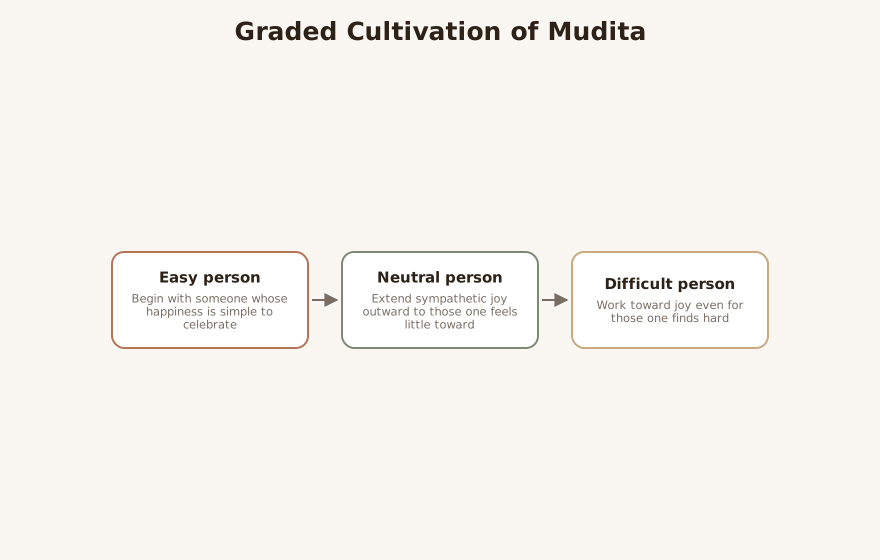
Mudita is trained, not assumed. Contemplative sources treat sympathetic joy as a skill cultivated in graded steps, not a trait one simply has or lacks. 1 The practitioner begins with someone whose happiness is easy to celebrate and works outward toward neutral and even difficult people. 14
The four states are interdependent. Mudita is not practiced in isolation; it is structurally paired with loving-kindness, compassion, and equanimity, each correcting the others’ failure modes. 1 Compassion without joy can curdle into a grim, patronizing relationship to others’ lives; joy without equanimity can become brittle elation. 1
Near and far enemies. Buddhist psychology analyzes each sublime state by its far enemy (its opposite) and its near enemy (a counterfeit that masquerades as the real thing). LLM The far enemies of mudita are jealousy, envy, covetousness, and greed. 15 The near enemy is subtler: an ungrounded exhilaration or “frivolity” — a grasping at pleasant experience “out of a sense of insufficiency or lack” that uses surface cheerfulness to avoid difficult realities such as impermanence and loss. 54 This near-enemy concept is clinically valuable, because it distinguishes genuine appreciative joy from manic defense or compulsive positivity. LLM
Interventions & Techniques
The core technique is a graded mudita meditation that parallels the structure of loving-kindness practice. 1
- Anchor with an easy figure. Begin by bringing to mind a person whose happiness you can already celebrate freely — a dear friend, a beloved companion — and rest attention on their good fortune. 14
- Offer mudita phrases. Silently extend wishes such as “May your happiness and good fortune continue to grow.” 3 These function like the phrase repetitions of metta practice. LLM
- Widen the circle. Progress from the easy figure to neutral persons, then toward difficult or even hostile persons, and finally toward all beings, “pervading” the field in all directions. 145
- Pair with gratitude. Practitioners often find that establishing one’s own felt “fullness” through gratitude first creates enough inner sufficiency to extend joy to others without resentment. 3
- Reframe envy in the moment. Fischer offers in-practice reframes for when resentment arises: resentment harms primarily oneself; jealousy often targets an imagined, idealized version of the other person rather than the real one; and one can choose to “practice steadily and realistically” despite internal resistance. 4
LLM-generated illustrative example (not a guideline): A clinician adapting mudita for a client locked in social comparison on social media might pair a brief gratitude inventory with a single-target practice: the client selects one person whose post triggered envy, and silently offers “May your good fortune continue,” noticing — without forcing — where the body contracts. The aim is not to manufacture warmth but to observe envy’s grip and rehearse an alternative response. LLM
Evidence Base
Honesty about maturity matters here. LLM As a contemplative practice within a 2,500-year tradition, mudita is well established and richly described. 15 As a discretely measured, manualized clinical target, the evidence base is thin and largely inferential — it rides on the broader, much stronger literature for loving-kindness and compassion meditation rather than on trials isolating mudita itself. LLM
Mudita has been taken seriously in recent academic work as a moral emotion and analyzed philosophically as the affective counterpart and corrective to envy. 67 But clinicians should not represent sympathetic-joy practice as an independently validated intervention for any DSM condition. LLM Its strongest current warrant is (a) face-valid mechanistic fit with envy, social comparison, and scarcity cognition, and (b) its embeddedness in mindfulness- and compassion-based programs that do have a maturing evidence base. 34 Treat it as a promising adjunctive practice, not a stand-alone treatment. LLM
Populations & Indications
Mudita practice is most readily indicated for meditation practitioners and clients already enrolled in mindfulness-based programs, for whom it extends an existing skill set. 14 It maps conceptually onto presentations marked by envy, chronic social comparison, low self-esteem, resentment, and the contraction of scarcity thinking. 35
It has plausible application for adults with depression and anhedonia/emotional numbing, where the capacity to be moved by good news — one’s own or others’ — is blunted, though here it should sit inside a broader treatment plan rather than carry the load alone. LLM In relational work, sympathetic joy is relevant to couples and to loneliness, since the ability to genuinely celebrate a partner’s or friend’s success is a measurable relational asset, and its absence — being unable to share in another’s wins — is a common, corrosive pattern. LLM
Problems-for-Work
- Envy and jealousy. The primary target; mudita is explicitly its antidote, reframing another’s gain as non-threatening. 13 Application: a client who feels diminished by a colleague’s promotion practices offering appreciative joy toward that colleague as exposure to, and reappraisal of, the envy response. LLM
- Social comparison. Mudita interrupts the comparative reflex by shifting from ranking to shared benefit. 3 Application: structured practice paired with reduced or mindful social-media use. LLM
- Depression and anhedonia. Re-cultivating responsiveness to good fortune as a graded behavioral-affective rehearsal. LLM
- Low self-esteem. Loosening the link between others’ success and one’s own sense of insufficiency, the “personal insufficiency” that fuels resentment. 4
- Resentment. Practicing the recognition that resentment “hurts you alone.” 4
- Relationship conflict / loneliness. Building the capacity to celebrate a partner’s or friend’s good news as relational repair. LLM
Contraindications, Cautions & Cultural Humility
Mudita is a religious practice with a specific cosmological context; importing it as a secular “technique” without acknowledgment risks decontextualization and can feel appropriative to clients from Buddhist backgrounds. LLM Name the lineage, and offer it as an option rather than a prescription. LLM
Watch for the near enemy clinically: pushed prematurely, sympathetic-joy practice can become a demand for forced positivity that bypasses legitimate grief, anger, or injustice — precisely the “grasping at pleasant experience out of a sense of insufficiency” the tradition warns against. 5 For clients with trauma histories, active mania or hypomania, or strong self-criticism, generating positive affect or directing it toward difficult figures can backfire; titrate, and stay with easy targets longer. LLM As with all contemplative practices, some clients experience meditation-related adverse effects; screen and monitor. LLM Finally, never use mudita to imply a client should simply feel happy for someone who has harmed them — the difficult-person stage is advanced, optional, and not a substitute for boundaries or safety. LLM
Treatment-Plan Suggestions & SMART Objectives
| Goal | SMART objective (example) | Mechanism |
|---|---|---|
| Reduce envy reactivity | Over 6 weeks, client will complete a 5-minute daily sympathetic-joy practice toward one comparison trigger, logging envy intensity (0–10) pre/post, with a ≥2-point mean drop | Repeated reappraisal of another’s gain as non-threatening 13 |
| Interrupt social comparison | Within 4 weeks, client will identify 3 weekly comparison episodes and substitute a mudita phrase (“may your good fortune grow”) in ≥2 of them | Shift from ranking to shared-benefit framing 3 |
| Rebuild responsiveness to good news (anhedonia) | Over 8 weeks, client will note one instance daily of someone’s good fortune and a felt response, reporting ≥4 days/week by week 8 | Graded re-engagement of positive affect LLM |
| Loosen self-insufficiency in low self-esteem | Within 6 weeks, client will pair a daily gratitude entry with one mudita offering, reporting reduced “less than” thoughts on a weekly check-in | Establishing inner sufficiency before extending joy 34 |
| Reduce resentment | Over 5 weeks, client will practice the “resentment harms me” reframe in 3 logged situations weekly | Cognitive reappraisal of resentment’s cost 4 |
| Strengthen relational celebration | Within 4 weeks, client will verbally affirm a partner’s/friend’s success ≥3 times weekly and rate connection (0–10) | Behavioral activation of shared joy in relationships LLM |
| Build the four-states skill set | Over 8 weeks, client will rotate loving-kindness, compassion, and sympathetic-joy practices, completing ≥3 sessions weekly | Interdependent cultivation of the Brahmaviharas 1 |
Common Misconceptions
- “Mudita means being happy all the time.” No — its near enemy is exactly that shallow, defensive cheerfulness; genuine mudita coexists with full acknowledgment of suffering and loss. 54
- “It’s just empathy / it’s just compassion.” Mudita is the specific response to another’s happiness, distinct from compassion’s response to suffering. 4
- “Feeling joy for others means I get less.” The practice rests on rejecting that scarcity premise; sympathetic joy is held to multiply one’s own capacity for contentment. 34
- “Schadenfreude or a polite smile counts.” Taking pleasure in another’s misfortune is the inverse of mudita, and “deceitful smirks” and “false compliments” are explicitly excluded. 5
- “You either have it or you don’t.” It is a graded, trainable practice, not a fixed trait. 1
Training & Certification
There is no certifying body or credential for mudita specifically. LLM Clinicians typically encounter it through loving-kindness and compassion meditation training, mindfulness-based program teacher trainings (e.g., mindfulness-based cognitive and stress-reduction lineages), and direct study of Brahmavihara sources such as Nyanaponika Thera’s synthesis. 1 Personal practice is the recommended prerequisite to teaching it: as with all contemplative interventions, clinicians should establish their own familiarity with the graded practice before introducing it, and should locate it accurately within its tradition. 14
Key Terms
- Brahmaviharas / Four Immeasurables: the four sublime states — loving-kindness, compassion, sympathetic joy, equanimity. 15
- Mudita: sympathetic, appreciative, or unselfish joy in another’s well-being. 5
- Metta: loving-kindness; the affectionate basis that makes mudita possible. 1
- Karuna: compassion; the response to suffering, paired with mudita. 1
- Upekkha: equanimity; the balancing aim of the four states. 1
- Far enemy: the direct opposite of a state — for mudita, envy, jealousy, and greed. 15
- Near enemy: a counterfeit resembling the state — for mudita, ungrounded exhilaration/frivolity arising from a sense of lack. 54
- Pervasion: the meditative extension of a quality in all directions to all beings. 5
Resources & Further Reading
▶ Watch — a video introduction to this concept:
- Nyanaponika Thera — The Four Sublime States / Mudita: The Buddha’s Teaching on Unselfish Joy (Access to Insight)
- The Liberating Practices of Sympathetic Joy and Gratitude (Tricycle)
- Sympathetic Joy (Mudita) — Second of the Four Immeasurables (Everyday Zen, Norman Fischer)
- Mudita — Wikipedia
- Sympathetic Joy — Erkenntnis (2023)
- Sympathetic Joy — Encyclopedia of Personality and Individual Differences (Springer)
Reflective / Supervision Questions
- Where in my own practice do I notice the near enemy — forced cheerfulness substituting for genuine appreciative joy — and how might that shape what I model for clients? LLM
- For this client, is envy the presenting problem, or a defense against grief, shame, or injustice that mudita practice could prematurely bypass? LLM
- Have I named the Buddhist lineage of this practice and offered it as an option, rather than repackaging it as a neutral technique? LLM
- How will I sequence loving-kindness, compassion, and sympathetic joy so the client builds sufficient self-directed warmth before extending joy outward? LLM
- What is my plan if generating positive affect destabilizes this client (trauma, mania, severe self-criticism), and how will I titrate the difficult-person stage? LLM