
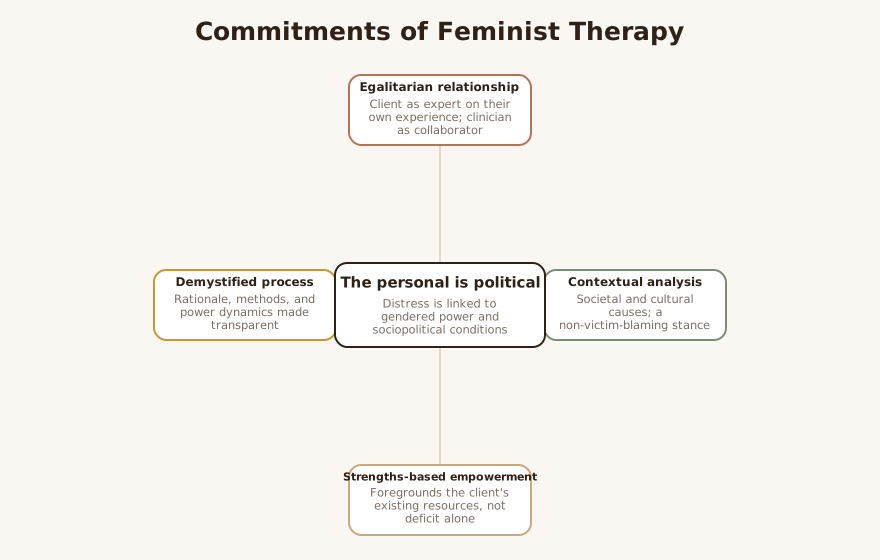
Feminist therapy is less a fixed set of techniques than a way of reading distress: it asks the clinician to hold the social, cultural, and political context of a client’s suffering in view alongside the intrapsychic, and to treat the therapeutic relationship itself as a place where power should be made visible and shared rather than concealed 2. Its organizing slogan, “the personal is political,” compresses the central claim — that problems experienced as private and self-caused are frequently shaped by gendered power, discrimination, and material conditions that are themselves changeable 4. For a practicing therapist, the practical payoff is a stance that resists pathologizing reasonable responses to unjust circumstances, that names oppression where it is operating, and that builds the client’s agency rather than substituting the clinician’s authority for it 1.
Type & Discipline
Feminist therapy is best understood as an integrative therapeutic approach and orienting framework rather than a single manualized protocol 2. It does not own a proprietary technique set; instead it supplies a gender- and power-analytic lens that reshapes how assessment, formulation, and intervention are conducted within whatever methods the clinician already uses 1. Its disciplinary home is in critical and liberation-oriented psychology, and it draws on critical theory, multicultural counseling, and empowerment theory to read individual problems partly as expressions of social arrangements 4. Because it is an approach rather than a discrete treatment, feminist therapy is routinely described as integrative — practitioners combine its principles with cognitive, relational, narrative, somatic, or trauma-focused methods 2. The defining commitment is not a procedure but a set of values: attention to power, refusal to blame the victim, an egalitarian relationship, and a goal of change at both the individual and the social level 4.
Creators & Lineage
Feminist therapy emerged in the late 1960s and 1970s out of the recognition that the established therapies of the era were frequently not helping women and were sometimes actively harming them — dismissing reports of abuse, pathologizing nonconformity to gender roles, and treating socially produced distress as individual deficit 4. It grew directly out of the women’s movement and second-wave feminism, with consciousness-raising groups as an early influence on its method 2. Rather than a single founder, the approach was built by many contributors, and the field is usually described as having developed collectively 4.
Several figures anchor the lineage. Carol Gilligan’s work on a relational, care-oriented “different voice” challenged developmental models that took a male norm as universal and helped legitimize the study of women’s experience on its own terms 4. Jean Baker Miller and the relational-cultural tradition reframed connection and relationship as central to psychological health rather than as signs of dependence 4. Carolyn Zerbe Enns and Judith Worell are central scholars who systematized feminist therapy’s principles, history, and empirical study within psychology 4. Laura S. Brown is among the most influential contemporary theorists, and her later articulation explicitly frames the work as decolonial and intersectional, correcting the early movement’s narrow demographic focus 5. The intellectual ancestry runs through critical theory, empowerment theory, multicultural counseling, and narrative therapy, all of which share the conviction that personal troubles cannot be understood apart from social structure 4.
Core Principles
The foundational principle is “the personal is political”: the recognition that wellness is inextricably linked to a person’s social and cultural identities and to the political environment in which they live, so that distress framed as purely private is often partly the product of external conditions 2. From this follow several interlocking commitments 4.
First, the therapeutic relationship should be egalitarian — a relationship in which the participants have, as far as possible, equal status, with the client treated as the expert on their own experience and the clinician as a collaborator rather than an authority who imposes solutions 2. Second, distress is examined contextually, with attention to societal, cultural, and political causes rather than only intrapsychic ones, which leads to a deliberate stance of non-victim-blaming 2. Third, the work is strengths-based and empowering: it foregrounds the client’s existing resources and capacities rather than organizing the encounter around deficit and symptom alone 2. Fourth, the process is demystified — the rationale, the methods, and the power dynamics of therapy are made transparent rather than hidden behind professional opacity 4. Finally, change is understood at two levels at once: the client’s individual healing and, where the client chooses, action on the conditions that produced the suffering 4.
Interventions & Techniques
Because feminist therapy is a stance applied within other methods, its “techniques” are better understood as signature practice moves 2. The two most characteristic are gender-role analysis and power analysis 4. Gender-role analysis helps a client examine the messages they have absorbed about how someone of their gender is supposed to think, feel, and behave, and the cost of conforming to or resisting those expectations 4. Power analysis examines how differences in power — within relationships, families, workplaces, and institutions — shape a person’s options, mental health, and sense of what is possible 2.
Several further methods are commonly described. Reframing or relabeling shifts a problem from an individual pathology toward a societal lens, so that, for example, a client’s anxiety is examined in light of a genuinely constraining environment rather than coded solely as distortion 2. Assertiveness training and role-play are used to build self-esteem and to rehearse exercising agency 2. bibliotherapy — recommending readings on gender, identity, and social power — supports consciousness-raising outside the session 2. Some practitioners integrate somatic and mindfulness-based work emphasizing body awareness and self-compassion, and many use limited, intentional therapist self-disclosure to flatten the relationship and model transparency 2. Consciousness-raising — helping a client see private struggles as part of a shared, socially patterned experience — remains a through-line across these methods 4.
LLM-generated illustrative example (not a guideline): A clinician working with a client who feels she is “failing” because she cannot keep an immaculate home while working full time might use gender-role analysis to surface the unspoken standard she is measuring herself against, then a power analysis of how domestic labor is distributed in her household — not to dismiss her self-criticism, but to separate a humanly made expectation from a personal defect LLM.
Evidence Base
Honesty about maturity is essential here. Feminist therapy is established in the sense that matters most for a clinician: it is a coherent, widely taught approach with articulated principles, a developed scholarly literature, and a half-century of practice and theory behind it 4. It has been elaborated by serious psychologists, integrated into training, and applied across a wide range of clinical settings 2. In that sense it is mature and respectable, not fringe 4.
It is not, however, established in the sense that a specific manualized treatment is established through a deep base of randomized controlled trials LLM. Because feminist therapy is integrative and lacks a single standardized protocol, there is comparatively little controlled outcome research on its effectiveness as a discrete intervention, and what exists does not support disorder-specific effect-size claims of the kind one would make for an empirically supported, manualized treatment 2. The honest framing for clinicians is that the value of feminist therapy lies in the fit, safety, and relational stance it brings to care — particularly for clients whose distress is entangled with gender and power — rather than in a claim of superior symptom reduction over comparison treatments 2. The approach has also drawn substantive critique: some commentators have questioned whether its social-change aims can conflict with conventional therapeutic goals, and others have asked whether it functions as therapy or as activism, a debate the clinician should be able to engage honestly 4.
Populations & Indications
Feminist therapy was originally developed in the late 1960s for and with women, and women remain a central population 2. It has since broadened to serve people of all genders, as well as couples and families, with particular relevance for those marginalized by gender, race, sexual orientation, gender identity, poverty, immigration status, or disability 2. Survivors of gender-based violence and of sexual abuse and incest are a paradigmatic indication, in part because the approach arose precisely from the failure of older therapies to take such abuse seriously 4. LGBTQ+ individuals individuals and other marginalized groups are well served by a framework that treats minority stress and discrimination as real external stressors rather than as evidence of internal disorder 2.
The settings reflect these populations: feminist therapy is practiced in private offices but also in women’s health clinics, LGBTQ organizations, and domestic violence centers 2. The approach’s value across these groups is that it prevents the clinician from misattributing externally produced suffering to individual deficit, and it positions the client as an agent in their own recovery 1.
Problems-for-Work
Feminist therapy reframes a familiar list of presenting problems by situating each in its social and relational context 2. With trauma from interpersonal violence and posttraumatic stress disorder, the approach validates the injury as real and externally caused, counters self-blame, and connects a private wound to a shared, gendered pattern of harm 4. With anxiety disorders and major depressive disorder, the clinician still delivers appropriate evidence-based treatment for those conditions, but holds the client’s circumstances — discrimination, caregiving load, economic precarity — in view rather than framing all distress as cognitive error 2.
With eating disorders and body image disturbance, gender-role analysis directly addresses the cultural standards and objectifying messages the client has internalized about appearance and worth 2. With low self-esteem and internalized oppression, the work helps a client recognize that demeaning beliefs about themselves were absorbed from an environment that devalues them, then loosens their grip through analysis and empowerment 2. With relationship conflict, a power analysis of how decision-making, labor, and voice are distributed can reframe what felt like a personal failing as a structural imbalance to be renegotiated 2. With identity concerns, particularly around gender and sexuality, the approach supports a coherent, agentic sense of self rather than one organized around stigma 4.
LLM-generated illustrative example (not a guideline): A clinician treating a client whose panic worsens around a controlling partner might validate the physiology of the fear response while using a power analysis to name the relational dynamics maintaining it, supporting both symptom management and the client’s own assessment of her options and safety LLM.
Contraindications, Cautions & Cultural Humility
There are few formal contraindications to a values-based stance, but several cautions are clinically important LLM. The first is the risk of the clinician imposing their own political analysis onto a client who has not requested it; the approach’s own commitment to an egalitarian relationship and client expertise forbids this, and naming oppression should follow the client’s experience rather than override it 2. The second is over-attribution: a clinician who frames all distress as externally caused may neglect treatable biological, relational, or intrapsychic contributors — feminist therapy is meant to widen the formulation, not collapse it LLM. The third is that pushing social action prematurely can be harmful for a client who is in acute crisis, unsafe, or not yet stabilized, since action carries real consequences the client, not the clinician, will bear LLM.
Cultural humility is intrinsic to the contemporary form of the approach rather than an add-on. The early movement has been fairly criticized for centering the experience of white, Western, middle-class, heterosexual women and generalizing from it LLM. The field’s own leading theorists have taken up this correction directly: Laura S. Brown frames present-day feminist therapy as explicitly decolonial and intersectional, attending to how gender intersects with race, class, sexuality, disability, and colonial history rather than treating “women” as a single undifferentiated category 5. A clinician practicing this approach honestly must therefore examine their own social position and avoid universalizing a particular cultural script of gender, agency, or liberation onto clients whose worldviews — collectivist, faith-based, or otherwise — may frame both the problem and the desirable response differently 5.
Treatment-Plan Suggestions & SMART Objectives
| Goal | SMART objective (example) | Mechanism |
|---|---|---|
| Reduce self-blame after interpersonal violence | Client will, over 6 weeks, articulate the external and gendered contributors to one distressing experience and report a measurable drop in self-blame ratings | Contextual reframing; non-victim-blaming stance 2 |
| Counter internalized oppression | Client will identify 3 internalized negative beliefs about their gender or group and generate counter-statements in 4 of 6 sessions | Consciousness-raising; gender-role analysis 4 |
| Improve body image | Client will examine and name 3 cultural messages shaping body dissatisfaction and practice 1 self-compassion strategy daily for 4 weeks | Gender-role analysis of appearance standards 2 |
| Renegotiate relationship power | Client will complete a power analysis of one key relationship and identify 2 changes to request within 6 weeks | Power analysis; agency-building 2 |
| Build assertive agency | Client will rehearse and then enact 1 assertive request per week for 8 weeks, rating confidence before and after | Assertiveness training and role-play 2 |
| Strengthen contextual understanding of distress | Client will reframe 2 “something is wrong with me” statements into context-inclusive terms in 4 of 6 sessions | Reframing distress through a societal lens 2 |
| Flatten the therapeutic power differential | Clinician and client will co-create the session agenda and review the working relationship monthly | Egalitarian relationship; demystification 4 |
Common Misconceptions
The most common misconception is that feminist therapy is only for women, or only for clients who identify as feminists; in practice it serves people of all genders, couples, and families, and is defined by its analysis of power rather than by the client’s identity or politics 2. A second is that it is a discrete, manualized treatment with its own technique set — it is an integrative approach layered onto other methods 2. A third is that it means importing the clinician’s politics into the room; its discipline of egalitarian relationship and client expertise constrains the clinician from doing exactly that, and consciousness must emerge from the client’s own dialogue 2. A fourth is that it denies individual agency or biology — it widens the formulation to include social causes rather than denying internal ones LLM. A fifth is that it has the same kind of randomized-trial outcome base as a disorder-specific protocol; the approach is mature and established, but its controlled effectiveness research is limited because it lacks standardized protocols 2. A final misconception is that it is essentially activism rather than therapy — a charge the literature records, and one the clinician should be able to answer by keeping clinical function, distress, and recovery goals at the center of the work 4.
Training & Certification
There is no separate license or certificate that confers “feminist therapist” status, consistent with the approach’s status as an orientation rather than a proprietary modality 2. What clients are advised to look for is a licensed mental health professional who embraces the principles of feminist theory and social justice, who understands discrimination and cultural expectations, and whose values align with the client’s — something preliminary conversations are meant to surface 2. For clinicians, the competencies are typically acquired through coursement and supervision in feminist, multicultural, and social-justice counseling, and through the foundational scholarly literature 1. Laura S. Brown’s volume in the Theories of Psychotherapy Series is a standard text that lays out the theory, the therapy process, and its evaluation for practitioners 1. In psychology, the lineage is associated with organized professional infrastructure devoted to the psychology of women and gender, which has supported its scholarship and training over decades 4. The practical path is to train and remain credentialed in a host method one is already qualified to deliver, and to learn feminist therapy’s principles well enough to embody its egalitarian, power-aware stance honestly 1.
Key Terms
- The personal is political: the core premise that individual distress is shaped by social, cultural, and political conditions, not by the individual alone 4.
- Egalitarian relationship: a therapeutic relationship in which participants have, as far as possible, equal status and the client is the expert on their own experience 2.
- Gender-role analysis: examination of the gendered expectations a client has internalized and the costs of conforming to or resisting them 4.
- Power analysis: examination of how power differences across relationships and institutions shape a client’s mental health and options 2.
- Consciousness-raising: helping a client see private struggles as part of a shared, socially patterned experience 2.
- Non-victim-blaming: a stance that refuses to locate the cause of socially produced harm in the person who was harmed 2.
- Empowerment: a strengths-based orientation that foregrounds the client’s existing resources and agency rather than therapist-imposed solutions 2.
- Intersectional / decolonial feminist therapy: the contemporary form attending to how gender intersects with race, class, sexuality, disability, and colonial history 5.
Resources & Further Reading
▶ Watch — a video introduction to this concept:
- Brown, Feminist Therapy (Theories of Psychotherapy Series), APA Books — the standard practitioner text on theory, process, and evaluation 1
- Feminist Therapy — Psychology Today, Therapy Types — concise overview of principles, techniques, populations, and limitations 2
- Feminist Therapy: Benefits, Techniques & How It Works — GoodTherapy — accessible explainer on how the approach works 3
- Feminist therapy — Wikipedia — history, key figures, principles, and critiques 4
- Decolonial, Intersectional Feminist Therapy — Laura S. Brown (official site) — a leading theorist’s contemporary, intersectional framing 5
Reflective / Supervision Questions
- Where in my current caseload am I attributing externally produced, gendered suffering to individual deficit, and how would the formulation change if I held power and context in view 2?
- How does the power differential between me and this client show up in our sessions, and what concrete move could make it more egalitarian this week 2?
- Am I naming oppression in response to the client’s own experience, or importing my analysis onto a client who has not raised it 2?
- Where might I be over-attributing distress to social structure in a way that risks missing a biological, relational, or intrapsychic contributor — or the reverse LLM?
- How does my own gender, culture, and social position shape what I notice, validate, or pathologize, and whose experience am I treating as the default 5?
- For this client, does the goal of social action serve their healing and safety, or am I introducing it before they are ready to bear its consequences LLM?