
Type & Discipline
Stigma, as theorized by Erving Goffman, is a sociological theory rooted in symbolic interactionism and the dramaturgical tradition rather than a clinical treatment model 1. It examines how social interaction marks certain attributes as deeply discrediting, disqualifying the bearer from full social acceptance 4. Goffman defined stigma as “an attribute, behavior, or reputation which is socially discrediting,” classifying the person mentally as undesirable rather than ordinary 4. The theory operates at the level of interaction and meaning—how identity is constructed, performed, and “spoiled” in the eyes of others—rather than at the level of intrapsychic pathology 3. For clinicians, this matters because it relocates the problem from a defect inside the client to a social process enacted between people LLM. Understanding stigma as a discipline of sociology helps therapists resist the temptation to treat a client’s distress as purely individual when much of it is socially produced LLM.
Creators & Lineage
The theory is the work of Erving Goffman, articulated in his 1963 book Stigma: Notes on the Management of Spoiled Identity 1. Goffman built on the symbolic interactionist tradition, which holds that the self emerges through social interaction and the meanings others assign to us 3. His earlier dramaturgical work framed social life as performance, and Stigma extends this by analyzing how a discrediting attribute forces a person to manage information about a “spoiled” self 3. The theory sits alongside labeling theory, which similarly examines how social reactions to deviance shape identity and outcomes 4. It is also a direct intellectual ancestor of later frameworks such as minority stress theory, which describes how stigmatized social status produces chronic stress and health disparities LLM. In social work and the helping professions, Goffman’s vocabulary has been adopted to sensitize practitioners to how institutions and labels devalue the people they serve 5.
Core Principles
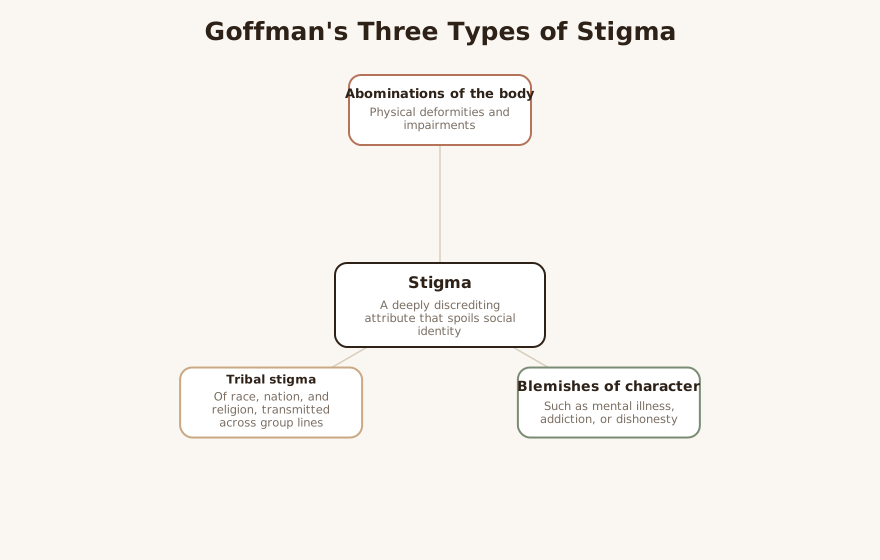
Goffman’s central image is that stigma reduces a person “from a whole and usual person to a tainted, discounted one” 1. He framed this as a discrepancy between virtual social identity—the assumptions others make about who a person ought to be—and actual social identity, the attributes the person actually possesses 4. When this gap is discrediting, the person’s identity becomes spoiled 4. Goffman identified three types of stigma: abominations of the body (physical deformities and impairments), blemishes of individual character (such as mental illness, addiction, or dishonesty), and tribal stigma of race, nation, and religion that is transmitted across group lines 3. A pivotal distinction is between the discredited, whose stigma is already known or visible, and the discreditable, whose stigma is hidden and not yet revealed 3. This distinction governs the person’s core task: the discredited must manage tension during interaction, while the discreditable must manage information about whether to disclose 3.
Goffman also described a social cast of characters around the stigmatized person 4. The “normals” are those who do not bear the stigma; the “own” are fellow stigmatized people who share the attribute; and the “wise” are non-stigmatized people who are intimately familiar with the stigmatized person’s world and accepted as honorary insiders 4. A further principle is the internalization of shame: the stigmatized person, sharing the wider society’s beliefs, may come to perceive one of his own attributes as “a defiling thing to possess,” producing shame and a damaged self-identity 5.
Interventions & Techniques
Goffman’s framework is descriptive rather than prescriptive, but it catalogues the strategies stigmatized people use to manage spoiled identity, and these map directly onto clinical material LLM. Passing is the active concealment of a discreditable stigma by performing normalcy 3. Covering is the effort to keep an already-known stigma from looming large in interaction—reducing its obtrusiveness rather than hiding it entirely 3. Other documented management techniques include normalizing (asserting ordinariness despite the trait), distancing (separating oneself from other stigmatized people), embracement (publicly owning the characteristic with pride), neutralizing (arguing the trait should not be stigmatized), and insulating (withdrawing from mainstream society) 3.
In therapy, these are not interventions to prescribe but patterns to name and explore LLM. A clinician can help a client notice the cost of chronic passing, weigh the risks and benefits of selective disclosure, and move—where the client chooses and where it is safe—from concealment toward embracement or neutralizing self-talk LLM. The “wise” concept also informs treatment: connecting a client to the “own” through peer or group settings, and modeling the stance of the “wise” within the therapeutic relationship, can reduce isolation LLM.
LLM-generated illustrative example (not a guideline): A client newly diagnosed with bipolar disorder describes exhausting effort to seem “fine” at work. Naming this as “passing” gives the client language for a previously nameless burden, and opens a collaborative conversation about whom, if anyone, it would be safe and worthwhile to tell LLM.
Evidence Base
The maturity of this theory is best described as established, but in a specific sense LLM. Goffman’s 1963 formulation is a foundational, widely cited theoretical text that has shaped sociology, social work, public health, and psychology for over six decades 1. It is “established” as a conceptual framework, not as an empirically validated treatment protocol—it does not carry randomized-trial evidence because it is a theory of social process rather than an intervention LLM. Its core constructs have been extended and operationalized by later scholars: Link and Phelan, for example, specified stigma as the co-occurrence of labeling, stereotyping, separation into “us” and “them,” and status loss and discrimination, emphasizing that power is necessary for stigmatization to take hold 4. Contemporary research distinguishes public stigma (society’s negative attitudes), self-stigma (internalized shame), and structural stigma (institutional policies that perpetuate disadvantage) 4. Importantly, the literature holds that stigma is “not inevitable, and can be challenged” through education, legislation, and community mobilization—an evidence-informed basis for clinical optimism 4.
Populations & Indications
Goffman’s framework is broadly indicated wherever a client’s distress is bound up with a discrediting social attribute LLM. People with mental illness are a paradigm case—mental illness is one of Goffman’s “blemishes of individual character” and is a frequent target of both public and self-stigma 3. People with substance use disorders similarly carry character-type stigma that can drive concealment and treatment avoidance 3. People with disabilities and chronic illness, including people with HIV/AIDS, often bear bodily stigma and face the discredited/discreditable dilemma depending on the visibility of their condition 3. LGBTQ+ individuals individuals frequently navigate discreditable stigma and the labor of passing or selective disclosure LLM. Racial and ethnic minorities are subject to tribal stigma, transmitted across group lines and embedded in structural inequities 3. Across these populations, the framework illuminates internalized stigma, shame, identity concealment, and the social isolation that follows 5.
Problems-for-Work
The theory gives clinicians a structured way to formulate several common presenting problems LLM. Internalized stigma and self-stigma can be framed as the client absorbing society’s discrediting view and treating an attribute of the self as “a defiling thing to possess” 5. Shame is the predictable affective product of that internalization and a primary target for work 5. Identity concealment maps onto passing and covering, and its chronic effort can be linked to social anxiety, social isolation, and exhaustion 3. Depression and low self-esteem can be understood partly as sequelae of a spoiled identity and status loss 4. Discrimination-related distress and minority stress can be formulated as the cumulative burden of separation, status loss, and discrimination identified in the modern stigma model 4. Treatment avoidance itself is often a stigma-management strategy—seeking care can feel like confirming a discredited label LLM.
LLM-generated illustrative example (not a guideline): A client in early recovery avoids a support group because attending would, in her words, “make it real that I’m an addict.” Framed through stigma theory, her avoidance is legible as protecting against a discrediting label, which lets the clinician address the label’s grip rather than scolding the avoidance LLM.
Contraindications, Cautions & Cultural Humility
Because Goffman’s theory is a lens rather than a procedure, the cautions are interpretive rather than clinical LLM. The first caution is not to impose a “spoiled identity” reading on a client who does not experience their attribute as discrediting—doing so can pathologize difference and recapitulate the very stigma the clinician hopes to relieve LLM. Goffman’s original character typology reflects the language of its era, and terms such as “blemishes” or “abominations” describe social judgments, not the clinician’s stance toward the client 1. Cultural humility is essential because what is stigmatizing is socially and culturally specific: the same attribute may be discrediting in one community and neutral or valued in another LLM. Tribal stigma in particular is structural and intersectional, so clinicians should attend to power, racism, and institutional practice rather than locating the problem solely in the client’s coping 4. Practitioners should also recognize that institutions—including treatment settings—can themselves stigmatize, through dehumanizing practices that strip personhood, and should actively counter such practices and affirm dignity 5.
Treatment-Plan Suggestions & SMART Objectives
The following examples translate stigma constructs into measurable objectives; they are illustrative, not prescriptive LLM.
| Goal | SMART objective (example) | Mechanism |
|---|---|---|
| Reduce internalized stigma | Within 8 weeks, client will identify and verbally challenge at least 3 self-stigmatizing beliefs per week in session | Externalizing the discrediting societal view absorbed as self-judgment 5 |
| Decrease shame | Within 10 weeks, client will report a 30% reduction on a shame self-rating across two consecutive sessions | Naming and reattributing shame to social process rather than personal defect 5 |
| Lower concealment burden | Within 6 weeks, client will complete a written cost-benefit analysis of passing in 2 specific settings | Making the labor and risk of passing/covering explicit and choiceful 3 |
| Build supportive connection | Within 12 weeks, client will attend 4 peer or group meetings with others who share the attribute | Reducing isolation by linking client to the “own” 4 |
| Practice selective disclosure | Within 8 weeks, client will disclose to 1 chosen, low-risk “wise” person and review the outcome | Shifting from blanket concealment to deliberate, safer disclosure 3 |
| Reduce treatment avoidance | Within 4 weeks, client will attend all scheduled sessions and name 1 stigma-driven avoidance pattern | Identifying care-seeking avoidance as stigma management LLM |
| Counter discrimination distress | Within 10 weeks, client will distinguish, in 3 logged incidents, external discrimination from self-blame | Reframing distress as response to status loss and discrimination 4 |
Common Misconceptions
A frequent misconception is that stigma is simply a synonym for stereotype or prejudice; in Goffman’s framework it is a relational discrepancy between virtual and actual social identity that discredits the person, not merely a negative belief 4. Another is that stigma lives entirely “in the head” of the stigmatized; the modern model insists that power and discrimination are required for stigma to operate, locating it in social structure as well as in cognition 4. Clinicians sometimes assume that a stigma must be visible, but Goffman’s discreditable category shows that hidden, not-yet-revealed attributes generate their own distinct burden of information management 3. It is also mistaken to treat passing as deceitful weakness; Goffman presents it as a rational, often necessary management of a discrediting situation 3. Finally, some assume stigma is permanent and immovable, whereas the literature explicitly holds that it can be challenged and reduced 4.
Training & Certification
There is no certification in “stigma theory,” because it is a body of scholarship rather than a credentialed treatment modality LLM. Clinicians typically encounter Goffman’s work in graduate sociology, social work, and counseling curricula, and the primary route to fluency is reading the source text and scholarly reviews 1. The Open University’s social work materials and academic review chapters offer accessible, applied introductions for practitioners 5. Continuing education in anti-stigma practice, cultural humility, and minority stress provides the applied layer that Goffman’s descriptive theory does not supply on its own LLM.
Key Terms
Spoiled identity — an identity discredited by a stigmatizing attribute, reducing the person from “whole and usual” to “tainted and discounted” 1. Virtual vs. actual social identity — the gap between what society assumes a person to be and what they actually are 4. Discredited vs. discreditable — whether the stigma is already known/visible or still hidden 3. Passing — concealing a discreditable stigma by performing normalcy 3. Covering — minimizing the obtrusiveness of a known stigma 3. The own — fellow bearers of the same stigma 4. The wise — non-stigmatized people accepted as sympathetic insiders 4. Public, self, and structural stigma — societal attitudes, internalized shame, and institutional disadvantage, respectively 4.
Resources & Further Reading
▶ Watch — a video introduction to this concept:
- Stigma: Notes on the Management of Spoiled Identity (Goffman, 1963)
- Stigma (Matthew Clair, Harvard — scholarly review chapter PDF)
- Stigma (Subcultures and Sociology, Grinnell College)
- Social stigma (Wikipedia)
- Spoiled identities: stigma (OpenLearn, The Open University)
- What is Stigma? Explaining Goffman’s Idea of Spoiled Identity (YouTube)
Reflective / Supervision Questions
- How do I distinguish, in formulation, the distress my client brings that is socially produced from distress that is intrapsychic—and does my treatment plan address both? LLM
- When a client conceals an attribute, am I helping them weigh disclosure as a genuine choice, or subtly pushing them toward either passing or coming out? LLM
- Where in my own practice setting do institutional routines risk stigmatizing the people I serve, and what can I change? LLM
- Whose definition of “discrediting” am I working from—the client’s, the dominant culture’s, or my own—and have I checked? LLM
- How do I act as one of the “wise” in the therapeutic relationship without overstepping into claiming an experience that is not mine? LLM