
Type & Discipline
Empowerment theory is a framework or orienting theory rather than a single, manualized psychotherapy. LLM It originates in community psychology and has been widely adopted within social work, where it reorganizes how practitioners understand power, control, and change. 5 At its core is the claim that wellbeing comes from people, organizations, and communities gaining greater influence and control over the matters that affect their lives. 4 What distinguishes it from a standard clinical model is its insistence that this control is real and multilevel — it lives not only in a client’s internal sense of agency but in their organizations and communities as well. 3
Because it is an orienting framework rather than a packaged protocol, clinicians most often apply empowerment theory by infusing its principles into a recognized treatment modality, by structuring group and advocacy work, or by reshaping the therapeutic stance itself. LLM It shifted helping professions away from deficit-based, expert-driven models toward strengths-focused, collaborative ones. 5
Creators & Lineage
The theory is most associated with Julian Rappaport, who placed empowerment at the conceptual center of community psychology in the early 1980s and argued for it as an organizing aim for the field. 4 Rappaport framed empowerment in deliberate contrast to a “needs-based” or prevention-and-advocacy model that, however well-intentioned, can position professionals as the experts who define and meet the needs of relatively powerless people. 1 Marc Zimmerman then developed the construct into a more rigorous multilevel and psychological theory, distinguishing levels of analysis and operationalizing what individual empowerment actually consists of. 23
The intellectual lineage is broader than community psychology alone. LLM A central influence is Paulo Freire’s critical pedagogy and his concept of critical consciousness — the recognition that oppressed people often internalize a narrative of inferiority and become passive, and that developing critical awareness of injustice is the first step toward change. 4 The framework also draws on feminist theory’s traditions of consciousness-raising and collective action, on social-psychological work such as Bandura’s self-efficacy and research on locus of control, on Martín-Baró’s liberation psychology and its focus on the psychological impact of oppression, and on ecological systems theory’s view of persons nested in environments. 5 Within social work specifically, Lorraine Gutiérrez and Zimmerman are among the most frequently cited theorists translating these ideas into practice. 6
Core Principles
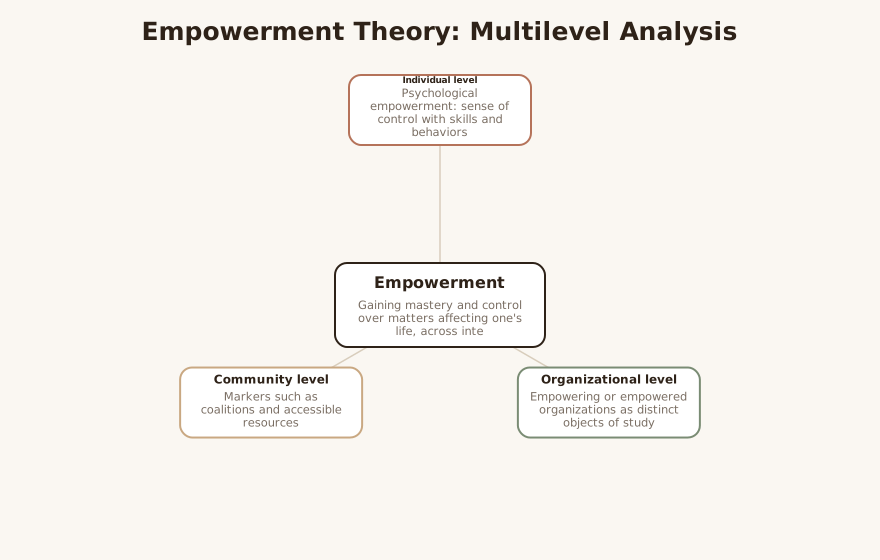
The first principle is multilevel analysis. LLM Empowerment operates at the individual (psychological), organizational, and community levels, and these levels are interconnected rather than independent. 3 Zimmerman’s framework treats them as distinct objects of study: an empowered person, an empowering or empowered organization, and an empowered community each have different markers. 3
The second principle is the distinction between empowering processes and empowered outcomes. 3 Empowering processes are the activities through which people gain control — participating in decision-making, gaining access to resources, developing critical awareness. 3 Empowered outcomes are the consequences that can be observed and studied: at the individual level, a sense of control combined with skills and behaviors; at the community level, things like organizational coalitions and accessible resources. 3 This distinction matters clinically because it warns against measuring success only by a client’s internal feeling of confidence. LLM
The third principle is psychological empowerment (PE), Zimmerman’s individual-level construct, which integrates three components. 2 The intrapersonal component is how people think about themselves — perceived control, self-efficacy, and a sense of competence and mastery. 2 The interactional component is the critical awareness and understanding of one’s social and political environment, including knowing what resources exist and how to access them. 2 The behavioral component is the actions people take to exert control, such as participation in community organizations or coping behaviors. 2 Critically, PE is not a fixed trait; it is expected to vary across people and contexts and is best understood through a nomological network of related constructs rather than a single universal measure. 2
The fourth principle is that empowerment is more than confidence. LLM True individual empowerment combines personal efficacy with critical awareness of systemic barriers, so that powerlessness is not attributed to fate; meaningful empowerment ultimately requires redistributing actual resources and power, not merely building a client’s self-esteem. 4
A fifth, more provocative principle is Rappaport’s argument that empowerment is paradoxical and divergent. LLM He held that empowerment looks different across people and settings — there is no single “right” solution to be delivered, and the same conditions can require different responses — which resists the standardized, convergent thinking of many professional interventions. 1
Interventions & Techniques
Because empowerment is a framework, its techniques are about how a clinician works rather than a fixed sequence of steps. LLM Core practice moves drawn from the literature include strengths-based assessment rather than deficit-focused diagnosis, collaborative partnerships that deliberately flatten the traditional professional hierarchy, power analysis and consciousness-raising activities, skill development and capacity building, and multilevel intervention that addresses individual and structural barriers at the same time. 5
Consciousness-raising — helping a client name and examine the social and political conditions shaping their distress — is the technique most directly inherited from Freire and feminist practice. 45 At the community and organizational levels, the toolkit broadens into tactics for collective action: gathering information, public education and demonstrations, filing formal complaints and using established systems, and media exposure. 4 Balcazar and Suarez-Balcazar’s process model frames this as a cyclical sequence — identifying injustices, developing advocacy goals, and implementing strategies for redistributing power, with iterative setbacks and repeated cycles. 4
LLM-generated illustrative example (not a guideline): A clinician working with a client who has serious mental illness might pair symptom-focused work with helping the client learn their rights regarding housing, connect with a peer-run advocacy group, and rehearse self-advocacy in a treatment-team meeting — moving from intrapersonal mastery toward interactional knowledge and behavioral action. LLM
Evidence Base
Empowerment theory is best characterized as established as a framework, not as an evidence-based treatment in the way an RCT-validated protocol would be. LLM It is a mature, widely cited, and influential orienting theory with decades of conceptual development and a large applied literature spanning women of color, LGBTQ youth, people experiencing poverty, people in foster care, and other marginalized groups. 6 The construct of psychological empowerment is operationalized and has been studied across many contexts, but Zimmerman himself emphasized that empowerment is population- and context-specific and resists a single universal measure — which is a strength conceptually but a complication for accumulating uniform outcome evidence. 2
Honesty about maturity requires naming real limitations. LLM Commentators note that the theory originated largely in Western contexts and needs cultural responsiveness work, that agency and institutional constraints often limit genuinely participatory practice, that professional education frequently underteaches empowerment methods, and that the complexity and divergence at the heart of the theory can sit uneasily with narrow evidence-based-practice demands. 5 In short: the framework is well-validated as a way of thinking, less so as a single measurable intervention. LLM
Populations & Indications
Empowerment theory is most indicated where powerlessness — actual or internalized — is central to the clinical picture. LLM The literature points to marginalized and oppressed communities, people with disabilities, survivors of abuse and violence, people with serious mental illness, low-income populations, and disempowered clients and groups more broadly. 46 The mental health advocacy and disability movements are cited as community-level exemplars, with collective empowerment contributing to landmark change such as the Americans with Disabilities Act. 4
It is especially apt when a client’s difficulties are entangled with systemic conditions — when attributing distress purely to individual pathology would obscure the role of oppression, marginalization, or lack of access to resources. 4 In those cases the framework gives the clinician permission to look outward at the environment as well as inward. LLM
Problems-for-Work
Learned helplessness and low self-efficacy. The intrapersonal component of psychological empowerment — perceived control, competence, mastery — directly targets the cognitive residue of repeated powerlessness. 2
LLM-generated illustrative example (not a guideline): With a client who says “nothing I do matters,” a clinician might structure small, winnable acts of agency (requesting an accommodation, attending one tenants’ meeting) so that behavioral action begins to disconfirm the helplessness belief. LLM
Disempowerment and the effects of oppression. Here the interactional component — critical awareness of one’s social-political context — and consciousness-raising are central, helping a client distinguish personal failing from structural barrier. 24
Trauma from abuse and internalized stigma. Survivors and stigmatized clients often carry an internalized narrative of inferiority; Freire-derived critical-consciousness work and strengths-based framing aim to externalize that narrative and restore a sense of agency. 45
Low self-esteem and social isolation. Participation in empowering organizations and groups is itself an intervention, addressing isolation while building the behavioral and relational dimensions of empowerment. 3
Contraindications, Cautions & Cultural Humility
Empowerment theory is not a standalone crisis treatment and should not displace evidence-based, symptom-focused care when a client is acutely unsafe or destabilized. LLM Consciousness-raising and power analysis can be activating for trauma survivors, so they should be paced and grounded within a stabilizing, trauma-informed frame rather than pushed prematurely. LLM
The most important caution is conceptual: empowerment is not the clinician’s to give. LLM A genuine empowerment stance flattens hierarchy and follows the client’s own definition of meaningful control; a clinician who decides what an “empowered” client should want has reproduced the very expert-knows-best dynamic Rappaport critiqued. 1 There is also a structural caution — building a client’s confidence without addressing real resource and power deficits risks placing the burden of change on the individual while leaving oppressive conditions intact. 4
Cultural humility is built into the theory’s honest limitations: the framework arose in Western contexts and requires adaptation, and what counts as control, agency, and a good outcome varies across cultures and communities. 52 Clinicians should treat the client and their community as the experts on what empowerment means for them. LLM
Treatment-Plan Suggestions & SMART Objectives
| Goal | SMART objective (example) | Mechanism |
|---|---|---|
| Increase perceived control over a key life domain | Within 8 weeks, client will identify and complete 3 self-selected actions (e.g., calls, appointments, requests) addressing a stressor they currently feel is “out of their hands,” rated weekly | Intrapersonal component of PE — perceived control, self-efficacy, mastery 2 |
| Build critical awareness of systemic factors | Within 6 sessions, client will articulate at least 2 environmental/structural contributors to their distress (distinct from personal failing) and 2 available resources and how to access them | Interactional component of PE — critical understanding of context 2 |
| Increase behavioral participation | Over 12 weeks, client will attend ≥3 meetings of a chosen community, peer, or advocacy group and report on the experience | Behavioral component of PE; reduces isolation 3 |
| Reduce internalized stigma / helplessness narrative | Within 8 weeks, client will reframe ≥3 self-statements from fixed/fated to changeable, documented in session | Critical-consciousness / consciousness-raising 4 |
| Develop self-advocacy skills | Within 10 weeks, client will rehearse and then enact one self-advocacy request in a real setting (treatment team, landlord, employer) | Skill development and capacity building 5 |
| Strengthen collaborative engagement in own care | Each session, client co-sets the agenda and reviews progress, with clinician documenting client-defined goals | Strengths-based, hierarchy-flattening partnership 5 |
| Connect individual gains to collective resources | Within 12 weeks, client will link with one organizational/community resource (peer group, coalition, services) and report increased access | Linking individual and community levels of empowerment 3 |
Common Misconceptions
“Empowerment just means boosting self-esteem or confidence.” No — the theory explicitly couples internal efficacy with critical awareness of systemic barriers and, ultimately, redistribution of real resources and power; confidence alone is not empowerment. 4
“Empowerment is something the clinician gives the client.” This inverts the model. LLM Rappaport’s framing critiques the expert-driven stance in which professionals define and deliver what less-powerful people supposedly need. 1
“There is one correct empowered outcome to aim for.” Empowerment is divergent and context-specific; it looks different across people, settings, and cultures, and resists a single universal target or measure. 12
“It’s purely an individual, intrapsychic process.” It is inherently multilevel — individual, organizational, and community — and ignoring the organizational and community levels misreads the theory. 3
Training & Certification
There is no single credential or certification in “empowerment therapy,” consistent with its status as a framework rather than a manualized treatment. LLM It is taught primarily within community psychology and social work curricula and appears across the social work theories literature as a foundational practice perspective. 6 Commentators note that professional education has gaps in actually teaching empowerment methods, so clinicians often build competence through coursework in community psychology, social justice and anti-oppressive practice, feminist and liberation-informed approaches, and supervised application within their existing modality. 5
Key Terms
- Empowerment — gaining greater influence and control over the matters that affect one’s life and environment. 4
- Psychological empowerment (PE) — the individual-level construct integrating intrapersonal, interactional, and behavioral components. 2
- Intrapersonal component — perceived control, self-efficacy, competence, and mastery. 2
- Interactional component — critical awareness and understanding of one’s social-political environment and its resources. 2
- Behavioral component — the actions taken to exert control, including participation and coping. 2
- Empowering processes vs. empowered outcomes — the activities that build control vs. the observable consequences of having gained it. 3
- Critical consciousness — Freire’s term for recognizing injustice and one’s own capacity to change it. 4
- Levels of analysis — individual/psychological, organizational, and community. 3
Resources & Further Reading
▶ Watch — a video introduction to this concept:
- Rappaport (1987), Terms of empowerment/exemplars of prevention — American Journal of Community Psychology
- Zimmerman (1995), Psychological Empowerment: Issues and Illustrations — American Journal of Community Psychology
- Zimmerman (2000), Empowerment Theory — Handbook of Community Psychology (Springer)
- Empowerment — Introduction to Community Psychology (Rebus open textbook)
- Empowerment Theory in Social Work — iResearchNet
- Empowerment Theory — Social Work Theories LibGuide, UNC Pembroke
Reflective / Supervision Questions
- In my last case, did I work for the client or with them — and where did I quietly assume the role of expert who knew the “right” outcome? LLM
- Where on the intrapersonal–interactional–behavioral spectrum is this client, and which component am I actually targeting? 2
- Am I addressing only the client’s internal sense of control while leaving real structural barriers unexamined? 4
- How do this client’s culture and community define meaningful control and a good outcome, and have I asked? 5
- Am I documenting empowerment-informed work within a recognized, billable modality in a way that is clinically honest? LLM
- When have I confused building confidence with genuine empowerment in my own caseload? 4