
Type & Discipline
Assertiveness training is a behavioral skills technique within clinical psychology, situated in the “first wave” of behavior therapy that emphasized classical and operant conditioning 1. It is best understood as a component of broader social skills training, which aims to reduce anxiety-based inhibitions and build competent social functioning 1. Assertive behavior is defined as any action that reflects an individual’s own best interest, including standing up for oneself without significant anxiety, expressing one’s feelings comfortably, and exercising one’s rights without denying the rights of others 1. Critically, assertiveness is conceived along a continuum: difficulties can manifest as excessive agreeableness (submissive/unassertive) at one pole or excessive hostility (aggressive) at the other, and the goal of training is the middle position—openly verbalizing what one wants without being either submissive or aggressive 1. Because it cuts across diagnoses rather than targeting a single disorder, the technique is most usefully framed as a transdiagnostic intervention 1.
Creators & Lineage
The lineage begins with Andrew Salter’s 1949 book Conditioned Reflex Therapy, which urged certain individuals—those he called “inhibitory personalities”—to learn to express themselves more openly, including the deliberate use of “I” statements to convey what they thought and felt 1. Salter’s writings initially had relatively little impact on the field 14. Joseph Wolpe, widely credited as a prime innovator of behavior therapy in the United States, found open, honest self-expressiveness a natural fit for his new approach and conceptualized assertiveness training as a way of reducing anxiety, alongside relaxation, by means consistent with reciprocal inhibition 1. Wolpe explicitly differentiated assertiveness from aggressiveness, framing the former as a way of putting oneself up without putting another person down 1. In the mid-1960s Wolpe collaborated with Arnold Lazarus on the first questionnaire for assessing assertiveness, and Lazarus later defined assertive behavior as “social competence,” identifying four component abilities: communicating one’s desires and needs, saying no, expressing positive and negative feelings, and initiating, maintaining, and ending conversations 1. Robert Alberti and Michael Emmons authored the first assertiveness-training book written for the general public, arguing that all individuals have a right to be master of their own life and to act in accordance with their own interests, beliefs, and feelings 1. Marvin Goldfried and Gerald Davison subsequently introduced a cognitive conceptualization—proposing that unassertive people may be inhibited from self-expression by concerns about interpersonal consequences—which marked part of the shift from behavior therapy toward cognitive behavioral therapy 1. The co-occurring civil rights and feminist movements gave parallel impetus, with several authors framing assertiveness as a means of protecting individual rights without prejudice to the rights of others 1.
Core Principles
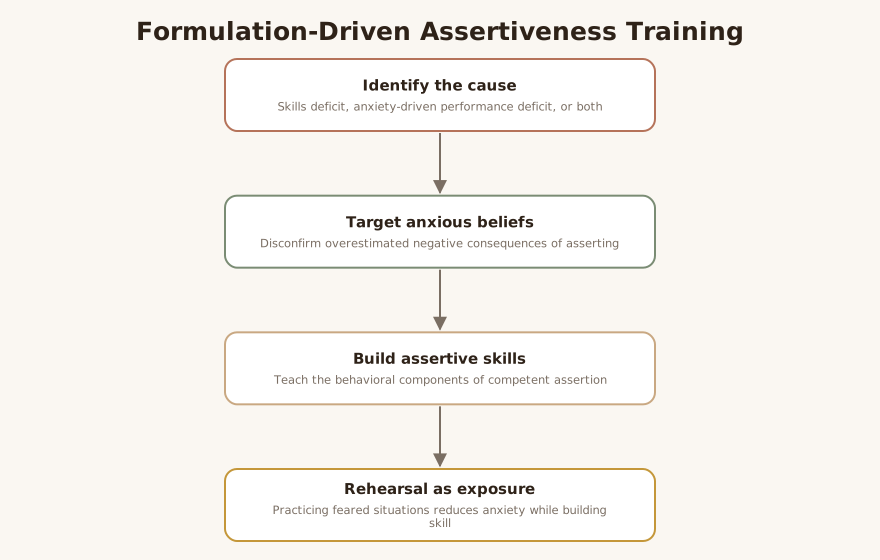
Three principles organize the technique. First, unassertiveness has more than one cause: it may stem from a genuine skills deficit (not knowing how or when to assert effectively), a performance deficit driven by anxiety, or both—and the formulation should drive the intervention 1. Second, the targets are correspondingly dual. When anticipatory anxiety predominates, treatment focuses on the cognitive mediators of inhibition—chiefly the belief that an assertive response will damage how others regard the person, alongside fears of hurting, disappointing, or being rejected by others 1. When a skill deficit predominates, the behavioral components of competent assertive interaction become the focus 1. Third, behavioral skill training itself functions as a form of exposure: rehearsing feared interpersonal situations can reduce anxiety in addition to building skill 1. A recurring clinical observation underwrites the cognitive work—unassertive clients typically overestimate the negative consequences of asserting themselves, and (ironically) often report that they dislike unassertiveness in others, which opens a direct route to disconfirming their anticipatory misperceptions 1.
LLM-generated illustrative example (not a guideline): A client who never sends back an incorrect restaurant order predicts the server will be humiliated and the table embarrassed. The clinician asks how the client feels when a friend quietly tolerates a wrong order rather than speaking up—surfacing that the client actually reads silence as awkward, not the correction. That contradiction becomes the lever for behavioral rehearsal. LLM
Interventions & Techniques
The standard toolkit combines cognitive and behavioral methods. Cognitive restructuring targets the anxious, guilt-laden thoughts that drive avoidance—particularly the belief that asserting oneself will produce a negative reaction in others 1. Behavioral rehearsal, modeling (including the therapist modeling assertive behavior), and role play build the verbal and nonverbal repertoire of assertion, attending to eye contact, voice volume, affect, and physical posture 1. Audio or video feedback helps clients learn not only what to say but how to say it, and between-session practice consolidates gains in vivo 1. Both live and covert modeling have been shown effective for increasing assertive behavior in unassertive psychiatric inpatients 1. Importantly, controlled comparisons indicate that cognitive restructuring and behavioral rehearsal are roughly equally effective at improving self-reported assertiveness and reducing fear of negative evaluation—so the clinician can weight the components toward whichever determinant (anxiety vs. skill) the case formulation implicates 1. Structured, standardized assertive-training programs have also been developed and evaluated as discrete protocols 5, and the technique has been adapted for couple and family work 3.
Evidence Base
The honest summary is “established but under-researched, and roughly as good as other active treatments—not better.” Overall results for efficacy are positive, and assertiveness sits on a substantial body of basic research linking unassertiveness to multiple clinical problems 1. Meta-analyses of depression and social anxiety outcomes found that social skills training involving assertiveness was similarly effective compared to other CBT interventions, and more effective than wait-list control 1. A meta-analysis of social skills training in schizophrenic inpatients—primarily assertiveness training—found strong positive effects on behavioral measures of social skill, self-rated assertiveness, and hospital discharge rate 1. The major caveats are real. Most of the outcome literature was published in the 1970s, 1980s, and 1990s, and the field’s attention has since collapsed: a PsycINFO search yielded roughly 23 publications per year between 1967 and 1999 but only about 11 per year thereafter, a decline that runs against rising publication rates across science generally 1. Meta-analysts found very few includable trials—one identified only five suitable assertiveness studies, another only seven—so the meta-analytic base is genuinely thin 1. And where assertiveness training has been compared head-to-head with other evidence-based treatments for depression, its efficacy is essentially equivalent, not superior 1. Practitioners should therefore offer it as a credible, mechanism-clear option, not as a uniquely powerful one 1.
Populations & Indications
Assertiveness training has been studied across a wide range of populations. In anxiety, particularly social anxiety, unassertiveness is reliably associated with the disorder, and assertiveness training reduces social anxiety symptoms in both men and women relative to no-treatment or placebo control 1. The link between expressed social fears and low assertiveness has direct treatment implications, supporting assertion as a target in socially anxious presentations 2. In depression, assertiveness is inversely correlated with depressive symptoms, consistent with behavioral and interpersonal models positing social-skill deficits; group assertiveness training increases assertive behavior and reduces depressive symptoms, with gains maintained at follow-up 1. In serious mental illness, including chronic schizophrenia where social withdrawal is a core feature, group assertiveness training improves assertive behavior, decreases social anxiety, and raises satisfaction with interpersonal communication in inpatient and outpatient settings 1. The technique also improves self-esteem and self-concept across professional women, nurses, adolescents, and people with physical disabilities 1. In couples, where unassertiveness predicts hostility, anxiety, and lower relationship satisfaction, assertiveness training—delivered to one or both partners—improves trust, intimacy, and verbal assertion while reducing verbal aggression 13. Finally, sexual-assertiveness training programs for undergraduate women have been associated with reduced sexual-assault victimization 1.
Problems-for-Work
- Unassertiveness / chronic submissiveness. The presenting problem itself—saying “yes” when one means “no,” chronic apologizing, suppressed wants—maps directly onto cognitive restructuring of fear/guilt plus behavioral rehearsal of refusals 1.
- Social anxiety in interpersonal situations. Where avoidance is anxiety-driven, behavioral rehearsal doubles as exposure to feared interactions, reducing anxiety while building skill 12.
- Depression with interpersonal withdrawal. Targeting assertive, reinforcement-eliciting behavior addresses the social-skill and reduced-reinforcement pathways of depression 1.
- Low self-esteem. As clients become less governed by others’ opinions, they grow more confident in the legitimacy of what they want, think, and feel 1.
- Marital/relationship dissatisfaction and hostility. Conjoint or individual assertiveness work increases clear, positive communication and reduces verbal aggression in the dyad 13.
- Anger and hostility. Because social anxiety can co-occur with anger, assertion offers a regulated alternative to both submission and aggression 1.
LLM-generated illustrative example (not a guideline): A depressed client who has stopped initiating contact with friends practices, in session, a two-sentence text inviting a friend for coffee, then rates the predicted vs. actual response after sending it—linking assertive initiation to a corrective interpersonal experience. LLM
Contraindications, Cautions & Cultural Humility
The most important caution is that assertiveness is not perceived equally across contexts, genders, and cultures, and clinicians should not treat “more assertive” as a culture-free good 1. Evidence indicates that situational factors and gender shape how assertive behavior is received—one study found that men rated assertive women managers positively while women observers rated them negatively—pointing to a documented double bind in which women may be penalized both for asserting and for failing to communicate effectively 1. Findings on assertiveness, depression, and gender also diverge across studies and cultural groups, with some work reporting that Asians report lower assertiveness and higher depression, underscoring that norms are not universal 1. The clinical implication is collaborative: target the client’s own valued outcomes rather than imposing a culturally specific assertion ideal, and weigh the real interpersonal contingencies the client faces, which are sometimes genuinely costly rather than merely feared 1.
LLM-generated illustrative example (not a guideline): Before coaching a client to “set a firm boundary” with an elder relative, the clinician asks what directness means in the client’s family and culture, and they co-design a phrasing that honors respect norms while still communicating the need—rather than defaulting to a templated assertive script. LLM
A second caution: unassertiveness can be situation-specific. Otherwise highly assertive clients may be unassertive in one domain when the difficulty is an anxiety-driven performance deficit rather than a global skill deficit, so assessment should be domain-specific rather than dispositional 1.
Treatment-Plan Suggestions & SMART Objectives
| Goal | SMART objective (example) | Mechanism |
|---|---|---|
| Reduce chronic submissiveness | Client will deliver at least 2 direct “no” responses per week to low-stakes requests for 4 weeks, logged in a between-session record | Behavioral rehearsal + in-vivo exposure to feared refusal 1 |
| Lower social anxiety in conversations | Client will initiate 1 brief unsolicited conversation per session-week and rate predicted vs. actual outcome for 6 weeks | Cognitive restructuring of anticipated negative evaluation 12 |
| Decrease depressive withdrawal | Client will make 3 assertive, reinforcement-eliciting requests of others weekly for 5 weeks | Increasing reinforcing social interactions 1 |
| Raise self-esteem/self-concept | Client will name and verbally claim one legitimate want per session for 8 weeks without apologizing | Disconfirming the belief that one’s needs are illegitimate 1 |
| Improve relationship communication | Client will use an “I”-statement to express one need to their partner twice weekly for 4 weeks | Increased verbal assertion, reduced verbal aggression 13 |
| Replace hostility with assertion | Client will identify 2 anger-triggering situations weekly and rehearse a non-aggressive assertive response | Regulated middle-position alternative to aggression 1 |
| Build refusal skills under pressure | Client will role-play and then enact 1 boundary with an intimidating authority figure within 6 weeks | Modeling + behavioral rehearsal with feedback 1 |
Common Misconceptions
- “Assertiveness means being aggressive or getting your way.” It is explicitly the middle of a continuum—putting oneself up without putting the other person down—not hostility, and not winning every exchange 1.
- “Assertiveness training is purely a behavioral skills drill.” From Goldfried and Davison onward, inhibition is often cognitive; for many clients the active ingredient is restructuring fear/guilt beliefs, not teaching scripts 1.
- “It’s outdated and unsupported.” The decline reflects shifts in research funding toward DSM-disorder treatment packages, not a verdict that it stopped working—the supportive (if thin) evidence predates the decline 1.
- “It’s not used anymore.” It persists under other names inside larger packages—DBT’s interpersonal effectiveness module, behavioral activation, and CBASP all teach assertive action—so clinicians often deliver it without labeling it 1.
- “More assertiveness is always better for the client.” Perception is context-, gender-, and culture-dependent, and assertive behavior is not always received positively 1.
Training & Certification
There is no stand-alone certification or credential for assertiveness training, and the technique is not listed as a primary treatment in central CBT handbooks even though unassertiveness is named as a key client characteristic in anxiety, depression, and substance-use disorders 1. Competence is acquired as part of general training in behavioral and cognitive behavioral therapy, where the constituent skills—cognitive restructuring, modeling, behavioral rehearsal, and exposure—are taught 1. For procedural guidance, the paper points clinicians to established practitioner texts, including Alberti and Emmons, Goldfried and Davison, Lange and Jakubowski, and Smith 1. Structured assertive-training program protocols offer one route to a more manualized delivery 5.
Key Terms
- Assertive behavior — Action reflecting one’s own best interest: standing up for oneself without significant anxiety, expressing feelings comfortably, and exercising one’s rights without denying others’ rights 1.
- Assertiveness continuum — The dimensional view in which problems appear as excessive agreeableness (submissive) or excessive hostility (aggressive), with assertion as the adaptive middle 1.
- Inhibitory personality — Salter’s term for individuals who fail to express themselves openly and benefit from learning direct expression 1.
- Skill deficit vs. performance deficit — Whether unassertiveness arises from not knowing how/when to assert versus anxiety blocking known skills; this distinction directs the intervention 1.
- Transdiagnostic factor — A dimensional construct (like assertiveness) relevant across diagnoses rather than specific to one, mapping onto NIMH RDoC domains such as Social Processes and Negative Valence 1.
- Interpersonal effectiveness — The DBT module that teaches assertive request-making and refusal while preserving the relationship and self-respect 1.
Resources & Further Reading
▶ Watch — a video introduction to this concept:
- Speed, Goldstein & Goldfried (2018), Assertiveness Training: A Forgotten Evidence-Based Treatment (Clinical Psychology: Science and Practice)
- The relationship between expressed social fears and assertiveness and its treatment implications (ScienceDirect)
- Assertiveness Training in Couple and Family Therapy (Springer, Encyclopedia of Couple and Family Therapy)
- Andrew Salter’s Assertiveness Training (Cortes Counseling)
- The Efficiency of a Standardized Assertive Training Program (ATP) (Springer)
Reflective / Supervision Questions
- For a given client, is the unassertiveness primarily a skill deficit, an anxiety-driven performance deficit, or both—and does my treatment plan weight cognitive and behavioral components accordingly? 1
- Have I checked the client’s actual interpersonal contingencies, or am I assuming their feared consequences are distortions when some costs may be real? 1
- How do this client’s cultural, gendered, and family norms shape what “assertive” should look like, and am I co-designing rather than imposing a script? 1
- Am I treating “more assertive” as a universal good, when the evidence shows assertive behavior is not always perceived positively? 1
- Where assertiveness work already lives inside a package I use (DBT, behavioral activation, CBASP), am I being explicit with the client about the mechanism, so gains are attributed to a transferable skill? 1
- Given that the outcome evidence is thin and roughly equivalent to other active treatments, how do I frame expectations honestly while still offering this as a credible option? 1