
Type & Discipline
Therapist self-disclosure (TSD) is a discrete, intentional therapeutic communication technique rather than a standalone modality: it is a microskill that can be deployed within almost any treatment approach, from psychodynamic to cognitive-behavioral to humanistic work LLM. It belongs to the family of relational and interpersonal-process interventions and is studied primarily within psychotherapy process research, the empirical tradition that examines what actually happens between therapist and client in session and what follows from it LLM. Hill, Knox, and Pinto-Coelho situate self-disclosure alongside a closely related construct, immediacy (Im) — the therapist’s disclosure of in-the-moment feelings about the client, about themselves in relation to the client, or about the therapeutic relationship itself 1. Throughout this article the two are treated together, because the process literature consistently pairs them: ordinary self-disclosure concerns facts and reactions about the therapist’s life outside the room, while immediacy concerns the here-and-now of the relationship 1.
The technique sits at the intersection of two evidence streams. The first is the granular process research on disclosure and immediacy themselves 1. The second is the broader, well-established evidence on the therapy relationship as a contributor to outcome, synthesized by the Interdivisional (APA Divisions 12 and 29) Task Force on Evidence-Based Therapy Relationships 4. Understanding TSD requires holding both: a specific, judiciously-used skill nested inside a relationship that is itself a robust predictor of whether clients improve 4.
Creators & Lineage
Therapist self-disclosure has no single inventor; it emerged across competing traditions that disagreed sharply about it LLM. Classical psychoanalysis treated the analyst as a relatively opaque “blank screen,” minimizing personal disclosure to protect the transference, while humanistic and existential therapists came to value therapist genuineness and transparency as relationship-building tools LLM. The technique therefore carries an inherited tension between restraint and authenticity that still shapes how clinicians use it LLM.
The modern, evidence-anchored account of the technique is owed substantially to Clara E. Hill and Sarah Knox, whose program of process research operationalized self-disclosure and immediacy and examined what follows them in session 1. Their qualitative meta-analysis with Pinto-Coelho consolidated this work and provided the field’s clearest synthesis of when these interventions tend to help 1. Ofer Zur is associated with the ethical and boundary literature on disclosure, framing it as one of many boundary considerations clinicians must weigh deliberately LLM. The broader relational context — the claim that the relationship “makes substantial and consistent contributions to psychotherapy outcome independent of the specific type of treatment” — comes from the Task Force led by John Norcross and Michael Lambert 4. Their conclusion that efforts to identify best practices “without including the relationship are seriously incomplete and potentially misleading” supplies the rationale for taking a relational microskill like disclosure seriously 4.
Core Principles
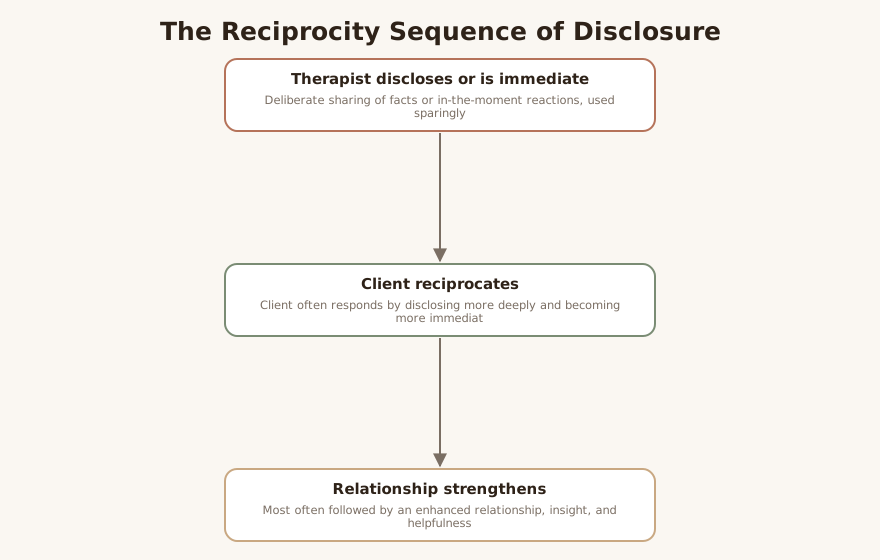
The governing principle is that self-disclosure is potent and double-edged, so it should be used deliberately, sparingly, and in the client’s service rather than the therapist’s LLM. Process research supports an optimistic but qualified reading: across 21 studies of what happens after disclosure and immediacy, the most frequent subsequent processes were an enhanced therapy relationship, improved client mental health functioning, gains in insight, and overall helpfulness — that is, disclosure and immediacy were most often followed by positive and beneficial therapeutic processes 1. This is encouraging, but it is process data, not proof that disclosure causes good outcomes LLM.
A second principle is the facts/feelings distinction. Disclosure of facts (the therapist’s history, identity, or experiences) functions differently from immediacy (the therapist’s present feelings about the client and relationship), and the research suggests immediacy in particular is associated with clients opening up and becoming more immediate themselves 1. A third principle is reciprocity and modeling: when a therapist discloses appropriately, clients often respond by disclosing more deeply, which is one mechanism by which the technique deepens the work 1. A fourth is moderation by context — Hill and colleagues explicitly flag moderating variables, including client contributions and diversity issues, meaning the same disclosure can land very differently depending on who the client is and what they bring 1. Finally, the relationship-as-outcome principle frames everything: because the relationship accounts for why clients improve at least as much as the particular method, interventions that strengthen it warrant skilled attention 4.
Interventions & Techniques
In practice, the clinician’s toolkit divides along the same fault line the research uses 1. Disclosure of similarity shares a relevant commonality (“I’ve also navigated a major career change”) to normalize and build rapport LLM. Disclosure of strategy or coping briefly shares how the therapist or someone they know managed an analogous challenge, offered as one option rather than a prescription LLM. Reassurance-oriented disclosure conveys the therapist’s genuine optimism or care, used cautiously because premature reassurance can shut down exploration LLM.
Immediacy interventions address the relationship directly in the present moment. The therapist might name a here-and-now reaction (“I notice I feel pushed away when we get close to this topic”) or invite the client into a relational conversation, which the research links to clients themselves becoming more immediate and open 1. Immediacy is the primary tool for working with strain in the alliance, because it makes the relationship itself discussable LLM.
Across all forms, the disciplined sequence is: notice an internal impulse to disclose, check whose needs it serves, keep it brief and relevant, and return focus to the client LLM. The disclosure should be a doorway back to the client’s experience, not a detour into the therapist’s LLM.
LLM-generated illustrative example (not a guideline): A client repeatedly apologizes for “taking up time.” The therapist uses immediacy: “Right now, when you apologize, I feel like I’m being asked to reassure you rather than to hear you — can we look at what just happened between us?” The client pauses, then connects the pattern to a critical parent, and the disclosure of the therapist’s in-the-moment reaction opens new material LLM.
Evidence Base
The honest summary has two layers. At the relationship level, the evidence is established and strong: the Task Force concluded that the therapy relationship makes substantial and consistent contributions to outcome independent of treatment type, and that it accounts for why clients improve or fail to improve at least as much as the specific method 4. This conclusion is robust and widely cited across the Psychotherapy Relationships That Work program 35.
At the disclosure-specific level, the evidence is more limited and largely qualitative. The Hill, Knox, and Pinto-Coelho synthesis is explicitly a qualitative meta-analysis of 21 studies examining the subsequent process following disclosure and immediacy, excluding analogue and correlational studies 1. It documents that beneficial processes most often follow these interventions, but it does not establish a quantitative effect size on symptom outcomes, and the authors frame their guidance as research-informed recommendations for judicious use rather than as a settled causal claim 1. Notably, the Society for Psychotherapy’s public summary of the Task Force conclusions does not list self-disclosure or immediacy among the relationship elements classified as demonstrably effective, probably effective, or promising — a useful reminder that disclosure is a respected, evidence-informed skill rather than an outcome with a clean meta-analytic effect size 4. Clinicians should therefore treat disclosure as a well-studied process tool embedded in a strongly-supported relational context, not as an independently validated intervention LLM.
Populations & Indications
Disclosure and immediacy are studied predominantly in adult individual psychotherapy and appear most useful when the goal is to deepen the relationship, increase insight, or improve functioning — the very processes that most frequently followed them in the meta-analysis 1. They are particularly indicated when a client struggles with relational closeness, feedback, or trusting that they affect the therapist, because immediacy makes those dynamics explicit and workable LLM.
Similarity disclosure can be valuable with clients from marginalized or minority backgrounds, where a therapist’s disclosure of shared identity or experience may help establish trust — though this must be weighed against diversity-related moderators the authors flag, since identity is precisely where disclosure can also misfire 1. Trauma survivors may benefit from carefully titrated immediacy that names safety and trust in the relationship, and group and process-oriented therapies rely heavily on immediacy as a core mechanism LLM. In all cases the indication is relational depth, not symptom targeting per se LLM.
Problems-for-Work
Ruptures in the therapeutic alliance. Immediacy is the front-line response when the alliance strains; naming the rupture in the here-and-now is the mechanism by which it becomes repairable, consistent with the relationship’s central role in outcome 4LLM.
Client shame and self-stigma. A brief similarity or normalizing disclosure can reduce a client’s sense of being uniquely defective, supporting the improved functioning that often followed disclosure in the process literature 1LLM.
Therapeutic impasse and avoidance. When work stalls, immediacy about the stuckness (“we seem to circle this and then back away”) can surface avoidance and generate insight, one of the documented subsequent processes 1LLM.
Difficulty with relational closeness and feedback. Clients who cannot believe they affect others can use immediacy as live, in-room evidence that they do LLM.
Normalizing distressing experiences. Judicious factual disclosure can validate that a reaction is human, provided it pivots quickly back to the client LLM.
LLM-generated illustrative example (not a guideline): With a client convinced their anxiety makes them “broken,” a therapist briefly discloses, “Many people I work with describe that exact wave of panic before sleep — you’re describing something I recognize,” then immediately asks, “What’s it like to hear that you’re not alone in it?” The focus returns to the client within seconds LLM.
Contraindications, Cautions & Cultural Humility
Self-disclosure is contraindicated whenever it primarily serves the therapist — to relieve the clinician’s anxiety, secure the client’s approval, or fill silence LLM. Because it is potent and can shift the relationship’s focus onto the therapist, over-disclosure risks burdening the client, blurring boundaries, or derailing the work, which is why the literature counsels judicious, sparing use 1. Premature reassurance can foreclose exploration the client still needs to do LLM.
Cultural humility is essential. Hill and colleagues explicitly identify diversity issues and client contributions as moderators, meaning a disclosure that builds trust with one client may feel intrusive, presumptuous, or boundary-violating to another from a different cultural frame 1. Assumed similarity (“I understand exactly what your community goes through”) can rupture rather than repair if it flattens real difference LLM. The clinician should hold disclosures as hypotheses, attend closely to the client’s reaction, and be ready to repair — and should routinely monitor the client’s response to the relationship and treatment, as the Task Force recommends 4. Disclosure is never a substitute for the foundational alliance work that the broader evidence base prioritizes 45.
Treatment-Plan Suggestions & SMART Objectives
| Goal | SMART objective (example) | Mechanism |
|---|---|---|
| Repair a strained alliance | Within 3 sessions, client will engage in at least one immediacy conversation about the relationship and rate the alliance as improved on a brief check-in measure | Immediacy makes the rupture discussable and repairable 14 |
| Reduce shame about symptoms | Over 4 weeks, client will verbalize one reframe of a symptom as “human/common” rather than “broken” in 3 of 4 sessions | Normalizing/similarity disclosure reduces self-stigma 1 |
| Increase relational openness | By week 6, client will initiate disclosure of a previously avoided topic in session at least twice | Reciprocity: appropriate TSD models and invites deeper client disclosure 1 |
| Build capacity to receive feedback | Within 5 sessions, client will tolerate and respond to one piece of immediate relational feedback without withdrawing | Here-and-now immediacy provides corrective relational experience 1LLM |
| Surface and name avoidance | Over 3 sessions, client will identify one impasse pattern after therapist immediacy and propose a way through it | Immediacy about stuckness generates insight 1 |
| Strengthen sense of interpersonal impact | By week 8, client will articulate one way they affect the therapist, drawn from an immediacy exchange | Live relational evidence counters “I don’t matter” beliefs LLM |
| Improve overall engagement and trust | Across treatment, client will report increased trust on a session-rating scale in 4 consecutive sessions | Relationship strengthening is associated with improved functioning and outcome 14 |
Common Misconceptions
A frequent misconception is that more disclosure means a warmer, better relationship; in fact the literature counsels judicious, sparing use, and the value lies in fit and timing, not frequency 1. Another is that self-disclosure is itself an “evidence-based treatment” with a known effect size on symptoms — it is not; the disclosure-specific evidence is qualitative process research, even though the surrounding relationship literature is strong 14. A third is conflating factual disclosure with immediacy: sharing facts about one’s life is not the same as disclosing one’s present feelings about the client, and the two have different uses and risks 1. A fourth is treating self-disclosure as inherently boundary-crossing or unprofessional; the evidence frames it as a legitimate, beneficial process when used in the client’s service 1. Finally, some assume similarity disclosure universally builds rapport, when diversity moderators mean it can just as easily misfire 1.
Training & Certification
There is no certification in “self-disclosure” as such; it is a microskill cultivated through clinical training, supervision, and process-oriented coursework LLM. The most direct training lineage is Clara Hill’s Helping Skills framework, in which disclosure and immediacy are taught as advanced interpersonal skills alongside the empirical process research 1. More broadly, the Task Force recommends that training programs provide competency-based training in the demonstrably and probably effective elements of the therapy relationship, which situates disclosure-related skills within a larger relational competency curriculum 4. The authoritative reference texts are the Psychotherapy Relationships That Work volumes, which clinicians can use for self-study and supervisors can use to structure relational-skills training 35. In practice, the most reliable “certification” is ongoing supervision in which disclosures are reviewed for whose needs they served and how the client responded LLM.
Key Terms
Self-disclosure (TSD): the therapist’s deliberate sharing of personal information or reactions; in the process literature, often divided into disclosure of facts and disclosure of feelings 1. Immediacy (Im): the therapist’s disclosure of in-the-moment feelings about the client, about themselves in relation to the client, or about the relationship 1. Disclosure of similarity: sharing a relevant commonality to normalize and build rapport LLM. Reassurance: a disclosure conveying optimism or care, to be used cautiously LLM. Reciprocity: the tendency for appropriate therapist disclosure to elicit deeper client disclosure 1. Subsequent process: what happens in the session after an intervention — the unit the Hill et al. meta-analysis actually measured 1. Moderators: variables such as client contributions and diversity that change how disclosure lands 1. Evidence-based therapy relationship: the relational elements the Task Force identified as contributing to outcome 4.
Resources & Further Reading
▶ Watch — a video introduction to this concept:
- Hill, Knox & Pinto-Coelho (2018), Therapist self-disclosure and immediacy: A qualitative meta-analysis (abstract)
- Hill, Knox & Pinto-Coelho (2018), full text (Marquette ePublications)
- Norcross & Lambert (2018), Psychotherapy Relationships That Work III (APA PsycNet PDF)
- Conclusions of the Interdivisional (APA Divisions 12 & 29) Task Force on Evidence-Based Therapy Relationships (Society for Psychotherapy)
- Psychotherapy Relationships That Work, Vol. 1: Evidence-Based Therapist Contributions (Oxford University Press)
Reflective / Supervision Questions
- Before my last disclosure, whose need was I meeting — the client’s, or my own discomfort, desire to be liked, or wish to fill silence? LLM
- Did I disclose a fact about myself, or my immediate feeling about the relationship — and was that the right tool for what the client needed? 1
- How did the client respond in the moments after I disclosed? Did they open up, withdraw, or shift focus onto me? 1
- Where might a cultural or identity difference have made my disclosure land differently than I intended, and did I check? 1
- Am I using disclosure to strengthen the alliance, or as a shortcut around the slower relational work the evidence prioritizes? 4
- If I reviewed this session’s disclosures in supervision, which would I keep, and which would I reconsider — and why? LLM