
Type & Discipline
Intersectionality is an analytical framework, not a therapy or a diagnostic system 2. It originated in legal studies and Black feminist sociology and was later transferred into multicultural counseling and clinical psychology 5. Its core claim is that a person’s social and political identities combine to produce unique configurations of discrimination and privilege rather than simply adding together 7. For clinicians, this means it operates one level up from any single technique: it is a lens on case conceptualization, the therapeutic relationship, and the systems in which care is delivered 5. It belongs to the family of critical and liberation-oriented theory, sitting alongside critical race theory, feminist theory, and liberation psychology 7.
The framework’s central insight for practice is that experience at the intersection of two or more marginalized positions is qualitatively distinct, not merely the arithmetic sum of each 2. A client who is a Black disabled woman, for example, may face a set of daily realities that neither “Black clients,” “women clients,” nor “disabled clients” as separate categories fully capture LLM. Treating those axes as additive can lead a therapist to overlook the specific lived experience that is most central for the client 5.
Creators & Lineage
Legal scholar Kimberlé Crenshaw coined the term intersectionality in her 1989 article “Demarginalizing the Intersection of Race and Sex,” published in the University of Chicago Legal Forum 1. She developed it to explain how the experiences of Black women are shaped by a combination of race- and gender-based prejudice, producing distinctive discrimination that existing legal and social systems addressed inadequately 2. Crenshaw demonstrated this through employment-discrimination cases in which courts treated race claims and sex claims separately and so failed to recognize the compounded marginalization of women of color 7.
The concept did not appear in a vacuum. W. E. B. Du Bois had earlier theorized how race, class, and culture mutually reinforce discrimination, and the Combahee River Collective, a 1970s Black feminist group, articulated the “interlocking oppressions” of racism, sexism, and heteronormativity, along with the idea of “simultaneity” in which multiple identities shape experience at once 7. Formal study of intersectionality grew through the 1970s as Black feminist scholars, joined by Chicana, lesbian, and international feminist authors, named how Black women’s experiences were omitted from dominant discourse on racism and sexism 5.
Patricia Hill Collins extended the framework substantially. She developed the notion of vectors of oppression and privilege forming a “matrix of domination,” and identified three branches of intersectional scholarship: examining debates within the field, analyzing how institutions perpetuate inequality, and advancing social justice 7. The transfer into clinical work owes much to Pamela A. Hays, whose ADDRESSING framework operationalizes intersectional thinking for psychotherapy and maps to the American Psychological Association’s 2019 multicultural guidelines 5.
Core Principles
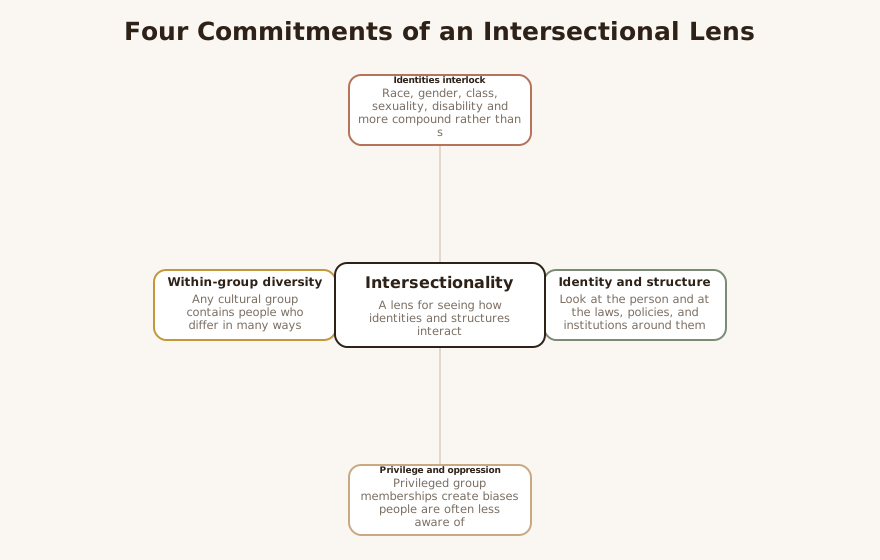
First, identities interlock rather than stack 7. Race, gender, class, sexuality, disability, religion, age, national origin, and Indigenous heritage interact to create compounded experiences of marginalization or advantage 7. Second, the framework attends to both identity and structure: an intersectional approach requires looking not only at who a client is but at the laws, policies, and institutions that drive social determinants of health such as food insecurity, income inequality, and adverse childhood experiences 5.
Third, intersectionality examines privilege as well as oppression 5. Privileged group memberships create biases in thinking, feeling, and behavior that affect what therapists do, and privileged people are typically less aware of their own power than marginalized people are of theirs 5. Fourth, attention to within-group diversity is essential: the framework counters stereotype by reminding clinicians that any cultural group contains people who differ by sexual orientation, disability, class, and more 5.
Crenshaw herself has cautioned against inflating the concept into a “grand theory of everything”; she frames it as a practical lens for seeing where power collides and interlocks, not a universal explanation, and warns that “it’s complicated” can become an excuse for inaction 3. For clinicians, that caution translates into using intersectionality to sharpen specific case formulation rather than as a vague gesture toward complexity LLM.
Interventions & Techniques
Intersectionality is delivered through structured reflective and assessment practices rather than discrete “interventions.” The most developed clinical operationalization is Hays’s ADDRESSING framework, an acronym covering Age and generational influences, Developmental and other Disability, Religion and spirituality, Ethnicity and racial identity, Socioeconomic status, Sexual orientation, Indigenous heritage, National origin, and Gender 5. Each domain corresponds to a system of privilege and oppression, the “isms”: ageism, ableism, antisemitism and Islamophobia, racism, classism, heterosexism, colonialism, nationalism, and sexism and cissexism 5.
Hays proposes four concrete steps for integrating intersectionality into practice. Step one is the therapist’s ongoing cultural self-assessment, listing the ADDRESSING domains and starring those in which one holds privilege, because the areas of greatest privilege are usually the areas of least awareness about others’ lives 5. Step two is attention to structural inequities embedded in the mental health system, including Eurocentric assumptions in diagnostic and assessment tools and physical barriers such as offices inaccessible to wheelchair users 5. Step three is actively seeking to understand identity-related oppression, including what Pinder-Amaker and Wadsworth term “identity-related aggressions” (a reframing of microaggressions that avoids implying such acts are minor and that signals intersecting systems beyond racism) 5. Step four is recognizing resilience, strengths, and support, increasingly understood as communal practices rather than solely individual traits 5.
LLM-generated illustrative example (not a guideline): In session, a therapist using ADDRESSING as a mental guide notices she has formed a case picture organized almost entirely around a client’s recent immigration, while the client repeatedly returns to her experience as a queer woman within her faith community. Recognizing that she has over-weighted the domain most salient to her and under-weighted the intersection most salient to the client, the therapist names the gap and asks the client which threads feel most central. LLM
In practice, clinicians can use the acronym collaboratively with clients or privately as a conceptualization scaffold; Hays notes that some clients welcome direct exploration of identity and oppression while others may experience such questions as intrusive or irrelevant to their presenting problem 5.
Evidence Base
The maturity of intersectionality is best described in two halves. As a conceptual and analytical framework, it is established: it is foundational across law and sociology, it is now written into the APA’s 2019 multicultural guidelines, and its core construct of interlocking oppression is widely accepted 5. As a clinical-outcomes intervention, the evidence is emerging and thin 5.
Hays is candid that there is a paucity of clinical and counseling research validating the usefulness of intersectional approaches, attributing this to the complexity of the construct and the limited counseling research on intersectionality in general 5. A content analysis he cites found that of roughly 6,700 articles across two major counseling journals through 2016, only about 40 took an intersectional approach 5. Wikipedia’s summary similarly notes that limited high-quality quantitative research validates the framework’s practical utility, and that critics see it as difficult to apply in research 7.
What clinical evidence exists is largely qualitative. A 2024 systematic review with qualitative evidence synthesis in Psychiatric Services examined studies published between 1989 and 2022, ultimately including 15 studies representing 383 service users and 114 providers, most focused on intersections of mental illness with race and with sexual and gender diversity in the United States and Canada 4. It identified four themes: the relevance of social identity in mental health settings, knowledge-related concerns, microaggressions in clinical practice, and service users’ responses to discriminatory care 4. Critically, it found that anticipated or experienced discrimination led multiply marginalized service users to reduce their contact with mental health care or develop communication strategies to pre-empt negative experiences 4. The bottom line: the framework is well established conceptually, but clinicians should not present it as an efficacy-proven treatment LLM.
Populations & Indications
Intersectionality is most clinically indicated for clients holding multiple marginalized identities, where single-axis cultural formulation is likely to miss the central features of their experience 5. This includes racial and ethnic minorities, women, LGBTQ+ individuals individuals, people with disabilities, and low-income populations, and especially those at the intersections of these positions 7. Hays notes that people with disabilities are the largest minoritized group, and that disabled people who also belong to other marginalized groups may experience compounded stress 5.
The framework is also indicated when structural barriers shape access and outcomes. The maternal-mortality disparity in which Black women fare worse even after controlling for income and education is a frequently cited illustration of how intersecting identities and structural racism, not individual factors alone, drive health disparities 7. It is equally relevant when the therapist and client differ on one or more identity domains, where there is heightened risk of misattunement 5.
Problems-for-Work
Intersectionality is most useful for presenting concerns rooted in or amplified by identity-based stress. These include minority stress, identity-related distress, internalized oppression, racial trauma, and discrimination-related distress, as well as their downstream sequelae such as depression, anxiety, posttraumatic stress disorder, and low self-esteem 7.
For minority stress and discrimination-related distress, the framework helps a clinician locate distress in social context rather than in the client’s pathology, countering self-blame 5. Hays notes that an intersectional approach can be used precisely to counter clients’ internalized racism, ableism, and heterosexism by naming systemic rather than personal causes 5.
LLM-generated illustrative example (not a guideline): A low-income transgender client of color presents with depressive symptoms and a belief that he is “too much work” for any provider. Rather than treating the belief solely as a cognitive distortion, the clinician explores how repeated experiences of being mishandled across class, race, and gender lines have made the belief a reasonable prediction about systems, then distinguishes that prediction from the client’s worth. LLM
For racial trauma, the framework directs attention to the cumulative interpersonal “identity-related aggressions” a client absorbs, and to communal sources of resilience such as cultural pride and connection with similar others that can be mobilized in treatment 5.
Contraindications, Cautions & Cultural Humility
Intersectionality is a framework, not a manualized treatment, so the cautions concern misuse rather than physiological risk LLM. The first caution comes from Hays himself: defining culture broadly across many domains risks minimizing racism specifically, because focusing on other forms of difference can become a way to avoid the discomfort of discussing race while appearing to consider culture 5. He notes that the ADDRESSING framework deliberately centers race as the primary “ism” for this reason 5.
Second, the acronym is a heuristic, explicitly described as imperfect and not comprehensive; it is a starting point for raising questions, not a system for neatly categorizing people 5. Reducing a client to a checklist of demographic boxes is a known failure mode and a criticism leveled at intersectionality generally 7. Third, it is not the client’s job to educate the therapist; clinicians are responsible for learning general cultural and structural context on their own, then using it as a template for understanding the individual rather than a substitute for it 5.
Cultural humility is the disposition that makes the framework safe to use: recognizing opportunities to learn about culture, tolerating discomfort in cultural conversations, and remaining aware that one’s own privileged domains are one’s blind spots 5. Where a client experiences identity questions as intrusive or irrelevant to their presenting problem, the clinician should hold the considerations privately in formulation rather than pressing 5.
Treatment-Plan Suggestions & SMART Objectives
| Goal | SMART objective (example) | Mechanism |
|---|---|---|
| Reduce internalized oppression | Client will identify and reframe 3 self-blaming beliefs as system-attributable within 8 sessions, rated on a self-report log | Externalizing distress from identity to structure counters self-blame 5 |
| Build identity-related coping | Client will name and rehearse 2 communal or cultural coping strategies (e.g., community connection, cultural pride) by week 6 | Resilience reconceptualized as communal practice 5 |
| Improve alliance across difference | Therapist will complete an ADDRESSING self-assessment and review power/identity differences with the client by session 2 | Naming power differences strengthens the therapeutic relationship 5 |
| Process discrimination-related distress | Client will track and process weekly identity-related aggressions, reducing avoidance behavior on a 0-10 scale over 10 sessions | Recognizing cumulative interpersonal insults validates and contextualizes distress 5 |
| Reduce care-avoidance | Client will attend scheduled mental health appointments at >=80% rate over 3 months and report perceived safety at each | Anticipated discrimination drives reduced care contact; safety reverses it 4 |
| Increase identity-congruent self-concept | Client will articulate a strengths-based narrative integrating >=2 intersecting identities by session 12 | Holistic, strengths-oriented formulation increases feeling understood 5 |
| Address minority stress symptoms | Client will reduce PHQ-9 / GAD-7 scores by a clinically meaningful margin over 12 weeks alongside identity-informed work | Contextualizing stressors supports symptom-targeted treatment 7 |
Common Misconceptions
A frequent error is treating intersectionality as additive arithmetic, as though a person’s experience equals “racism plus sexism.” The framework’s defining claim is the opposite: intersecting positions produce qualitatively distinct experiences that single-axis or additive thinking cannot capture 2. A second misconception is that intersectionality is a comprehensive theory of identity or “everything”; Crenshaw explicitly rejects this, framing it as a practical lens designed for specific purposes 3.
A third is that the ADDRESSING acronym is a fixed classification system; it is a heuristic meant to raise questions, not to file clients into boxes 5. A fourth, common in clinical settings, is that an intersectional approach means cataloguing identities while leaving structure untouched; Hays stresses that the framework requires attention to both identity and the structural inequities embedded in systems of care 5. Finally, some clinicians assume the framework is empirically validated as a treatment. It is established conceptually, but its clinical-outcomes evidence base is still emerging 5.
Training & Certification
There is no certification or license in intersectionality, consistent with its status as a framework rather than a treatment LLM. Competence is built through structured learning practices. Hays’s ADDRESSING cultural self-assessment is the most concrete entry point and is designed to be repeated and updated over a career, ideally in a group so that peers’ differing experiences make one’s own privilege more visible 5.
The framework has been adopted in clinically oriented university training programs, supervision, and institutional diversity efforts; documented examples include a single-session group intervention adapted from the ADDRESSING self-assessment at a hospital system and the integration of the framework into structured clinical interview and intake processes in counselor-training clinics 5. Beyond formal training, Hays recommends reading and consuming material produced by marginalized groups, joining consultation groups, and community engagement, beginning with the domain in which one holds the most privilege 5. The relevant professional anchor in the United States is the APA’s 2019 multicultural guidelines, which the ADDRESSING framework maps onto directly 5.
Key Terms
- Intersectionality: An analytical framework for how social and political identities combine to produce unique configurations of discrimination and privilege 7.
- Single-axis framework: Analysis that treats one identity dimension (e.g., race or sex) at a time, the limitation Crenshaw critiqued in 1989 1.
- Matrix of domination: Patricia Hill Collins’s concept of vectors of oppression and privilege intersecting across a social structure 7.
- Simultaneity: The Combahee River Collective’s idea that race, class, gender, and sexuality shape lived experience all at once 7.
- ADDRESSING framework: Hays’s acronym (Age, Disability, Religion, Ethnicity/race, Socioeconomic status, Sexual orientation, Indigenous heritage, National origin, Gender) for intersectional psychotherapy 5.
- Identity-related aggressions (IRAs): A reframing of microaggressions that avoids implying such acts are minor and that names intersecting systems beyond racism alone 5.
- Communal resilience: Resilience understood as a set of individual and communal practices rather than a solely individual trait 5.
- The “isms”: Systems of privilege and oppression (racism, classism, ableism, heterosexism, sexism, etc.) corresponding to each cultural domain 5.
Resources & Further Reading
▶ Watch — a video introduction to this concept:
- Crenshaw, K. (1989). Demarginalizing the Intersection of Race and Sex (University of Chicago Legal Forum, PDF)
- Intersectionality — Encyclopaedia Britannica
- Kimberlé Crenshaw on Intersectionality, More than Two Decades Later — Columbia Law School
- Intersectional Discrimination in Mental Health Care: A Systematic Review With Qualitative Evidence Synthesis — Psychiatric Services (2024)
- Four Steps Toward Intersectionality in Psychotherapy Using the ADDRESSING Framework — Hays (2024), Professional Psychology: Research and Practice (PDF)
- The Urgency of Intersectionality — Kimberlé Crenshaw (TED Talk)
- Intersectionality — Wikipedia
Reflective / Supervision Questions
- In which ADDRESSING domains do I hold the most privilege, and how might those be the blind spots in my work with this client? 5
- Am I treating this client’s identities as additive, or am I attending to the qualitatively distinct experience that emerges at their intersection? 2
- Have I considered structural inequities (in my own setting, my assessment tools, my office’s accessibility) and not only the client’s identity? 5
- Where might I be over-weighting the identity domain most salient to me and under-weighting the one most central to the client? 5
- Has anticipated discrimination shaped how this client uses care, including reduced contact or guarded communication, and how can I make the work feel safer? 4
- Am I using intersectionality to sharpen a specific formulation, or as a vague gesture toward complexity that risks becoming an excuse for inaction? 3
- What communal and cultural strengths can this client mobilize, and have I named them as deliberately as I have named distress? 5