
Type & Discipline
Writing-based intervention is an umbrella covering several distinct but related techniques: bibliotherapy (the guided use of reading material to support psychological change), journaling (self-directed, open-ended writing), and expressive writing (a structured protocol in which a person writes about their deepest thoughts and feelings regarding an emotional or traumatic experience) 5. Within the arts-based and narrative family of therapies, expressive writing is the most heavily researched member, owing largely to James Pennebaker’s experimental work beginning in the late 1980s 5. LLM
These are best understood as techniques rather than freestanding modalities. They are typically embedded within a larger treatment frame—cognitive behavioral therapy, narrative therapy, or expressive arts therapy—and draw on shared mechanisms of disclosure, cognitive processing, and meaning-making LLM. A useful clinical distinction is that journaling is self-directed and documentary, while therapeutic writing follows a structured protocol with a specific aim, deliberately targeting emotional disclosure, cognitive reframing, and narrative coherence to produce measurable change rather than mere record-keeping 7.
Creators & Lineage
The modern field crystallized around James W. Pennebaker, whose expressive writing paradigm demonstrated that structured writing about upsetting experiences produced measurable health benefits and established the empirical foundation for contemporary writing therapy 5. Pennebaker has authored or co-authored well over 100 articles on expressive writing, making him the dominant figure in the literature 5. His accessible synthesis with Joshua Smyth, Opening Up by Writing It Down, translates the research program into a practitioner- and client-facing guide 6.
The lineage is genuinely cross-disciplinary LLM. Journaling is the oldest self-help form of therapeutic writing, predating any formal protocol 5. Poetry therapy, represented by figures such as Alicia Ostriker, uses poetic form to reach repressed or hard-to-articulate emotion 5. The expressive writing paradigm itself sits at the intersection of cognitive behavioral therapy (cognitive restructuring, graded exposure to feared memories), narrative therapy (re-authoring and coherence), and expressive arts therapy (externalizing experience through a creative medium) LLM. Subsequent meta-analytic work by Joanne Frattaroli and clinically oriented reviews by Karen Baikie and Kay Wilhelm consolidated the technique for mental-health practitioners 13.
Core Principles
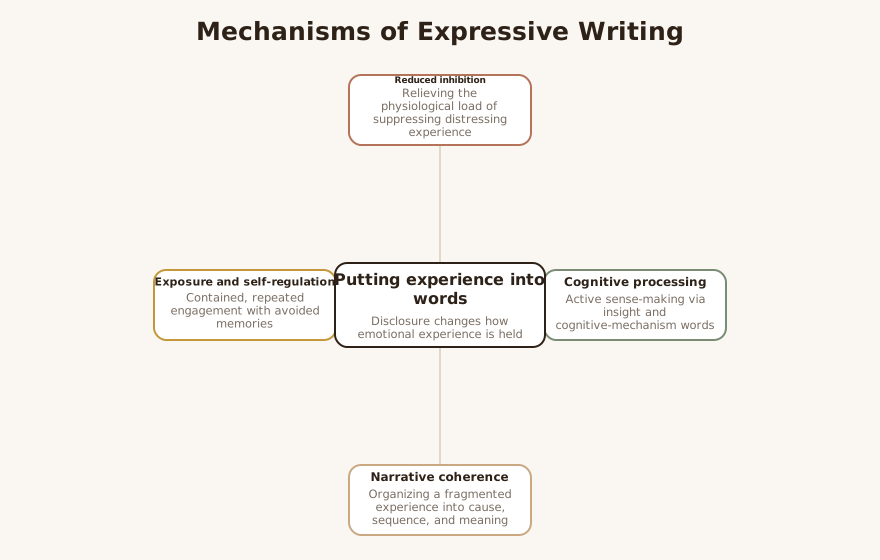
The organizing premise is that putting emotional experience into words changes how that experience is held LLM. Pennebaker’s original framing emphasized inhibition: actively withholding or suppressing distressing experience is physiologically taxing, and disclosure relieves that load 5. The reach of the effect beyond simple suppression—shown by findings that writing about imagined traumas can also help—pushed the field toward additional explanatory mechanisms 5. LLM
Contemporary accounts foreground several complementary processes LLM. Cognitive processing is central: expressive writing is associated with increased use of insight and cognitive-mechanism words over the course of writing, suggesting active sense-making rather than mere venting 4. Narrative coherence—organizing a fragmented experience into a story with cause, sequence, and meaning—is a related target 7. Exposure to avoided memories and self-regulation through repeated, contained engagement round out the mechanistic picture LLM. A practical corollary is that the goal is processing, not catharsis for its own sake; unstructured emotional discharge that loops back on itself can entrench rumination rather than resolve it 7.
Interventions & Techniques
The canonical expressive writing protocol asks the person to write continuously for about 15 minutes on each of three to four consecutive days about their deepest thoughts and feelings concerning a traumatic or emotionally significant experience 5. Spelling, grammar, and structure are explicitly set aside; the instruction is to keep the pen moving 5. The writing is often private and need not be shared or read back 3. LLM
LLM-generated illustrative example (not a guideline): A clinician introduces the protocol to a client processing a difficult medical diagnosis: “For the next four sessions at home, set a timer for 15 minutes and write without stopping about what this diagnosis has meant to you—your fears, what you have not said out loud, how it connects to your past. No one else will read it. If you run out of words, repeat the last sentence until new ones come.” LLM
Variations and adjuncts include LLM:
- Positive writing, in which the person writes about positive aspects of an experience or about benefits and growth; this tends to be less distressing and may suit clients who are fragile or non-clinical 4.
- Bibliotherapy, pairing structured reading—self-help workbooks, narratives, or poetry—with reflective discussion or written response, gaining its therapeutic power through guided, active engagement rather than passive consumption 7.
- Letters never sent, gratitude or unsent-message letters, and structured prompts that scaffold the writing for clients who freeze on an open page LLM.
- Asynchronous and online formats (email-based or chat), which add anonymity and accessibility for clients who write more freely than they speak 5.
Evidence Base
The evidence base is mature and established, and it is best characterized honestly: effects are real, replicated, and generally small in magnitude 1. Frattaroli’s large meta-analysis of experimental disclosure established that the technique produces a small but reliable overall benefit, with effectiveness moderated by how the intervention is delivered 1. Baikie and Wilhelm’s clinically oriented review documents improvements including reduced depressive symptoms, improved mood, lowered blood pressure, and changes in immune-function markers across studies 35.
Important caveats temper enthusiasm LLM. The 2023 meta-analysis comparing expressive writing with positive writing across 24 randomized trials (1,558 participants) found no significant between-group differences for depression, anxiety, or stress as individual outcomes, and no significant differences on physical-health metrics such as pain, symptoms, or healthcare visits 4. For general (non-clinical) populations, positive writing actually produced higher positive and lower negative emotion, being “less difficult and upsetting,” whereas expressive writing more strongly stimulated cognitive change in clinical patients 4. Trials in some clinical populations, such as cancer patients, have yielded primarily non-significant initial results 5. The literature also carries publication-bias signals for several outcomes 4. The reasonable clinical reading: a low-cost, scalable adjunct with modest average benefit, not a stand-alone treatment for major disorders LLM.
Populations & Indications
Writing interventions have been applied across a broad range LLM. Documented populations include trauma and PTSD survivors, war veterans, cancer and other chronically ill patients, people in recovery from substance use, and individuals working through bereavement, abuse, or abandonment 5. The provided lineage for this article emphasizes adults, adolescents, trauma survivors, people with chronic illness, bereaved individuals, and caregivers—all groups for whom an externalizing, self-paced processing tool is plausibly useful LLM.
Indications cluster where verbal processing is constrained or where between-session consolidation matters: clients who articulate more on the page than aloud, those facing identifiable stressors or transitions, and those for whom homework-style engagement extends the reach of weekly sessions 7. For everyday stress, grief, and life transitions, structured therapeutic writing can even function well as a guided self-help adjunct 7. LLM
Problems-for-Work
The most defensible applications target affective and processing problems rather than acute crisis LLM:
- Rumination and stress. Structured writing redirects circular thinking into a coherent narrative, encouraging insight and cognitive processing rather than repetitive replay 4. Application: a client with work-related stress writes about the precipitating conflict to surface the underlying appraisal driving the loop LLM.
- Grief and adjustment. Writing offers a contained, repeatable space to articulate loss and reorganize a life story disrupted by a transition or bereavement 5. LLM
- Emotional dysregulation and low self-esteem. Naming and organizing feeling on the page supports labeling and distance; benefit-focused or positive writing can reinforce strengths and growth 4. LLM
- Depression and anxiety symptoms. Expressive writing can reduce depressive symptoms and improve mood as an adjunct, though it should not be positioned as a primary treatment given the modest and outcome-specific evidence 34.
- Trauma-related avoidance (sub-acute). When timed well and clinically supported, writing provides graded exposure to avoided material and helps build narrative coherence 7. LLM
Contraindications, Cautions & Cultural Humility
The clearest caution is short-term distress: some participants experience immediate negative emotion after writing sessions, even though longer-term follow-up typically shows benefit 5. Clients should be told to expect this and given a way to down-regulate afterward LLM. Professional oversight is specifically indicated for recent trauma, active PTSD, suicidal ideation, and severe conditions, and for any situation where self-directed writing reliably triggers rumination rather than processing 7. Timing matters: writing into very fresh trauma without containment can overwhelm 7.
Expressive writing is not a substitute for active treatment of major disorders, and the between-group nulls for depression, anxiety, and physical health argue against overselling it 4. LLM Cultural humility is essential and under-studied: the 2023 review explicitly notes insufficient attention to gender, ethnicity, and cultural factors across trials 4. Norms around emotional disclosure, privacy, literacy, language of expression, and the meaning of writing itself vary widely; clinicians should adapt prompts, language, and even modality (spoken or recorded alternatives) rather than assume the standard paradigm fits every client LLM.
Treatment-Plan Suggestions & SMART Objectives
| Goal | SMART objective (example) | Mechanism |
|---|---|---|
| Reduce stress-related rumination | Client completes three 15-minute structured writing sessions per week for 4 weeks and rates rumination weekly, targeting a measurable decline | Cognitive processing; narrative coherence 4 |
| Process a recent loss | Client writes about the loss for 15 minutes on 4 occasions over 2 weeks and reviews emerging meaning with clinician | Disclosure; meaning-making 5 |
| Build emotion-labeling skill | Client names at least two specific emotions per entry in 6 of 8 entries over 4 weeks | Affect labeling; self-regulation LLM |
| Increase self-compassion / esteem | Client completes weekly benefit-focused (positive) writing for 4 weeks, noting one strength per entry | Positive reappraisal; lower distress load 4 |
| Reduce trauma-related avoidance (sub-acute) | With clinician pacing, client writes about one avoided memory for 15 minutes weekly for 4 weeks, tracking distress before/after | Graded exposure; coherence 7 |
| Extend session work between visits | Client responds in writing to one assigned reading per week for 6 weeks and discusses reactions in session | Guided bibliotherapy; consolidation 7 |
| Improve mood as CBT adjunct | Client logs mood pre/post each of 4 expressive writing sessions and identifies one cognitive shift per session | Cognitive restructuring; insight 3 |
Common Misconceptions
- “More is always better.” Effects are small on average and outcome-specific; brief protocols already capture most of the documented benefit, and prolonged unstructured writing can entrench rumination 47. LLM
- “Catharsis is the active ingredient.” Pure venting is not the goal; the data favor cognitive processing and coherence over emotional discharge, and benefits appear even when writing about imagined events 5. LLM
- “Journaling and expressive writing are the same.” Journaling is open-ended documentation; expressive and therapeutic writing follow structured protocols aimed at measurable change 7.
- “It works equally for everyone.” Positive writing often suits non-clinical and fragile clients better, while expressive writing more strongly drives cognitive change in clinical patients 4.
- “Writing replaces therapy for depression or trauma.” The evidence supports it as an adjunct, not a primary treatment, especially given null between-group findings on key clinical outcomes 4. LLM
Training & Certification
The core expressive writing protocol is simple to administer and does not require specialized certification, which is part of its appeal as a scalable adjunct LLM. Competent use rests on standard clinical judgment about timing, containment, and risk rather than a credential 7. Opening Up by Writing It Down serves as a practical training text for clinicians and clients alike 6. Adjacent forms—poetry therapy and structured journal therapy—have their own professional communities and credentialing pathways for clinicians who wish to specialize, though these sit outside the basic expressive writing technique 5. LLM
Key Terms
- Expressive writing paradigm — the structured protocol of writing about one’s deepest thoughts and feelings on an emotional topic, typically ~15 minutes across several consecutive days 5.
- Bibliotherapy — guided use of reading material, gaining therapeutic value through active, structured engagement 7.
- Positive writing — writing focused on positive aspects, benefits, or growth; generally less distressing than expressive writing 4.
- Narrative coherence — the organization of a fragmented experience into a structured, meaningful story 7.
- Inhibition hypothesis — Pennebaker’s early account that withholding emotional experience is taxing and disclosure relieves it 5.
- Cognitive processing — active sense-making during writing, indexed by increased insight and mechanism words 4.
Resources & Further Reading
▶ Watch — a video introduction to this concept:
- Frattaroli, J. (2006). Experimental Disclosure and Its Moderators: A Meta-Analysis
- Pennebaker, J. W. (2018). Expressive Writing in Psychological Science
- Baikie, K. A., & Wilhelm, K. (2005). Emotional and Physical Health Benefits of Expressive Writing
- Efficacy of Expressive Writing versus Positive Writing: Systematic Review and Meta-Analysis (2023)
- Writing therapy — Wikipedia
- Pennebaker & Smyth — Opening Up by Writing It Down (3rd ed.)
- Therapeutic Writing vs Journaling: Which Helps More? — explainer
Reflective / Supervision Questions
- For this client, is the therapeutic target processing and coherence, or am I implicitly hoping for catharsis—and does the distinction change my prompt? LLM
- Have I assessed timing and containment so that writing into trauma will not outpace this client’s current regulation capacity? 7
- Would benefit-focused positive writing serve this client better than the standard expressive protocol right now, given their fragility and clinical status? 4
- How have I adapted prompts, language, and modality to this client’s cultural and literacy context rather than defaulting to the standard paradigm? 4
- Am I framing writing as an adjunct with realistic, modest expectations, or am I overselling it relative to what the evidence supports? 4 LLM
- What is my plan to monitor and respond to post-session distress between visits? 5