
Type & Discipline
Gilligan’s ethic of care is a theory in moral and developmental psychology that doubles as a normative ethical framework in feminist philosophy.7 It is not a treatment modality, a diagnostic system, or a manualized protocol; it is a model of how people reason about moral conflict and a critique of the dominant justice-based account of moral maturity.7 In its ethical form, the ethics of care holds that moral action centers on interpersonal relationships and on care or benevolence as a virtue, rather than on the application of universal principles.6 For clinicians, it functions primarily as an interpretive lens—a way of hearing how clients construe obligation, relationship, and self-worth—rather than as an intervention in itself.LLM
Creators & Lineage
The theory originates with Carol Gilligan (b. 1936), an American psychologist and ethicist trained in clinical and social psychology, who taught for decades at Harvard and later at New York University.7 Gilligan worked as a research assistant to Lawrence Kohlberg, whose six-stage model of moral development she came to critique on the grounds that it was built largely from male samples and consequently scored women as less mature.7 Her 1977 Harvard Educational Review article and the 1982 book In a Different Voice argued that women were not deficient reasoners but were attending to a different theme—responsibility and relationship rather than rights and justice.1 The book has sold more than 700,000 copies and been translated into many languages, marking it as one of the most influential psychology texts of its era.7
Gilligan’s work seeded a broader tradition of care ethics, developed by Nel Noddings, Joan Tronto, and Virginia Held, and it sits within the lineage of feminist therapy and relational-cultural theory, which similarly relocate the self within relationship rather than treating autonomy as the developmental endpoint.6 Importantly, Gilligan’s relationship to Kohlberg was generative rather than purely oppositional; she described her project as reframing his stages, not merely charting a detour through them.1
Core Principles
The central claim is that there are two distinguishable moral orientations: a justice orientation, which is logical, individualistic, and concerned with rights and fairness, and a care orientation, which is contextual, relational, and concerned with responsiveness to particular needs.7 Care ethics asks “how do I respond?” rather than “what is just?”, treating situational detail as morally decisive rather than as noise to be abstracted away.6 It assumes human interdependence and vulnerability as the baseline condition of moral life, not autonomous individuals contracting from a position of independence.6
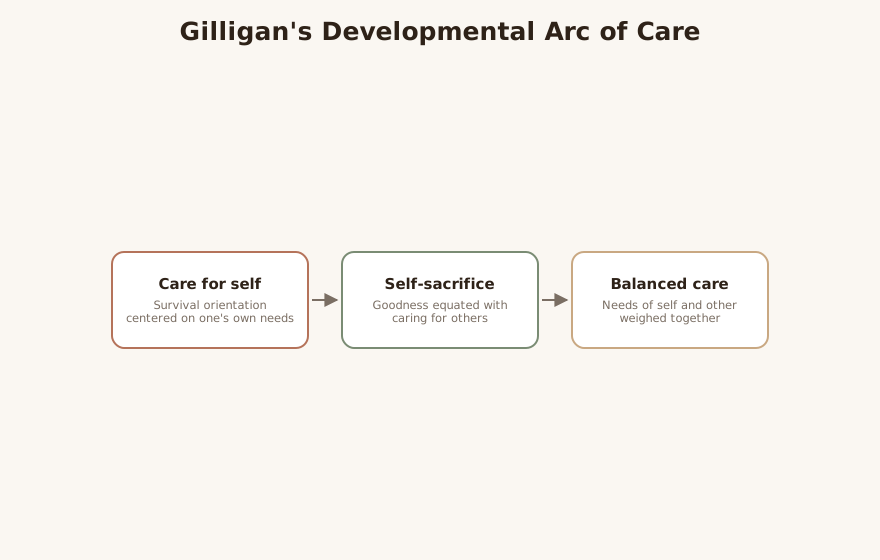
A second principle is that these orientations have historically been gendered, with the care voice associated with women—but Gilligan insisted the difference was “characterized not by gender but theme.”7 In her later work she went further, arguing that patriarchal culture constructs gender difference and actively suppresses a relational capacity that is fundamentally human, not female.1 A third principle is developmental: the care orientation can mature, moving from a narrow focus on self toward a reflective balance in which the needs of self and other are weighed as genuinely equal.3
Interventions & Techniques
The ethic of care is not a set of techniques, but it has spawned an associated method and a clinical posture. Gilligan developed the Listening Guide, a qualitative method of “radical listening” that attends to the layered voices in a person’s narrative—especially the “story beneath the story” and the moments where a client’s authentic knowing is covered over.1 A signature observation is that a proliferating “I don’t know” can function not as ignorance but as suppression, placing “don’t” between “I” and “know” to shield understanding from social judgment.1
LLM-generated illustrative example (not a guideline): A clinician notices a client repeatedly says “I don’t know what I want—whatever’s best for everyone” when describing a family decision. Rather than problem-solving the decision, the clinician slows down and reflects the pattern: “I keep hearing your needs disappear from the sentence. What would you know if you let yourself?” LLM.
In practice, clinicians draw on the framework to validate relational and contextual reasoning rather than pathologizing it, to surface where a client has internalized cultural devaluation of their own experience, and to distinguish healthy care from self-erasure.1 These moves are delivered inside conventional psychotherapy; the framework supplies the listening stance, not a standalone procedure.LLM
Evidence Base
The maturity of this concept is best described as established as theory, contested as empirical claim.LLM As an ethical framework and a developmental theory, Gilligan’s work is foundational, heavily cited, and durably influential across psychology, nursing, education, and philosophy.1 As an empirical claim that women and men reason in measurably distinct moral voices, it is genuinely disputed: the original studies were qualitative and narrative rather than quantitative, and critics argued they lacked formal coding systems and a representative empirical foundation.1 Subsequent commentators have held that any observed gender differences reflect socialization and societal expectation rather than inherent difference, and that the original work may have exaggerated a binary.7
Two points keep this honest. First, Gilligan herself moved away from a strong gender claim, reframing the “different voice” as a suppressed human voice and rejecting essentialism.1 Second, there are no randomized controlled trials of an “ethic-of-care therapy,” because no such standalone, manualized treatment exists; the construct should be used as a clinically useful lens, not cited as an evidence-based modality.LLM Its value to practice rests on conceptual coherence and resonance with clinical experience more than on outcome data.1
Populations & Indications
The framework is most clinically generative with women and adolescent girls, where Gilligan documented patterns of voice suppression and internalized self-silencing as relational capacities collide with cultural pressure.1 It is highly applicable to caregivers and helping professionals, whose roles can normalize chronic self-sacrifice and obscure the line between care and depletion.4 It is useful with couples, where partners often operate from different moral orientations—one prioritizing fairness and rights, the other relationship and responsibility—generating recurrent miscommunication.LLM Finally, it speaks to clients in moral or ethical distress, who are weighing obligations to others against obligations to self.7 Gilligan’s later work notes that boys and men are also subject to relational suppression, so the lens is not restricted to female clients.1
Problems-for-Work
- Self-sacrifice and lack of self-care: the conventional “goodness as self-sacrifice” stance maps directly onto clients who equate moral worth with putting others first.3 Work targets the transition from goodness to honesty, where the client’s own needs are admitted as legitimate.3
- Caregiver strain and burnout: naming care as a finite, two-directional obligation—owed to self as well as other—reframes depletion as a moral and not merely logistical problem.4
- Codependency and boundary problems: the model gives language for an over-developed care orientation in which the self dissolves into others’ needs.LLM
- Low self-worth and identity confusion: voice suppression and “I don’t know” patterns can be heard as protective covering rather than absence of knowing.1
- Relationship conflict: orientation mismatch (justice vs. care) is reframed as difference rather than deficit.7
LLM-generated illustrative example (not a guideline): A hospice nurse presents with exhaustion and guilt about wanting time off. Framing her bind as a conventional self-sacrifice stage—where “good” means others-first—lets the clinician introduce the second transition: that her needs are not in competition with her patients’ but equal to them. LLM.
Contraindications, Cautions & Cultural Humility
The chief caution is built into the theory’s own history: presenting the care voice as essentially female risks reinforcing the gender stereotypes feminist scholars have warned against, and can pathologize men’s care or naturalize women’s self-sacrifice.6 Clinicians should use the framework descriptively, not prescriptively, and should foreground Gilligan’s later position that the relational voice is human and culturally suppressed rather than biologically female.1 A related risk is paternalism—care ethics can slide into the caregiver imposing their own sense of what the other needs.6
Cultural humility matters acutely here. What looks like “self-sacrifice” or “enmeshment” through an individualistic lens may be a valued expression of collectivist obligation, kinship duty, or spiritual commitment in a client’s culture.LLM The aim is to help clients locate a balance they author, not to import the clinician’s notion of healthy autonomy.LLM The framework should never be used to label relational or contextual moral reasoning as developmentally inferior—reversing that very judgment was Gilligan’s point.7
Treatment-Plan Suggestions & SMART Objectives
| Goal | SMART objective (example) | Mechanism |
|---|---|---|
| Reduce self-silencing | Within 8 sessions, client will identify and verbally name a personal need in 3 of 4 weekly relational situations, logged between sessions | Surfacing the suppressed voice; goodness-to-honesty transition1 |
| Rebalance care toward self | Over 6 weeks, client will schedule and complete 2 self-directed activities weekly without seeking permission | Moving from conventional self-sacrifice toward integrated care3 |
| Strengthen boundaries | By week 10, client will decline 2 non-essential requests using a prepared script, rating distress before and after | Differentiating care for other from self-erasureLLM |
| Reframe caregiver guilt | Within 4 sessions, client will articulate care as a two-directional obligation in their own words | Reconceiving the moral domain to include duty to self4 |
| Reduce orientation-based conflict (couples) | Within 6 sessions, each partner will accurately restate the other’s moral orientation (justice vs. care) in 2 recurring disputes | Recognizing difference rather than deficit7 |
| Increase self-worth | Over 8 weeks, client will record one instance of trusting their own knowing daily | Countering internalized devaluation of relational knowledge1 |
| Resolve moral distress | By week 8, client will use a structured reflection to weigh competing obligations in 1 real dilemma without defaulting to self-erasure | Holding self and other as equal stakeholders3 |
Common Misconceptions
A first misconception is that Gilligan claimed women are morally superior; she claimed they reason differently and were wrongly judged inferior by a male-derived yardstick.7 A second is that the theory is essentialist—that women are biologically wired for care; Gilligan explicitly rejected this and located the difference in patriarchal culture.1 A third is that the care orientation simply means being nice or self-effacing; mature care, in her account, weighs the self’s needs as equal to others’ and includes a morality of nonviolence toward oneself.3 A fourth is that care and justice are mutually exclusive; Gilligan advocated integrating both orientations rather than replacing one with the other.7 A fifth is that the framework is an evidence-based treatment—it is a theory and a stance, not a protocol with outcome trials.LLM
Training & Certification
There is no certification in “ethic of care” as a clinical credential, because it is a theoretical framework rather than a proprietary modality.LLM Clinicians typically encounter it within graduate coursework on moral and developmental psychology and within feminist and relational-cultural training.7 The most concrete trainable skill associated with it is the Listening Guide, a qualitative interview-and-analysis method that researchers and some clinicians learn through Gilligan’s own writings and through workshops in narrative and feminist research traditions.1 Practitioners wanting to operationalize it clinically are best served by formal training in feminist therapy or relational-cultural therapy, which translate care-ethics commitments into therapeutic technique.LLM
Key Terms
- Care orientation: a moral perspective centered on responsibility, relationship, and responsiveness to particular needs.7
- Justice orientation: a moral perspective centered on rights, fairness, and impartial principle, associated with Kohlberg’s model.7
- The three levels: preconventional self-care (survival-focused), conventional self-sacrifice (goodness defined as putting others first), and postconventional integrated care (self and other weighed as equal).3
- The two transitions: the shift from selfishness to responsibility, and the shift from “goodness” to “truth/honesty” in which one’s own needs are admitted as legitimate.7
- Different voice: the relational, contextual moral theme Gilligan said was suppressed and devalued—framed by theme, not strictly by gender.7
- Listening Guide: Gilligan’s qualitative method of attending to layered voices in narrative.1
- Ethics of care: the normative theory that morality centers on relationships and benevolence rather than universal rules.6
Resources & Further Reading
▶ Watch — a video introduction to this concept:
- Developing a different voice: The life and work of Carol Gilligan
- Carol Gilligan’s Different Moral Voice: Gender, Ethics of Care, and the Reconstitution of the Moral Domain
- In a Different Voice: Psychological Theory and Women’s Development (Harvard University Press)
- Women’s psychology according to Carol Gilligan (EBSCO Research Starter)
- Ethics of care (Wikipedia)
- Carol Gilligan (Wikipedia)
Reflective / Supervision Questions
- When a client describes a moral conflict, do I default to hearing it through a justice lens (rights, fairness) and risk missing the care lens (relationship, responsibility)?LLM
- Where in my caseload have I framed relational or contextual reasoning as enmeshment or immaturity, when it might be a culturally valued orientation?LLM
- How do I distinguish a client’s healthy care for others from self-erasing self-sacrifice, and what language do I offer for the difference?LLM
- Am I at risk of reinforcing gendered assumptions—expecting care work from women clients or pathologizing it in men?LLM
- In my own clinical role as a caregiver, where have I treated care as one-directional and neglected the obligation I owe myself?LLM
- When I hear “I don’t know” repeatedly, do I treat it as absence of knowledge or consider it might be protective suppression of knowing?1