
Type & Discipline
Existentialism is not a therapy but a tradition of philosophy — a loose family of nineteenth- and twentieth-century thinkers united less by doctrine than by a shared starting point: the concrete, lived situation of the individual human being rather than abstract systems or fixed essences.14 Its defining thesis, formulated by Sartre, is that for human beings existence precedes essence: a person first exists, “turns up, appears on the scene,” and only afterward defines who they are through choices and actions, unlike a manufactured object whose essence is fixed in advance.12 In this wiki it sits as a cross-disciplinary framework: a body of ideas from philosophy whose preoccupations — freedom, responsibility, anxiety, authenticity, mortality, and meaning — map directly onto the existential and humanistic psychotherapies it later seeded.1 LLM Its clinical relevance is that it names, rigorously, the dimensions of suffering that are not symptoms to be removed but conditions of being a self-aware, finite, choosing creature. LLM
Creators & Lineage
Existentialism has no single founder and, strikingly, few thinkers who accepted the label.6 The Stanford Encyclopedia notes that of the major figures, only Jean-Paul Sartre and Simone de Beauvoir explicitly self-identified as “existentialists.”1 The term itself was introduced by Gabriel Marcel in 1943.1 The nineteenth-century forerunner is Søren Kierkegaard, who rejected Hegelian abstraction and insisted on subjective, lived truth — “a truth which is true for me” — grounding philosophy in the existing individual rather than the system.1 Kierkegaard’s strand is religious and Christian; the later, best-known strand is atheistic.1 LLM Martin Heidegger is foundational — his Being and Time (1927) held that “the ‘essence’ of Dasein lies in its existence” — yet he is among the major contributors who did not themselves adopt the existentialist label, which only Sartre and Beauvoir explicitly did.1 Sartre systematized the position in Being and Nothingness (1943) and popularized it in the lecture Existentialism Is a Humanism (1946).25 Simone de Beauvoir extended it ethically and politically, developing the idea of situated freedom and applying it to gender and oppression.1 Albert Camus, often grouped with the movement for his treatment of the absurd, is associated with it largely through his literary expression of these themes rather than by self-identification.1 LLM The lineage then runs forward into clinical practice — Frankl’s logotherapy, the daseinsanalysis of Binswanger and Boss, the British school of Existential Psychotherapy, and the existential-humanistic psychotherapy associated with Rollo May and Irvin Yalom. LLM
Core Principles
Several interlocking ideas recur across existentialist writers, even where they disagree on metaphysics.1
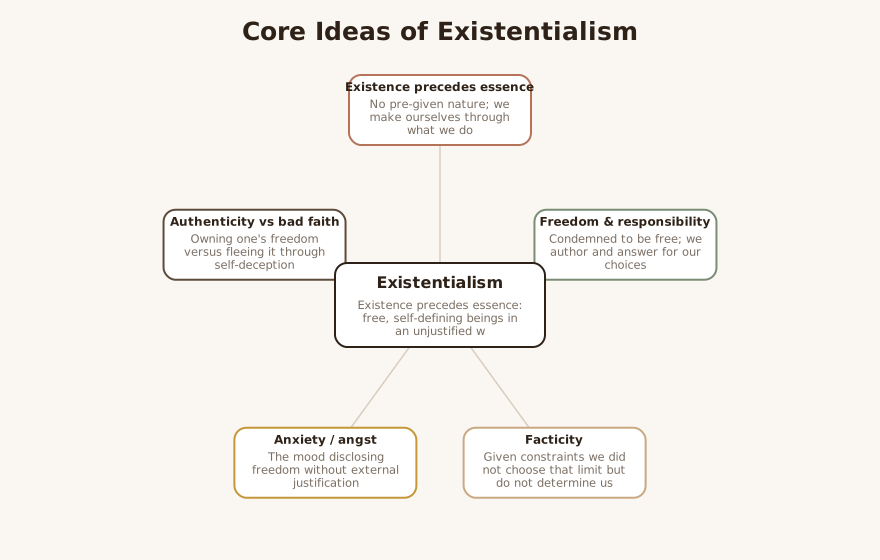
- Existence precedes essence. There is no pre-given human nature that determines who we must be; we make ourselves through what we do.12
- Radical freedom and responsibility. Sartre held that consciousness has no fixed nature and so we are “condemned to be free” — unable to escape authorship of, and responsibility for, our choices.25 Freedom is nonetheless situated: it is exercised within, not above, our circumstances.1
- Facticity. The given constraints we did not choose — body, history, social position, the fact of having been born into a particular world — which limit but do not determine us.12
- Anxiety / angst. The mood that discloses freedom itself: facing responsibility without external justification, we feel the unsettledness of having no ground beneath our choices.1
- Authenticity and bad faith. To live authentically is to own one’s freedom and finitude; bad faith (mauvaise foi) is the self-deception of fleeing freedom — either over-identifying with a fixed role (Sartre’s café waiter) or pretending one is wholly unconstrained.12
- The absurd. The confrontation between our demand for meaning and a universe that offers none in advance, with meaning to be created rather than discovered.1
- Being-for-itself vs. being-in-itself. Sartre’s distinction between consciousness, which continually transcends and negates any fixed identity, and the inert, complete being of objects.2
A further idea — Sartre’s “the look” — describes how being perceived by another turns us into an object, generating shame and revealing the inescapably intersubjective nature of selfhood.2
Interventions & Techniques
Existentialism is a philosophy, not a manualized treatment, so it has no technique set of its own; what it offers the clinician is a stance and a set of organizing questions that are delivered through recognized therapies. LLM The most direct clinical translation is the existential-humanistic tradition, in which the principles above become the content of the work: surfacing how a client avoids ownership of their choices (bad faith), naming anxiety as the disclosure of freedom rather than a defect to be medicated away, and treating the confrontation with mortality and meaninglessness as material rather than noise. LLM
In practice this looks like a phenomenological stance — describing the client’s lived experience closely before explaining or problem-solving it — paired with a here-and-now focus on the authentic encounter between two people. LLM Concrete moves include reflecting back the language of passivity (“it just happened to me”) to invite ownership, exploring the facticity a client cannot change alongside the freedom they still hold within it, and helping a client locate sources of self-created meaning rather than waiting to discover a pre-given purpose. LLM Because existentialism insists meaning is made rather than found, much of the work is generative — clarifying values, commitments, and projects — which is why it integrates naturally with logotherapy’s will-to-meaning and with the values work of acceptance- and commitment-based therapies. LLM
LLM-generated illustrative example (not a guideline): A client in a stalled career describes every setback as something that “happens to” him. Rather than offering coping strategies, the clinician gently mirrors this language of passivity and invites him to examine where authorship and choice still lie — a freedom-and-responsibility intervention delivered within ordinary individual psychotherapy. LLM
Evidence Base
Honesty about maturity is essential here. As a philosophical tradition, existentialism is well-established, influential, and widely taught — it is foundational to a whole family of psychotherapies.1 But it is not an empirical claim and carries no randomized-controlled-trial rating of its own, because a philosophy is not the kind of thing one tests in an outcome trial. LLM Its evidentiary weight in the clinic is therefore indirect: it is carried by the therapies it seeded. LLM
The honest framing for clinicians is that the philosophy is mature, but its clinical derivatives carry limited and largely early outcome data. LLM Direct outcome evidence is concentrated in manualized descendants developed for serious illness — meaning-centered psychotherapy, Managing Cancer and Living Meaningfully (CALM), and dignity therapy — where studies remain relatively few and effects on existential or spiritual well-being are promising but not yet robust across diagnoses. LLM Existential psychotherapy as a standalone, manualized treatment has a thinner trial base than symptom-focused modalities, even as its conceptual influence is enormous. LLM The practical conclusion: use existentialism as a conceptual scaffold, and deliver change through its evidence-based or evidence-developing clinical relatives. LLM
Populations & Indications
Because its concerns are universal, existentialism can inform work with almost anyone, but it gains the most traction where existential realities are acute and unavoidable. LLM The clearest indications are adults navigating identity or life transitions, where the question “who am I now, and who do I choose to become?” is live. LLM People confronting mortality — those with chronic or terminal illness, and older adults facing the foreshortening of time — encounter the philosophy’s themes of finitude and meaning directly. LLM Young adults seeking meaning in the absence of inherited certainties, and individuals experiencing alienation from work, culture, or self, often find that an existential frame names their distress more accurately than a purely symptom-based one. LLM The common thread is a presentation in which the suffering is about freedom, responsibility, isolation, or meaning rather than reducible to a discrete behavioral or cognitive target. LLM
Problems-for-Work
Existential work is most apt when distress has a clear existential dimension that symptom-focused treatment alone does not reach. LLM
- Loss of meaning / meaninglessness — the prototypical target: the felt absence of purpose treated as a condition to engage, with meaning generated through commitment and self-transcendence rather than prescribed. LLM
- Existential crisis — a destabilizing confrontation with freedom or finitude, reframed as an opening for authentic re-choice rather than purely as pathology. LLM
- Death anxiety — awareness of personal finitude, worked with directly to intensify engagement with living rather than suppressed. LLM
- Identity disturbance — the “existence precedes essence” frame supports rebuilding a self through chosen commitments rather than recovering a supposed fixed true self. LLM
- Demoralization — the loss of hope and morale common in illness, addressed through meaning and dignity rather than mood symptoms alone. LLM
- Anxiety — when formulation implicates avoidance of freedom or unacknowledged mortality, the anxiety is read as disclosure of the human condition, usually alongside evidence-based anxiety treatment. LLM
- Alienation and isolation — examining both interpersonal loneliness and the deeper existential isolation that no relationship fully dissolves. LLM
- Decisional conflict around freedom and responsibility — clarifying that not choosing is itself a choice, and supporting ownership of the decision. LLM
LLM-generated illustrative example (not a guideline): A recently bereaved older adult reports that “nothing matters anymore.” The clinician treats this as meaninglessness rather than only depression, exploring small avenues of connection and contribution as routes to self-created meaning — while monitoring for, and separately treating, a co-occurring major depressive episode. LLM
Contraindications, Cautions & Cultural Humility
Existential exploration is not a first-line substitute for acute stabilization; clients in crisis, acute psychosis, or untreated severe depression generally need safety-oriented, symptom-focused care before or alongside any existential work. LLM The open, unstructured quality of existential inquiry can feel destabilizing for clients who need containment, and confronting freedom or death prematurely may heighten rather than relieve distress. LLM
A specific philosophical caution matters clinically: existentialism’s emphasis on radical individual responsibility can shade into self-blame when a client’s suffering stems from real injustice, deprivation, or trauma. LLM Beauvoir’s insistence that freedom is always situated — exercised within facticity, not above it — is the corrective: ownership of one’s response must never become counsel to tolerate harm or ignore structural causes.1 LLM Culturally, the tradition’s atheistic and individualistic strands may clash with clients whose worldviews are religious, fatalistic, or collectivist; the framing of a meaningless universe is not neutral.1 LLM Clinicians should hold the framework lightly, inquire into the client’s own meaning systems rather than imposing a secular existential reading, and remember that the phenomenological stance — describing the client’s world without premature explanation — is itself a tool of cultural humility. LLM
Treatment-Plan Suggestions & SMART Objectives
The objectives below illustrate how existential targets can be operationalized within ordinary clinical documentation. LLM
| Goal | SMART objective (example) | Mechanism |
|---|---|---|
| Increase ownership of choices | Client will reframe two “it just happened to me” narratives into language of authorship by session 8 | Freedom and responsibility LLM |
| Restore a sense of meaning | Client will name three current sources of engagement (relationships, creativity, contribution) and act on one weekly for 6 weeks | Meaning is created, not discovered LLM |
| Reduce death-related avoidance | Client will identify and verbalize two ways they avoid awareness of finitude within 4 sessions | Confronting mortality to intensify living LLM |
| Resolve decisional paralysis | Within 6 weeks, client will make and act on one deferred decision, recognizing non-choice as itself a choice | Radical freedom / anguish LLM |
| Reduce bad-faith role rigidity | Client will identify one fixed role they hide behind and test one authentic alternative behavior weekly for 4 weeks | Authenticity vs. bad faith LLM |
| Rebuild identity in transition | Over 8 weeks, client will articulate a self defined by chosen commitments rather than by a lost role | Existence precedes essence LLM |
| Address alienation/isolation | Client will distinguish changeable loneliness from existential isolation and pursue one authentic connection over 5 sessions | Situated freedom within isolation LLM |
Common Misconceptions
- “Existentialism is uniformly atheistic and pessimistic.” The tradition includes a strong religious strand (Kierkegaard) alongside the atheistic one (Sartre), and its aim is engaged, authentic living rather than despair.1 LLM
- “Everyone in it called themselves an existentialist.” In fact, of the major contributors only Sartre and Beauvoir explicitly self-identified as existentialists; foundational figures such as Heidegger and Jaspers did not adopt the label.1 LLM
- “It’s just gloomy talk about death and nothingness.” The confrontation with finitude and the absurd is meant to intensify commitment to living, not to wallow in it.1 LLM
- “Radical freedom means we can do anything.” Freedom is always situated within facticity — body, history, and circumstance constrain it.12 LLM
- “Existentialism and logotherapy are the same thing.” Meaning is one major theme, but freedom, finitude, and authenticity are equally central, and logotherapy is one clinical descendant rather than the whole. LLM
Training & Certification
There is no credential in “existentialism” and no licensure attached to the philosophy itself. LLM Competent clinical use rests on two legs: philosophical literacy — reading the primary thinkers and reputable secondary sources such as the Stanford and Internet Encyclopedias of Philosophy — combined with training in the therapies that operationalize it.13 LLM Clinicians wanting to work this way most often pursue supervised training in existential, existential-humanistic, or logotherapeutic practice, and continuing education in phenomenological listening, rather than any board examination. LLM For work with serious illness, structured training exists in the manualized descendants (meaning-centered psychotherapy, dignity therapy), which provide documentable, teachable protocols grounded in the same philosophy. LLM
Key Terms
- Existence precedes essence — humans have no fixed prior nature and define themselves through choice and action.12
- Facticity — the given constraints (body, history, situation) we did not choose and cannot wish away.12
- Bad faith (mauvaise foi) — the self-deception of fleeing one’s freedom, by over-identifying with a role or denying one’s situation.12
- Anguish / angst — the mood that discloses the burden of groundless freedom and responsibility.12
- Authenticity — owning one’s freedom and finitude and committing to self-defining projects.1
- The absurd — the clash between our demand for meaning and a universe that supplies none in advance.1
- Being-for-itself / being-in-itself — Sartre’s contrast between self-transcending consciousness and the fixed being of objects.2
Resources & Further Reading
▶ Watch — a video introduction to this concept:
- Existentialism — Stanford Encyclopedia of Philosophy
- Jean-Paul Sartre — Stanford Encyclopedia of Philosophy
- Sartre — Being and Nothingness (Stanford Encyclopedia of Philosophy)
- Existentialism — Internet Encyclopedia of Philosophy (IEP)
- Existentialism (summary) — Britannica
- Existentialism — Wikipedia
Reflective / Supervision Questions
- When I invoke “you are free to choose,” am I empowering the client or subtly blaming them for suffering rooted in circumstances they did not choose? LLM
- How comfortable am I sitting with a client’s confrontation with death or meaninglessness without reaching prematurely for problem-solving or reassurance? LLM
- Whose meaning system is operating in the room — the client’s, or my own existential or secular assumptions? LLM
- How do I distinguish a clinically appropriate existential focus from avoiding the client’s need for stabilization or evidence-based symptom treatment? LLM
- Where in my own life do freedom, finitude, and meaning go unexamined, and how might that shape what I notice — or avoid — in the work? LLM