
Type & Discipline
Being-in-the-world (German: In-der-Welt-sein) is a foundational concept in Western philosophy, belonging to the traditions of phenomenology and existentialism 4. It was introduced by Martin Heidegger in his 1927 work Being and Time (Sein und Zeit), which is widely regarded as one of the most influential philosophical texts of the twentieth century 1. It is not a clinical theory, a diagnostic construct, or a manualized therapy; it is an account of the structure of human existence 4. For clinicians, its value is interpretive and orienting rather than procedural — it supplies a vocabulary for how human beings actually inhabit their lives LLM.
The discipline is continental philosophy, specifically the strand Heidegger called fundamental ontology — the study of the meaning of Being itself, pursued by examining the one being for whom its own existence is a question 2. Heidegger named that being Dasein, literally “being-there” or “being-here,” his term for the human mode of existence 3. Being-in-the-world is the basic state, or “constitution,” of Dasein 5.
Creators & Lineage
The concept is Heidegger’s, developed in Being and Time under the supervision and influence of his teacher Edmund Husserl, the founder of phenomenology 4. Heidegger took Husserl’s phenomenological method — the careful description of phenomena as they are given to experience — but redirected it away from consciousness and toward the question of Being 4. Where Husserl emphasized intentional consciousness, Heidegger insisted that human existence cannot be understood as a detached subject confronting external objects 4.
Heidegger’s analysis became the bridge between abstract philosophy and clinical practice through two psychiatrists. Ludwig Binswanger and later Medard Boss adapted Heidegger’s existential analytic into Daseinsanalysis, a phenomenological approach to psychotherapy and psychiatry that reads symptoms as modifications of a person’s way of being-in-the-world LLM. This lineage flows forward into the broader field of existential psychotherapy — including the work of figures such as Irvin Yalom — which treats anxiety, meaninglessness, isolation, and mortality not merely as symptoms but as features of the human condition to be engaged rather than only suppressed LLM. The conceptual chain runs: Husserlian phenomenology → Heidegger’s existential phenomenology → Daseinsanalysis → existential psychotherapy 4.
Core Principles
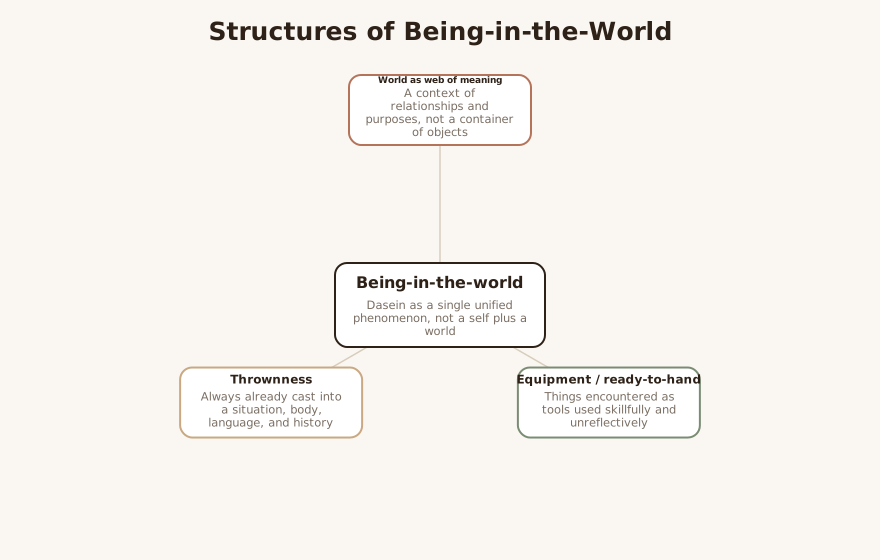
The hyphenated phrase being-in-the-world is deliberate: Heidegger uses the hyphens to insist that human existence is a single unified phenomenon, not a self plus a world that happen to be in contact 6. There is no “subject” sealed inside a mind that must then reach out to an “external” reality; Dasein is always already out there, absorbed in its world 6. This is Heidegger’s direct challenge to the Cartesian picture of a thinking thing detached from extended matter 4.
Several interlocking structures define being-in-the-world:
-
The “world” is a web of meaning and significance, not a container of objects. For Heidegger the world is the meaningful context of relationships, practices, and purposes within which things show up as mattering 5. We primarily encounter things not as inert objects we observe but as equipment — tools that are “ready-to-hand,” used skillfully and unreflectively in the course of our concerns 4.
-
Thrownness (Geworfenheit). Dasein always finds itself already thrown into a particular situation, time, body, language, and history it did not choose 4. We do not begin from a neutral vantage point; we are delivered over to a world already underway LLM.
-
Care (Sorge) and concern. Dasein’s basic mode of being is care — it is always involved with, mattering about, and projecting toward its world rather than indifferently surveying it 4.
-
Temporality. Human existence is fundamentally temporal: it is stretched between a past it has been thrown into, a present of dealings, and a future toward which it projects possibilities 2. Temporality, for Heidegger, is the very horizon within which the meaning of Being becomes intelligible 2.
-
Existence as possibility. Dasein is defined not by a fixed essence but by its possibilities — it is the being that, in its very being, “is an issue for it” and must take a stance on who it is becoming 3.
-
Authenticity and inauthenticity. Dasein can either own its existence (authenticity, Eigentlichkeit) or lose itself in the anonymous conformity of “the they” (das Man) — doing, thinking, and wanting what “one” is supposed to 4. Inauthenticity is the default, everyday condition of being absorbed and dispersed in social roles 4.
-
Being-toward-death (Sein-zum-Tode). Death is Dasein’s “ownmost” possibility — non-relational, certain, and not to be outstripped 4. Anticipating one’s mortality, rather than fleeing it, is what allows Dasein to grasp its existence as a finite whole and to live authentically 4.
-
Anxiety (Angst). Anxiety is distinguished from ordinary fear, which has a definite object; anxiety has no specific object because what it discloses is being-in-the-world as such, and one’s own freedom and finitude 4. Anxiety strips away the comfortable familiarity of the everyday and confronts Dasein with itself LLM.
Interventions & Techniques
Being-in-the-world prescribes no techniques of its own; it is philosophy, not a treatment protocol LLM. What it offers the clinician is a stance and a set of interpretive lenses that have been operationalized within existential psychotherapy and Daseinsanalysis LLM. The following are clinical applications derived from the concept, not Heideggerian doctrine LLM:
-
Phenomenological listening. Rather than immediately translating a client’s report into a diagnostic category, the clinician describes and stays with the client’s lived experience — their actual world of meanings, moods, and concerns — before interpreting 5.
-
Mapping the client’s world. Existential clinicians often explore the client’s relationships across dimensions of their world: their physical/bodily world, their world of relationships with others, their personal/psychological world, and their world of values and beliefs LLM. This is a direct application of the insight that a person is inseparable from the web of significance they inhabit 5.
-
Working with thrownness and givens. The clinician helps the client distinguish what is genuinely given and unchosen (their thrownness) from where freedom and responsibility still operate LLM.
-
Engaging mortality directly. Instead of reflexively reassuring a client away from death talk, the existential approach treats awareness of finitude as potentially clarifying and life-organizing, consistent with Heidegger’s being-toward-death 4.
-
Addressing authenticity. Therapeutic conversation can surface where a client is living according to “the they” — others’ expectations and borrowed scripts — versus owning their own possibilities 4.
-
Reframing anxiety. Existential anxiety can be reframed not as pure pathology to eliminate but, in part, as a signal of confronting freedom, choice, and finitude 4.
LLM-generated illustrative example (not a guideline): A 58-year-old client says, “Since the diagnosis, nothing feels real — I’m just going through the motions.” Rather than moving immediately to symptom-checklists, the clinician might explore how the client’s familiar world has lost its taken-for-granted solidity (an experience resonant with Heideggerian anxiety), and gently invite reflection on which projects and relationships now matter most given a foreshortened future LLM.
Evidence Base
The maturity of the concept must be assessed on two distinct axes LLM. As a work of philosophy, Being and Time is established and canonical — it is consistently described as among the most important and influential philosophical works of the twentieth century, and it has shaped existentialism, hermeneutics, deconstruction, and much of continental thought 1. Its standing within philosophy is not in dispute, even as its interpretation remains contested and the book itself was left unfinished 2.
As a basis for clinical practice, the picture is different and more modest LLM. Being-in-the-world informs existential psychotherapy and Daseinsanalysis, but these are humanistic-philosophical approaches whose evidence base in terms of randomized controlled trials is thinner than that of, for example, cognitive-behavioral therapy LLM. Clinicians should be candid with clients and themselves: the philosophical concept is rigorous and durable, but its translation into measurable clinical outcomes rests largely on the broader existential-humanistic tradition rather than on Heidegger’s text supplying validated procedures LLM. Heidegger himself offered an ontological description of human existence, not therapeutic claims 4.
It is also worth noting honestly that Heidegger’s personal and political history — including his involvement with National Socialism — is a serious matter that the philosophical literature does not ignore, and clinicians drawing on his ideas should be aware of it 4.
Populations & Indications
The concept is most clinically apt with adults whose presenting difficulties have an existential dimension rather than (or alongside) a purely symptomatic one LLM. Indicated populations include adults in existential distress, people facing mortality or terminal illness, bereaved individuals, those experiencing meaninglessness and emptiness, clients already engaged in existential psychotherapy, and individuals navigating identity crises LLM. The framework is especially resonant when a client’s suffering centers on the “givens” of existence — finitude, freedom, isolation, and meaning — which map onto Heideggerian themes of being-toward-death, possibility, and being-with-others 4.
It is well suited to clients who experience their problem not as a discrete malfunction but as a disturbance in how they inhabit their whole world — a loss of the sense that things matter, or that the future holds genuine possibility 5.
Problems-for-Work
-
Existential distress and demoralization. The framework helps name a loss of orientation in one’s world and a collapse of meaningful future possibilities, and to engage it directly rather than only medicating it 5.
-
Meaninglessness and emptiness. Heidegger’s account of the world as a web of significance offers a way to explore where and how significance has drained out of a client’s world, and where it might be rebuilt through engaged concern 5.
-
Death anxiety. Being-toward-death reframes the work as helping the client face finitude as a structural feature of existence rather than a problem to be argued away 4.
-
Grief. Bereavement can be understood as a rupture in the client’s being-with-others and a disturbance of the shared world they inhabited; the temporal structure of existence helps explain why the past and future both feel altered 2.
-
Identity disturbance and identity crises. The authentic/inauthentic distinction and the idea of existence-as-possibility give language to the experience of living someone else’s life or losing a sense of who one is becoming 4.
-
Alienation and isolation. “The they” and the analysis of being-with help articulate the difference between genuine connection and the lonely conformity of everyday social existence 4.
-
Anxiety. The distinction between fear (object-directed) and anxiety (disclosing existence itself) helps clinicians and clients understand free-floating dread that lacks an identifiable cause 4.
LLM-generated illustrative example (not a guideline): A 34-year-old reports that, after leaving a career chosen entirely to satisfy their parents, they feel “untethered.” A clinician might frame the untethering as the unsettling but potentially generative disclosure that accompanies stepping out of “the they” — and use it to explore which possibilities are genuinely the client’s own LLM.
Contraindications, Cautions & Cultural Humility
Because being-in-the-world is a philosophy and not a treatment, the cautions concern its application LLM. Existential exploration of mortality, freedom, and meaninglessness can be destabilizing and is generally not the first move for clients in acute crisis, active psychosis, or at imminent risk; safety, stabilization, and evidence-based first-line treatments take priority LLM. Heidegger’s analysis of anxiety as disclosive should never be used to minimize or romanticize clinically significant anxiety or depression that requires direct intervention LLM.
Conceptual humility is also warranted: Heidegger’s analysis emerged from a specific European intellectual and historical context, and its notions of authenticity and “the they” can be misapplied in ways that pathologize culturally embedded interdependence, collectivist values, or religious frameworks of meaning LLM. Clinicians should hold the framework lightly, privilege the client’s own description of their world, and avoid imposing an individualistic ideal of “authenticity” as a therapeutic goal 5. The therapist’s task is to illuminate the client’s world, not to recruit the client into a philosophy LLM. Finally, the language of Being and Time is famously dense and easily mystified; using opaque jargon with clients is itself a clinical error LLM.
Treatment-Plan Suggestions & SMART Objectives
The following are illustrative; being-in-the-world is not itself a billable, standalone therapy, so objectives are written to be delivered within a recognized modality LLM.
| Goal | SMART objective (example) | Mechanism |
|---|---|---|
| Reduce existential distress | Within 8 sessions, client will identify and describe 3 domains of their “world” (relationships, body, values) where meaning has diminished, rated weekly | Phenomenological mapping of being-in-the-world 5 |
| Engage death anxiety adaptively | Over 6 sessions, client will tolerate one structured conversation about mortality per session without escalating distress (self-rated SUDS reduction of 2 points) | Being-toward-death as clarifying rather than only threatening 4 |
| Restore sense of possibility | Within 10 sessions, client will articulate and take one concrete action toward a self-chosen future possibility | Existence-as-possibility; projecting toward the future 3 |
| Differentiate chosen vs. unchosen | Within 5 sessions, client will list 5 “givens” (thrownness) vs. 5 areas of genuine choice | Thrownness vs. freedom/responsibility 4 |
| Reduce alienation | Over 8 sessions, client will identify 2 relationships of authentic connection vs. conformity to “the they” and act to strengthen one | Being-with vs. anonymous social existence 4 |
| Process grief | Within 12 sessions, client will narrate how the loss altered their past, present, and anticipated future in their own words | Temporality as structure of existence 2 |
| Clarify identity | Within 8 sessions, client will describe 3 values they own versus inherit, with one behavioral commitment | Authenticity; owning one’s possibilities 4 |
Common Misconceptions
-
“Being-in-the-world means being physically located in a place.” No — Heidegger’s “world” is a web of meaning and significance, and the “in” denotes involvement and dwelling, not spatial containment like water in a glass 6.
-
“Dasein is just a fancy word for the conscious mind or the ego.” Dasein is not a mind or a subject; it is the human way of existing that is always already engaged in a world, prior to the split between subject and object 4.
-
“Authenticity means being your spontaneous true self / doing whatever you feel.” Authenticity is owning one’s finite, thrown existence and one’s possibilities; it is not self-expression, and inauthenticity is not moral failure but the ordinary everyday condition 4.
-
“Being-toward-death is morbid preoccupation.” It is a structural feature of existence whose authentic acknowledgment is meant to clarify and integrate life, not to fixate on dying 4.
-
“It’s an off-the-shelf therapy with techniques.” It is fundamental ontology; clinical methods come from existential psychotherapy and Daseinsanalysis that build on it LLM.
Training & Certification
There is no certification in “being-in-the-world” as such; it is studied as philosophy LLM. Clinicians wishing to apply it competently typically pursue training in existential and existential-phenomenological psychotherapy, or in Daseinsanalysis, through specialist institutes, supervised practice, and supervision rather than through a single credential LLM. Primary engagement with the source material — Being and Time — alongside reputable secondary scholarship is the foundation, given how easily the concepts are distorted in summary 1. The Stanford Encyclopedia of Philosophy entry is a rigorous starting point for the philosophy, and accessible explainers can scaffold the dense primary text 4.
Key Terms
- Dasein — Heidegger’s term for the human mode of being, literally “being-there/here”; the being for whom its own existence is a question 3.
- Being-in-the-world (In-der-Welt-sein) — the unified basic constitution of Dasein as always already engaged in a meaningful world 5.
- Thrownness (Geworfenheit) — finding oneself already delivered into a situation, history, and body one did not choose 4.
- Care (Sorge) — Dasein’s basic structure of mattering about and being involved with its world 4.
- The they (das Man) — the anonymous social “one” whose norms govern everyday inauthentic existence 4.
- Authenticity (Eigentlichkeit) — owning one’s existence and possibilities rather than losing oneself in “the they” 4.
- Being-toward-death (Sein-zum-Tode) — Dasein’s relation to its ownmost, certain, non-relational possibility 4.
- Anxiety (Angst) — objectless mood that discloses being-in-the-world, freedom, and finitude 4.
- Temporality — the past-present-future structure that constitutes the meaning of Dasein’s being 2.
- Ready-to-hand — the mode in which things show up as usable equipment within engaged activity 4.
Resources & Further Reading
▶ Watch — a video introduction to this concept:
- Being and Time (Sein und Zeit), 1927 — Wikipedia
- Being and Time — Encyclopaedia Britannica
- Dasein — Encyclopaedia Britannica
- Martin Heidegger — Stanford Encyclopedia of Philosophy
- Being-in-the-World — Dasein Foundation
- What Heidegger Means by Being-in-the-World — royby.com
Reflective / Supervision Questions
- When a client describes their distress, do I first translate it into a diagnosis, or do I let their lived world show itself before interpreting? 5
- Where in my caseload am I reflexively steering clients away from talk of death, freedom, or meaninglessness because it unsettles me? 4
- Am I holding “authenticity” as a culturally neutral goal, and could that be imposing an individualistic value on a client whose meaning is relational or communal? LLM
- Can I distinguish, with this client, what is genuinely given (thrownness) from where freedom and responsibility remain? 4
- Am I using existential concepts to deepen the work, or to intellectualize and avoid the client’s raw affect? LLM
- For this client, is existential exploration appropriate now, or do safety, stabilization, and first-line evidence-based treatment take priority? LLM