
Type & Discipline
Kierkegaardian anxiety and the leap of faith are not a treatment modality but a cluster of philosophical concepts from nineteenth-century Western philosophy 1. They belong to the family of existentialism, and Søren Kierkegaard is widely regarded as a proto-existentialist whose analyses of anxiety, despair, and authentic choice prefigured twentieth-century existential thought 1. The central texts are The Concept of Anxiety (1844) and The Sickness unto Death (1849), both published under pseudonyms as part of Kierkegaard’s program of “indirect communication” 23. For clinicians, the value of this material is not a protocol but a vocabulary and a conceptual lens that reframes certain forms of suffering as features of human freedom rather than purely as pathology LLM.
This article treats the concepts as a philosophical scaffold that informs existential and meaning-centered practice, not as an evidence-based intervention in its own right LLM. The distinction matters clinically because it shapes both how the ideas are introduced to clients and how their effects can honestly be claimed LLM.
Creators & Lineage
Søren Kierkegaard (1813–1855), a Danish philosopher and theologian, is the sole originator of these concepts 1. He developed his psychology of anxiety under the pseudonym Vigilius Haufniensis, glossed as “the Watchman of Copenhagen,” and his analysis of despair under the pseudonym Anti-Climacus 23. Kierkegaard used pseudonyms not to conceal authorship but to present distinct life-views that readers might recognize in themselves and be transformed by, rather than merely assent to as doctrine 1.
The downstream lineage is substantial. Kierkegaard’s account of anxiety and freedom fed directly into phenomenology and Heideggerian philosophy, and through them into existential psychotherapy and Frankl’s logotherapy 1. Sartre later reformulated Kierkegaard’s vertigo of possibility as consciousness “frightened by its own spontaneity,” carrying the structure of anxiety-as-freedom into mid-century existentialism 6. The American existential-humanistic tradition, including Rollo May, explicitly drew on Kierkegaard’s claim that learning to be anxious rightly is “the most important thing” 2. These related traditions—existential psychotherapy, logotherapy, phenomenology, and Heideggerian philosophy—are where the concepts most directly touch clinical work 1.
Core Principles
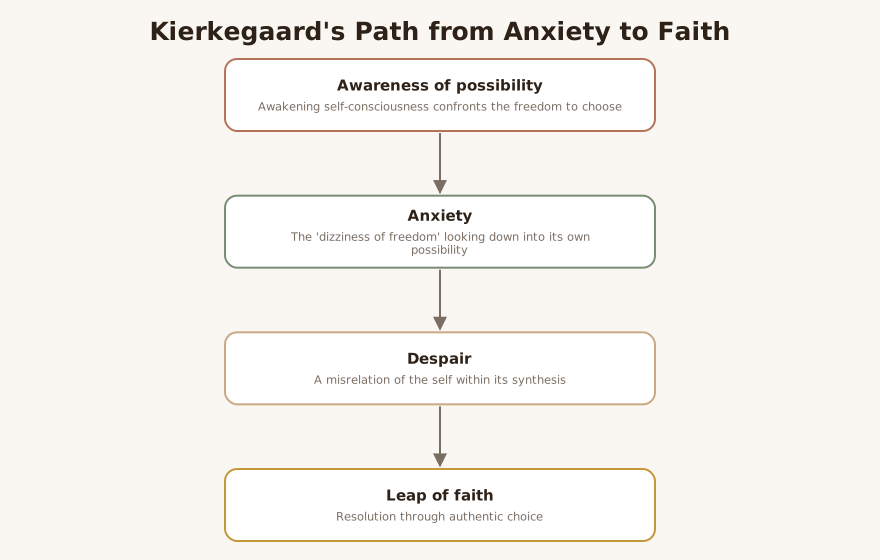
The first principle is the distinction between anxiety and fear. Fear has a definite object—a threat one can name and, in principle, avoid—whereas anxiety (Danish angest) is objectless, arising from within rather than from an external danger 57. Anxiety, in Kierkegaard’s famous phrase, is “the dizziness of freedom, which emerges when the spirit wants to posit the synthesis and freedom looks down into its own possibility” 1. It is the vertigo we feel not because of the cliff edge but because we are aware we are free to jump 6.
The second principle is that anxiety is constitutive of being human, not merely a symptom 2. Anxiety accompanies the awakening of self-consciousness: as we become aware of our capacity to choose, we confront “the alarming possibility of being able” to direct our lives in countless directions 5. Kierkegaard frames the human being as a synthesis of the infinite and finite, the temporal and eternal, freedom and necessity, and anxiety registers the tension within that synthesis 6. Crucially, this means anxiety can be redemptive: “anxiety about sin produces sin,” yet learning to be anxious in the right way is itself a spiritual advance 2.
The third principle concerns despair. In The Sickness unto Death, the self is defined as “a relation that relates itself to itself”—a self that cannot ground itself but must rest in the power that established it 13. Despair is the misrelation of this self: a failure to synthesize finitude and infinitude, or possibility and necessity 1. Despair appears in distinct forms—the despair of not wanting to be oneself (weakness) and the despair of defiantly wanting to be oneself apart from any grounding (defiance)—and, in Kierkegaard’s view, it is universal, often unconscious 3. Its opposite is not happiness but faith, the state in which “the self rests transparently in the power that established it” 3.
The fourth principle is the response: authentic choice and the leap of faith. Because reflection has an “inner infinity” and can continue indefinitely without resolving, no amount of reasoning delivers commitment 1. Faith requires a leap—an act of will that halts reflection and identifies with a possibility 1. Kierkegaard maps this onto stages or spheres of existence—the aesthetic, the ethical, and the religious—through which a person may move toward fuller selfhood 1.
Interventions & Techniques
Kierkegaard wrote no techniques, so what follows are clinical translations of his concepts as used within existential and meaning-centered practice LLM. The first is normalizing and reframing anxiety: helping a client distinguish objectless existential anxiety from object-specific fear, and reframing the former as a signal of freedom and possibility rather than a defect to be eliminated 57. This does not replace symptom-focused care for an anxiety disorder; it runs alongside it where the anxiety is bound up with choice, meaning, or identity LLM.
A second technique is working at the cliff edge of possibility—inviting the client to notice the vertigo that accompanies genuinely open choices, and to tolerate it rather than collapse it prematurely by “grasping at finiteness” 56. Kierkegaard observed that we often retreat into the illusion of a fixed, unchangeable world for temporary relief, at the cost of growth 5. Naming that retreat can itself be clinically useful LLM.
A third is choosing despair, drawn from the ethical sphere—helping a client recognize that a current life-view cannot support the self they are becoming, and consciously “choosing choice itself” rather than drifting 1. A fourth is supporting the leap: where a client has reflected endlessly without committing, the work is to recognize that reflection alone will not decide, and to support an act of commitment the client owns 1. Finally, for clients exploring spirituality or meaning, the framework offers a way to explore faith, surrender, and resting in something larger without imposing a particular creed LLM.
LLM-generated illustrative example (not a guideline): A 26-year-old presents with paralyzing indecision about leaving a stable career. Rather than treating the “anxiety” as a target to suppress, the clinician names the vertigo as the dizziness of freedom—evidence that the choice is genuinely the client’s to make. The work shifts from “how do I stop feeling anxious?” to “what would it mean to own this choice?” LLM.
Evidence Base
Honesty about maturity is essential here. As a philosophical concept, Kierkegaardian anxiety is established—it is canonical in the history of Western philosophy and is a documented historical foundation of existential psychotherapy, logotherapy, and phenomenology 14. The Marquette doctoral analysis of The Concept of Anxiety and The Sickness unto Death exemplifies the mature scholarly literature interpreting these texts 4.
What “established” does not mean is that “Kierkegaardian anxiety” is a validated treatment LLM. There is essentially no direct outcome evidence for it as an intervention, because it is not a manualized protocol with defined procedures and endpoints LLM. Any empirical signal lives downstream, in the existential, humanistic, and meaning-centered therapies the concept helped seed—and even that body of evidence is modest rather than robust LLM. Clinicians should therefore present these ideas as a conceptual lens and a source of therapeutic stance, not cite Kierkegaard as if he validated an outcome LLM. Where measurable change is needed, it should be tracked through the established modality within which the concepts are deployed LLM.
Populations & Indications
The framework is most apt for adults and emerging adults confronting open futures and the weight of self-determination; the emphasis on possibility resonates particularly with young adults navigating identity and direction 7. It speaks directly to people facing an existential crisis, where the presenting distress is bound up with freedom, choice, and responsibility rather than a discrete threat 5. People with chronic illness and those at end of life often face the synthesis of finitude and infinitude that Kierkegaard describes, making the despair framework relevant to demoralization and loss of future 3LLM. Clients exploring spirituality or meaning find in the leap of faith a non-dogmatic structure for examining surrender, trust, and grounding 1LLM.
The lens is indicated when anxiety is objectless and tied to possibility, when despair shows up as a quiet misrelation to oneself, and when a client is stalled at the threshold of a meaningful choice 16. It is less indicated as a stand-alone response to acute, object-specific, or biologically driven symptom presentations LLM.
Problems-for-Work
Existential anxiety and fear of freedom and responsibility. When a client’s distress is the vertigo of open possibility, naming it as the dizziness of freedom can shift the work from suppression to ownership 15.
Crisis of meaning and demoralization. The despair framework helps articulate a misrelation of the self—a sense of being unable to become who one is—rather than reducing it to low mood alone 3LLM.
Decision-making difficulties. Kierkegaard’s observation that reflection has an inner infinity and never decides on its own gives language to chronic indecision and supports a move toward committed choice 1.
Identity disturbance. The stages of existence offer a developmental map for a client whose current life-view no longer fits, framing the felt instability as a transition rather than a failure 1LLM.
Despair and depression. Distinguishing despair as a misrelation of the self from a purely affective or biological depression can sharpen formulation, while never substituting for appropriate treatment of a mood disorder 3LLM.
Spiritual or religious problems. The leap of faith provides a structure to explore trust, surrender, and grounding without prescribing a particular belief 1LLM.
Contraindications, Cautions & Cultural Humility
The chief caution is misapplication to acute risk. Kierkegaard’s cliff-edge image is a metaphor for freedom, but a client who literally lacks a “psychological guard rail” against self-destruction requires safety assessment and standard crisis care, not philosophical reframing 6LLM. Reframing anxiety as “freedom” is contraindicated as a first move with acute panic, trauma activation, or biologically driven symptoms, where it can feel dismissive or invalidating LLM.
A second caution is the explicitly Christian and theistic frame of the original texts: the resolution of despair through resting in “the power that established it” is religious in Kierkegaard’s hands 3. Imposing this on a client who does not share it would breach cultural and spiritual humility LLM. The concepts can be offered in secular form—possibility, choice, responsibility, grounding—when the theological frame is not shared LLM. Clinicians should also be alert to the individualistic emphasis on personal freedom, which may not map cleanly onto collectivist or relational frameworks of self, and should adapt language accordingly LLM. Finally, because none of this is an outcome-validated treatment, it should supplement rather than replace evidence-based care for diagnosable disorders LLM.
Treatment-Plan Suggestions & SMART Objectives
| Goal | SMART objective (example) | Mechanism |
|---|---|---|
| Reduce avoidance of existential anxiety | Within 8 weeks, client will identify and tolerate two objectless-anxiety episodes per week without avoidant “grasping at finiteness,” logging each 5 | Distinguishing anxiety from fear reframes vertigo as a signal of freedom rather than a defect 7 |
| Increase capacity for committed choice | Over 6 sessions, client will move one stalled decision from open-ended reflection to a chosen, owned next step 1 | Recognizing reflection’s “inner infinity” supports a deliberate leap into commitment 1 |
| Address crisis of meaning | Within 10 weeks, client will articulate two sources of meaning that survive their current life-circumstances, rated weekly LLM | Naming despair as a misrelation of the self reorients work toward grounding rather than mood alone 3 |
| Strengthen self-relation in despair | Over 12 weeks, client will describe their sense of self without defiance or weakness in two journal entries per week 3 | The self as “a relation that relates itself to itself” frames despair as workable misrelation 1 |
| Reduce decision paralysis | Within 4 weeks, client will set and hold one self-chosen boundary tied to a valued direction LLM | “Choosing choice itself” converts drift into ethical self-authorship 1 |
| Explore spirituality or meaning safely | Over 8 sessions, client will examine one experience of trust or surrender without adopting any imposed creed LLM | The leap of faith offers a non-dogmatic structure for grounding 1 |
| Normalize anxiety in emerging adulthood | Within 6 weeks, client will reframe one “what if I fail” worry as a possibility of freedom, weekly 7 | Possibility-focused reframing reduces shame about developmental uncertainty 5 |
Common Misconceptions
A first misconception is that Kierkegaard equated anxiety with a disorder to be eliminated; in fact he treats anxiety as constitutive of human freedom and potentially redemptive, such that learning to be anxious rightly is an advance, not a symptom cleared 25. A second is that anxiety and fear are interchangeable; Kierkegaard’s distinction—anxiety is objectless and inward, fear has a definite object—is central and is lost if the terms are merged 57. A third is that the “leap of faith” means an irrational gamble; it is better understood as an act of will that ends interminable reflection and commits, given that reasoning alone cannot deliver commitment 1. A fourth is that despair means feeling sad; for Kierkegaard despair is a structural misrelation of the self that is often unconscious and can coexist with apparent contentment 3. A fifth is treating these concepts as a stand-alone therapy with proven outcomes, when they are a philosophical foundation rather than a validated protocol 4LLM.
Training & Certification
There is no certification in “Kierkegaardian anxiety,” because it is a philosophical concept rather than a credentialed modality LLM. Clinicians typically encounter it through training in existential psychotherapy, logotherapy, or existential-humanistic approaches, within which Kierkegaard is studied as a foundational source 1. Direct engagement with the primary texts—The Concept of Anxiety and The Sickness unto Death—and with reputable secondary scholarship deepens fluency 234. The Stanford Encyclopedia entry is a rigorous starting point for the conceptual map, and scholarly commentaries support careful reading of the pseudonymous works 18.
Key Terms
Anxiety (angest): Objectless dread arising from awareness of freedom and possibility; “the dizziness of freedom” 15. Fear: Distress directed at a definite, nameable object, distinct from anxiety 7. The dizziness of freedom: Kierkegaard’s image for the vertigo felt when freedom looks into its own possibility 1. Despair: A misrelation of the self to itself; the “sickness unto death,” often unconscious and held to be universal 3. The self: “A relation that relates itself to itself,” which must rest in the power that established it 13. Leap of faith: An act of will that halts endless reflection and commits to a possibility 1. Stages/spheres of existence: The aesthetic, ethical, and religious modes of life through which selfhood may deepen 1. Indirect communication: Kierkegaard’s pseudonymous method of presenting life-views for recognition rather than doctrinal assent 1.
Resources & Further Reading
▶ Watch — a video introduction to this concept:
- Søren Kierkegaard — Stanford Encyclopedia of Philosophy
- The Concept of Anxiety — overview
- The Sickness unto Death — overview
- Kierkegaard on anxiety and despair (Marquette doctoral dissertation)
- Soren Kierkegaard and The Psychology of Anxiety — Academy of Ideas
- What Is Anxiety to Soren Kierkegaard? — The Collector
- Kierkegaard: Young, Free & Anxious — Philosophy Now
- D. Anthony Storm’s Commentary on The Concept of Anxiety
Reflective / Supervision Questions
- With a given client, can I distinguish objectless existential anxiety from object-specific fear, and does that distinction change my formulation? 7
- Am I treating a client’s anxiety as a defect to suppress, or am I able to hold it as a possible signal of freedom—and is that reframe appropriate for this presentation? 5LLM
- Where a client is stalled in endless reflection, am I supporting an owned commitment, or am I inadvertently extending the deliberation? 1
- When despair presents, am I attending to a possible misrelation of the self, while still ensuring proper treatment of any mood disorder? 3LLM
- Am I imposing the theistic frame of these texts, or offering the concepts in a form that respects the client’s own beliefs and cultural context? 3LLM
- Have I been honest with myself and my client that this is a philosophical lens, not a validated treatment, and have I paired it with appropriate evidence-based care? 4LLM