
Type & Discipline
Authenticity and bad faith are concepts from Western philosophy, specifically the existentialist tradition associated with Jean-Paul Sartre. 2 They are not a therapy, a diagnosis, or a manualized intervention; they are an account of the human condition that has been taken up by existential and humanistic psychotherapy as a lens for understanding self-deception, avoidance, and the struggle to live a chosen life. LLM The ideas are articulated most fully in Sartre’s 1943 treatise Being and Nothingness, a work of phenomenological ontology examining consciousness, freedom, and self-deception. 4 For clinicians, the value is conceptual rather than procedural: these terms name patterns therapists already see — clients who experience themselves as trapped by a role, an identity, or a circumstance they are in fact actively maintaining. LLM
Creators & Lineage
The framework is Sartre’s, developed in Being and Nothingness (1943), which is often treated as the central text of existentialism. 5 Sartre’s collaborator Simone de Beauvoir extended the analysis of bad faith, describing characteristic forms such as the Narcissist who denies freedom through being desired, the Woman in Love who submerges her identity in another, and the “Serious Man” who subordinates himself to an external cause. 3 The lineage that matters clinically runs from existential philosophy into existential psychotherapy, and shares family resemblances with humanistic therapy and with Frankl’s logotherapy, all of which place freedom, responsibility, and meaning-making at the center of the work. LLM Sartre’s project was explicitly humanistic — the conviction that “man is nothing else but what he makes of himself” and that we alone create meaning in an indifferent universe. 6
Core Principles
The foundational claim is existence precedes essence: human beings have no predetermined nature or fixed purpose, unlike a manufactured object made for a function. 1 We first exist, and then define ourselves through our choices and actions. 6 Consciousness is described as being-for-itself (être-pour-soi) — a being characterized by a lack of identity with itself, constantly transcending what it is — as distinct from being-in-itself (être-en-soi), the mode of objects, which simply are, fully determinate and without freedom. 1 Sartre’s paradoxical formula is that the for-itself “is what it is not and is not what it is.” 2
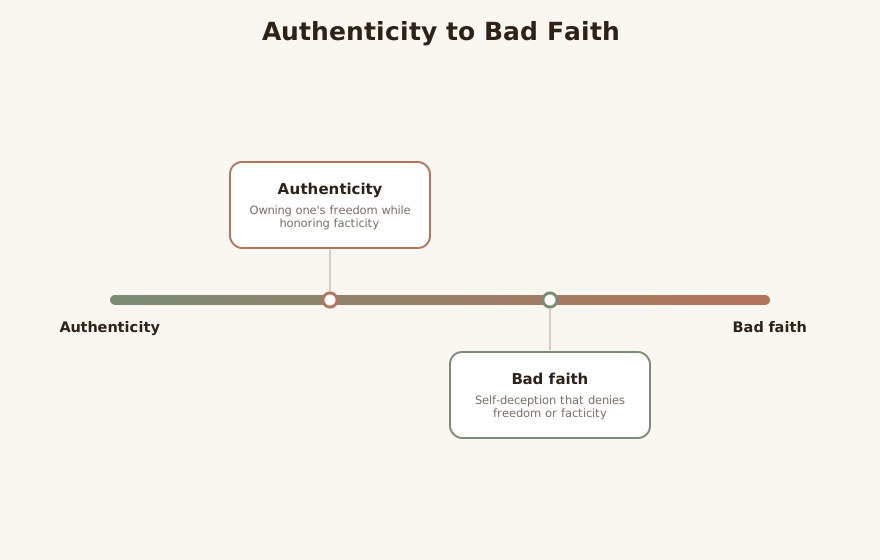
From this follows radical freedom: humans are “condemned to be free,” unable to escape choosing their responses, and therefore fully responsible — Sartre holds that we are “without excuses,” even for our emotional states. 1 This freedom is not unconstrained spontaneity; it operates within facticity, the given circumstances of body, history, and situation, which constrain choice without determining it. 1 Authenticity, accordingly, means choosing in a way that honors both poles of the for-itself: acknowledging freedom while respecting facticity, rather than privileging one and disowning the other. 1
Bad faith (mauvaise foi) is the self-deception by which a person flees freedom — either by treating oneself as a fixed thing (denying transcendence) or by pretending one’s situation does not constrain at all (denying facticity). 3 Its structure is paradoxical: the person must simultaneously know and not know, using their freedom to deny that very freedom. 3 Finally, there is being-for-others: under the gaze of another — Sartre’s image of being caught peeping through a keyhole — one is suddenly objectified and feels shame, which makes intersubjectivity fundamentally fraught. 2
Interventions & Techniques
Because this is a philosophy rather than a protocol, “techniques” are better understood as therapeutic stances and lines of inquiry derived from the concepts. LLM The first is detecting bad faith: helping the client notice when “I can’t” or “that’s just who I am” is functioning to disown a choice they are in fact making. 3 Sartre’s own examples are useful teaching tools — the café waiter whose movements are “a little too precise,” playing at being a waiter as if his nature were fixed; the woman on a date who lets her hand rest “neither consenting nor resisting — a thing” so as to defer the choice she must make; and the claim “I cannot risk my life because I must support my family,” which converts a value-laden choice into an apparent external necessity. 3
A second stance is restoring authorship: returning responsibility to the client without blame, reframing felt necessities (“I have to”) as choices with reasons (“I am choosing this, for these reasons”). LLM A third is holding facticity and transcendence together — validating real constraints (illness, history, circumstance) while keeping alive the space of response, so the work neither minimizes hardship nor collapses into “you chose your suffering.” 1 A fourth is working with the anguish, abandonment, and despair that accompany recognizing one’s freedom: the anxiety that nothing external constrains the choice, that no authority guarantees the right answer, and that one controls one’s actions but not outcomes. 6
LLM-generated illustrative example (not a guideline): A client says, “I can’t leave this job, I’m just not the kind of person who takes risks.” The clinician gently reflects the bad-faith structure — “you’re describing yourself as a fixed thing, but staying is also a choice you’re making each day” — then holds the facticity (“and the mortgage and your kids are real”) alongside the transcendence (“and within that, what would owning the choice look like?”). LLM
Evidence Base
The honest framing for clinicians: as a body of philosophy, this material is established — it is canonical, heavily commented, and central to twentieth-century thought. 5 As a treatment, it is not an evidence-based protocol; there are no randomized controlled trials of “Sartrean authenticity therapy,” and the concepts function as theory rather than as an empirically validated intervention. LLM What carries empirical weight is the broader family these ideas inform — existential and humanistic psychotherapies — and even there the evidence is more modest and less RCT-dense than for, say, cognitive-behavioral approaches. LLM Sartre himself acknowledged that authenticity is possible but struggled to build a workable ethics from it, partly because his account makes interpersonal relations inherently conflictual (“Hell is other people”). 5 The Stanford entry notes a further tension: because consciousness cannot coincide with itself, a project of perfect “sincerity” is impossible, so authenticity is better treated as a regulative value and a discernible direction of travel than as a stable achieved state. 2 Clinicians should therefore present these ideas as a meaning-making framework, not as a claim of clinical efficacy. LLM
Populations & Indications
The concepts map most naturally onto adults capable of abstract, reflective conversation, and onto existential therapy clients who present with concerns about freedom, choice, and meaning rather than discrete symptom clusters. LLM They are especially apt for people in life transitions — career change, divorce, retirement, becoming a parent — where identity is in flux and “who I am” is genuinely up for renegotiation. LLM They resonate for individuals facing mortality, where the finitude of facticity throws the question of how to live into relief, and for people seeking meaning who feel their lives are unauthored or borrowed. LLM The framework treats freedom and responsibility as universal features of consciousness, so the lens is broadly applicable, but its delivery requires verbal, psychologically minded clients who can tolerate ambiguity. 1
Problems-for-Work
- Existential anxiety and anguish: normalize anxiety as the felt texture of freedom — the recognition that nothing external dictates the choice — rather than as a symptom to be eliminated. 6
- Self-deception and avoidance: name bad-faith maneuvers in vivo, where “I can’t” disguises “I won’t” or “I’m choosing not to.” 3
- Identity confusion: use “existence precedes essence” to loosen a frozen self-concept, treating identity as something enacted through choices rather than discovered. 1
- Meaning and purpose problems / demoralization: locate the source of meaning in the client’s own projects and committed action rather than in an external guarantor. 6
- Decision-making difficulties: reframe paralysis as the deferral the woman-on-a-date example illustrates — keeping oneself a passive “thing” to avoid authoring the decision. 3
- Depression, life dissatisfaction, and “stuckness”: explore where the person has institutionalized themselves as a fixed object and lost contact with transcendence and possibility. 1
LLM-generated illustrative example (not a guideline): A demoralized client reports that “nothing matters.” Rather than disputing the belief, the clinician works existentially: meaning is not found pre-made in the universe but created through engaged, chosen projects, so the question becomes “what would you commit to, knowing no one hands you the answer?” 6LLM
Contraindications, Cautions & Cultural Humility
The strongest caution is iatrogenic misuse: pushed clumsily, “you are radically responsible” and “you are always choosing” can shade into blaming clients for trauma, oppression, poverty, illness, or abuse. LLM Sartre’s own concept of facticity is the corrective — freedom operates within real constraints that limit options, and authenticity requires respecting facticity rather than pretending circumstances do not bind. 1 Clinicians must hold structural and historical reality (racism, economic precarity, disability) as genuine facticity, not as excuses to be dissolved, which matters acutely for cultural humility with clients whose constraints are externally imposed and unchosen. LLM
The framework is also a poor fit, or requires heavy adaptation, for clients in acute crisis, active psychosis, or severe cognitive impairment, where abstract reflection on freedom is destabilizing rather than clarifying. LLM It carries a Western, individualist emphasis on personal authorship that may not align with collectivist value systems where identity is relationally and communally constituted; therapists should adapt the language rather than impose it. LLM Finally, the relentless focus on freedom can become its own bad faith if it denies the weight of facticity, so the clinician’s task is to keep both poles in view. 1
Treatment-Plan Suggestions & SMART Objectives
| Goal | SMART objective (example) | Mechanism |
|---|---|---|
| Reduce avoidance driven by self-deception | Within 6 weeks, client will identify and log 3 “I can’t” statements per week, reframing each as a choice with reasons, in session and via homework | Surfacing bad-faith maneuvers restores authorship of avoided choices 3 |
| Loosen a rigid, fixed self-concept | Over 8 sessions, client will articulate 2 instances where past behavior contradicts their “this is just who I am” identity, rated on a self-concept-flexibility scale | “Existence precedes essence” reframes identity as enacted, not fixed 1 |
| Tolerate decisional anxiety | Within 4 weeks, client will make and act on 1 deferred decision per week without seeking external reassurance, tracking anxiety pre/post | Anxiety reframed as the texture of freedom rather than a stop signal 6 |
| Increase value-driven engagement | Over 10 sessions, client will commit to and complete 1 self-chosen meaningful project, reviewed weekly | Meaning is created through engaged, chosen action 6 |
| Balance responsibility with facticity | By week 6, client will distinguish, for one stuck situation, what is genuine constraint vs. disowned choice, using a two-column worksheet | Coordinating facticity and transcendence prevents both blame and helplessness 1 |
| Reduce demoralization | Within 8 weeks, client will report a 2-point rise on a meaning/purpose measure after defining 1 personal source of value not dependent on external guarantee | Relocating meaning in self-authored projects counters demoralization 6 |
| Improve agency in relationships | Over 6 sessions, client will assert 1 authentic preference per week rather than performing a role, tracking outcomes | Reducing role-performance (“playing at” an identity) recovers freedom 4 |
Common Misconceptions
The most common error is equating authenticity with doing whatever you feel — unconstrained spontaneity. 1 Sartre rejects this: authentic choice must respect facticity and even carries a universal dimension, since in choosing I implicitly commit to values any other person in my situation could make sense of. 1 A second misconception is that freedom means the absence of constraints; in fact freedom is the inescapable responsibility to choose within constraints, not the ability to act without them. 1 A third is reading bad faith as ordinary lying to others, when it is specifically self-deception — knowing and not-knowing at once. 3 A fourth is assuming authenticity is a stable trait one acquires; the philosophy suggests it is never perfectly achieved, because consciousness cannot coincide with itself, making it a direction rather than a destination. 2 A fifth, clinically dangerous one is that radical responsibility means clients are to blame for everything that happens to them — facticity explicitly contradicts this. 1
Training & Certification
There is no certification in “authenticity and bad faith”; it is philosophical literacy, not a credential. LLM Clinicians who want to use it well typically pursue training in existential psychotherapy or existential-humanistic approaches and read primary and secondary sources directly. LLM A reasonable self-study path is to start with accessible overviews and then move to the primary text: Being and Nothingness itself, supported by the Stanford and Internet Encyclopedia of Philosophy entries for rigorous grounding. 21 Supervision with a clinician experienced in existential work is the most reliable way to learn to deploy these ideas without slipping into blame or abstraction. LLM
Key Terms
- Existence precedes essence: humans have no fixed nature and define themselves through choices. 1
- Bad faith (mauvaise foi): self-deception that flees freedom by treating oneself as a fixed thing or by disowning one’s situation. 3
- Authenticity: owning one’s freedom while honoring facticity — coordinating both rather than privileging one. 1
- Being-for-itself (être-pour-soi): consciousness, a lack of self-identity that perpetually transcends itself. 1
- Being-in-itself (être-en-soi): the determinate, non-conscious mode of objects. 1
- Facticity: the given circumstances — body, history, situation — that constrain choice without determining it. 1
- Transcendence: the capacity to surpass one’s situation through free choice. 1
- The Look / being-for-others: becoming an object under another’s gaze, producing shame and conflict. 2
- Anguish, abandonment, despair: the affective signatures of recognizing freedom, the absence of an external guarantor, and control over actions but not outcomes. 6
- “Condemned to be free”: Sartre’s phrase for the inescapability of choice and responsibility. 4
Resources & Further Reading
▶ Watch — a video introduction to this concept:
- Jean-Paul Sartre: Existentialism — Internet Encyclopedia of Philosophy
- Jean-Paul Sartre — Stanford Encyclopedia of Philosophy
- Bad faith (existentialism) — Wikipedia
- Being and Nothingness — Wikipedia
- Sartre’s Being and Nothingness: The Bible of Existentialism? — Philosophy Now, Issue 53
- Exploring Jean-Paul Sartre: Existence, Freedom, and the Path to Authenticity — Play For Thoughts
Reflective / Supervision Questions
- Where in my own clinical stance do I treat a client’s identity as a fixed essence rather than as something enacted and revisable? LLM
- When I invite a client to “own their choices,” am I holding facticity with equal seriousness, or am I subtly assigning blame for unchosen constraints? 1
- How do I distinguish a client’s genuine “I can’t” (real constraint) from a bad-faith “I can’t” (disowned choice), and how confident am I in that distinction? 3
- With clients from collectivist or marginalized backgrounds, am I imposing an individualist notion of authorship, or adapting the language to their relational and structural reality? LLM
- How do I tolerate the anguish these conversations surface — in the client and in myself — without rushing to resolve it? 6
- Am I presenting these ideas honestly as a meaning-making framework rather than implying clinical efficacy they have not demonstrated? LLM