
Type & Discipline
Daseinsanalysis is a phenomenological-hermeneutic psychotherapeutic approach grounded in the ontology of Martin Heidegger.1 It sits within the broader family of existential therapy and originates at the intersection of psychiatry and continental philosophy rather than within academic clinical psychology.1 Its name comes from Heidegger’s term Dasein (“being-there” or “human existence”), which it takes as the proper object of clinical understanding.2
The defining methodological commitment is captured in a single phrase: “The concern of Daseinsanalysis is to see (sehen), not to explain (erklären).”1 Where natural-science psychiatry seeks causal mechanisms, Daseinsanalysis attends to phenomena as they show themselves in the patient’s lived experience.1 It explicitly rejects natural-scientific reductionism, viewing the human being not as a closed psychic apparatus driven by instincts but as a being inherently open and related to its world.1 For the practicing clinician, this places Daseinsanalysis closer to a disciplined interpretive stance than to a manualized technique.LLM
Creators & Lineage
The approach has two principal founders. Ludwig Binswanger, working in a Swiss sanatorium in the 1920s–40s, initiated what he called a phenomenological anthropology, treating conditions such as schizophrenia and melancholia as altered modes of lived experience rather than as deficits of drive or attachment.2 Binswanger drew on both Freud and Heidegger, but his work remained largely descriptive and research-oriented.2
Medard Boss (1903–1990) transformed the project into a practical therapy.3 Boss trained in psychoanalysis with Freud in Vienna and studied under Karen Horney, Ernest Jones, and Carl Jung before Binswanger introduced him to Heidegger’s philosophy in the 1930s.3 After the Second World War, Boss began a roughly 25-year working relationship with Heidegger that produced the Zollikon Seminars, protocols of their discussions on how existential phenomenology could reshape medical and psychological practice.3 Boss founded the first systematic approach to existential psychotherapy and established the Swiss Society for Daseinsanalysis (1970) and the Zurich institute for daseinsanalytic psychotherapy (1971).3 Gion Condrau subsequently established the Zurich school and, in 1990, the International Federation of Daseinsanalysis (IFDA).1 The lineage thus runs from phenomenology and psychoanalysis, through Heidegger’s ontology, into an institutionalized clinical tradition.LLM
Core Principles
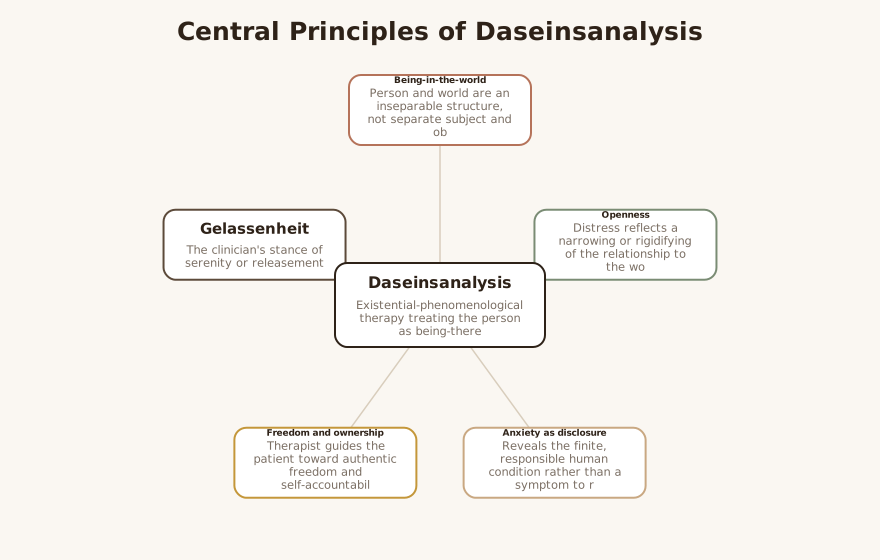
The central principle is being-in-the-world: the person and world are not separable subject and object but an inseparable structure, so experience can only be understood within its lived context.14 Boss adopted Heidegger’s rejection of Cartesian dualism, holding that Dasein “is not a self-contained subject separate from the world, but a being always already immersed in and constituted by its world.”4
A second principle is openness. Healthy existence involves a fundamental receptivity to the world, and psychological distress reflects “a narrowing or rigidification of the individual’s relationship to the world.”4 Symptoms are read as constricted relatedness rather than as encoded conflicts.4
Anxiety occupies a privileged place. Rather than a symptom to be eliminated, it can reveal the fundamental human condition — a “fear for one’s own existence” that discloses something true about being finite and responsible.1 Alongside this, the tradition emphasizes freedom and self-accountability: the therapist guides the patient toward authentic freedom and ownership of their existence.1 The clinician’s own stance is one of Gelassenheit (serenity or releasement) within a relationship understood as a primordial, mutual human encounter.1
Interventions & Techniques
Daseinsanalysis is deliberately light on technique. Therapy is conceived less as a procedure than as “a shared journey of discovery, a deeply human encounter,” in which the therapist maintains phenomenological presence and attends to each client’s unique meanings without imposing theory.4 The therapist aims for objectivity without prejudice, working toward transparency of the patient’s phenomenological world while preserving the patient’s existing structure of being.2
A signature reorientation is the shift from asking “why?” to asking “why not?”2 Rather than excavating causes, the analyst confronts the patient’s self-imposed limitations to disclose the freedom that has been foreclosed.2 This is described as an analysis of resistance directed at self-limitation rather than at repressed content.2
Dreams are handled in a way that sharply distinguishes the approach from psychoanalysis. Boss rejected the idea that dreams express repressed impulses from an unconscious “place,” understanding them instead as “coming from a person’s life as a whole.”3 Manifest dream content is treated as equally real to waking experience and explored phenomenologically, at face value, without translating it into hidden latent meaning.12
LLM-generated illustrative example (not a guideline): A client recounts a recurring dream of standing at a locked door. Rather than asking what the door “symbolizes,” a daseinsanalytic therapist might dwell with the lived quality of standing-before-a-closed-way — the felt sense of being barred, the absence of a key, the not-turning-away — and ask what kinds of doors stand closed in the client’s waking world and why the client does not open them. LLM
Evidence Base
Honesty matters here. Daseinsanalysis is established in the sense that it is a recognized, institutionalized modality with a long historical lineage, named founders, a dedicated international federation, and formal training pathways.13 It is not established in the sense of being validated by controlled outcome research.LLM
The available sources describe a philosophical and clinical tradition, not an evidence base of randomized trials, effect sizes, or comparative efficacy data.1234 Clinicians should therefore treat its empirical support as minimal and indirect: it shares conceptual ground with the broader existential-humanistic field, but its specific claims have not been subjected to the kind of trial-based scrutiny that supports, say, CBT for anxiety.LLM Practitioners drawn to it should hold its insights as a clinically rich lens and integrate it within modalities that do carry evidentiary support, rather than presenting it to clients or payers as an empirically validated stand-alone treatment.LLM
Populations & Indications
The tradition was developed in long-term psychotherapy and psychiatric settings, and it remains best suited to adults engaged in extended, insight-oriented work.23 Binswanger and Boss applied phenomenological understanding across neurotic and psychosomatic conditions, viewing them as altered modes of being-in-the-world.24
Indications most coherent with the model include existential distress; meaning and mortality crises; identity disturbance and alienation; and the diffuse anxiety that the tradition reads as disclosing the human condition.14LLM Because the approach foregrounds freedom, responsibility, and self-understanding, it fits clients in life transitions and those explicitly seeking to understand themselves rather than to reduce a discrete symptom as quickly as possible.1LLM It is, in short, indicated where the clinical question is “how am I living?” more than “how do I stop this specific behavior?”LLM
Problems-for-Work
- Existential and death anxiety. Anxiety is engaged as disclosure rather than malfunction; the work helps the client face finitude and “fear for one’s own existence” with less avoidance.1 Application: a client with health anxiety explores what mortality is asking of how they live, not only how to suppress the dread.LLM
- Meaninglessness and existential despair. The constriction of openness is examined directly, looking for where the client’s world has narrowed.4LLM
- Depression and neurotic conflict. Read as restricted modes of relatedness, these are approached by asking “why not” the foreclosed possibilities, surfacing self-imposed limits.24
- Psychosomatic complaints. Consistent with the rejection of mind-body dualism, bodily symptoms are understood within the whole person’s being-in-the-world rather than as separable somatic events.4LLM
- Identity disturbance and alienation. The work addresses the felt distance between the client and their world, restoring fundamental relatedness.4LLM
- Anxiety disorders. Symptom relief is pursued indirectly, through clarifying the existential situation the anxiety expresses.1LLM
Contraindications, Cautions & Cultural Humility
Daseinsanalysis is poorly matched to clients in acute crisis, active psychosis, or states requiring rapid stabilization, structure, or risk management, where an open-ended exploratory stance can leave urgent needs unmet.LLM Its emphasis on self-accountability and freedom must be applied with care: framed clumsily, it can slide into implying that distress is the client’s own doing, which is iatrogenic for trauma survivors and for clients whose suffering is substantially shaped by oppression, poverty, discrimination, or material constraint.LLM
This points to a real limit of the original tradition. Its founders worked in mid-twentieth-century European sanatoria and philosophy seminars, and the framework as transmitted says little about social context, power, or culture.23LLM Culturally humble practice asks whether the constriction of a client’s “world” is existential, structural, or both — and refuses to individualize what is in fact systemic.LLM The philosophical vocabulary (Dasein, Gelassenheit, authenticity) also presumes a particular intellectual register; clinicians should translate, not perform, these ideas, and should not assume every client wants meaning-level work.LLM
Treatment-Plan Suggestions & SMART Objectives
| Goal | SMART objective (example) | Mechanism |
|---|---|---|
| Reduce avoidance of existential anxiety | Within 8 sessions, client will name and stay present with 2 specific feared existential themes (e.g., mortality, freedom) for a full session without changing the subject, rated by therapist process notes | Tolerating anxiety as disclosure rather than threat; openness to lived experience1 |
| Restore openness to a narrowed world | Over 12 weeks, client will identify and re-engage 3 previously abandoned relationships or activities, tracked weekly | Reversing constriction of relatedness; widening being-in-the-world4 |
| Increase ownership of choices | By session 10, client will reframe 3 “I can’t” statements into examined “why not?” possibilities in session | Shift from causal blame to freedom and self-accountability2 |
| Integrate dream/imagery material | Across 6 sessions, client will explore 2 recurring dreams phenomenologically and link their felt qualities to waking life | Manifest experience treated at face value, no latent decoding13 |
| Address psychosomatic complaint contextually | Within 8 weeks, client will map 1 bodily symptom onto its lived situations and report any shift, alongside medical care | Understanding symptom within whole being-in-the-world4 |
| Reduce alienation/identity distress | By week 12, client will articulate a coherent first-person account of “how I am living” and 2 desired changes | Restoring fundamental relatedness and self-understanding4 |
| Build tolerance for uncertainty in transition | Over 10 sessions, client will make 2 values-anchored decisions despite incomplete certainty | Engaging freedom and finitude rather than avoiding them1 |
Common Misconceptions
- “It’s just unstructured talking.” The lack of manualized technique is principled, not careless; it reflects a disciplined commitment to seeing phenomena rather than imposing theory.14LLM
- “It’s psychoanalysis with new words.” It explicitly rejects libido, instinct, and the unconscious-as-place, and refuses latent dream interpretation in favor of manifest meaning.23
- “Dasein means the self.” Dasein is not an inner self but being-there — existence understood only as inseparable from its world.24
- “Anxiety must be eliminated.” Anxiety can be a disclosure of the human condition to be engaged, not merely a symptom to suppress.1
- “It’s empirically validated.” It is an established tradition without a controlled-trial evidence base; maturity of the lineage is not the same as proof of efficacy.LLM
Training & Certification
Training is offered through the institutional structures the tradition built: the Swiss Society for Daseinsanalysis (founded 1970) and the Zurich institute for daseinsanalytic psychotherapy (1971), with international coordination under the IFDA, founded by Gion Condrau in 1990.31 Unlike Binswanger’s earlier research-focused work, the later Swiss schools established formal professional training standards.2 Prospective practitioners should expect a depth-oriented, supervision-heavy formation grounded in Heideggerian philosophy and the Zollikon Seminars, rather than a short certificate course.13LLM In North America, formal Daseinsanalysis training is uncommon; most clinicians encounter it through existential-therapy training and the wider existential-humanistic literature.LLM
Key Terms
- Dasein — “being-there”; human existence as always already related to its world.2
- Being-in-the-world — the inseparable person–world structure that is the unit of understanding.14
- Openness — fundamental receptivity to the world; its narrowing is the form of pathology.4
- Sehen vs. erklären — to see (the phenomena) rather than to explain (by causes).1
- Gelassenheit — the therapist’s stance of serenity or releasement.1
- Care (Sorge) — a central structure of human existence in the therapeutic frame.1
- “Why not?” — the reorientation from causal inquiry to disclosing foreclosed freedom.2
- Zollikon Seminars — Boss–Heidegger protocols underpinning the clinical translation.3
Resources & Further Reading
▶ Watch — a video introduction to this concept:
- International Federation of Daseinsanalysis (IFDA) — What about Daseinsanalysis
- Daseinsanalysis — Wikipedia
- Medard Boss — Wikipedia
- Medard Boss: Pioneering Daseinsanalysis — Get Therapy Birmingham / Taproot Therapy
Reflective / Supervision Questions
- When a client describes a symptom, do I more readily ask “why does this happen?” or “what world does this open and close for this person?” — and what does my default reveal about my frame? LLM
- Where might my use of existential language (freedom, authenticity, meaning) be performing depth rather than meeting the client where they are? LLM
- How do I distinguish a constriction that is existential from one that is structural — and do I risk individualizing suffering that is rooted in oppression or material constraint? LLM
- With a client in acute risk or crisis, can I hold daseinsanalytic openness in reserve while providing the structure and stabilization that safety requires? LLM
- How do I represent this work honestly to clients and in documentation, given that it is an established tradition but not an empirically validated stand-alone treatment? LLM