
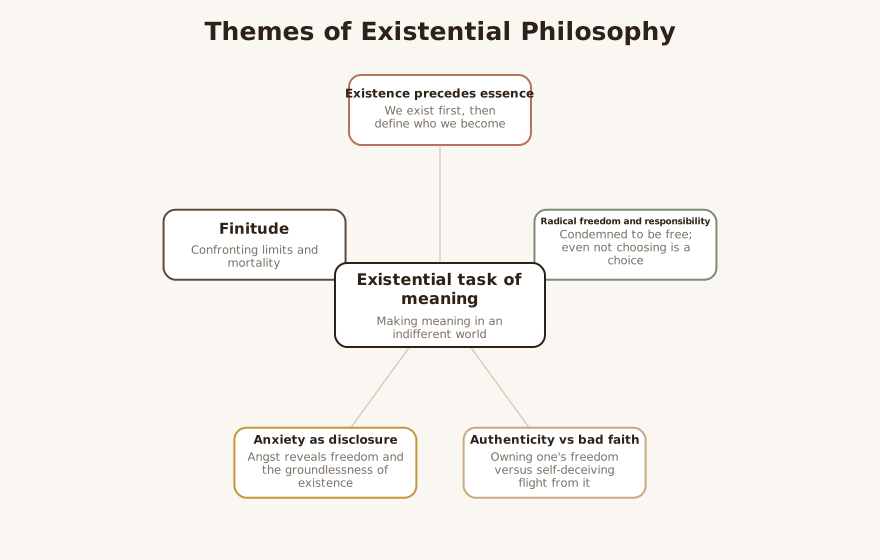
Existential philosophy is less a doctrine than a shared set of preoccupations: it begins from the lived situation of the concrete, choosing individual rather than from abstract systems or universal essences 1. For the clinician, it offers a vocabulary for the suffering that diagnostic categories often leave untouched – the dread that has no object, the sense that one’s life is not one’s own, the question of what any of it is for. This article situates the tradition, then translates it into clinical reasoning, technique, and treatment planning, while staying honest about what is philosophy and what is therapy.
Type & Discipline
Existentialism is a philosophical movement, not a psychological theory or a treatment protocol 4. Its center of gravity is the analysis of human existence – the conditions, moods, and choices of a being who must define itself rather than discover a fixed nature 1. The slogan most associated with it, Sartre’s “existence precedes essence,” captures the core inversion: there is no pre-given human essence that determines who we are, so we are what we make of ourselves through our choices 3. It is closely entangled with phenomenology, the disciplined description of experience as it is lived, which supplies existentialism much of its method 2.
Because it is philosophy, existentialism does not prescribe interventions, outcome measures, or a scope of practice LLM. Its clinical descendants – existential therapy, logotherapy, and strands of humanistic psychology – are where these ideas were operationalized into a helping relationship LLM. Keeping that distinction clear matters: a therapist works from existential philosophy, but bills, documents, and intervenes within a recognized therapeutic modality LLM.
Creators & Lineage
The tradition is usually traced to the 19th-century writers Soren Kierkegaard and Friedrich Nietzsche, who are read as its forerunners 4. Kierkegaard is frequently called the “father of existentialism” for his focus on the anxious, choosing, single individual and the “leap” of faith and commitment 5. Nietzsche contributed the diagnosis of nihilism and the demand that individuals create their own values after the collapse of inherited certainties 4.
In the 20th century the movement was developed by Martin Heidegger, whose analysis of human existence as Dasein – “being-there,” a being for whom its own being is an issue – reframed selfhood as something thrown into a world and projected toward possibilities 2. Jean-Paul Sartre, who actually embraced the label “existentialist,” gave the movement its most public form in postwar France, alongside Simone de Beauvoir and the closely allied Albert Camus 4. The phenomenology of Edmund Husserl is the methodological root from which Heidegger and later figures grew 2. The label itself was popularized in mid-20th-century France and was at times applied to thinkers who resisted it, so the boundaries of the “movement” are genuinely contested 6.
For clinicians, the relevant downstream lineage runs from these philosophers into existential-phenomenological psychotherapy, Viktor Frankl’s logotherapy, and humanistic psychology more broadly LLM. These are the bridges that carry the philosophy into the consulting room LLM.
Core Principles
Existence precedes essence. We are not born with a fixed purpose; we exist first and then, through choices and projects, define who we become 3. This places the burden – and the freedom – of self-definition on the person rather than on nature, God, or society 1.
Radical freedom and responsibility. Because there is no external script, the individual is “condemned to be free”: free in every situation and therefore responsible for what they make of it 3. Sartre treated this as inescapable, arguing that even refusing to choose is a choice 6.
Authenticity and bad faith. Authenticity is owning one’s freedom and finitude rather than fleeing them; its opposite, Sartre’s “bad faith,” is the self-deception by which we pretend we have no choice or hide behind a role 6. Heidegger frames a parallel contrast between authentic existence and absorption in “the they” (das Man), the anonymous public self that dictates what “one” does 2.
Anxiety (angst) as disclosure. Existential anxiety is not a symptom to be eliminated but a mood that reveals freedom and the groundlessness of existence; in anxiety the familiar world loses its taken-for-granted hold and the individual confronts their own possibilities 2. Kierkegaard treated this dread as intrinsic to freedom itself 5.
Finitude and being-toward-death. Heidegger argues that human existence is fundamentally finite – a “being-toward-death” – and that authentically facing mortality individualizes us and discloses what matters 2. Death is not just a future event but a structuring horizon of the present 2.
Subjectivity and the concrete individual. Against systems that dissolve the person into abstractions, the tradition insists on starting from the situated, first-person standpoint of the existing individual 1. Truth, for Kierkegaard, is approached through inward, subjective appropriation rather than detached spectatorship 5.
The absurd and meaning-making. Camus described the “absurd” as the collision between our demand for meaning and a universe that offers none, and asked how one lives without appeal to false consolations 4. The shared existential answer is that meaning is made, not found – a task rather than a given 1.
Interventions & Techniques
Existential philosophy itself contains no techniques; what follows are clinically derived moves that operationalize its themes, drawn from the helping traditions that grew out of it LLM. They are best understood as a stance and a set of conversational emphases rather than a manualized procedure LLM.
- Confronting the givens. Naming and exploring the “ultimate concerns” – death, freedom, isolation, and meaninglessness – rather than steering around them, treating these as the source of much non-pathological distress LLM. This rests on the philosophical claim that these confrontations are constitutive of human existence, not malfunctions 1.
- Reframing anxiety as disclosure. Helping a client treat existential anxiety as information about freedom and stakes rather than purely as a defect to be medicated away, consistent with the view of angst as revealing one’s possibilities 2.
- Surfacing bad faith. Gently identifying the moments where a client disowns choice (“I have no choice,” “that’s just how I am”) and re-presenting the choice as theirs, drawing on the concept of bad faith 6.
- Clarifying values and projects. Inviting the client to articulate what they are choosing to commit to, given that the self is constituted through its projects rather than discovered ready-made 1.
- Working with mortality awareness. Using the awareness of finitude as a clarifier of priorities, in line with the idea that confronting being-toward-death individualizes and orients a life 2.
LLM-generated illustrative example (not a guideline): A 52-year-old client recovering from a cardiac event says, “Since the heart attack, none of my old goals feel real.” Rather than rushing to restore the prior goal list, the clinician stays with the disclosure: “It sounds like brushing against death has made the old script feel borrowed. What feels like yours now?” The conversation moves from symptom-reduction to a re-authoring of commitments. LLM
Evidence Base
The relevant honesty here is about maturity, and the maturity is split LLM. As philosophy, existentialism is an established, canonical tradition with a large scholarly literature and standing in reference works such as the Stanford and Internet encyclopedias and Britannica 1 3 4. Its concepts – freedom, authenticity, angst, finitude – are well-developed and rigorously debated 1.
As a clinical approach, the picture is different and should not be overstated LLM. Existential philosophy is not itself an empirically validated treatment, and the provided sources are philosophical and encyclopedic rather than clinical-outcome literature LLM. Claims about efficacy belong to the descendant therapies (existential, logotherapeutic, humanistic), and even there the evidence base is generally considered less mature and less manualized than for cognitive-behavioral approaches LLM. Clinicians should therefore present existential work as a values-and-meaning framework that enriches recognized modalities, not as a proven standalone cure LLM.
Populations & Indications
The framework is most natural with adults who are articulate about and troubled by questions of meaning, freedom, and finitude, since it presupposes a capacity for reflective self-examination LLM. It is especially apt for people facing existential crises – moments when an inherited framework of meaning has collapsed – which the tradition treats as a near-universal feature of human life rather than a pathology 1.
People in major life transitions (career endings, divorce, empty nest, retirement, immigration) often present with precisely the disorientation the tradition describes as confronting one’s own undefined possibilities 2. People confronting mortality – through terminal or serious illness, aging, or near-death experience – map directly onto the theme of being-toward-death 2. Bereaved individuals frequently face not only grief but the meaning-rupture and freedom-burden of reconstructing a life, terrain the absurd-and-meaning theme speaks to directly 4.
Problems-for-Work
- Existential anxiety. Distress that has no specific object and arises from confronting freedom and groundlessness can be reframed as disclosure rather than disorder, so the work becomes building tolerance for the anxiety rather than only suppressing it 2.
- Meaninglessness. When a client reports that “nothing matters,” the absurd frame reframes the task as actively making meaning rather than waiting to find a pre-given one 4.
- Death anxiety. Heidegger’s analysis lets the clinician treat dread of mortality not as morbid rumination to be shut down but as a horizon that can clarify what the client wants their finite time to hold 2.
- Identity confusion. “I don’t know who I am” is reframed through “existence precedes essence”: identity is something to be enacted through commitments rather than uncovered 3.
- Demoralization and despair. Kierkegaard’s analysis of despair as a sickness of the self that fails to ground itself gives language for the collapse of hope distinct from a mood disorder 5.
- Authenticity struggles. When a client feels they are living someone else’s life, the authentic-versus-“the they” distinction names the problem and points toward owning one’s own choices 2.
- Freedom and responsibility conflicts. Clients who feel either paralyzed by options or trapped by circumstance can be met with the paradox that they remain responsible for their stance even when options are constrained 3.
LLM-generated illustrative example (not a guideline): A graduate student says, “I only went into law because my parents expected it – I had no choice.” The clinician reflects the bad-faith structure without shaming: “You did face real pressure. And you’re also telling me the decision was made by ‘them,’ not you. What would it mean to claim it – or to choose differently now?” The aim is not to assign blame but to restore agency. LLM
Contraindications, Cautions & Cultural Humility
Existential work presumes verbal, abstract, reflective capacity, so it is a poor primary frame in acute crisis, active psychosis, severe cognitive impairment, or when a client is too symptomatic to reflect; stabilization and safety come first LLM. Dwelling on death, freedom, and meaninglessness can intensify hopelessness in an acutely suicidal client, so mortality and meaning themes should be approached only with adequate safety scaffolding LLM. The philosophy’s emphasis on radical individual responsibility can, if handled clumsily, shade into blaming clients for circumstances shaped by trauma, poverty, racism, or illness – a real risk the clinician must actively counter LLM.
Cultural humility is essential because the tradition is largely a product of 19th- and 20th-century European thought and its individualism is not universal 4. Its stress on autonomous self-definition may not fit clients whose identity and meaning are constituted relationally, communally, or through faith and ancestry LLM. Notably, many existentialist thinkers were atheistic or framed meaning as humanly constructed, while others, beginning with Kierkegaard, were deeply religious, so the tradition is internally divided on faith and should never be imposed as secular dogma onto a client’s belief system 6. The clinician’s task is to use existential themes as questions, not as a worldview to install.
Treatment-Plan Suggestions & SMART Objectives
| Goal | SMART objective (example) | Mechanism |
|---|---|---|
| Reduce avoidance of existential anxiety | Within 8 weeks, client will name and stay with one anxiety-provoking “ultimate concern” in 3 consecutive sessions without changing the subject, rated via session notes | Treating angst as disclosure rather than defect 2 |
| Restore sense of agency | Within 6 weeks, client will identify 3 life decisions they had described as “forced” and reframe each as a choice with consequences, documented in a values worksheet | Countering bad faith; owning freedom 6 |
| Rebuild meaning after loss | Over 12 weeks, client will articulate and act on 2 self-chosen sources of meaning, with weekly behavioral logging | Meaning as made, not found 1 |
| Clarify authentic values | Within 5 sessions, client will distinguish 3 values that are genuinely their own from those adopted from “the they,” self-rated 0-10 on ownership | Authenticity vs. anonymous public self 2 |
| Use mortality awareness adaptively | Within 8 weeks, client will translate awareness of finitude into 2 concrete reprioritized commitments, tracked between sessions | Being-toward-death as clarifier 2 |
| Address despair distinct from depression | Within 6 weeks, client will identify the specific self-relation underlying their despair and one act of self-grounding, noted in session | Despair as a failure to ground the self 5 |
| Tolerate uncertainty/absurdity | Over 10 weeks, client will practice one chosen meaningful action weekly despite reporting that life “feels meaningless,” logged daily | Living amid the absurd without false consolation 4 |
Common Misconceptions
“Existentialism is just pessimism or nihilism.” The tradition diagnoses nihilism and the absurd but generally responds with a call to create meaning and value, not with surrender to despair 4. Nietzsche and Camus are concerned precisely with living after the loss of guaranteed meaning, not with celebrating its absence 4.
“It means anything goes / morality is arbitrary.” Radical freedom in Sartre’s hands comes with radical responsibility, including responsibility for the kind of world one’s choices endorse, which is the opposite of a license for caprice 3. Beauvoir and Sartre developed explicit ethical projects from these premises 6.
“Existentialism and phenomenology are the same thing.” Phenomenology is a method for describing experience; existentialism is a set of substantive claims about human existence that uses phenomenology, especially in Heidegger 2. One can do phenomenology without being an existentialist LLM.
“Heidegger was an existentialist who studied feelings about death.” Heidegger’s “being-toward-death” is an ontological analysis of the structure of human existence, not a psychology of dying or grief, and he himself kept his distance from the existentialist label 2. Borrowing the concept clinically is legitimate, but it is a translation, not a direct reading LLM.
“It’s a self-help philosophy of positive thinking.” The tradition takes anxiety, dread, and finitude seriously as permanent features of existence rather than problems to be optimized away 1.
Training & Certification
There is no certification in “existential philosophy” as a clinical credential, because it is an academic discipline rather than a regulated treatment LLM. Foundational literacy comes from primary and reference reading – the Stanford and Internet encyclopedia entries and Britannica are reliable entry points, supplemented by primary texts of Kierkegaard, Heidegger, Sartre, Beauvoir, and Camus 1 3 4. For clinicians, the practical path runs through the applied traditions: training in existential or existential-phenomenological psychotherapy, logotherapy, and humanistic/person-centered approaches, which is where supervised competency and any relevant certification reside LLM. As with any framework, supervised practice and ongoing case consultation matter more than reading alone LLM.
Key Terms
- Existence precedes essence – the thesis that humans have no fixed pre-given nature and define themselves through choices 3.
- Dasein – Heidegger’s term for human existence as a “being-there” for whom its own being is at issue 2.
- Authenticity / bad faith – owning one’s freedom and finitude versus self-deceptively denying one’s choices 6.
- The they (das Man) – the anonymous public self that dictates what “one” does, contrasted with authentic individual existence 2.
- Angst / existential anxiety – objectless dread that discloses freedom and the groundlessness of existence 2.
- Being-toward-death – the finite, mortality-structured character of human existence 2.
- The absurd – the clash between the human demand for meaning and a universe that supplies none 4.
- Despair – in Kierkegaard, a misrelation of the self to itself, deeper than ordinary sadness 5.
- Nihilism – the condition in which inherited values lose their authority, which the tradition seeks to move beyond 4.
Resources & Further Reading
▶ Watch — a video introduction to this concept:
- Existentialism — Stanford Encyclopedia of Philosophy
- Martin Heidegger — Stanford Encyclopedia of Philosophy
- Existentialism — Internet Encyclopedia of Philosophy (IEP)
- Existentialism | Definition, History, Characteristics — Britannica
- Existentialism (Kierkegaard, Sartre, Heidegger) — The Philosophy Project
- Existentialism — Wikipedia
Reflective / Supervision Questions
- Where in my caseload am I treating existential distress – meaninglessness, freedom-burden, death anxiety – as if it were only a symptom to be reduced, and what would change if I treated it as disclosure? LLM
- When a client says “I had no choice,” can I distinguish genuine constraint (trauma, oppression, illness) from bad faith without sliding into blame? LLM
- Whose conception of a meaningful life am I implicitly holding up as the standard, and is the tradition’s individualism a fit for this particular client’s cultural and relational world? 4
- Am I clear, in my documentation and in my own mind, about which billable modality I am practicing when existential themes carry the session? LLM
- How do I hold mortality and meaning themes safely with a client whose hope is fragile, and what is my threshold for prioritizing stabilization over exploration? LLM