
Type & Discipline
Alienation (German Entfremdung) is a construct, not a treatment modality — a concept imported into clinical work from philosophy and sociology rather than developed within psychotherapy LLM. Its home disciplines are philosophy and sociology, and within them it sits in the family of critical social theory LLM. At its most general, alienation names “a problematic separation between a self and other that belong together” — a subject, an object (which may be another person, the world, or the self), and a relation of separation that frustrates a connection that ought rationally or naturally to hold 1. Because the construct presupposes that the separated terms properly belong together, every use of it smuggles in a normative claim: that some better, more connected relation was possible and has been lost or blocked 1.
For clinicians, alienation is best treated as a trans-diagnostic descriptive lens rather than a diagnosis or a manualized intervention LLM. It gives language to experiences that DSM categories capture only obliquely — chronic emptiness, demoralization, “going through the motions,” a sense that one’s own life feels foreign — and it links those experiences to social and material conditions rather than locating them purely inside the individual LLM. That social-structural emphasis is the construct’s distinctive contribution and its main clinical value LLM.
Creators & Lineage
The construct has a long philosophical pedigree before it reaches the clinic. Rousseau diagnosed an “inflamed” form of amour propre (pride, or comparative self-love) in modern society, leaving individuals “divided from their own nature” 1. Hegel gave alienation (Entfremdung) its technical shape, treating modern institutions as structures that can enable self-realization but are often experienced subjectively as alien, because individuals fail to recognize existing structures as a “home” 1. Ludwig Feuerbach then argued in The Essence of Christianity (1841) that humans project their own qualities onto a divine being and thereby estrange themselves from their own nature — a “transformative method” Marx would borrow 5.
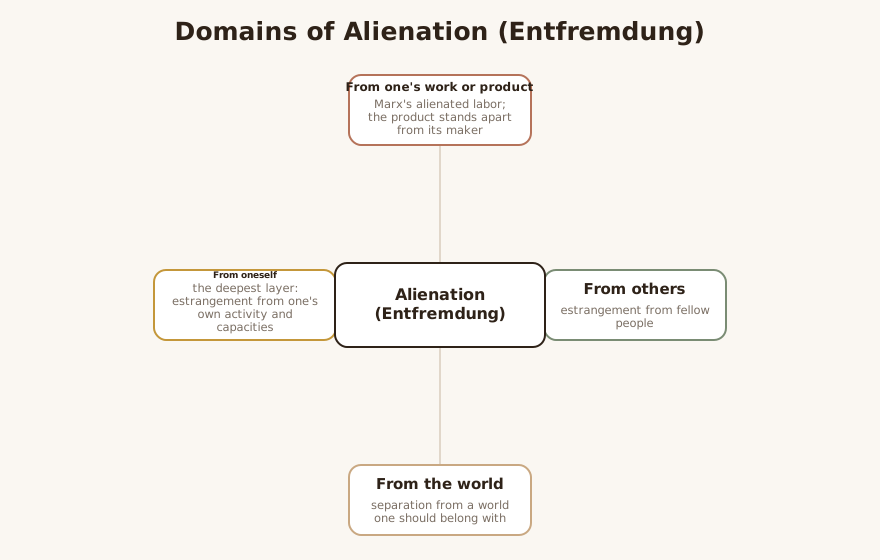
Karl Marx is the pivotal figure. In the Economic and Philosophic Manuscripts of 1844, he relocated alienation from spirit and religion to economic life, arguing that workers under capitalism are inevitably separated from the products they create, from the activity of production, from their fellow human beings, and from their own creative potential 5. Marx distinguished Entfremdung (estrangement, discord) from Entäußerung (externalization or objectification) — a distinction that matters because not all making-external is bad; only estranged making-external is 5. Scholars debate whether the “humanist” alienation of the young Marx survives into the “scientific” mature work, but most contemporary readers see continuity, with commodity fetishism in Capital elaborating rather than abandoning the early theory 5.
Two later figures carry the construct toward usable form. Melvin Seeman translated the philosophical concept into measurable social-psychological variables, the move that made empirical research possible 3. Rahel Jaeggi, in Alienation (German 2005; English translation by Frederick Neuhouser and Alan E. Smith, Columbia University Press, 2014), reconceived the construct for contemporary critical theory, drawing on Hegel, Marx, Kierkegaard, and Heidegger to define alienation as a “relation of relationlessness” — a broken form of self-relation rather than the violation of a fixed human essence 4.
Core Principles
Several principles organize the construct across its versions LLM.
Separation from what belongs together. Alienation always involves a subject divided from an object — work, others, world, or self — where the connection ought to hold; the diagnosis is meaningless without that baseline of proper belonging 1.
Subjective and objective alienation come apart. One can feel estranged while objectively realizing oneself, or be objectively blocked from developing essential capacities while feeling content 1. These two axes generate distinct clinical pictures and warn against reading felt contentment as evidence that nothing is wrong 1.
Self-alienation is the deepest layer. Beyond estrangement from product and others lies estrangement from one’s own activity and capacities — Marx’s alienation from species-being (Gattungswesen), the loss of the human as a free, conscious, creative producer 5. The worker “only feels himself outside his work, and in his work feels outside himself” 5.
Appropriation, not authenticity. Jaeggi reframes the cure-side concept away from recovering a hidden true self and toward appropriation — being present in and the author of one’s own actions, steering one’s life rather than being driven by it 1. On this view alienation is “an inadequate power and a lack of presence in what one does, a failure to identify with one’s own actions” 1. This is a procedural standard about how one relates to one’s life, not a substantive claim about which life is authentic 1.
Not wholly negative. The construct resists romanticism: alienation is necessarily negative but not wholly negative, and individuality itself can emerge within alienated conditions 1. Some separation is the price of differentiation and freedom 1.
Interventions & Techniques
Alienation is a construct, not an intervention, so there is no “alienation therapy” with proprietary techniques LLM. What follows are clinical applications of the lens, each housed within an established modality LLM.
- Mapping the locus of estrangement. Use Marx’s and Seeman’s distinctions as an assessment scaffold: is the client estranged primarily from their work, from others, from norms and values, or from themselves? 53 Naming the locus reframes a diffuse “I feel empty” into a workable target LLM.
- Appropriation work. Borrowing Jaeggi, help the client move from experiencing their own actions “as an alien one” toward authorship — small, reflexive acts of choosing and identifying with what they do, rather than chasing a buried authentic self 41.
- Re-engaging powerlessness. Where alienation presents as Seeman’s powerlessness — the expectancy that one’s behavior cannot determine the outcomes one seeks — behavioral activation and graded mastery experiences directly contest the expectancy 3LLM.
- Meaning and values clarification. For meaninglessness, values work (as in acceptance and commitment therapy) and meaning-centered approaches restore a coherent frame for events 3LLM.
- Repairing isolation. For social isolation, interpersonal and group modalities rebuild the cooperative, mediated-by-persons-not-commodities dimension Marx flagged as lost 5LLM.
- Naming structural causes. A liberation-informed move: validate that some estrangement is a rational response to genuinely alienating conditions, not individual pathology 1LLM.
LLM-generated illustrative example (not a guideline): A warehouse worker reports he “feels like a robot” and “nothing he does matters.” Rather than treating this only as depression, the clinician maps it: estrangement from the labor process (the work is coerced and meaningless), from product (he never sees a finished outcome), and resulting powerlessness. Treatment pairs behavioral activation outside work with values clarification, while explicitly validating that the deadening quality of the job is real and not a personal failing LLM.
Evidence Base
The maturity of alienation as a philosophical and social-science construct is established: it has a centuries-long lineage, a stable conceptual core, and a measurable operationalization 13. What is not established is alienation as a clinical target with its own outcome trials — there is no body of randomized controlled treatment research for “alienation reduction,” because it is a construct clinicians borrow, not a branded therapy LLM.
The empirical work that exists is largely correlational and concentrated in organizational and social psychology, where Seeman’s dimensions have been operationalized as scales 3. Alienation and its correlates in work settings have been examined meta-analytically, linking the construct to outcomes in the domains of job attitudes and well-being 2. Clinicians should read this literature as establishing that alienation is measurable and meaningfully associated with distress and disengagement, not as demonstrating that any specific therapy lowers it 2LLM.
Honest appraisal also requires acknowledging the construct’s open problems. The Stanford account flags unresolved empirical difficulties: whether work under given conditions necessarily frustrates self-realization, and how to compare alienation’s intensity across contexts, remain genuinely contested 1. The construct is conceptually rich and clinically evocative but operationally slippery, which is precisely why Seeman’s translation into discrete variables matters 13.
Populations & Indications
Alienation is most clinically apt where distress is bound up with social position, role, or conditions rather than internal conflict alone LLM. Indicated populations include:
- Workers in low-autonomy, precarious, or repetitive employment, where alienation from the labor process and product is structurally produced 5LLM.
- Clients reporting chronic emptiness or “not feeling like myself”, where self-estrangement is the presenting texture 34.
- Marginalized and minoritized clients facing exclusion, for whom social isolation and normlessness may track real exclusion rather than distorted cognition 31.
- Immigrants and culturally displaced clients, who may experience estrangement from a shared world and norms during transition LLM.
- Burned-out helping professionals, whose demoralization often reads as alienation from a vocation that once felt self-expressive LLM.
The lens is an indication-shaper, not an inclusion criterion: it tells you how to frame and validate, and which adjacent constructs (anomie, demoralization, existential isolation) to assess LLM.
Problems-for-Work
- Meaninglessness / loss of purpose. Maps to Seeman’s meaninglessness — difficulty understanding and predicting the events one is engaged in 3. Application: a graduate student who can no longer say why their research matters benefits from values clarification that rebuilds a coherent frame LLM.
- Powerlessness / learned helplessness. Seeman’s powerlessness — the expectancy that one’s behavior cannot determine outcomes 3. Application: graded mastery tasks contest the expectancy in vivo LLM.
- Normlessness / value confusion (anomie). A breakdown in the norms regulating conduct, drawing on Durkheim 3. Application: a recently divorced client unsure “what the rules even are now” works on reconstructing a personal value system LLM.
- Social isolation. Segregation from community and the substitution of strangers for ongoing bonds 35. Application: group therapy rebuilds direct, non-instrumental human connection LLM.
- Self-estrangement. Denying one’s own interests and seeking extrinsic over intrinsic satisfaction 3. Application: appropriation-focused work restoring authorship over one’s actions 4.
- Disconnection from work or vocation. Marx’s alienation from the act of production and from species-being 5. Application: exploring where any remnant of creative, self-expressive activity survives, in or outside the job LLM.
Contraindications, Cautions & Cultural Humility
The chief caution is conceptual overreach LLM. Because alienation is so capacious, it can absorb any complaint and thereby explain nothing; clinicians should pin it to a specific locus and, where possible, a measurable dimension rather than using it as a mood-word 13.
A second caution is misattributing structural distress to individual pathology — or the reverse LLM. The subjective/objective distinction cuts both ways: a content client may be objectively alienated, and a distressed client’s estrangement may be a rational response to genuinely alienating conditions 1. Treating either as simple cognitive distortion risks invalidation and can replicate the very powerlessness at issue 1LLM.
A third caution concerns authenticity language. Jaeggi’s whole move is to avoid presupposing a fixed true self that alienation hides; clinicians who frame the work as “finding your authentic self” import an essentialism the construct’s most careful theorist deliberately rejects 41. Appropriation — authorship and presence — is the more defensible frame 1.
On cultural humility: the norms, communities, and forms of “belonging” against which alienation is measured are culturally specific, and what registers as healthy connectedness in one frame may not in another LLM. The construct’s Western, largely European intellectual lineage (Rousseau, Hegel, Marx) should not be applied as a universal yardstick of how a self ought to relate to work and others 1LLM.
Treatment-Plan Suggestions & SMART Objectives
| Goal | SMART objective (example) | Mechanism |
|---|---|---|
| Reduce felt powerlessness | Client will complete one self-chosen graded mastery task per week for 6 weeks and rate perceived control 0–10 each time | Disconfirms the expectancy that behavior cannot determine outcomes (powerlessness) 3 |
| Restore meaning | Client will identify and articulate three core values and one action expressing each within 4 sessions | Rebuilds a coherent frame for events (meaninglessness) 3 |
| Increase authorship of daily life | Client will name, in session weekly, one action they chose and identify with vs. one they felt “driven into” for 8 weeks | Strengthens appropriation and presence in one’s own activity 41 |
| Reduce social isolation | Client will initiate two non-instrumental social contacts per week and log felt connection for one month | Repairs the relational dimension estranged under commodified relations 5 |
| Clarify values amid normlessness | Client will draft a personal “working rules” document and revise it across 3 sessions | Reconstructs regulating norms after their breakdown (anomie) 3 |
| Re-engage vocational self-expression | Client will schedule two hours weekly of self-directed creative or skilled activity for 6 weeks | Counters estrangement from the act of production and species-being 5 |
| Reduce self-estrangement | Client will track intrinsic vs. extrinsic motivation for daily activities for 2 weeks and review patterns | Surfaces the denial of one’s own interests central to self-estrangement 3 |
Common Misconceptions
- “Alienation is just depression.” Alienation is a relational-structural construct that can be present without a mood disorder and vice versa; it specifies what one is estranged from, which depression alone does not 1LLM.
- “It’s only Marxist economics.” Marx’s labor theory is one chapter; Rousseau, Hegel, Feuerbach, Seeman, and Jaeggi extend the construct well beyond political economy 154.
- “Alienation means inauthenticity, so therapy recovers the true self.” Jaeggi’s leading account explicitly rejects essentialist authenticity in favor of appropriation 41.
- “If the client feels fine, there’s no alienation.” Objective alienation can coexist with subjective contentment 1.
- “Alienation is wholly bad and must be eliminated.” It is necessarily negative but not wholly so; individuality and differentiation emerge through it 1.
- “Objectification is the problem.” Marx separates objectification/Entäußerung (a normal expression of human capacity) from estrangement/Entfremdung (its distorted form) 5.
Training & Certification
There is no certification in alienation because it is a scholarly construct, not a credentialed modality LLM. Competence comes from primary reading and from training in the established therapies through which the lens is applied — acceptance and commitment therapy for meaninglessness, behavioral activation for powerlessness, interpersonal and group work for isolation LLM. Foundational texts for clinicians are Marx’s 1844 Manuscripts (the labor account) 5, Seeman’s operationalization into measurable dimensions 3, and Jaeggi’s Alienation (the contemporary critical-theory reframing) 4, with the Stanford Encyclopedia entry as the best single orienting overview 1.
Key Terms
- Entfremdung — estrangement; the German term for alienation as discord or separation 5.
- Entäußerung — externalization/objectification; the (not inherently negative) making-external of human capacity, distinguished by Marx from Entfremdung 5.
- Species-being (Gattungswesen) — the human essence as a free, conscious, creative producer; its loss is Marx’s deepest layer of alienation 5.
- Subjective vs. objective alienation — felt estrangement vs. structural blockage of self-realization, which can occur independently 1.
- Self-estrangement — denying one’s own interests and seeking extrinsic over intrinsic satisfaction (Seeman) 3.
- Powerlessness / meaninglessness / normlessness / isolation — Seeman’s measurable dimensions 3.
- Appropriation — Jaeggi’s term for being present in and the author of one’s own actions, the alternative to authenticity 14.
- Relation of relationlessness — Jaeggi’s formula: alienation as a broken form of self-relation 4.
- Commodity fetishism — the illusion that commodities hold inherent value rather than embodying social relations; a form of alienation 51.
Resources & Further Reading
▶ Watch — a video introduction to this concept:
- Alienation — Stanford Encyclopedia of Philosophy
- Alienation and its correlates: A meta-analysis (ScienceDirect)
- Seeman, “On the Meaning of Alienation” / Alienation as a concept in the social sciences (SAGE)
- Rahel Jaeggi, Alienation (Columbia University Press)
- Marx’s theory of alienation (Wikipedia)
Reflective / Supervision Questions
- When a client describes emptiness or “going through the motions,” do I locate the estrangement — from work, others, norms, or self — or do I leave it diffuse? 3LLM
- Am I reading a client’s distress as individual pathology when it may be a rational response to objectively alienating conditions? 1LLM
- Do I default to “find your authentic self” language, and have I considered Jaeggi’s appropriation frame as a more defensible alternative? 41LLM
- How do my own cultural assumptions about good work and good connection shape what I count as alienation in this client? LLM
- For this client, which of Seeman’s dimensions is primary, and does my treatment plan target that specific dimension? 3LLM
- Where might some degree of separation be healthy differentiation rather than pathology I should resolve? 1LLM