
Type & Discipline
Logotherapy is a meaning-centered, existential psychotherapy that sits at the intersection of clinical psychology, psychiatry, and philosophy 7. It is most usefully understood as a coherent theory of human motivation paired with a set of clinical techniques, rather than as a manualized, protocol-driven treatment package LLM. Frankl framed it as the “Third Viennese School of Psychotherapy,” positioned alongside Freud’s psychoanalysis and Adler’s individual psychology 7. Within the broader landscape it belongs to the existential family, sharing assumptions with existential-humanistic psychology and phenomenology, and it functions today as the conceptual ancestor of contemporary meaning-centered psychotherapies 7. For practicing clinicians, the practical implication is that logotherapy is more often delivered as an orienting framework and a collection of specific interventions woven into a recognized modality than as a stand-alone treatment with its own reimbursement category LLM.
Creators & Lineage
Viktor Frankl (1905–1984) was an Austrian psychiatrist and neurologist, trained in the Freudian and Adlerian traditions before diverging from both 5. Where Freud posited a “will to pleasure” and Adler a “will to power,” Frankl drew on Kierkegaard to argue that the deepest human motivation is a “will to meaning” 7. He had developed the core of logotherapy before his deportation, but his survival of Nazi concentration camps became the crucible that, in his account, validated the theory: prisoners who retained a sense of meaning or a future purpose appeared more resilient under extremity 5. He set out this synthesis in Man’s Search for Meaning, which pairs a memoir of the camps with an exposition of the therapy and has sold more than sixteen million copies in over fifty languages since its 1946 publication 1.
The lineage flows outward from Frankl in several directions. Logotherapy is closely tied to Existential Psychotherapy, the broader European existential-analytic tradition, and to the phenomenological method of attending to lived experience as the patient encounters it 7. Downstream, its concepts were translated into more explicitly psychological mechanisms by figures such as Paul Wong, whose meaning therapy renders logotherapy’s ideas in operational terms, and its emphasis on meaning has been integrated into cognitive-behavioral and acceptance-based approaches and into modern meaning-centered psychotherapies used in oncology and palliative care 7. Rollo May, himself a central figure in American existential psychology, was an early critic, and that exchange marks one of the field’s important internal debates 7.
Core Principles
Logotherapy rests on three interlocking tenets. The first is freedom of will: people retain the capacity to choose their stance toward their circumstances and are responsible for that choice, even when biological, social, and psychological factors constrain them 4. The second is the will to meaning, the claim that the search for meaning is the primary motivational force in human life, and that its frustration produces distress 4. The third is meaning in life, the conviction that life holds potential meaning under all conditions, including the most miserable, and that the person is called to respond to the concrete demands of each moment 47.
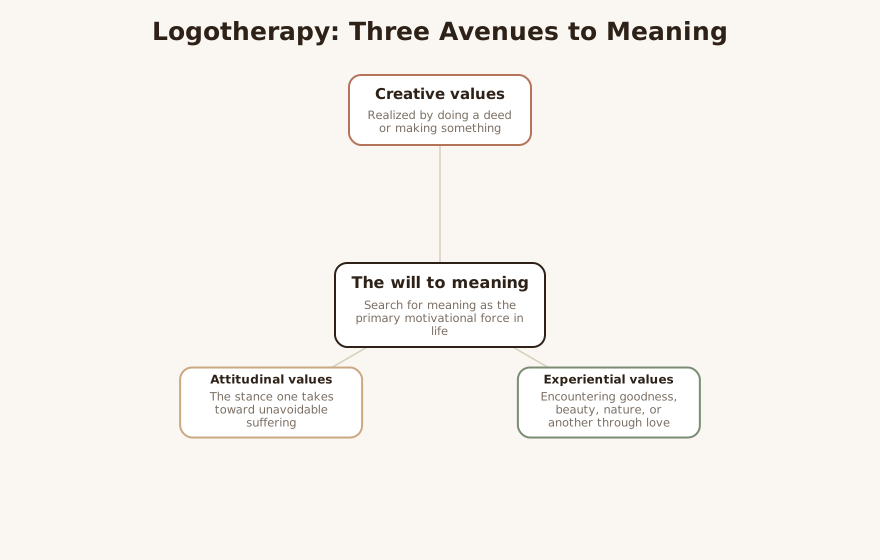
Frankl held that meaning is discovered, not invented, through three avenues, sometimes called creative, experiential, and attitudinal values 4. Creative values are realized by doing a deed or making something; experiential values by encountering goodness, beauty, nature, or another person through love; and attitudinal values by the stance one takes toward unavoidable suffering 4. The third avenue carries the signature claim of the approach, that meaning can be wrested even from circumstances that cannot be changed 4. Frankl bundled the unchangeable hardships of existence into a “tragic triad” of suffering, guilt, and death, against which attitudinal meaning is the available response 4.
Central to the clinical picture is the existential vacuum, the inner void left when the search for meaning is thwarted, often experienced as boredom, apathy, or a pervasive sense of emptiness 45. When meaninglessness itself generates clinical symptoms, Frankl called the resulting condition a noogenic neurosis, distinguishing distress rooted in the “noetic” or spiritual dimension of the person from distress with primarily psychological or biological origins 75. The noetic dimension, in Frankl’s anthropology, is the specifically human register that houses conscience, humor, love, and the capacity for self-transcendence, the reaching beyond oneself toward a cause or another person 4.
Interventions & Techniques
Three techniques are most identified with logotherapy. Paradoxical intention asks the patient to intend, often with deliberate humor, the very outcome they fear, on the logic that anticipatory anxiety and the “hyper-intention” of forcing a result paradoxically produce or sustain the symptom 7. The classic application is insomnia, where the patient is coached to try to stay awake rather than to force sleep 7. Its mechanism is self-distancing: the patient steps back from the symptom and, through humor, loosens its grip 4.
LLM-generated illustrative example (not a guideline): A client with performance-related blushing who dreads turning red in meetings is coached, half in jest, to “show everyone the reddest face in the room” when anxiety rises. The deliberate exaggeration interrupts the anticipatory loop, and the feared blush, no longer fought, tends to subside. LLM
Dereflection targets the opposite problem, excessive self-observation, or “hyper-reflection,” in which monitoring a function disrupts it 7. The patient is helped to redirect attention away from the self and toward a meaningful task or another person, restoring spontaneity 5. Socratic dialogue, sometimes paired with attitude modification, uses guided questioning to help patients discover meanings and resources already latent in their own words and history, including the “Ecce Homo” move of naming the strengths a person has shown through adversity 57. Across all three, the consistent therapeutic posture is to mobilize the patient’s healthy core and inner resources rather than to excavate pathology 5.
Evidence Base
The honest summary is that logotherapy is an established and influential concept with an outcome literature that is emerging rather than mature LLM. Frankl’s theory has been enormously durable as a framework, and decades of correlational research using the Purpose in Life (PIL) test associate a stronger sense of meaning with lower depression, reduced substance use, and better health outcomes 7. A dedicated review of the empirical status of logotherapy and Existential Psychotherapy catalogs the development of validated meaning-related instruments while noting the unevenness of controlled outcome research in the tradition 6.
More recent quantitative syntheses have begun to test logotherapy-based interventions directly. A meta-analysis examined logotherapy for depressive symptoms across both passive and active control studies, situating the question of efficacy within a comparative-control framework 2. A separate systematic review and meta-analysis by Hong and colleagues evaluated nurse-delivered logotherapy-based interventions, reflecting how the approach is increasingly operationalized as brief, structured programs in medical and nursing settings 3. The existence of these syntheses signals a maturing interest in controlled evaluation; clinicians should nonetheless read the primary reports for effect sizes, comparator types, and risk-of-bias appraisal before drawing strength-of-evidence conclusions, since reviews in this area frequently flag small samples, heterogeneous protocols, and concentration of trials in particular regions and populations LLM6. The defensible clinical stance is that logotherapy’s constructs are well validated as correlates of wellbeing, while its standing as an efficacious stand-alone treatment is promising but not yet established to the level of first-line evidence-based therapies LLM.
Populations & Indications
Logotherapy was forged in the most extreme of human conditions and has historically resonated with Holocaust and atrocity survivors, for whom the question of meaning in the face of catastrophic suffering is not abstract 1. In contemporary practice it is applied with adults and older adults, bereaved individuals, people facing terminal illness, trauma survivors, and people in acute existential crisis 45. It is reported in use for depression, anxiety, grief, addiction, guilt, and burnout, and as supportive care for cancer patients and, in some accounts, adolescents 5. The strongest natural indication is any presentation in which loss of meaning, demoralization, or an existential vacuum is central to the clinical picture rather than incidental to it 47.
Problems-for-Work
The clearest problem-for-work is the existential vacuum and loss of meaning, where the patient describes emptiness, boredom, or a sense that nothing matters; here the work centers on Socratic dialogue and the deliberate identification of creative, experiential, and attitudinal avenues to meaning 4. Demoralization and despair in terminal illness lend themselves to attitudinal-value work, helping a patient locate a stance worth taking when the situation itself cannot be altered 4. Grief can be approached through the same lens, supporting the bereaved in finding ongoing meaning in the relationship and in their continuing obligations to life 57. Anxiety, particularly anticipatory and performance anxiety, maps onto paradoxical intention, while conditions sustained by self-monitoring respond to dereflection 7. Substance use disorders, adjustment disorder, and depression are treated as arenas where restoring a sense of purpose supplements symptom-focused work 5.
LLM-generated illustrative example (not a guideline): A retired widower presents with anhedonia and the refrain “there’s no point anymore.” Rather than only targeting mood symptoms, the clinician uses Socratic questioning to surface a latent experiential value — his grandchildren — and a creative one — mentoring at a community workshop, reframing his days around concrete demands that call for his response. LLM
Contraindications, Cautions & Cultural Humility
Logotherapy is not a substitute for indicated medical or pharmacological treatment, and Frankl himself combined logotherapy with medication where appropriate; noogenic concerns should never crowd out assessment of biologically or psychologically driven illness, including active suicidality 7LLM. The most cited critique, advanced by Rollo May, is that the approach can become authoritarian, with the therapist imposing meaning rather than enabling the patient to discover it 7. This is a live clinical risk: meaning is the patient’s to find, and a directive “you should see purpose in this” can be experienced as invalidating, especially with acute trauma or fresh grief LLM. Some scholars further argue that elements of logotherapy function more as philosophy or even secular religion than as empirical science, a caution worth holding given Frankl’s own acknowledgment of religious influences 7. Cultural humility is essential, because conceptions of meaning, suffering, duty, and the sacred are deeply shaped by culture, faith, and community, and a framework born in mid-century Vienna should be applied with explicit curiosity about the patient’s own meaning system rather than the clinician’s LLM.
Treatment-Plan Suggestions & SMART Objectives
| Goal | SMART objective (example) | Mechanism |
|---|---|---|
| Reduce existential vacuum | Within 8 weeks, client will identify and engage in 2 personally meaningful activities weekly, logging them in session 4 | Activation of creative and experiential values 4 |
| Build attitudinal meaning in unavoidable suffering | Over 6 sessions, client will articulate one chosen stance toward an unchangeable stressor and rate its helpfulness 0–10 weekly 4 | Attitudinal value; self-transcendence 4 |
| Decrease anticipatory anxiety | Within 4 weeks, client will apply paradoxical intention to one feared situation 3x/week and record outcomes 7 | Self-distancing; interruption of hyper-intention 7 |
| Interrupt symptom-maintaining self-monitoring | Within 4 weeks, client will practice dereflection by redirecting attention to a task during 5 monitored episodes 7 | Reduction of hyper-reflection 7 |
| Reframe demoralization | Over 6 weeks, client will complete weekly Socratic-dialogue reflections naming strengths shown through adversity 5 | Attitude modification; “Ecce Homo” 57 |
| Restore purpose in recovery | Within 12 weeks, client will define one valued life direction and take one concrete weekly step toward it 4 | Will to meaning re-engaged 4 |
| Process grief through continued meaning | Over 8 sessions, bereaved client will identify 2 ways to honor the relationship’s ongoing significance 7 | Experiential value; responsibility to life 7 |
Common Misconceptions
A frequent misconception is that logotherapy claims suffering is good or that the therapist supplies the patient’s meaning; in fact the approach holds that meaning is discovered by the patient and that the value at stake in unavoidable suffering is the attitude one takes, not the suffering itself 47. A second is that “the will to meaning” is interchangeable with happiness-seeking; Frankl distinguished meaning from happiness and held that pursuing meaning, not pleasure, is primary 15. A third is that logotherapy is purely abstract or motivational rather than clinical, when in fact it includes specific, operationalizable techniques such as paradoxical intention and dereflection 7. Finally, some assume the approach is fully evidence-based in the modern sense; the more accurate reading is that its constructs are well supported correlationally while controlled outcome research is still developing 6LLM.
Training & Certification
Frankl’s foundational text, Man’s Search for Meaning, remains the standard entry point and is widely used to introduce the theory 1. Formal education and clinical training are offered through Frankl-affiliated institutes, including the Viktor E. Frankl Institute of America, which disseminates the approach and its applications 4. Clinicians should treat logotherapy training as an adjunct to, not a replacement for, licensure in a recognized mental-health profession, integrating its methods within their existing scope of practice LLM.
Key Terms
- Will to meaning — the primary human motivation, the drive to find purpose 4.
- Existential vacuum — the inner emptiness left when the search for meaning is frustrated 4.
- Noogenic neurosis — clinical distress arising from the noetic (meaning) dimension rather than psychological or biological causes 7.
- Self-transcendence — reaching beyond oneself toward a cause or another person 4.
- Attitudinal values — meaning realized through the stance taken toward unavoidable suffering 4.
- Tragic triad — suffering, guilt, and death, the unchangeable hardships of existence 4.
- Paradoxical intention — intending the feared outcome to dissolve anticipatory anxiety 7.
- Dereflection — redirecting attention away from excessive self-monitoring 5.
Resources & Further Reading
▶ Watch — a video introduction to this concept:
- Man’s Search for Meaning (Viktor Frankl) — Beacon Press
- What is Logotherapy? — The Viktor E. Frankl Institute of America
- Logotherapy: Viktor Frankl’s Theory of Meaning — Simply Psychology
- The State of Empirical Research on Logotherapy and Existential Analysis — Springer
- Logotherapy for Depressive Symptoms: A Meta-Analysis of Passive and Active Control Studies — Wiley
- The Effectiveness of Nurse-Delivered Logotherapy-Based Interventions: A Systematic Review and Meta-Analysis (Hong et al.) — Wiley
- Logotherapy — Wikipedia
Reflective / Supervision Questions
- When a client says “nothing matters,” how do I distinguish a noogenic existential vacuum from a depressive episode requiring symptom-focused or pharmacological treatment, and how does that distinction change my plan? LLM
- Where is the line between helping a client discover meaning and imposing my own, and how would I notice if I had crossed into the “authoritarian” stance May warned against? LLM
- How do my own cultural and spiritual assumptions about suffering and purpose shape the meanings I find salient, and how do I keep the client’s meaning system at the center? LLM
- For which of my current clients is loss of meaning the core problem rather than a downstream symptom, and how confident am I in that formulation? LLM
- Given that controlled outcome evidence is still developing, how do I communicate honestly with clients about what logotherapy-based work can and cannot promise? LLM