
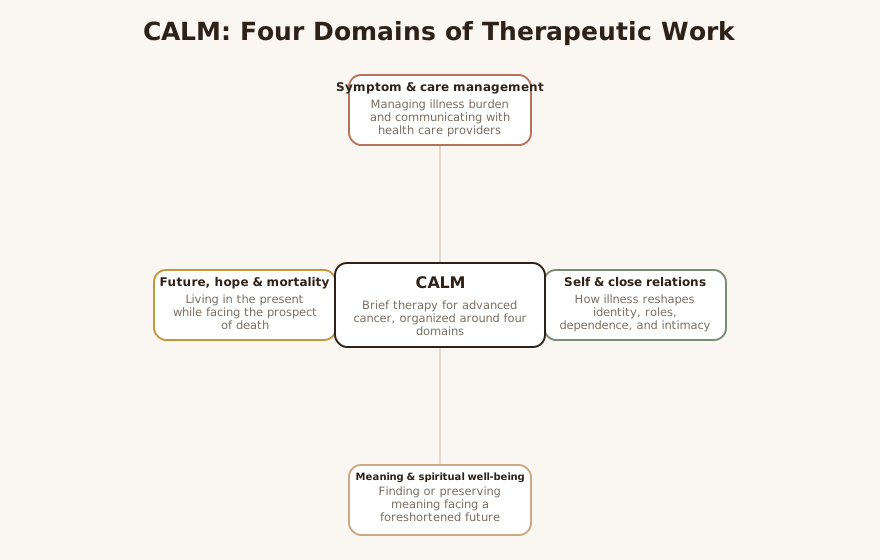
Managing Cancer and Living Meaningfully (CALM) is a brief, manualized individual psychotherapy designed specifically for patients living with advanced, life-limiting cancer, intended to help them face the practical and existential challenges of progressive disease while continuing to live meaningfully 23. Developed by Gary Rodin and colleagues, it is delivered as a short course of sessions structured around four content domains, and it draws explicitly on attachment theory, relational psychotherapy, and existential thought rather than on a symptom-by-symptom cognitive protocol 24. For the practicing therapist, CALM is worth understanding because it is one of the few psychotherapies built from the ground up for people who are seriously ill and may be dying, and because a randomized controlled trial found it both reduced and prevented depressive symptoms in patients with metastatic cancer 16.
Type & Discipline
CALM is a modality — a discrete, manualized psychotherapeutic intervention — situated within psycho-oncology and the broader field of psychosocial, palliative, and end-of-life care 24. It is an individual, time-limited therapy, typically delivered as a small number of sessions over several months, designed for adults with advanced cancer and a limited life expectancy 12. Its disciplinary home is the seam between oncology, palliative care, and psychotherapy, and its unit of intervention is the individual patient confronting the reality of progressive illness, often alongside a partner or family member who may be invited into sessions 23.
What distinguishes CALM as a coherent modality is that it is semi-structured rather than free-form supportive counseling: it organizes the therapeutic work around four defined domains while preserving the flexibility to follow the patient’s most pressing concerns 25. Because it was created for a population facing mortality, it integrates attention to the body and the medical situation with attention to relationships, meaning, and death in a single framework, rather than treating psychological distress as separable from the illness that generates it 23.
Creators & Lineage
CALM was developed by Gary Rodin and his colleagues at the University Health Network and the University of Toronto, where the intervention and its training are now housed within the Global Institute of Psychosocial, Palliative and End-of-Life Care (GIPPEC) 46. Rodin, a psychiatrist working in psycho-oncology, led the program of research that produced both the manual and the trial evidence, and his name is the one most closely associated with the model 16. Sarah Hales and Chris Lo are central collaborators: Hales co-authored the definitive book and the clinical description of the approach, and Lo contributed to the development and to the statistical and conceptual work underpinning the trial 123.
The intellectual lineage of CALM runs through attachment theory and relational psychotherapy, which inform its emphasis on security, dependence, and the patient’s relationships with close others and with the treatment team 23. It also draws on existential and meaning-centered traditions in its attention to mortality, hope, and meaning, and on the literature describing demoralization and the psychological burden of advanced disease 23. The intervention emerged from the recognition that patients with advanced cancer face a distinctive and predictable set of challenges — bodily, relational, and existential — that were not well addressed by existing therapies, and that a tailored, integrative approach was needed 26.
Core Principles
CALM is organized around four domains that structure the therapeutic work while leaving room to follow the patient 23. The first is symptom management and communication with health care providers: helping the patient manage the physical burden of illness and engage effectively with the medical system that is treating them 23. The second is changes in self and relations with close others: how serious illness reshapes identity, roles, dependence, and intimacy, and how the patient can sustain connection while needing more from others 23.
The third domain is spiritual well-being and the sense of meaning and purpose: how the patient finds or preserves meaning in the face of a foreshortened future 23. The fourth is the future, hope, and mortality — sometimes described as sustaining the capacity to live in the present while facing the prospect of death 23. A central organizing idea is what the model calls double awareness: the capacity to hold, at the same time, the awareness of dying and the continued engagement in living, rather than collapsing into either denial or hopelessness 26.
Underneath the four domains, CALM rests on a relational and attachment-informed stance: the therapist works to provide a secure base from which the patient can explore frightening material, attends to the patient’s characteristic ways of seeking or avoiding closeness, and supports the patient’s relationships outside the room 23. The approach is explicitly designed to be supportive and reflective rather than directive, and to integrate the practical, relational, and existential rather than addressing them in isolation 23.
Interventions & Techniques
The defining “technique” of CALM is the use of the four domains as a flexible map: the therapist moves among symptom and medical concerns, self and relationships, meaning and spirituality, and the future and mortality, following what is most alive for the patient while ensuring that the existential material is not avoided 25. Sessions are reflective and exploratory; the therapist helps the patient put words to fears that are often unspoken — including fear of dying, of dependence, and of being a burden — within a relationship experienced as safe 23.
A core relational move is the deliberate cultivation of a secure therapeutic relationship as a base for exploring threatening material, consistent with the model’s attachment roots 23. The therapist attends to the patient’s attachment style — whether they tend to suppress need and self-reliance, or to feel overwhelmed and seek reassurance — and tailors the work accordingly, helping the patient both rely on others and retain a sense of agency 23. Where appropriate, partners or family members are included, both to support the patient and to address the relational strain that advanced illness creates 23.
Fidelity to this approach is taken seriously: a treatment-integrity study examined whether therapists delivering CALM actually adhered to the intervention as specified and delivered it competently, an important step for a relational therapy where the manual guides rather than scripts the session 5. That work supports the idea that CALM is a teachable, reproducible intervention and not merely skilled improvisation, while acknowledging the inherent flexibility of the approach 5.
LLM-generated illustrative example (not a guideline): A 54-year-old woman with metastatic breast cancer spends the first sessions talking almost entirely about scan results and side effects. The therapist follows her into the symptom-and-communication domain, then gently opens the question of how the illness has changed how she sees herself as a mother. Over later sessions she is able, for the first time, to name her fear of dying and to talk with her husband about it — holding both the awareness of her prognosis and her wish to remain present for her children LLM.
Evidence Base
The maturity of CALM’s evidence base is best described as emerging: it rests primarily on a single large randomized controlled trial, supplemented by integrity and process research and a developing international program, rather than on a deep, independently replicated trial base 15LLM. This is an honest and important framing — CALM is promising and manualized and has trial support, but it is not yet at the level of evidentiary maturity of long-established therapies with many replications 1LLM.
The anchor study is the CALM randomized controlled trial, reported by Rodin, Lo, and colleagues in the Journal of Clinical Oncology in 2018, which tested CALM against usual care in patients with advanced cancer 1. The trial found that, compared with usual care, CALM reduced depressive symptoms over the months of the intervention and also had a preventive effect — patients receiving CALM were less likely to develop clinically significant depressive symptoms over time 1. The University Health Network summarized the central finding in lay terms: the intervention helped patients with advanced cancer find a measure of peace and was associated with less depression 6.
Beyond the efficacy trial, the treatment-integrity study published in Frontiers in Psychology examined whether the intervention was being delivered as intended, supporting the claim that CALM can be reliably reproduced by trained therapists 5. The body of work is consolidated in the book by Rodin and Hales, which sets out the evidence base and clinical method together 3. The remaining honest caveats are familiar for a young modality: the strongest evidence comes from the developers’ own program, broad independent replication is still accumulating, and the intervention’s reach has so far centered on adults with advanced cancer rather than the full range of serious illness 13LLM.
Populations & Indications
CALM was developed and tested for adults with advanced or metastatic cancer and a limited life expectancy, and that remains its paradigmatic indication 12. The randomized trial enrolled patients with advanced disease, and the intervention’s four-domain structure is built around the challenges that this population predictably faces 12. It is intended for patients who are still able to engage in reflective conversation, including those receiving palliative care and those approaching the end of life 23.
Because serious illness affects the whole relational field, CALM also attends to family caregivers and close others, who may be included in sessions and whose own distress and relationship with the patient are part of the clinical picture 23. The global dissemination effort has extended training in the model across multiple countries and care settings through GIPPEC’s program, broadening the range of patients to whom it is offered while keeping its focus on advanced, life-limiting illness 4. The core indications are the predictable burdens of advanced cancer: distress and demoralization, fear of dying, disrupted identity and relationships, and the search for meaning and hope in a foreshortened future 23.
Problems-for-Work
CALM gives the therapist a structured-yet-flexible way to work on the specific psychological problems that advanced illness generates, and the honest framing is that it targets the existential, relational, and bodily distress of serious cancer rather than a discrete disorder 23.
- Depression and demoralization in advanced illness is the flagship problem-for-work: the trial showed CALM both reduced depressive symptoms and helped prevent their emergence in patients with metastatic cancer 16.
- Death anxiety and fear of dying are addressed directly through the fourth domain, where the therapist helps the patient face mortality while sustaining engagement in living — the stance the model calls double awareness 26.
- Loss of identity and changes in self as illness erodes roles, capacities, and independence is worked through in the second domain, with attention to dependence and agency 23.
- Attachment insecurity and difficulty relying on others is a core relational target: the therapist helps the patient seek and accept support without losing a sense of self, consistent with the model’s attachment roots 23.
- Loss of meaning and a disrupted sense of the future is taken up in the spirituality-and-meaning domain, helping the patient locate purpose within a limited horizon 23.
- Communication strain with the medical team and with close others is addressed in the first and second domains, supporting effective engagement with providers and honest connection with family 23.
LLM-generated illustrative example (not a guideline): A man with advanced pancreatic cancer presents as stoic and self-reliant, insisting he does not want to “burden” his wife. Working in the self-and-relationships domain, the therapist helps him notice how his lifelong difficulty depending on others is now isolating him at the moment he most needs closeness. Over several sessions he begins to let his wife in, and the couple is able to speak together about what they fear and what they still hope for LLM.
Contraindications, Cautions & Cultural Humility
The principal limits of CALM concern fit and capacity rather than harm: it is a reflective, conversation-based therapy designed for patients with advanced cancer who can engage in exploring difficult material, and it is not a crisis intervention or a substitute for psychiatric treatment of severe depression, delirium, or acute suicidality 2LLM. A patient who is too physically unwell, too cognitively impaired, or too acutely distressed to participate in reflective work may need stabilization, symptom control, or psychiatric care first, with CALM offered when engagement becomes possible 2LLM.
A second caution is that CALM is explicitly an existentially confronting therapy: it invites patients to face mortality, and the therapist must be attuned to each patient’s readiness, defenses, and pace rather than pushing toward death-related material before the relationship can hold it 23. The model’s emphasis on double awareness — neither forcing confrontation nor colluding with avoidance — is itself the safeguard, and it requires clinical judgment to apply 26.
On cultural humility: beliefs about death, dying, disclosure of prognosis, the role of family in decision-making, and the place of spirituality vary enormously across cultures and individuals, and the meaning the patient makes of illness cannot be assumed 23. The spirituality-and-meaning domain in particular must be approached with openness to the patient’s own framework rather than the therapist’s; the four domains are a map of common concerns, not a template to impose 2LLM. As the model has been disseminated internationally, attention to cultural and contextual fit becomes part of delivering it responsibly 4LLM.
Treatment-Plan Suggestions & SMART Objectives
| Goal | SMART objective (example) | Mechanism |
|---|---|---|
| Reduce depressive symptoms | Over the course of CALM (typically several sessions across 3-6 months), client’s depressive symptoms will decrease on a validated measure from baseline | Brief manualized intervention shown to reduce depressive symptoms in advanced cancer 1 |
| Prevent emergence of depression | Across the intervention period, client will remain below the threshold for clinically significant depressive symptoms | CALM demonstrated a preventive effect on depression in the randomized trial 1 |
| Address death anxiety | Within the course of therapy, client will be able to name and reflect on specific fears about dying in session at least once | Fourth domain work on the future, hope, and mortality, supported by double awareness 26 |
| Support attachment security | Over the episode, client will identify one concrete way to seek or accept support from a close other and act on it | Attachment-informed work on dependence and relationships in the self-and-others domain 23 |
| Sustain meaning and purpose | Within the course of therapy, client will articulate at least one source of meaning that remains available within their current horizon | Spirituality-and-meaning domain of the four-domain framework 23 |
| Improve communication with the team | Over several sessions, client will prepare for and engage in one planned conversation with the medical team about goals or symptoms | First domain: symptom management and communication with health care providers 23 |
| Strengthen connection with close others | During the episode, client and a partner or family member will complete at least one joint session focused on a shared concern | Inclusion of close others to address relational strain of advanced illness 23 |
| Maintain double awareness | Across therapy, client will demonstrate the capacity to discuss both prognosis and continued living within the same session | Cultivating double awareness — holding dying and living together 26 |
Common Misconceptions
The most common misconception is that CALM is just supportive listening for dying patients. It is a semi-structured, manualized intervention organized around four defined domains and grounded in attachment and existential theory, not unstructured supportive counseling 23. A second misconception is that CALM is end-of-life care delivered only in the final weeks; it is designed to be offered earlier in the course of advanced disease, while patients can still engage reflectively, so that they can live more meaningfully across whatever time remains 23. A third is that facing mortality means relentless focus on death; the model’s principle of double awareness explicitly holds living and dying together and follows the patient’s pace rather than forcing death-related material 26. A fourth is that the evidence is as deep as for long-established therapies; CALM is supported chiefly by one large trial plus integrity research, and its evidence base is best described as emerging 15LLM. A fifth is that it is only for the patient; close others are often included, and the relational field around the patient is part of the work 23.
Training & Certification
CALM is delivered by licensed mental health and palliative-care clinicians who complete specific training in the model, rather than being an open technique any clinician applies from the book alone 4LLM. The principal source of training, supervision, and international dissemination is the Global Institute of Psychosocial, Palliative and End-of-Life Care (GIPPEC) at the University of Toronto and University Health Network, which runs the Global CALM Program and trains clinicians across multiple countries 46. The definitive clinical text by Rodin and Hales provides the manualized framework and the evidence base that training builds upon 3.
The emphasis on training is appropriate because, as the treatment-integrity research underscores, the value of CALM depends on therapists delivering it with fidelity and competence — covering the domains, sustaining the relational stance, and handling existential material skillfully — rather than simply having read the manual 5. The flexibility of the approach makes training and supervision more, not less, important, since the therapist must exercise judgment within the structure 25.
Key Terms
- Managing Cancer and Living Meaningfully (CALM): a brief, manualized, attachment- and relationally-informed individual psychotherapy for patients with advanced cancer, organized around four domains 23.
- The four domains: symptom management and communication with providers; changes in self and relations with close others; spiritual well-being and meaning; and the future, hope, and mortality 23.
- Double awareness: the capacity to hold awareness of dying and continued engagement in living at the same time, without collapsing into denial or despair 26.
- Demoralization: the loss of hope, meaning, and morale that can accompany advanced illness, a core target of the intervention 23.
- Secure base: the attachment concept, applied here as the therapist providing a relationship safe enough for the patient to explore frightening material 23.
- Treatment integrity (fidelity): the degree to which therapists deliver CALM as specified and with competence, examined to support its reproducibility 5.
- Global CALM Program: the GIPPEC-led effort to train clinicians and disseminate CALM internationally 4.
Resources & Further Reading
▶ Watch — a video introduction to this concept:
- Rodin, G., Lo, C., et al. (2018). Managing Cancer and Living Meaningfully (CALM): A Randomized Controlled Trial — PubMed
- Hales, S., Lo, C., & Rodin, G. Psychotherapeutic Approach for Advanced Illness: CALM Therapy — American Journal of Psychotherapy
- Rodin, G., & Hales, S. Managing Cancer and Living Meaningfully: An Evidence-Based Intervention for Cancer Patients and Their Caregivers — Oxford University Press
- Managing Cancer And Living Meaningfully (CALM) project & Global CALM Program — GIPPEC
- Testing the Treatment Integrity of the CALM Psychotherapeutic Intervention — Frontiers in Psychology
- Keep CALM to Find Peace — UHN Research
Reflective / Supervision Questions
- For a patient with advanced cancer on my caseload, am I attending to all four domains — body, relationships, meaning, and mortality — or am I quietly avoiding the existential material because it is hard for me too? 2
- How do I read this patient’s attachment style, and is my stance helping them both rely on others and keep their sense of agency? 23
- Am I following the patient’s pace toward death-related material, or either pushing it before the relationship can hold it or colluding with avoidance? 26
- When I describe what I am doing as “CALM,” am I delivering the manualized intervention with fidelity, or have I drifted into general supportive counseling? 5
- How do this patient’s cultural and spiritual frameworks shape what meaning, disclosure, and a “good” remaining life mean to them, and am I imposing my own assumptions in the meaning domain? 23
- Given that CALM’s evidence base is still emerging, how do I hold appropriate confidence in the approach while staying honest with patients and colleagues about what we do and do not yet know? 1LLM