
Type & Discipline
Meaning-Centered Psychotherapy (MCP) is a brief, manualized psychotherapeutic intervention situated within psycho-oncology and palliative psychology 4. It belongs to the existential/meaning-oriented family of therapies and was designed specifically to target existential and spiritual distress rather than psychiatric symptoms alone 7. MCP exists in two principal forms: individual MCP (IMCP), typically delivered across seven sessions, and meaning-centered group psychotherapy (MCGP), structured as an eight-session group format 12. Both versions are time-limited, semi-structured, and organized around a sequence of themes rather than open-ended exploration 6.
Although MCP draws on existential philosophy, it is operationalized as a concrete clinical protocol with session-by-session content, didactic teaching, experiential exercises, and homework 5. This manualization is what distinguishes it from broader, less structured existential psychotherapy and is what made it testable in randomized trials 1. The intervention is best understood as a focused adjunct to comprehensive cancer and palliative care rather than a treatment for a discrete DSM disorder LLM.
Creators & Lineage
MCP was developed by William Breitbart and colleagues at Memorial Sloan Kettering Cancer Center, where it grew out of clinical work with patients facing advanced cancer and the end of life 45. Its most direct intellectual ancestor is the logotherapy of Viktor Frankl, the Viennese psychiatrist and Holocaust survivor who argued that the search for meaning is a primary human motivation and that meaning can be found even in unavoidable suffering 7. Breitbart’s group translated Frankl’s largely philosophical and clinical writings into a structured, replicable protocol suitable for empirical study 5.
The group treatment manual was co-authored by Breitbart and Shannon Poppito and published by Oxford University Press, codifying the eight-session group sequence 6. The broader theoretical and clinical framework, spanning individual, group, and adapted formats, is laid out in the edited volume Meaning-Centered Psychotherapy in the Cancer Setting 5. Lineage beyond logotherapy includes the wider existential psychotherapy tradition and, in its structured and skills-oriented delivery, conceptual kinship with cognitive behavioral approaches and with Chochinov’s dignity therapy as a parallel meaning-and-legacy intervention in palliative care LLM.
Core Principles
The central premise of MCP is Frankl’s: that human beings are fundamentally motivated by a will to meaning, and that connection to meaning can buffer the suffering of advanced illness even when cure is impossible 7. Distress in serious illness is reframed not only as a symptom to be reduced but as a crisis of meaning to be addressed LLM. The therapy works to help patients sustain, reconnect with, or newly discover sources of meaning despite physical decline and mortality 5.
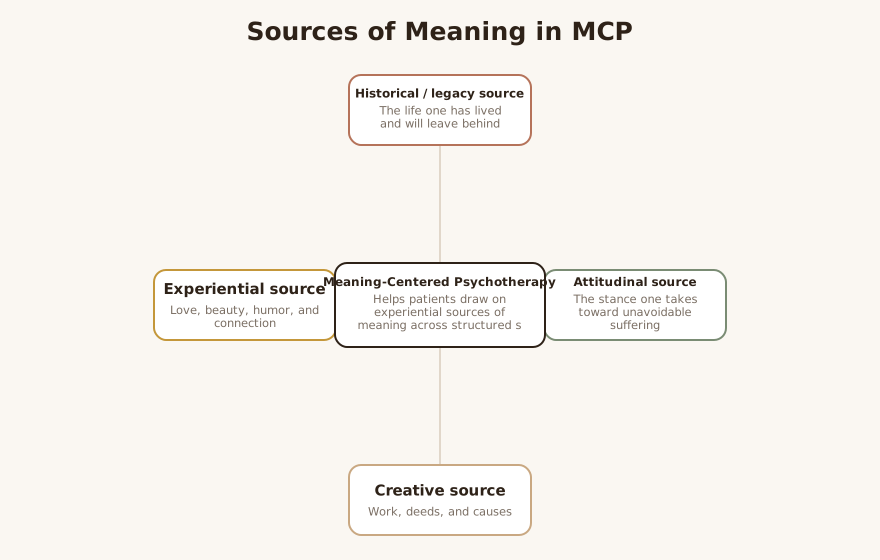
MCP organizes meaning into experiential sources that patients can deliberately draw upon. These typically include the historical or legacy source (the life one has lived and will leave), the attitudinal source (the stance one takes toward unavoidable suffering), the creative source (work, deeds, and causes), and the experiential source (love, beauty, humor, and connection) LLM. The attitudinal source is especially central, reflecting Frankl’s insight that even when circumstances cannot be changed, one retains the freedom to choose one’s attitude toward them 7. By moving through these sources across structured sessions, patients are helped to shift from a focus on what illness has taken to what remains possible and valuable 5.
Interventions & Techniques
Each MCP session pairs didactic teaching about a meaning-related theme with experiential exercises, facilitated discussion, and reflective homework 2. The group format opens with sessions on the concept of meaning and on identity before and after cancer, then moves through the sources of meaning, and closes with sessions on transitions, hope, and legacy 6. Specific exercises invite patients to narrate meaningful life experiences, articulate a personal legacy, identify enduring values, and consider the attitudinal choices available to them in the face of limitation 5.
LLM-generated illustrative example (not a guideline): In a session on the historical source of meaning, a clinician might ask, “Tell me about a time you felt most alive or most yourself — what does that say about what has mattered in your life?” The patient’s narrative then becomes material for exploring legacy and continuity beyond illness LLM.
The individual format compresses similar content into a more flexible, patient-paced sequence, which can be valuable for patients too debilitated or socially anxious for group work 1. Throughout, the therapist is active and educative, guiding patients toward meaning rather than waiting for it to emerge, which marks a stylistic departure from more nondirective existential work LLM.
Evidence Base
MCP qualifies as an established intervention by the standard of multiple randomized controlled trials, though its evidence base remains concentrated and its effects modest LLM. The largest individual trial randomized 321 patients with advanced cancer to IMCP, supportive psychotherapy, or enhanced usual care; compared with usual care, IMCP produced small-to-medium benefits across five of seven outcomes, with Cohen’s d ranging from 0.1 to 0.34, and it outperformed supportive psychotherapy on quality of life and sense of meaning (d = 0.19) 1. A pilot group trial found significantly greater improvement in spiritual well-being for MCGP than for supportive group psychotherapy, with effect sizes for the FACIT spiritual well-being measure of d = 0.72 post-treatment and d = 1.46 at follow-up, alongside benefits for anxiety and desire for death 2.
A larger group RCT of 253 advanced-cancer patients reported that, among those attending at least three sessions, MCGP yielded significantly greater gains in spiritual well-being and quality of life and greater reductions in depression, hopelessness, and desire for hastened death than supportive group therapy, with intent-to-treat analyses confirming effects for quality of life, depression, and hopelessness 3. The authors concluded the data provided strong support for MCGP’s efficacy in addressing existential and spiritual distress 3.
Honest appraisal requires noting the limits LLM. Effects are generally small to medium, the strongest signals come from per-protocol (attender) rather than intent-to-treat analyses, and the pilot trial showed substantial attrition that the authors flagged as a feasibility concern 23. The literature is heavily concentrated in the originating MSKCC group and in predominantly Caucasian, English-speaking advanced-cancer samples, leaving generalizability to diverse populations, non-cancer illness, and long-term outcomes less well established 2LLM.
Populations & Indications
MCP was designed for and tested most extensively in patients with advanced or stage III–IV cancer who are ambulatory and able to participate in structured sessions 2. Its natural indications extend across the palliative and end-of-life continuum, including people with terminal or life-limiting illness who are confronting mortality and questions of meaning 7. The intervention is most appropriate when distress is existential or spiritual in character — loss of purpose, demoralization, death anxiety — rather than driven primarily by an untreated mood or anxiety disorder LLM.
Clinically, MCP is also reasonably adapted for cancer survivors navigating altered identity and purpose after treatment, for bereaved individuals, and for caregivers of the seriously ill who face their own meaning-related strain LLM. The MSKCC training program explicitly frames the method as a tool for cancer care providers working across these populations 4. Group format suits patients who can tolerate and benefit from shared disclosure, while the individual format serves those who are more physically compromised, socially anxious, or scheduling-constrained 1.
Problems-for-Work
MCP directly targets a cluster of existential problems that conventional symptom-focused therapies often leave untouched LLM. Existential distress and loss of meaning and purpose are the core indications, addressed by reconnecting patients with the historical, attitudinal, creative, and experiential sources of meaning 5. Demoralization — the sense that one’s life no longer has worth or coherence — maps closely onto MCP’s reframing of suffering as a domain in which attitudinal choice remains possible 7.
Hopelessness, desire for hastened death, and depression in the medically ill have all shown responsiveness in group trials, making MCP a reasonable component of care for patients expressing a wish to die or pervasive despair 3. Death anxiety and spiritual distress are engaged through the sessions on legacy, transitions, and hope 6. For anticipatory grief and adjustment disorder accompanying a serious diagnosis, MCP offers a structured way to metabolize the diagnosis as a turning point rather than only a loss LLM.
LLM-generated illustrative example (not a guideline): A patient voicing “I’d rather not wake up than keep being a burden” might, over the legacy and creative-source sessions, reframe his role from burden to someone still actively transmitting values to grandchildren — a shift that can attenuate desire for hastened death LLM.
Contraindications, Cautions & Cultural Humility
MCP is not a crisis intervention and is not designed to manage acute, imminent suicidality; expressed desire for hastened death must be assessed and risk-managed through standard safety protocols before or alongside meaning-centered work LLM. Patients with significant cognitive impairment, active psychosis, or distress driven primarily by untreated major depression may need those conditions stabilized first, since the protocol assumes capacity for reflective, didactic engagement LLM. Severe physical debility or fatigue can make the group format impractical, favoring the briefer individual version 1.
Cultural humility is essential because meaning, legacy, suffering, and spirituality are deeply culturally and religiously shaped, and the trial evidence rests largely on predominantly Caucasian, English-speaking, Western samples 2LLM. Frankl’s framework, while humanistic, is rooted in a particular European existential tradition, and clinicians should not assume its emphasis on individual attitudinal choice maps cleanly onto collectivist, fatalistic, or faith-based meaning systems LLM. The intervention should be adapted to the patient’s own spiritual and cultural sources of meaning rather than imposing the manual’s defaults 5.
Treatment-Plan Suggestions & SMART Objectives
| Goal | SMART objective (example) | Mechanism |
|---|---|---|
| Restore sense of meaning | Patient will identify and verbalize at least 3 personal sources of meaning across 7 weekly sessions LLM | Engagement with historical, creative, experiential, and attitudinal sources of meaning 5 |
| Reduce demoralization | Patient will reframe one experience of suffering using an attitudinal stance, reported in session, within 4 weeks LLM | Frankl’s attitudinal source — freedom to choose one’s stance toward unavoidable suffering 7 |
| Reduce desire for hastened death | Patient will articulate one ongoing reason for living tied to legacy or connection by session 6 LLM | Legacy and connection work shown to reduce desire for death in trials 3 |
| Lower death anxiety | Patient will complete a legacy/letter exercise and discuss it by end of treatment LLM | Legacy and transitions sessions create continuity beyond mortality 6 |
| Improve spiritual well-being | Patient will report a measurable increase on a spiritual well-being measure (e.g., FACIT-Sp) at follow-up LLM | Meaning-reconnection improving FACIT spiritual well-being in RCTs 2 |
| Address anticipatory grief | Patient will name what remains valued and possible despite illness, weekly, over the course LLM | Shift from loss-focus to remaining sources of meaning 5 |
| Strengthen identity post-diagnosis | Patient will compare “who I was/am before and after cancer” and integrate both, by session 3 LLM | Identity-and-cancer session reconsolidating self-concept 6 |
Common Misconceptions
A frequent misconception is that MCP is simply unstructured “talking about meaning” or generic supportive counseling; in fact it is a manualized, session-by-session protocol with specific themes, exercises, and homework, and trials deliberately distinguished it from supportive therapy 16. Another is that it is interchangeable with logotherapy — MCP is a derivative that operationalizes Frankl’s ideas into a testable, time-limited treatment rather than a restatement of his original method 57.
Some clinicians assume MCP is a spiritual or religious intervention; it engages spirituality and meaning broadly but is not tied to any faith tradition and is delivered by mental health clinicians, not chaplains LLM. It is also wrongly seen as a panacea: the evidence shows real but modest effects concentrated in advanced-cancer samples, not large or universal benefit, and it does not replace antidepressant treatment, palliative symptom management, or suicide risk care 1LLM. Finally, MCP is not exclusively for the actively dying; it is indicated across the advanced-illness and survivorship continuum 4.
Training & Certification
Formal training in MCP is offered through Memorial Sloan Kettering Cancer Center’s Psycho-Oncology Education and Training Institute, which runs a dedicated training program for cancer care providers 4. The program teaches clinicians to deliver the individual and group protocols and is the principal route to structured, originator-endorsed instruction in the method 4. There is no single universal licensing body; MCP is practiced by already-licensed mental health professionals who add the protocol to their existing scope LLM.
The published treatment manuals function as core training and fidelity texts: the Breitbart and Poppito group manual provides the eight-session structure, and the edited Oxford volume supplies the broader clinical and theoretical framework, including adaptations 56. Clinicians intending to use MCP should ground themselves in these texts and, where possible, complete the MSKCC training to support fidelity to the protocol that the trials evaluated LLM.
Key Terms
Will to meaning — Frankl’s premise that the search for meaning is a primary human motivation, the philosophical foundation of MCP 7. Sources of meaning — the historical, attitudinal, creative, and experiential domains patients draw on to sustain meaning in illness 5. Attitudinal value — the stance one freely chooses toward unavoidable suffering, central to MCP’s reframing of distress 7. Demoralization — loss of meaning, purpose, and hope distinct from depression, a primary target of MCP LLM. Existential distress — suffering arising from confrontation with mortality, meaninglessness, and isolation, as opposed to symptom-defined psychiatric disorder 7. IMCP / MCGP — the individual (typically seven-session) and group (eight-session) formats of the intervention 12. Legacy — the sense of what one has lived and will leave behind, worked through in dedicated sessions 6.
Resources & Further Reading
▶ Watch — a video introduction to this concept:
- Individual meaning-centered psychotherapy: a randomized controlled trial in patients with advanced cancer (Cancer, 2018)
- Meaning-centered group psychotherapy for patients with advanced cancer: a pilot randomized controlled trial (PMC)
- Meaning-centered group psychotherapy: an effective intervention for improving psychological well-being (PubMed)
- Meaning-Centered Psychotherapy Training Program for Cancer Care Providers — Memorial Sloan Kettering
- Meaning-Centered Psychotherapy in the Cancer Setting (Breitbart, ed., Oxford University Press, 2017)
- Meaning-Centered Group Psychotherapy: A Treatment Manual (Breitbart & Poppito, OUP)
- Meaning-Centered Psychotherapy for Cancer Patients — AIM at Melanoma Foundation
Reflective / Supervision Questions
- When a patient expresses a desire for hastened death, how do I distinguish an existential crisis of meaning, which MCP can address, from an acute psychiatric emergency requiring safety intervention first? LLM
- Whose sources of meaning am I working with — the patient’s own cultural, spiritual, and relational world, or the defaults embedded in a Western, individualistic manual? LLM
- Given that the strongest trial effects come from session-attenders rather than intent-to-treat samples, how do I weigh MCP’s evidence honestly when recommending it to a debilitated patient? 3
- How do I hold the therapeutic stance of actively guiding toward meaning without imposing meaning or rushing a patient who is still in the territory of loss and grief? LLM
- Am I treating MCP as a structured protocol with fidelity, or have I drifted into generic supportive counseling that the trials specifically distinguished from MCP? 1