
Type & Discipline
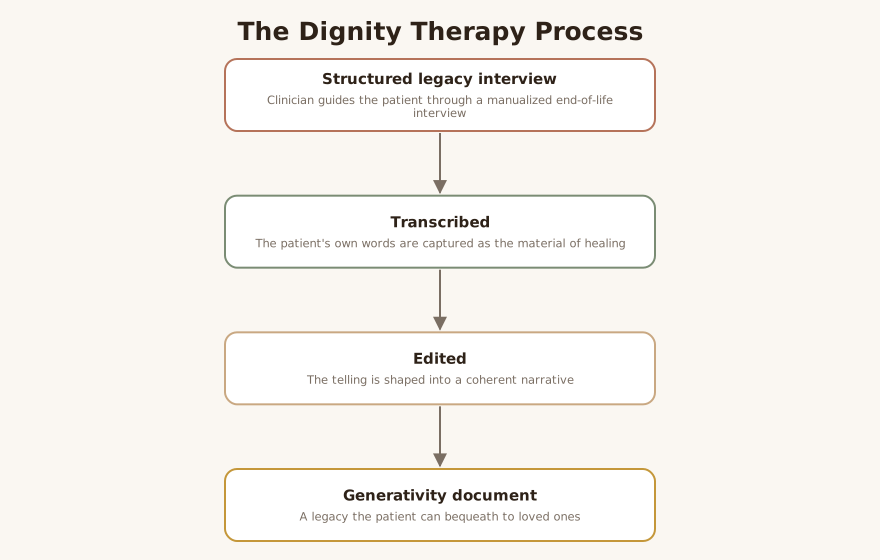
Dignity Therapy (DT) is a brief, manualized, individual psychotherapeutic intervention developed for patients facing the end of life, sitting at the intersection of palliative care and psycho-oncology 1. It is delivered in roughly one to two sessions and is organized around a structured legacy interview that is recorded, transcribed, edited, and returned to the patient as a written “generativity document” they can pass on to loved ones 1. Although it grew out of work with terminally ill cancer patients, the underlying dignity framework was explicitly designed to be transferable across health-care settings, occupations, and disease groups 3. Functionally it is best understood as a meaning- and legacy-focused intervention rather than a symptom-targeted psychotherapy, a distinction that matters when interpreting its evidence base LLM.
Creators & Lineage
Dignity Therapy was developed by the Canadian psychiatrist Harvey Max Chochinov and colleagues, beginning with qualitative dignity research in the mid-1990s and early 2000s and progressing to a piloted intervention around 2004 3. The therapy is the clinical application of an empirically derived Dignity Model generated from qualitative work with cancer patients, which sought to explain why some dying patients retain serenity while others develop a wish to die 3. From this program also came companion tools: the Patient Dignity Inventory (PDI) for screening dignity-related distress, the ABCDs of dignity-conserving care for everyday practice, and the single Patient Dignity Question for broader health-care use 3.
Conceptually, Dignity Therapy draws on a wider lineage of meaning- and narrative-oriented approaches, including Viktor Frankl’s logotherapy, life review and reminiscence therapy, narrative therapy, and meaning-centered psychotherapy LLM. What DT contributes that is distinctive is the tangible artifact — a permanent, editable document created for and given to others — which operationalizes generativity rather than leaving it as an abstract therapeutic aim LLM.
Core Principles
The central principle is that dignity at the end of life is shaped not only by physical decline but by how patients perceive themselves to be seen, valued, and remembered 3. DT assumes that demoralization and existential distress often stem from a threatened sense of meaning, purpose, and continuity rather than from psychiatric illness per se, and that affirming these can ease suffering LLM. A second principle is generativity: the human drive to leave something of oneself behind, which DT channels into a concrete legacy document 1.
A third principle is the therapeutic stance of the clinician as a respectful witness who reflects the patient’s worth back to them, consistent with the dignity-conserving care embodied in the ABCDs (Attitude, Behavior, Compassion, Dialogue) 3. Finally, DT treats the patient’s own words as the material of healing; the act of telling, hearing it shaped into a coherent narrative, and knowing it will reach loved ones is itself the proposed mechanism 1.
Interventions & Techniques
The technique is a guided interview built on a fixed set of open-ended prompts, typically nine to ten questions, which the patient receives in advance to allow reflection 2. The prompts invite the patient to narrate their life history, the times they felt most alive, the roles and accomplishments most important to them, what they want their family to know, lessons learned, hopes and dreams for loved ones, and any words or instructions they wish to pass on 2. In dementia adaptations, the same core questions are retained but slightly modified to fit the cognitive needs of the patient 5.
After the interview (commonly around 60 minutes), the recording is transcribed and clinically edited into a readable, chronologically coherent generativity document, which is then reviewed with the patient in a second contact (commonly around 30 minutes) for corrections before a final copy is given to them to bequeath 5. The editing step is a deliberate clinical act: the therapist removes confusion, repairs sequence, and ensures the document closes on a constructive or affirming note while preserving the patient’s voice LLM.
LLM-generated illustrative example (not a guideline): A clinician working with a man with advanced pancreatic cancer opens with “Tell me a little about your life history, particularly the parts you remember most or think are most important.” He recounts emigrating, building a small business, and raising two daughters. When asked what he most wants his family to know, he pauses and says he never told them he was proud of them. The transcript is edited so that statement closes the document, and his daughters later read it aloud at his bedside LLM.
Evidence Base
The evidence base is best characterized as established in maturity but mixed in what it actually demonstrates LLM. The intervention is manualized, has been tested in an international multisite randomized controlled trial, and is widely disseminated — which justifies the “established” label — but the same trials repeatedly fail to show change on hard distress endpoints LLM. The original 2005 study reported high acceptability and self-reported benefit: 91% of patients were satisfied, 76% reported a heightened sense of dignity, 68% an increased sense of purpose, 67% a heightened sense of meaning, and 47% an increased will to live, with statistically significant improvements in suffering (P = .023) and a borderline reduction in depressive symptoms (P = .05) 1.
The pivotal multisite RCT (Winnipeg, New York, Perth; 441 randomized, 326 completing) compared DT, client-centered care, and standard palliative care, and found no significant differences across arms on pre-post distress measures such as depression, hopelessness, and desire for death — attributed largely to a floor effect from unexpectedly low baseline distress 2. Where DT clearly outperformed the comparators was on patient-reported end-of-life experience: more patients found it helpful (81% vs 59% vs 54%), reported improved quality of life, an enhanced sense of dignity, and benefit to their family 2.
A 2024 multicenter Swiss RCT echoed this pattern: combining DT arms versus standard palliative care, quality of life improved (mean difference 6.15, P < .01), suffering decreased (P < .05), and there was a protective group-by-time effect on overall HADS distress (F = 4.33, P = .04), yet anxiety, depression, and dignity-related distress showed no individual significant change, and attrition was high 4. A waitlist-controlled pilot in early-stage dementia found DT feasible and highly accepted (11.1% dropout, high satisfaction) with within-group improvements, but no significant group-by-time interaction because the control group also improved and the study was underpowered with low baseline distress 5. Taken together, the honest synthesis is that DT is a well-accepted, deliverable intervention with reliable benefits to subjective experience and meaning, and weak or inconsistent effects on measured psychiatric symptom burden LLM.
Populations & Indications
DT was developed for and is most evidenced in adults with advanced, life-limiting illness, particularly terminally ill cancer patients and those in palliative or home-based palliative care 1. The multisite RCT population averaged 65 years, was predominantly cancer (largely gastrointestinal), and spanned inpatient and home settings 2. It has since been extended toward broader health-care contexts and nursing-home settings consistent with the transferable design of the dignity framework 3.
Emerging work supports cautious use in older adults with early-stage dementia, where it appears feasible and acceptable to patients and their study partners 5. The 2024 trial also formally enrolled family caregivers, reflecting growing interest in DT as a dyadic or family-inclusive intervention rather than a purely individual one 4. Clinically, the strongest indications are patients with reasonable cognitive capacity, a desire to reflect on legacy, and enough time and stamina to complete the interview LLM.
Problems-for-Work
DT is best matched to existential and meaning-related suffering rather than to acute psychiatric syndromes LLM. For demoralization, loss of meaning, and hopelessness, the interview directly elicits sources of purpose and accomplishment, and the original study found self-reported gains in meaning (67%) and purpose (68%) 1. For low self-worth and threatened dignity, the act of being witnessed and producing a valued document maps onto the reported heightened sense of dignity (76%) 1.
For anticipatory grief and family suffering, the generativity document gives both patient and family a concrete object of connection, consistent with the high proportion who felt it would help their family and the family-inclusive design of newer trials 14. For end-of-life suffering, DT showed significant suffering reduction in the pilot and the 2024 RCT 14. By contrast, for depression, death anxiety, and desire for death, clinicians should expect modest and inconsistent effects and should not rely on DT as primary treatment for these 2.
Contraindications, Cautions & Cultural Humility
DT requires sufficient cognitive capacity and verbal stamina to engage a structured interview, so advanced delirium, severe cognitive impairment beyond early-stage dementia, or rapid physical decline may make completion impossible — the dementia work deliberately used early-stage patients and adapted the questions 5. Because the intervention surfaces life narrative, it can also activate unresolved trauma, estrangement, regret, or family conflict, and the editing step exists partly to manage how such material is rendered LLM. It should not be positioned as a treatment for major depressive disorder, suicidality, or clinically significant death anxiety, given the repeated null findings on these endpoints; these require their own evidence-based care 2.
Practical cautions include high attrition and resource intensity observed in trials, which means timing matters — patients too close to death may not complete the protocol 4. Culturally, the dignity framework is explicitly about how patients perceive being valued, so clinicians must adapt the prompts to the patient’s own meanings of legacy, family, faith, and what is appropriate to disclose, rather than imposing a fixed narrative arc 3. Humility also means recognizing that for some patients and cultures, leaving an explicit written legacy may feel unfamiliar or burdensome, and consent to the recording and document must be genuinely informed LLM.
Treatment-Plan Suggestions & SMART Objectives
| Goal | SMART objective (example) | Mechanism |
|---|---|---|
| Reduce demoralization | Patient will complete a guided life-narrative interview within 2 sessions and identify at least 3 sources of meaning, rated weekly | Eliciting purpose and accomplishment counters loss of meaning 1 |
| Restore sense of dignity | Patient will produce a finalized generativity document within 3 weeks and report a heightened sense of dignity on a self-report check | Being witnessed and valued through legacy work 13 |
| Ease existential suffering | Patient will report a measurable decrease in suffering (e.g., PRISM/self-rating) by document completion | Narrative coherence and affirmation reduce suffering 14 |
| Support anticipatory grief in family | Patient will designate recipients and share the document with at least one family member within 4 weeks | Concrete legacy object strengthens connection and continuity 1 |
| Strengthen sense of purpose | Patient will articulate at least 2 lessons or hopes to pass on, captured verbatim in the document | Generativity drive operationalized in writing 1 |
| Screen and track dignity-related distress | Clinician will administer the Patient Dignity Inventory at baseline and after the document is returned | Systematic measurement of dignity-related concerns 3 |
| Include caregiver wellbeing | Family caregiver will participate in a dyadic DT session and complete a quality-of-life/suffering self-rating pre and post | Family-inclusive delivery improved caregiver QoL and suffering 4 |
Common Misconceptions
A frequent misconception is that DT reliably reduces depression and anxiety; the controlled evidence shows little or inconsistent effect on these symptom measures 24. A second is that DT is essentially life review or reminiscence — it overlaps but is distinguished by its fixed legacy-oriented question frame and, crucially, the production of an editable document intended to be bequeathed 1LLM. A third is that the recording and transcript are merely administrative; the clinical editing of the document is itself a therapeutic act LLM.
Some assume DT is only for cancer patients, but the framework was designed for transfer across diseases and settings and has been piloted in early dementia and nursing-home-adjacent contexts 35. Finally, the high satisfaction rates are sometimes read as proof of symptom efficacy; they primarily reflect acceptability and improved subjective experience, which is a different and more modest claim 12.
Training & Certification
The dignity research program, hosted through the Manitoba/Dignity in Care initiative, maintains the model and its companion tools and is the canonical reference point for clinicians seeking to learn the approach and its instruments such as the PDI and Patient Dignity Question 3. Because the intervention is manualized with a fixed question protocol and a defined two-contact structure, fidelity depends on adhering to the prompts, the interview-then-document workflow, and skilled editing 25. Notably, at least one trial flagged the lack of systematic fidelity assessment as a limitation, underscoring that training should emphasize standardized delivery and document editing 5. Clinicians should seek the official dignity-in-care materials and supervised practice rather than improvising the protocol 3LLM.
Key Terms
- Generativity document — the transcribed, edited written legacy produced from the interview and given to the patient to bequeath 1.
- Dignity Model — the empirically derived framework of factors that sustain or erode dignity in serious illness, from which DT was developed 3.
- Patient Dignity Inventory (PDI) — a screening instrument for dignity-related distress 3.
- ABCDs of dignity-conserving care — Attitude, Behavior, Compassion, Dialogue; a practical framework for dignity in everyday care 3.
- Patient Dignity Question — a single question extending dignity concepts into broader health-care settings 3.
- Floor effect — when low baseline distress leaves little room for measurable improvement, a key explanation for null distress findings in the DT RCT 2.
Resources & Further Reading
▶ Watch — a video introduction to this concept:
- Chochinov et al. 2005 — Dignity Therapy: A Novel Psychotherapeutic Intervention for Patients Near the End of Life (J Clin Oncol) 1
- Chochinov et al. 2011 — Effect of dignity therapy on distress and end-of-life experience: a randomised controlled trial (PMC) 2
- Dignity Research — Dignity in Care / Manitoba 3
- Effects of dignity therapy on psychological distress and wellbeing of palliative care patients and family caregivers — randomized controlled study (BMC Palliative Care, 2024) 4
- Feasibility, Acceptability, and Preliminary Efficacy of Dignity Therapy in Early Stage Dementia (Frontiers in Psychiatry) 5
Reflective / Supervision Questions
- For this patient, am I offering DT to relieve existential distress and affirm meaning, or am I implicitly expecting it to treat depression or suicidality it is unlikely to resolve? 2LLM
- Does the patient have the cognitive capacity, stamina, and time remaining to complete the interview and review the document, and how will I adapt if decline is rapid? 5LLM
- How will I handle trauma, estrangement, or regret that surfaces in the narrative, and how should the editing choices serve the patient rather than tidy the story for my comfort? LLM
- Whose meanings of dignity, family, and legacy am I privileging, and have I adapted the prompts to the patient’s culture and wishes rather than a standard arc? 3LLM
- Am I delivering the protocol with fidelity — advance questions, interview, skilled editing, document review — or improvising in ways that drift from the evidenced method? 5LLM
- Should I involve the family or a caregiver in the work, and how would I document and measure benefit if I did? 4LLM